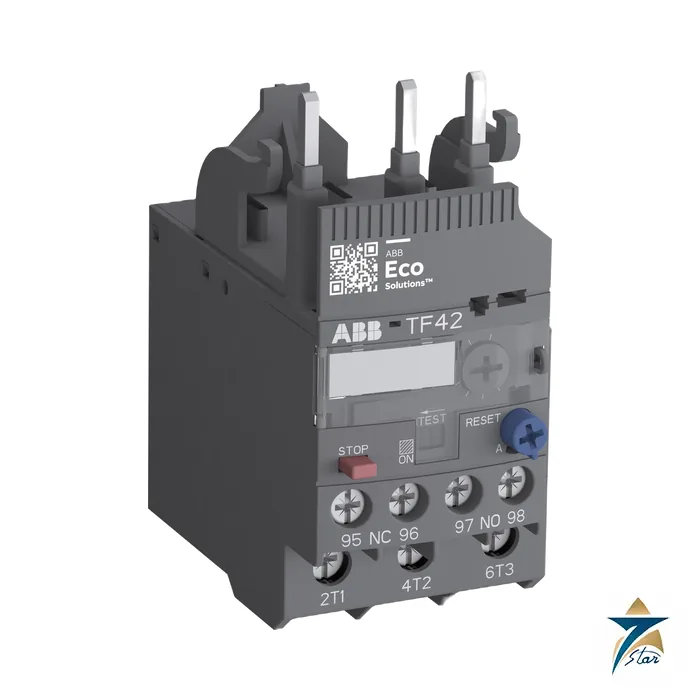
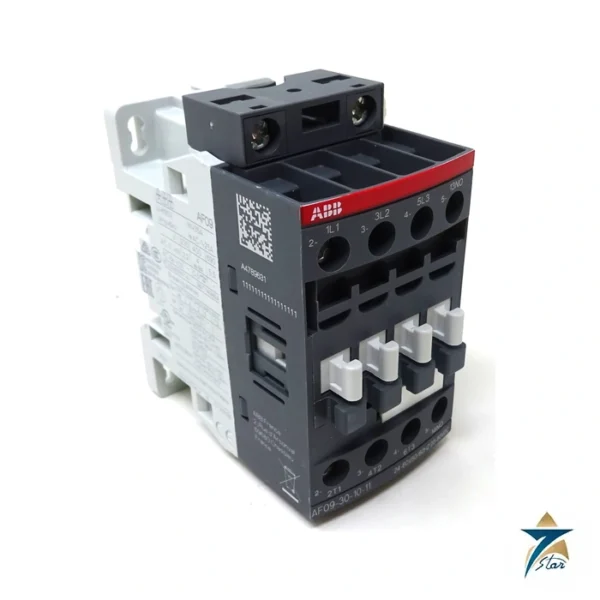
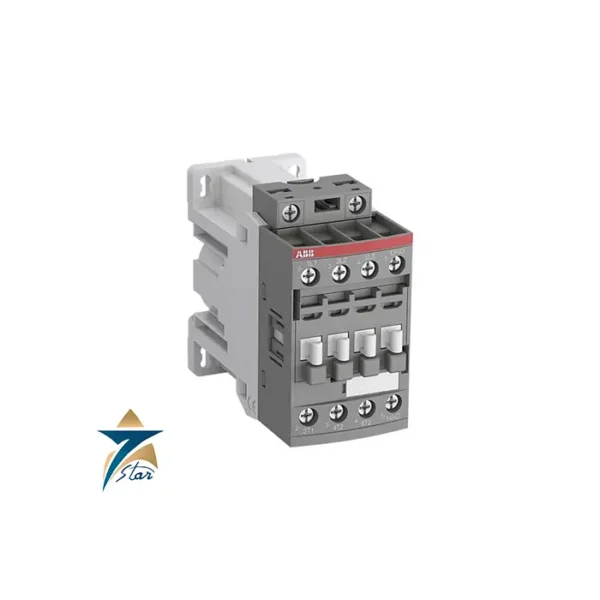
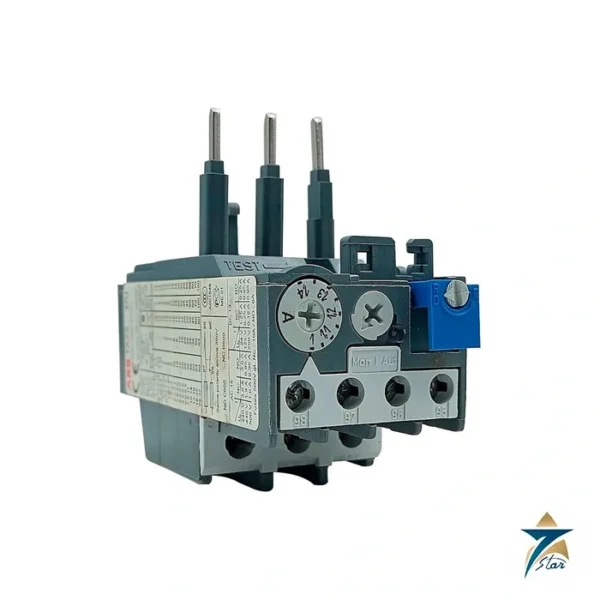
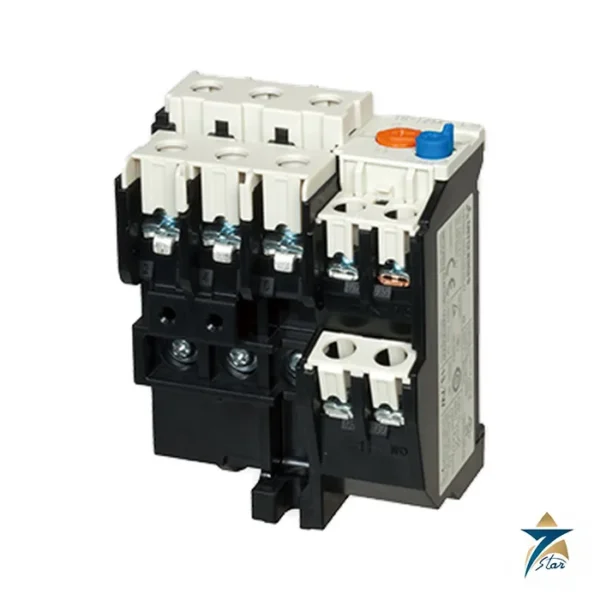
The TF42-13 is a three-pole thermal overload relay from ABB’s TF42 range, order code 1SAZ721201R1045. It is set between 10 A and 13 A and protects a motor against overload and phase failure with trip class 10. The relay is built to plug directly onto the AF09 to AF38 block contactors, so the load contactor and the overload device form one compact starter. Related starter components are listed under contactors and overload relays, for example the TA25DU thermal overload relay from the same maker.
Technical specifications
| Parameter |
Specification |
| Type / order code |
TF42-13 / 1SAZ721201R1045 |
| Setting range |
10 to 13 A |
| Trip class |
10 |
| Poles |
3, bimetal element in each pole |
| Rated operational voltage Ue (main circuit) |
690 V AC, 600 V DC |
| Rated frequency |
50/60 Hz |
| Resistance per pole |
13.07 mOhm |
| Power loss per pole |
1.3 W at lower setting value, 2.2 W at upper value |
| Short-circuit protective device (type 2) |
40 A gG |
| UL/CSA full load amps / SCCR |
13.0 A; 18 kA with 40 A K5; 100 kA with 45 A Class J |
| Auxiliary contacts |
1 NC (95-96) trip contact, 1 NO (97-98) signal contact |
| Reset |
Automatic or manual, selectable; trip-free mechanism, STOP and TEST |
| Temperature compensation |
-25 to +60 C |
| Rated impulse withstand voltage / insulation voltage |
6 kV / 690 V |
| Weight |
0.130 kg |
| Degree of protection |
Housing IP20 |
| Mounting |
Directly on AF09 to AF38 contactors; single mounting kit for 35 mm DIN rail |
| Approvals as printed |
cULus, CB, CCC, GOST-R, ABS, RINA, DNV, Lloyd’s Register, CE |
How the relay behaves at 10 to 13 A
The motor current flows through a bimetal element in every pole and heats it directly and indirectly. On overload the elements bend and the contact positions change: the NC contact 95-96 opens to drop out the contactor and the NO contact 97-98 closes for signalling. The scale is calibrated in amperes and the setting current is the motor rated current, because the data sheet defines no tripping at 1.05 times the setting and tripping at 1.2 times. For the TF42-13 the resistance is 13.07 mOhm per pole and the power loss rises from 1.3 W at the bottom of the range to 2.2 W at the top, which matters in a hot, closed panel.
Mounting and application
Mount the relay on the contactor and tighten the screws of the main circuit terminals; the connection capacity is 0.75 to 4 mm2 on relays up to 20 A, with a stripping length of 12 mm and a tightening torque of 1.5 to 2.5 Nm. The relay suits a 10 to 13 A motor on a small pump, fan or compressor drive where a class 10 trip is appropriate. With a fully loaded motor close to 13 A, pair it with an AF contactor of at least the same AC-3 rating, for instance an AF16 or AF26. The ambient limit is -25 to +60 C and the operating frequency without early tripping is up to 15 operations per hour.
Key features of the TF42-13
- Three-pole bimetal design: every pole carries motor current, so an unbalanced or lost phase heats the elements unevenly and leads to a trip.
- Trip class 10, the usual choice for standard-duty induction motors with normal run-up times.
- Selectable automatic or manual reset, plus a trip-free mechanism so the relay cannot be held closed against a fault.
- STOP and TEST functions on the front, useful during commissioning and periodic checks.
- Separate NC (95-96) and NO (97-98) contacts: one drops the contactor, the other signals the trip to a PLC, lamp or BMS input.
- Ambient temperature compensation from -25 to +60 °C, so the trip point does not drift strongly with panel temperature.
- Direct plug-on to AF09 to AF38 contactors, or DIN-rail use with a single mounting kit.
Setting the dial correctly
The dial is scaled in amperes. Set it to the full-load current stamped on the motor nameplate for the voltage actually used, not to the contactor rating or the cable rating. A motor with a nameplate current of 11.5 A, for example, is set at 11.5 A. If the nameplate current lies below 10 A or above 13 A, a neighbouring TF42 range should be chosen instead of pushing the dial to an end stop.
Where a motor is fitted with power-factor correction capacitors on the load side of the relay, the line current seen by the relay is lower than the motor current, and the setting needs to be reviewed by the panel designer. For star-delta starters the relay is normally placed in the phase (winding) circuit, where it sees phase current, so the setting is the nameplate current divided by the square root of three.
When class 10 is not enough
Fans with large impellers, loaded conveyors and centrifugal separators can take longer to reach speed than a class 10 relay tolerates. Nuisance trips during start-up are the usual symptom. In that case the cause should be checked first (supply voltage drop, mechanical binding), and if the long start is genuine, a protection device with a higher trip class is the correct answer rather than raising the setting above the nameplate current.
Installation and maintenance notes
- Fit the relay straight onto the matching AF contactor and tighten the main terminals to the torque given in the ABB instruction sheet.
- Wire the 95-96 contact in series with the contactor coil circuit; a relay that trips but is not wired into the coil circuit gives no protection.
- After a trip, let the bimetals cool before resetting. Find the cause, such as a blocked pump, worn bearings or a missing phase, before restarting.
- Use the TEST function during planned maintenance to confirm the contacts change over and the alarm reaches the control system.
- Keep the IP20 relay inside an enclosure that protects it from dust and moisture.
Use in Oman and GCC panels
Motor control centres in pumping stations, HVAC plant rooms and process skids across the region often run hot, especially in outdoor kiosks during summer. The relay’s compensation range up to +60 °C covers the air inside a well-ventilated panel, but panel builders should still check the internal temperature of sealed enclosures exposed to direct sun, since compensation does not correct for heat beyond the stated range. The marine approvals printed on the product (ABS, DNV, Lloyd’s Register, RINA) are relevant for port, offshore and vessel applications.
What to include in your RFQ
- Order code 1SAZ721201R1045 and quantity.
- Contactor type it will be mounted on (AF09 to AF38), or whether a DIN-rail mounting kit is needed.
- Motor nameplate current and voltage, so the range can be confirmed.
- Any required certificates or marine approvals for the project.
- Delivery location and required date.
Ordering code and confirmation
TF42 is the relay family and the number is the upper end of the setting range in amperes, so TF42-13 covers 10 to 13 A. The order code 1SAZ721201R1045 is the reference for a quotation. The relay has to be protected against short circuit, and ABB lists a 40 A gG fuse for type 2 coordination. Before ordering confirm the motor full-load current, the contactor type, the voltage and whether DIN-rail mounting needs the separate single mounting kit. The linked ABB data sheet gives the full order data for the TF42 range, main and auxiliary circuit data, UL/CSA values, dimensions and the tripping curve. Seven Star LLC is an independent supplier in Muscat and prepares quotations on request; no price or stock is shown on this page.








Reviews
There are no reviews yet.