- Automation & ControlView all 2,795 products
- Automation Accessories
- AC Drives
- PLC & I/O Cards
- Industrial Communications
- Vibration Monitoring
- Controllers & Data Acquisition
- Isolator & Barrier
- Safety Switches & Guard Locking
- Motor Soft Starters
- CCTV & Security
- Encoders
- Pneumatic Cylinders
- HMI Displays
- Servo Drives
- Industrial Computers
- Machine Vision
- Automation Software
- Robotics
Brand: SICK
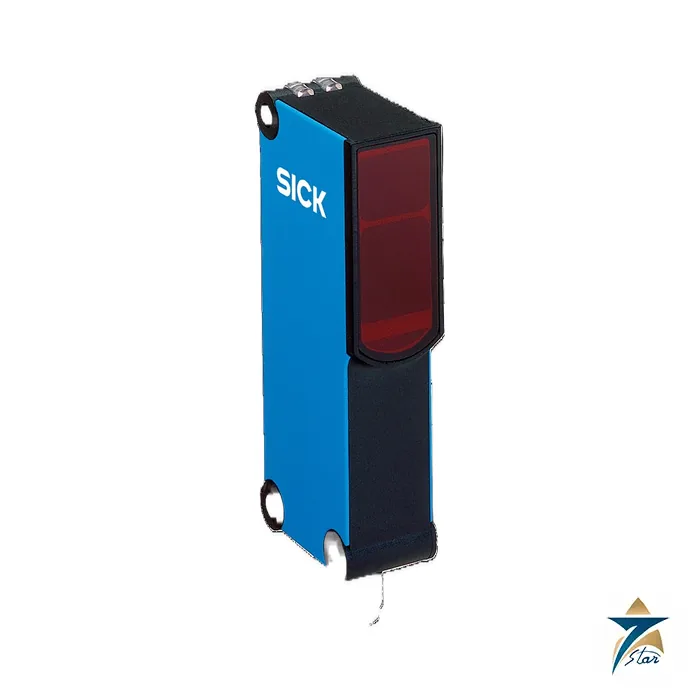
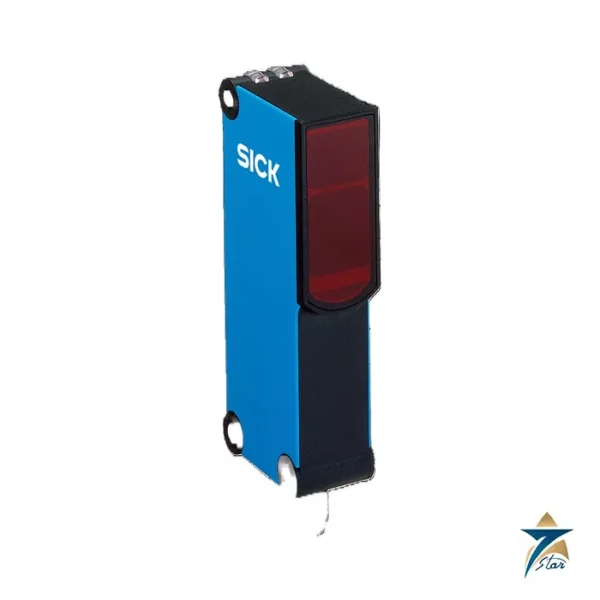
SICK WL18-3N430 NPN Retro-Reflective Photoelectric Sensor
Description
Why an NPN sensor still matters: SICK WL18-3N430
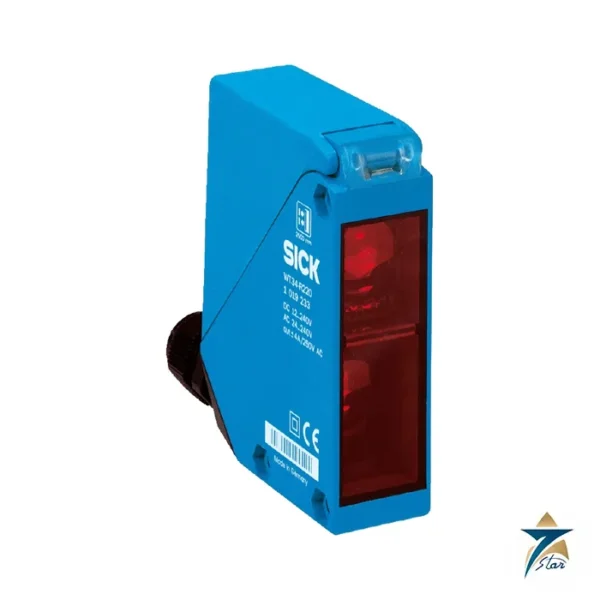
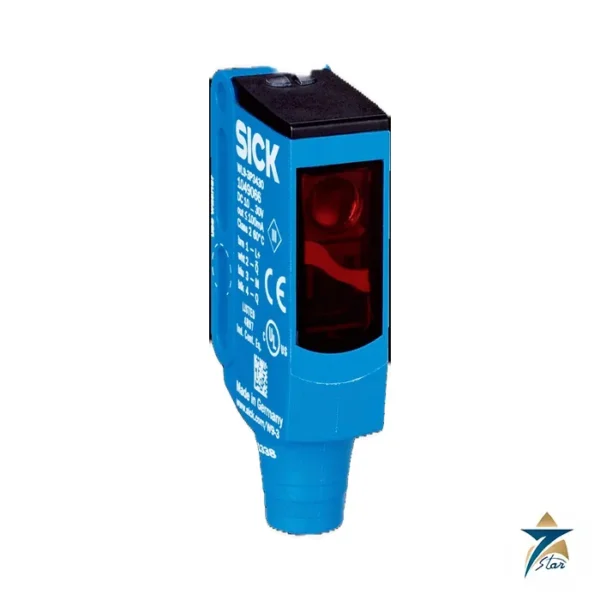
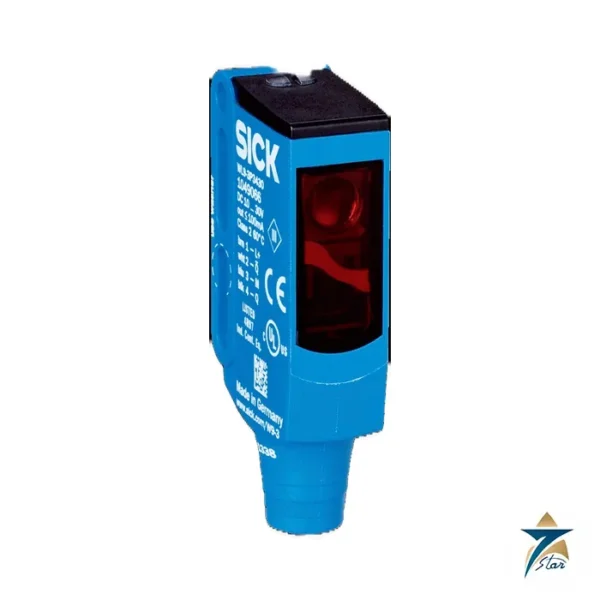
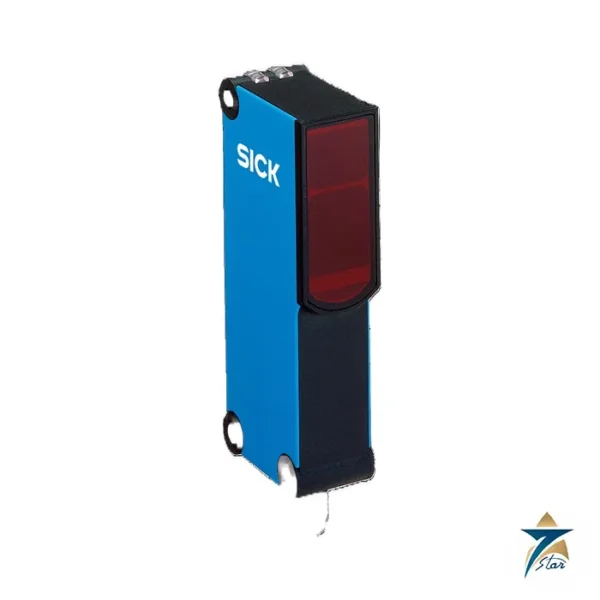
PNP dominates in Europe, but a large part of the installed base in the Gulf, especially on machines imported from Asia and on older relay-based panels, expects NPN signals. The SICK WL18-3N430 (part number 1025915) covers this need with a W18-3 retro-reflective sensor whose output stage switches to 0 V. The body is the proven 17.6 x 75.5 x 33.5 mm rectangle and the connection is a straight 4-pin M12 plug.
Output and wiring of WL18-3N430
The connection diagram in the datasheet (CD-083) allocates pin 1 (brown) to the positive supply, pin 2 (white) to the complementary output, pin 3 (blue) to the 0 V line and pin 4 (black) to the output Q. Because the output is NPN and complementary, one sensor delivers both light-switching and dark-switching information to a controller that sinks current to the common line. Output current is up to 100 mA and the supply range is 10 to 30 V DC with a current draw of about 40 mA.
- Response time under 500 microseconds
- Switching frequency 1,000 Hz
- Circuit protection: reverse polarity, interference suppression, short-circuit and overcurrent
- MTTFD 1,759 years, DCavg 0 percent
WL18-3N430 key parameters
| Parameter | Value |
|---|---|
| Part number | 1025915 |
| Principle | Retro-reflective, autocollimation, polarising |
| Sensing range | 0 to 5 m (max. 0 to 7 m) |
| Focus / spot | 1.8 degrees / 40 mm at 2 m |
| Light source | LED, visible red, 645 nm |
| Output | NPN, complementary, light or dark switching |
| Supply | 10 to 30 V DC, 40 mA |
| Connection | Male connector M12, 4-pin |
| Housing | ABS, optics PMMA, 40 g |
| Enclosure rating | IP67 |
| Operating temperature | Minus 40 to plus 60 C |
| UL file | NRKH.E181493 and NRKH7.E181493 |
How WL18-3N430 differs from other WL18-3 variants
The only electrical difference to the WL18-3P430 is the NPN output; mechanics, range and optics are identical. Neither of them has the heightened vibration resistance offered by WL18-3P130S06 and WL18-3P630S04. If your controller expects a PNP signal and you fit the N430 by mistake, the input will never see a positive level, which is a common wiring mistake on retrofits. Check the type letter in the code: N means NPN, P means PNP.
Typical jobs in regional industry
Examples include carton detection on old accumulating conveyors, door and gate monitoring on packaging lines, bottle-in-place checks on filler infeeds and detection of metal drums on pallet lines. The coaxial optics see an object right up to the lens, so a drum edge close to the sensor is not missed. In bakeries and dairies the IP67 body tolerates wet cleaning but not high-pressure steam, so aim the hose away from the front lens.
Selection pointers
Match the NPN output to a sourcing input, check the reflector size, and confirm that the supply can deliver 40 mA per sensor plus the load. If a mix of PNP and NPN sensors exists on the same machine, label each clearly and avoid swapping spare parts between channels.
Alignment and teaching of range
Place the PL80A reflector, switch on the sensor and watch the red spot. Adjust the potentiometer until the sensor switches reliably with the reflector exposed and stays stable when a transparent object is put in the beam. Fine-tune with a real product on the line.
Service life
An LED life of 100,000 hours at 25 degrees Celsius means a sensor can run for years. Clean the lens, keep the connector dry, and replace the sensor if the output stage is damaged. Seven Star LLC is an independent supplier serving Oman and the GCC and is not affiliated with the manufacturer.
The NPN design also fits retrofits in which the old sensor was a three-wire inductive or reed type switching to common. A fitter can usually keep the existing input card and only change the sensor. Always compare the load: output current is limited to 100 mA, so small relays and PLC inputs are fine, but contactor coils must be driven through an interposing relay. For a long cable run, remember that the leakage of a long cable adds to the current draw and can keep sensitive inputs partly on, so keep cable length reasonable and use shielded cable in noisy motor areas. The datasheet also lists UL files NRKH.E181493 and NRKH7.E181493, and it names a footnote limit of a short-circuit protected supply network, so fit a suitable fuse or protected power supply upstream of the sensor group.
Questions buyers ask about WL18-3N430
Why choose SICK WL18-3N430 over the PNP type? It has an NPN output stage with complementary function, which matches PLC input cards and relays that expect a switched 0 V signal, common on Asian and older machines.
What range can WL18-3N430 reach? 0 to 5 m typical and 0 to 7 m maximum with reflector PL80A; the light spot is 40 mm at 2 m and the focus is 1.8 degrees.
What are the wire colours and pins for WL18-3N430? The connection diagram CD-083 shows brown on pin 1 as plus, white on pin 2 as the complementary output, blue on pin 3 as minus and black on pin 4 as output Q.
What are the mechanical details of WL18-3N430? 17.6 x 75.5 x 33.5 mm, 40 g, ABS housing, PMMA optics and IP67 protection on a straight M12 male connector.
What current does WL18-3N430 draw and switch? Current consumption is 40 mA and it can switch up to 100 mA with a response time under 500 microseconds.
Documents and quotation
The manufacturer datasheet for WL18-3N430 is included with this listing. Please send an RFQ with the part number, quantity and delivery location in Oman or the GCC, and we will answer with availability and lead time.
Other Models in the Sick Wl18 3 Range
Seven Star LLC supplies models from the Sick Wl18 3 range in Oman and the GCC. Compare the related models below and request a quote for the one that matches your application.
| Model | Category | |
|---|---|---|
| SICK WL18-3N430 NPN Retro-Reflective Photoelectric Sensor | Inductive Proximity Sensors | You are viewing this model |
| SICK WL18-3P130S06 Cable Version Retro-Reflective Sensor | Inductive Proximity Sensors | View details |
| SICK WL18-3P630S04 Vibration-Resistant Retro-Reflective Sensor | Inductive Proximity Sensors | View details |
| SICK WL18-3P430 W18-3 Retro-Reflective Photoelectric Sensor | Inductive Proximity Sensors | View details |
Datasheets & Documents
- Datasheet SICK WL18-3N430 NPN Retro-Reflective Photoelectric Sensor Datasheet Download
Reviews (0)
How would you rate this product? Cancel reply
About brand
SICK is the German maker of industrial sensors: photoelectric and proximity sensors, safety laser scanners and light curtains, encoders, distance sensors, code readers and gas analysers. Erwin Sick, an optics engineer, founded it in Munich in 1946, and in 1952 it introduced its first marketable accident-prevention light curtain, which protected press operators by stopping the machine when a hand broke the light beam. The company moved to Waldkirch in the Black Forest in 1956 and is still headquartered there. It is a privately held company, and has been an Aktiengesellschaft (AG) since 1996.
SICK company profile
| Founded | 1946, Munich, Germany, by Erwin Sick (1909–1988) |
|---|---|
| Headquarters | Waldkirch, Baden-Württemberg, Germany (since 1956) |
| Ownership | Privately held; after the founder's death in 1988 his widow Gisela Sick became the main shareholder. Legal form SICK AG since 1996 |
| Size | More than 12,000 employees and group revenue of about EUR 2.3 billion (company figures for 2023) |
| First breakthrough | Accident-prevention light curtain for presses, shown in Hanover in 1952 |
| International growth | First foreign subsidiary in France in 1972, United States in 1976; today sales and service companies worldwide |
| Product families | Photoelectric, inductive, capacitive, magnetic and ultrasonic sensors; safety laser scanners, light curtains, safety controllers and relays; encoders and motor feedback systems; distance sensors and LiDAR; barcode and 2D code readers and machine vision; gas analysers, dust and flow measurement for process and emissions monitoring |
Milestones
- 1946: Erwin Sick receives a licence to run his engineering firm in Munich.
- 1952: The first marketable accident-prevention light curtain is presented in Hanover and goes into series production.
- 1956: The company moves to Waldkirch with 25 employees.
- 1972 and 1976: Subsidiaries are founded in France and the United States.
- 1996: SICK becomes an Aktiengesellschaft.
- Today: Sensors for factory and logistics automation, machine safety and process analysis, with a large share of revenue outside Germany.
Choosing a SICK sensor
For object detection, the sensing principle comes first. A retro-reflective sensor (WL series) sends light to a reflector and switches when an object breaks the beam; it is reliable over long distances and easy to align. A sensor with background suppression (WTB series) detects an object at a set distance and ignores what is behind it, which suits conveyors with shiny or dark backgrounds. A through-beam pair (WS/WE) gives the longest range and the highest reliability in dust. For transparent bottles and film, use a model built for transparent objects (for example WL12G-3B or WL150-P420). The digits in the code also matter: "P" usually means a PNP output and "N" NPN, and the last digits set the connector or cable. For machine guarding, a safety laser scanner such as nanoScan3 or microScan3 protects an area, while a safety controller such as Flexi Soft combines several safety devices.
Where SICK products are used
In Oman and the GCC, SICK sensors are used in packaging and bottling lines, food and beverage plants, logistics and airport baggage handling, cement and steel plants, ports and cranes, automated warehouses, and on machines built by European OEMs. SICK safety scanners guard robots and automated guided vehicles, and its encoders give position feedback on motors, hoists and conveyors.
SICK products we list
| Family | Examples |
|---|---|
| Photoelectric sensors | WL12-3P2431, WTB12-3P2431, GTB6-P4211, VL18-4P3240, WL12G-3B2531, WS/WE100, KT5W contrast, W26 IO-Link |
| Proximity, cylinder and ultrasonic sensors | IME12-08NPSZC0S, IME18-05BPSZC0S, MZT8, UM18 4-20 mA, UM30, UFN3 fork |
| Machine safety | nanoScan3, microScan3, S300 Professional, Flexi Soft FX3-CPU1, FX3-XTIO, ReLy OSSD |
| Encoders and motor feedback | DFS60B, AFM60 PROFINET, AFS60 SSI, ATM60 PROFIBUS, SRS50, EFS50 |
| Distance sensors and code readers | DT50, DL50, DT35, Lector632 |
Ordering SICK products: what we need
Send the type code and the 7-digit SICK part number from the label (for example WTB12-3P2431 together with its part number). For a replacement sensor, add the output (PNP or NPN), connection (M8, M12 or cable) and sensing distance. For encoders, add the interface (incremental, SSI, PROFIBUS, PROFINET), resolution and shaft type. For safety scanners, tell us the model and whether the existing configuration needs to be kept.
Frequently requested SICK models: SICK RT-P3231 ZoneControl Background Suppression Sensor.
Facts checked against SICK's published company history and annual figures, October 2026.
Browse SICK products by category: Sensors & Transmitters.
FAQ
Questions about the SICK WL18-3N430 NPN Retro-Reflective Photoelectric
Answers from our engineering team on installation, compatibility and integration.
01Why choose SICK WL18-3N430 over the PNP type?
It has an NPN output stage with complementary function, which matches PLC input cards and relays that expect a switched 0 V signal, common on Asian and older machines.
02What range can WL18-3N430 reach?
0 to 5 m typical and 0 to 7 m maximum with reflector PL80A; the light spot is 40 mm at 2 m and the focus is 1.8 degrees.
03What are the wire colours and pins for WL18-3N430?
The connection diagram CD-083 shows brown on pin 1 as plus, white on pin 2 as the complementary output, blue on pin 3 as minus and black on pin 4 as output Q.
04What are the mechanical details of WL18-3N430?
17.6 x 75.5 x 33.5 mm, 40 g, ABS housing, PMMA optics and IP67 protection on a straight M12 male connector.
05What current does WL18-3N430 draw and switch?
Current consumption is 40 mA and it can switch up to 100 mA with a response time under 500 microseconds.


Reviews
There are no reviews yet.