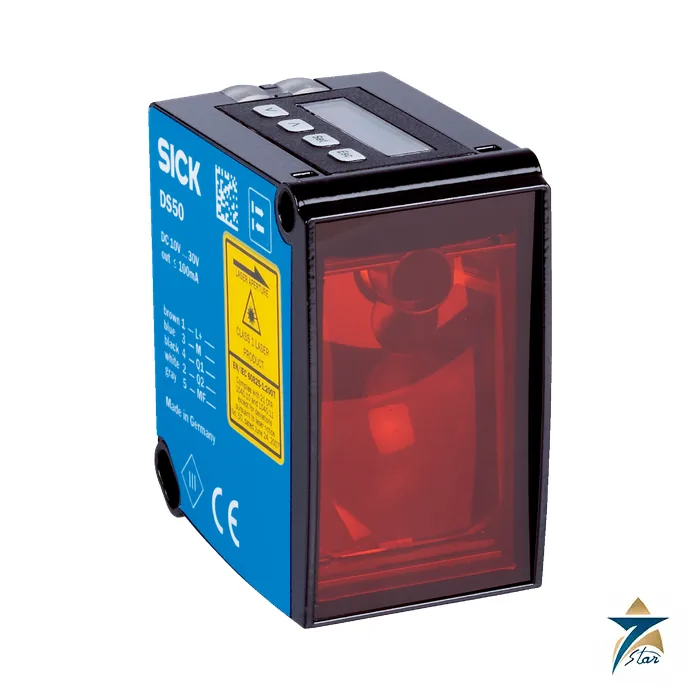
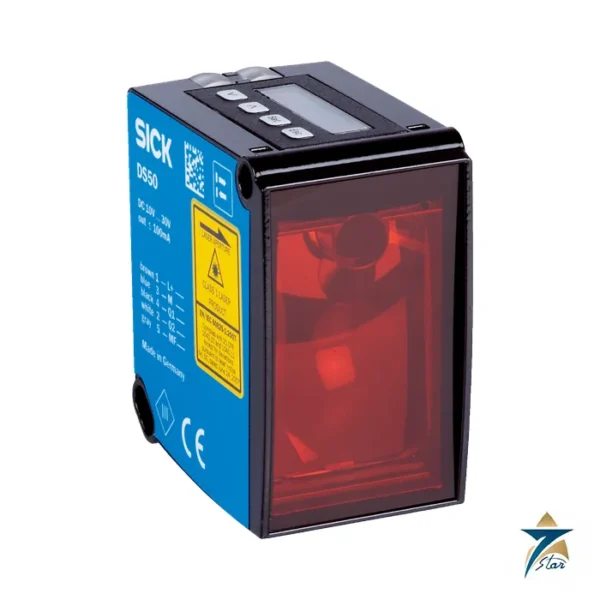
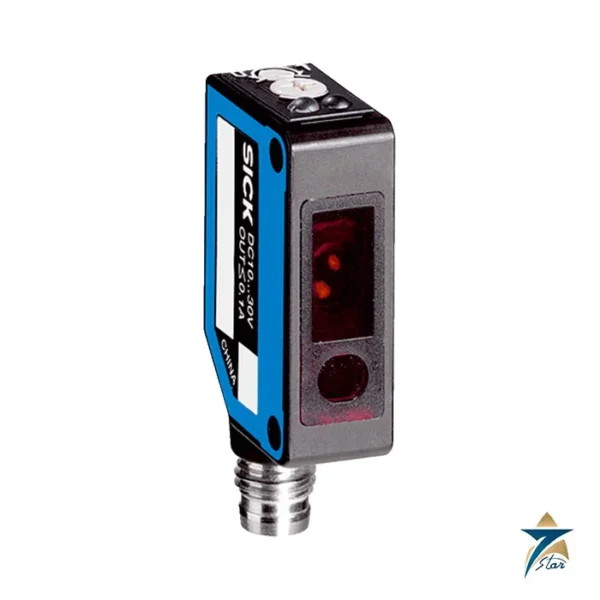
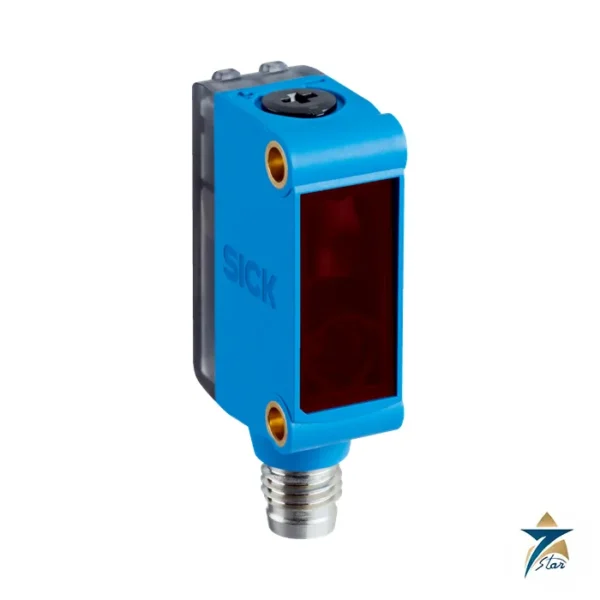
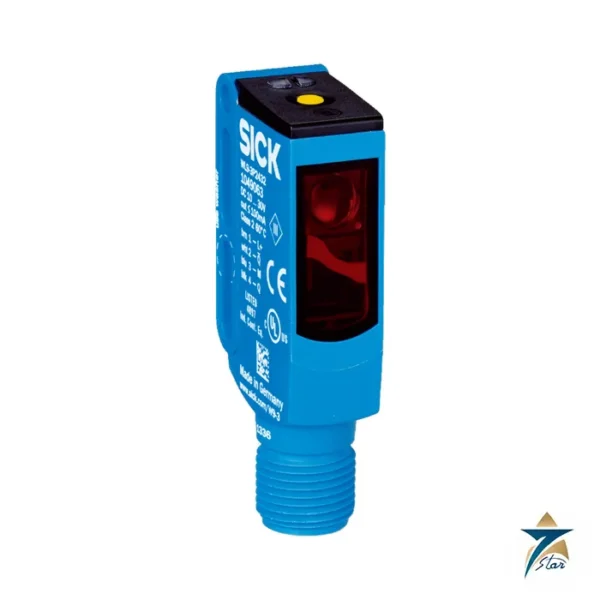
DT50-P1113 is a SICK Dx50 laser distance sensor (part no. 1044369) that measures distance by time of flight with a visible red laser. It works on natural objects, with a measuring range of 200 mm … 10,000 mm, 90% remission factor; 200 mm … 6,500 mm, 18% remission factor; 200 mm … 4,000 mm, 6% remission factor and laser class see table. It provides a PNP digital output and a current output analog output (4 mA … 20 mA, ≤ 300 Ω).
Time-of-flight measurement with the DT50-P1113
This version measures to natural objects, so no reflective tape is needed. The data sheet gives different ranges by target reflectance (90%, 18% and 6% remission), which is the honest way to read it: a dark or matt target will not reach the headline range. Use it for positioning, stack height and presence checks on ordinary surfaces. The visible red spot makes alignment easy: you can see where the sensor is measuring, which saves time when positioning on a crane, a shuttle or a long conveyor. Allow the warm-up time before relying on absolute accuracy, and keep the front window clean, because dirt on the window reduces the returned light.
Resolution 1,000 µm, repeatability ≥ 2.5 mm, accuracy ± 10 mm; response time 20 ms … 30 ms, 20 ms / 30 ms. A spot of 15 mm x 15 mm (10 m) is listed at 10 m and ambient light immunity is typically 40,000 lx. Configurable functions in the data sheet include: set moving average: fast/slow; Switching mode: distance to object (DtO); Teach-in, scaling and inversion of digital output; Set hysteresis; Teach-in, scaling and inversion of analog output; Multifunctional input: laser off / external teach / deactivated; Switch-off display; Reset to factory default; Lock user interface.
Technical specifications
| Parameter |
Specification |
| Type code |
DT50-P1113 |
| Part number |
1044369 |
| EAN |
4047084167072 |
| Product family |
Dx50 |
| Measuring range |
200 mm … 10,000 mm, 90% remission factor; 200 mm … 6,500 mm, 18% remission factor; 200 mm … 4,000 mm, 6% remission factor |
| Target |
Natural objects |
| Resolution |
1,000 µm |
| Measurement accuracy |
± 10 mm |
| Response time |
20 ms … 30 ms, 20 ms / 30 ms |
| Output time |
≥ 4 ms |
| Emitted beam: Light source |
Laser, red |
| Emitted beam: Type of light |
Visible red light |
| Emitted beam: Typ. light spot size (distance) |
15 mm x 15 mm (10 m) |
| Key laser figures: Normative reference |
IEC 60825-1:2014, EN 60825-1:2014 |
| Key laser figures: Laser class |
2 |
| Key laser figures: Average laser service life (at 25 °C) |
100,000 h |
| Additional function |
Set moving average: fast/slow; Switching mode: distance to object (DtO); Teach-in, scaling and inversion of digital output; Set hysteresis; Teach-in, scaling and inversion of analog output; Multifunctional input: laser off / external teach / deactivated; Switch-off display; Reset to factory default; Lock user interface |
| Safety-related parameters: MTTFD |
101 years |
| Safety-related parameters: DCavg |
0% |
| Digital output: Number |
1 |
| Digital output: Type |
PNP |
| Declarations and certificates in the data sheet |
EU declaration of conformity; UK declaration of conformity; ACMA declaration of conformity; Moroccan declaration of conformity; China RoHS; Optical radiation safety (GB 44703:2024) declaration of manufacturer (low risk) |
Type code DT50-P1113 and part number 1044369
The housing of DT50-P1113 is shared with its sibling in the Dx50 family, but the target type, range and laser class differ, so the part numbers differ too. Put 1044369 on the purchase request and describe the target (natural surface or tape).
Neighbouring versions of this family that SICK lists as active, with their part numbers:
- DT50-P1114 (part no. 1047581)
- DT50-P1124 (part no. 1047616)
- DT50-P1123 (part no. 1047118)
- DT50-N1114 (part no. 1047582) – Switching output: NPN
- DS50-P1112 (part no. 1047402)
Installation, laser safety and wiring notes
Electrical supply: DC 10 V … 30 V. Environmental limits: IP65 and –30 °C … +65 °C; –30 °C … +80 °C, operation with 2 cooling plates; –30 °C … +140 °C, operation with 2 cooling plates and protection filter ambient in operation. The body measures 36.1 mm x 62.7 mm x 57.7 mm and weighs 200 g. Current draw is ≤ 2.1 W. Observe the laser-safety instructions of the data sheet, never look into the beam, and allow the warm-up time listed in the table before relying on the measurement. If the sensor is used outdoors or near steam, check the enclosure rating and the operating temperature against the site conditions. Keep a record of the teach-in values so that a replacement sensor can be set up to the same switching points quickly.
Typical applications in logistics and process plants
A time-of-flight distance sensor that works on natural surfaces is useful wherever an object must be located or measured without fitting reflectors to it. In warehouses and distribution centres, the DT50-P1113 can measure the position of a shuttle or stacker along a short travel path, check stack height on pallets, or confirm that a storage location is empty before a load is placed. On cranes and conveyors it can provide a continuous position value to the controller through its analog output while the digital output signals a limit or presence condition. In bulk handling and process areas it can monitor the level of material in a bin or chute where the surface is visible to the beam, keeping in mind that the achievable range depends on how much light that surface returns.
Connecting the outputs to a control system
The 4 mA … 20 mA analog output is suited to PLC analog input cards and can be scaled by teach-in so that the measured span matches the part of the range that matters for the application. The PNP digital output can be taught to switch at a set distance, with hysteresis adjusted to prevent chattering when the target sits near the switching point. The multifunctional input allows the controller to switch the laser off or trigger an external teach, which is helpful when the sensor must be re-taught for different products without someone at the machine. Locking the user interface after commissioning protects the settings from accidental changes during routine operation.
Mounting and site conditions in Oman and the GCC
For stable readings, the sensor should be mounted rigidly so that vibration does not move the spot on the target, and aligned so the beam meets the target surface squarely. In Oman and the wider GCC, high ambient temperatures, strong sunlight and airborne dust are the main site factors to consider. Shading the sensor from direct sun helps keep it within its listed operating temperature, and aiming it so that bright sunlight does not shine straight into the front window supports reliable measurement. Regular cleaning of the front window is especially important in dusty warehouses, harbours and outdoor installations, since dust deposits reduce the returned light and shorten the effective range.
Documents and quotation
Download the SICK data sheet for DT50-P1113 from this page. It is the manufacturer’s PDF for part no. 1044369, unchanged, and it carries the drawings and the full parameter list. Quote the part number in the RFQ form together with the quantity and delivery location, and our team will respond with pricing. Related items are listed under Sensors & Transmitters. Compare the connection, the output and the ratings with your existing installation first; the PDF governs if it differs from this text.







Reviews
There are no reviews yet.