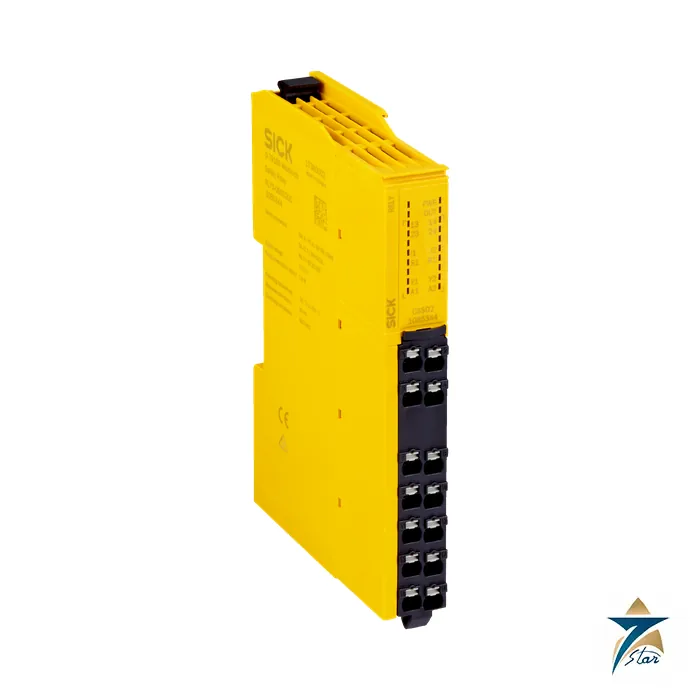
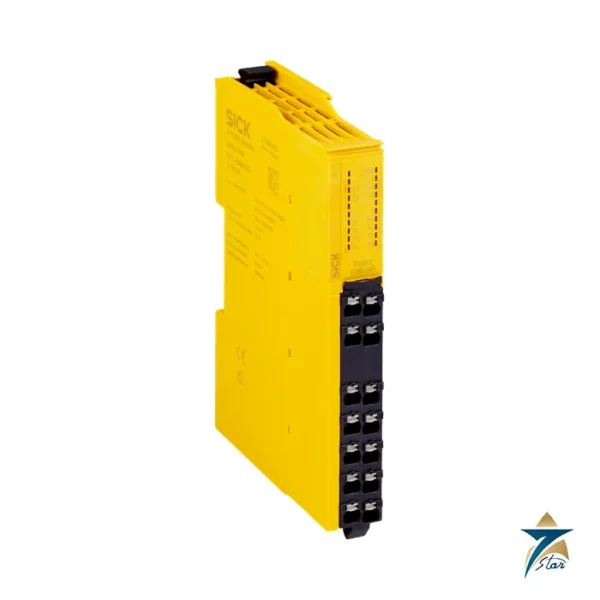
RLY3-OSSD200 is a SICK ReLy safety relay (part no. 1085344), an evaluation unit for safety sensors with OSSDs. It is 18 mm wide, has spring-terminal front connectors and is wired hard, so no software is needed. The data sheet lists SIL 3 (IEC 61508), PL e (ISO 13849-1) and category 4 (iso 13849-1); outputs are 2 enabling current paths (safe); 2 application diagnostic outputs (not safe); 1 test pulse output (not safe).
Safety evaluation with the RLY3-OSSD200
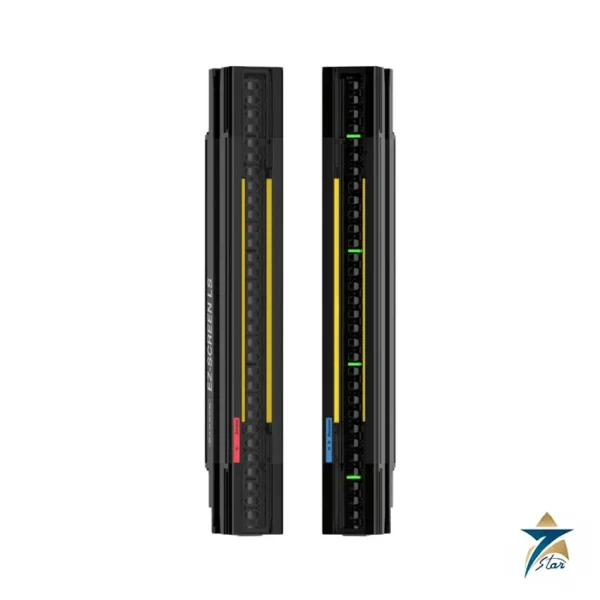
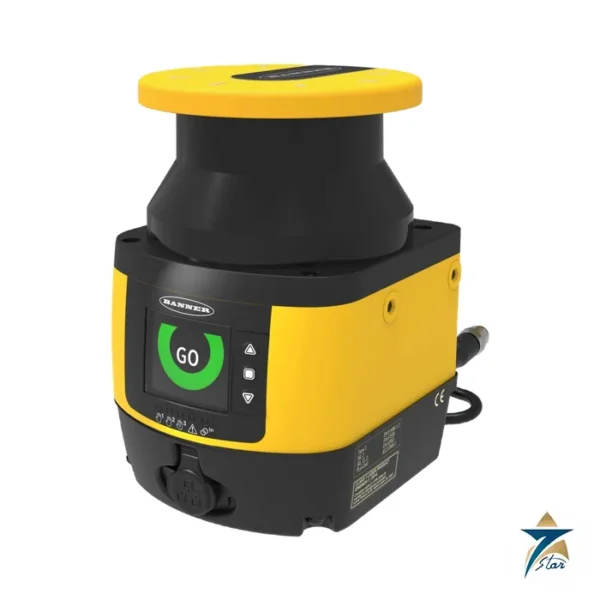
The OSSD version is designed to evaluate safety sensors that already have solid-state OSSD outputs, such as safety light curtains and safety laser scanners. The relay checks both channels for sequence (the data sheet lists sequence monitoring) and opens its enabling current paths when a protective device trips, with restart interlock and external device monitoring available.
Safety figures as printed: SIL 3 (IEC 61508), Category 4 (ISO 13849-1), PL e (ISO 13849-1), PFHD 1.0 x 10⁻⁹, mission time 20 years (ISO 13849-1), stop category 0 (IEC 60204-1). Reset: automatic; Manual. The two enabling current paths are N/O contacts, positively guided, switching 10 V AC … 230 V AC and 10 mA … 6 A up to a total of 12 A. Response time 10 ms.
Technical specifications
| Parameter |
Specification |
| Type code |
RLY3-OSSD200 |
| Part number |
1085344 |
| EAN |
4047084415197 |
| Product family |
ReLy |
| Applications |
Evaluation unit |
| Compatible sensor types |
Safety sensors with OSSDs |
| Safety integrity level |
SIL 3 (IEC 61508) |
| Category |
Category 4 (ISO 13849-1) |
| Performance level |
PL e (ISO 13849-1) |
| PFHD (mean probability of a dangerous failure per hour) |
1.0 x 10⁻⁹ |
| Stop category |
0 (IEC 60204-1) |
| Sensor monitoring |
Sequence monitoring |
| Restart interlock |
Yes |
| Reset |
Automatic; Manual |
| External device monitoring (EDM) |
Yes |
| Connection type |
Front connector with spring terminals |
| Inputs |
2 safety inputs; 1 input for reset pushbutton or external device monitoring (EDM) |
| Outputs |
2 enabling current paths (safe); 2 application diagnostic outputs (not safe); 1 test pulse output (not safe) |
| Display elements |
LEDs |
| Configuration method |
Hard wired |
| Voltage supply |
PELV or SELV |
| Supply voltage VS |
24 V DC (16.8 V … 30 V) |
| Residual ripple |
≤ 2.4 V |
| Power consumption |
≤ 2.5 W (DC) |
| Safety inputs: Number |
2 |
| Safety inputs: Input voltage HIGH |
24 V DC (11 V … 30 V) |
| Safety inputs: Input voltage LOW |
0 V DC (–3 V … 5 V) |
| Safety inputs: Input current |
4 mA … 6 mA |
| Safety inputs: Test pulse width |
≤ 1 ms |
| Safety inputs: Test pulse rate |
≤ 10 Hz |
| Reset pushbutton or external device monitoring (EDM) input: Number |
1 |
| Reset pushbutton or external device monitoring (EDM) input: Input voltage HIGH |
24 V DC (11 V … 30 V) |
| Reset pushbutton or external device monitoring (EDM) input: Input voltage LOW |
0 V DC (–3 V … 5 V) |
| Reset pushbutton or external device monitoring (EDM) input: Input current |
4 mA … 6 mA |
| Enabling current paths: Response time (opening of enabling current paths) |
10 ms |
| Enabling current paths: Number |
2 |
| Enabling current paths: Type of output |
N/O contacts, positively guided |
| Enabling current paths: Contact material |
Silver alloy, gold flashed |
| Declarations and certificates in the data sheet |
EU declaration of conformity; UK declaration of conformity; ACMA declaration of conformity; China RoHS; CCC certificate; UK-Type-Examination approval; cULus certificate; EAC certificate / DoC; cTUVus certificate; S Mark certificate; EC-Type-Examination approval; EC-Type-Examination approval (Machinery Directive); EC-Type-Examination approval (Machinery Regulation); Third party certificate |
Type code RLY3-OSSD200 and part number 1085344
RLY3-OSSD200 is catalogued under part number 1085344 in the ReLy line. Short type codes hide the input side: the letters after RLY3 tell you which kind of safety sensor the unit expects, so a wrong guess means the sensor cannot be connected as intended. Quote the part number, and describe the sensors on your machine (light curtain, scanner, door switch or emergency stop) so we can confirm the match.
Cabinet installation and validation checklist
The relay is a DIN-rail unit only 18 mm wide, intended for a control cabinet (IP20 (IEC 60529), ambient –25 °C … +55 °C, supply 24 V DC (16.8 V … 30 V)). Before putting a machine into service, check: input wiring and test pulses, reset type (automatic or manual), EDM loop to the contactors, and the actual response time of the whole chain, since the relay opens its paths in 10 ms but the actuators add their own delay. Keep the performance level calculation for the complete safety function on file.
Documents and quotation
Attached: the unaltered SICK data sheet for RLY3-OSSD200, part number 1085344. It is the reference if anything on this page needs checking. Tell us the quantity and the delivery location in the RFQ form, quoting the part number above, and we will come back with a quotation. Related items are listed under Safety Switches & Guard Locking. Before ordering, confirm that output polarity, connection and range match your controller and the device being replaced. If this page and the data sheet ever differ, the data sheet applies.




Reviews
There are no reviews yet.