UM30 ultrasonic sensor with analog output for level and distance
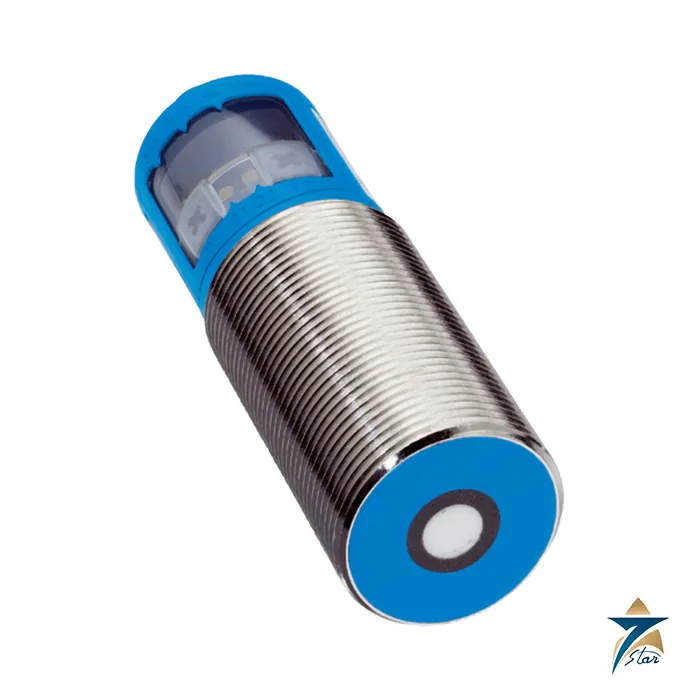
The SICK UM30-213113 (part no. 6036918) is a UM30 ultrasonic distance sensor in an M30 x 1.5 cylindrical metal housing. It measures from 200 mm to 1,300 mm (limiting range 2,000 mm) with a resolution of 0.18 mm or better, a repeatability of plus or minus 0.15 percent and a measurement accuracy of plus or minus 1 percent. One analog output switches automatically between 4 mA to 20 mA and 0 V to 10 V depending on the load.
Ultrasonic sensing is independent of colour and transparency, so the sensor measures liquid levels, film rolls, glass and shiny objects that defeat optical sensors.
Technical specifications
| Parameter |
Specification |
| Manufacturer |
SICK |
| Type / family |
UM30-213113 / UM30 |
| Part no. |
6036918 |
| Operating range / limiting range |
200 mm … 1,300 mm / 2,000 mm |
| Resolution |
0.18 mm or better |
| Repeatability |
plus or minus 0.15 % |
| Measurement accuracy |
plus or minus 1 %, temperature compensation (switchable) |
| Response time / output time |
92 ms / 23 ms |
| Ultrasonic frequency |
200 kHz (typical) |
| Analog output |
1; current 4 mA … 20 mA (up to 500 ohm) / voltage 0 V … 10 V (over 100 kohm), 12 bit, automatic selection by load |
| Multifunctional input |
1 x MF |
| Additional functions |
Teach-in and scaling of analog output, invertable output, synchronisation and multiplexing of up to 50 sensors, adjustable filters, switchable display, reset to factory default |
| Supply voltage |
DC 9 V … 30 V |
| Power consumption |
up to 2.4 W |
| Initialisation time |
below 300 ms |
| Display |
LED display, 2 x LED |
| Protection class |
III |
| Dimensions (W x H x D) |
30 mm x 30 mm x 84 mm; thread M30 x 1.5 |
| Housing material |
Metal (nickel-plated brass, PBT; transducer polyurethane foam, glass epoxy resin) |
| Connection |
Male connector, M12, 5-pin |
| Weight |
150 g |
| Enclosure rating |
IP65, IP67 |
| Ambient temperature |
-25 °C … +70 °C operation; -40 °C … +85 °C storage |
| MTTFD |
101 years (DCavg 0 %) |
Typical ultrasonic applications
The UM30 is used for level monitoring in open tanks and hoppers, roll diameter measurement, stack height checks, loop control and presence of transparent or highly reflective products. The sound beam has a detection area that widens with distance (the data sheet refers to diagrams), so choose the mounting distance so that nothing else enters the cone.
Teach-in sets the analog window to the actual process span, and filters, foreground suppression and sensitivity settings suit noisy environments. Up to 50 sensors can be synchronised or multiplexed to avoid cross-talk when several UM30 devices look at the same area. The 92 ms response time means the sensor is suited to level and positioning tasks rather than fast object counting.
Ordering reference
Order UM30-213113, part no. 6036918. This article is the version with an analog current/voltage output and an M12 5-pin plug. Ranges, outputs and connectors differ across the UM30 family, so quote the full type.
Selection checks for the UM30-213113
Begin with the geometry of the application. Measure the closest and farthest distances the target will reach and make sure both fall inside the 200 mm to 1,300 mm operating range, keeping in mind that anything closer than 200 mm will not be measured reliably. For tanks and hoppers, check the nozzle or bracket position against walls, ladders, agitators, inlet pipes and level switches, since any object inside the widening sound cone can return an echo before the real target. The beam diagrams in the data sheet are the reference for this check.
Look at the surface being measured as well. Calm liquids and flat solid surfaces return a strong echo, while heavy foam, steep angled piles of granular material or very soft surfaces can weaken it. Then confirm the electrical side: the 9 to 30 V DC supply, whether the receiving input expects current or voltage, and an M12 5-pin cable of suitable length for the route back to the panel.
Installation and commissioning
Mount the sensor so its face points squarely at the target surface, using the M30 thread rather than clamping on the transducer. Tighten moderately and support the cable so it does not pull on the connector. On tanks, keep the sensor face clear of the nozzle wall and avoid positions directly above a filling stream, where splashing and falling product can produce false readings.
With the sensor installed, use teach-in to set the analog output to the real process span, for example empty and full level, and check the resulting signal at the controller. Confirm that the reading changes smoothly across the span and adjust filters only as far as needed to steady the value, since heavy filtering slows the response further. Where several UM30 sensors view the same area, set up synchronisation or multiplexing before final testing.
Heat, dust and humidity in Oman
Ultrasonic measurement relies on the speed of sound in air, which changes with air temperature. Outdoor tanks and hoppers in Oman can see large differences between night and afternoon temperatures, and air directly above a sun-heated liquid surface may differ from the air at the sensor. Keep temperature compensation enabled, and where possible shade the sensor and the tank roof area around it so that the sensor and the air in the sound path stay closer to the same temperature.
Wind, strong ventilation and hot air rising from heated processes can deflect the sound beam and make readings unsteady, so shield outdoor installations from crosswinds where practical. Dust and sand settling on the transducer face can dampen the signal; inspect it during routine rounds and clean it gently with a soft, damp cloth, never with sharp tools or solvents that could damage the foam surface. At humid coastal sites, check that the M12 connector is fully tightened and that condensation is not collecting on the transducer.
Routine checks
Periodically compare the sensor reading with a manual dip or reference measurement, and repeat teach-in if the tank or mounting has been modified. Record the settings so a replacement sensor can be configured identically.
Documents and quotation
This page links the original SICK data sheet for UM30-213113 (part no. 6036918). Values in the specification table were copied from that document. Seven Star LLC supplies SICK products as an independent supplier in Muscat; send your request with the exact type and part number, the quantity and the delivery point, and mention any need for clamps, reflector or a cable with connector. Please verify the details with us before placing an order, since the manufacturer may change data without notice. See also sensors and transmitters and the SICK DT35-B15251 laser distance sensor.



Reviews
There are no reviews yet.