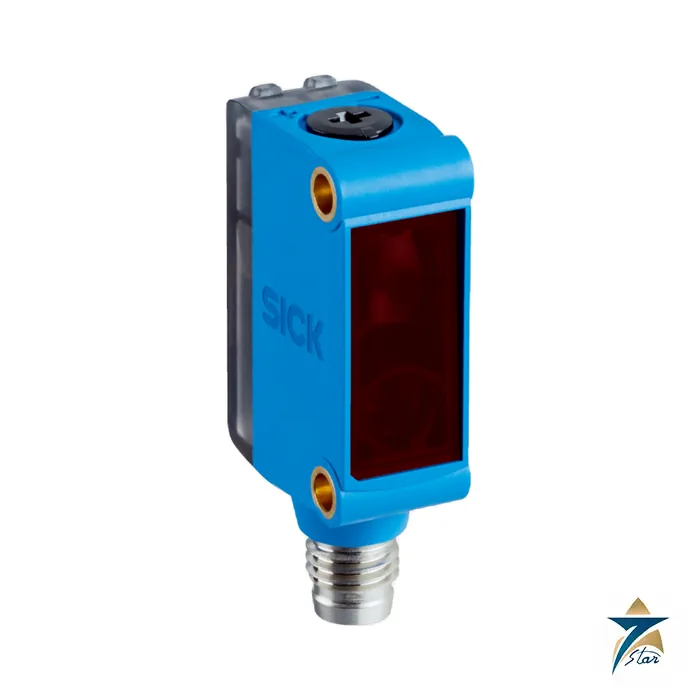
G6 miniature sensor for 35 to 140 mm working range
The SICK GTB6-P4211 (part no. 1052438) is a miniature G6 photoelectric sensor with background suppression. The 12 mm by 31.5 mm by 21 mm plastic housing weighs 20 g, connects via an M8 4-pin plug and works with a PinPoint LED at 650 nm. Its maximum range is 5 mm to 250 mm, with a typical working range of 35 mm to 140 mm.
The G6 housing is built for small machines and handling devices where cabling space and weight matter, and a mechanical spindle with five turns makes the switching distance easy to adjust.
Technical specifications
| Parameter |
Specification |
| Manufacturer |
SICK |
| Type / family |
GTB6-P4211 / G6 |
| Part no. |
1052438 |
| Functional principle |
Photoelectric proximity sensor, background suppression |
| Sensing range max. / typical |
5 mm … 250 mm / 35 mm … 140 mm |
| Light source / type |
PinPoint LED, visible red light, 650 nm |
| Light spot size |
6 mm diameter at 100 mm |
| Adjustment |
Mechanical spindle, 5 turns |
| Supply voltage UB |
10 V DC … 30 V DC |
| Ripple |
10 % |
| Current consumption |
30 mA |
| Output |
PNP, light/dark switching (selector) |
| Signal voltage PNP HIGH/LOW |
VS – (up to 3 V) / approx. 0 V |
| Output current Imax. |
100 mA |
| Response time / switching frequency |
625 microseconds max. / 1,000 Hz |
| Protection class |
III |
| Dimensions (W x H x D) |
12 mm x 31.5 mm x 21 mm |
| Housing / front screen |
Plastic ABS/PC / plastic PMMA |
| Connection |
Male connector M8, 4-pin |
| Weight |
20 g |
| Enclosure rating |
IP67 |
| Ambient temperature |
-25 °C … +55 °C operation; -40 °C … +70 °C storage |
| MTTFD |
1,886 years (DCavg 0 %) |
| UL file no. |
NRKH.E348498 and NRKH7.E348498 |
Positioning the G6 in small assemblies
A 250 mm maximum range with a 6 mm spot at 100 mm suits fingertip-level detection in assembly modules, vial handling and small-part feeding. The spindle adjustment gives a repeatable switching point, and the data sheet notes temperature stability following adjustment of plus or minus 10 °C.
Because the sensor is wired with an M8 connector, check the cordset length and the direction of the cable exit in the machine layout. The light/dark selector changes the output logic without rewiring. This type has the same 12 mm by 31.5 mm by 21 mm outline as the retro-reflective GL6-P4212 and the larger-range GTB6-P4231 in the same G6 family, so a mounting pattern can be reused.
G6 order references
Use GTB6-P4211 (part no. 1052438). The GTB6-P4231 is a separate G6 article with a longer sensing range of up to 400 mm and a different weight listing; the two are not interchangeable without checking the range. Quote the full part number to avoid mix-ups.
Key features of the GTB6-P4211
- Background suppression: the sensor detects objects within the set distance and ignores surfaces behind them, regardless of colour within the stated limits.
- PinPoint LED with a small, bright red spot that makes alignment on small parts quick and visible.
- Five-turn mechanical spindle for fine and repeatable adjustment of the switching distance.
- Light/dark switching selectable on the sensor, without changing the wiring or PLC program.
- IP67 plastic housing weighing 20 g, suitable for moving axes and pick-and-place heads.
- Fast response of 625 microseconds and 1,000 Hz switching frequency for high-rate counting.
How background suppression helps
A simple energetic proximity sensor switches on the amount of reflected light, so a white background can trigger it while a black object close to the sensor may not. A background suppression sensor such as the GTB6 uses triangulation: it evaluates the angle at which light returns, not only its intensity. As a result, a dark object at the set distance is detected and a bright conveyor frame further away is ignored. This makes the GTB6-P4211 a good fit where objects vary in colour or where a machine part sits just behind the detection zone.
Very shiny or mirror-like surfaces can still disturb any diffuse sensor. Tilting the sensor a few degrees from the perpendicular usually reduces direct reflections.
Mounting and setting up
- Fix the sensor with the through holes of the G6 housing and a matching mounting bracket, avoiding over-tightening the plastic body.
- Place the target at the farthest point where it must be detected, turn the spindle until the output switches, and then check with the background alone that the output does not switch.
- Use the light/dark selector to choose whether the output is active with an object present or absent.
- Connect via an M8 4-pin cordset; brown is normally supply positive, blue is 0 V and black is the switching output, but confirm the pin assignment in the data sheet.
- Keep the front screen clean; dust and fingerprints reduce the reserve.
Typical applications
Presence detection of components in assembly nests, checking parts on pick-and-place grippers, counting small packages on narrow belts, detecting caps and vials in pharmaceutical and cosmetic filling, and confirming tray position in electronics handling.
Considerations for GCC installations
The operating range of -25 to +55 °C covers most factory floors in Oman and the Gulf, but sensors mounted near ovens, sealing jaws or in unconditioned warehouses during summer should be checked against the upper limit. Fine dust on packaging lines settles on the front screen, so include the sensor in routine cleaning. IP67 protection allows occasional washdown, although aggressive cleaning chemicals should be checked for compatibility with the PMMA front screen.
What to include in an RFQ
- Type GTB6-P4211 and part number 1052438, with quantity.
- Required cordset length and connector angle (straight or angled M8).
- Mounting bracket or protective hood if needed.
- Any alternative family members under consideration, such as GTB6-P4231 for longer range.
Documents and quotation
This page links the original SICK data sheet for GTB6-P4211 (part no. 1052438). Values in the specification table were copied from that document. Seven Star LLC supplies SICK products as an independent supplier in Muscat; send your request with the exact type and part number, the quantity and the delivery point, and mention any need for a reflector, cordset or protective hood. Please verify the details with us before placing an order, since the manufacturer may change data without notice. See also sensors and transmitters and the SICK WTB4-3 miniature photoelectric sensor.












Reviews
There are no reviews yet.