W12 reflex sensor with coaxial optics and a 5 m range
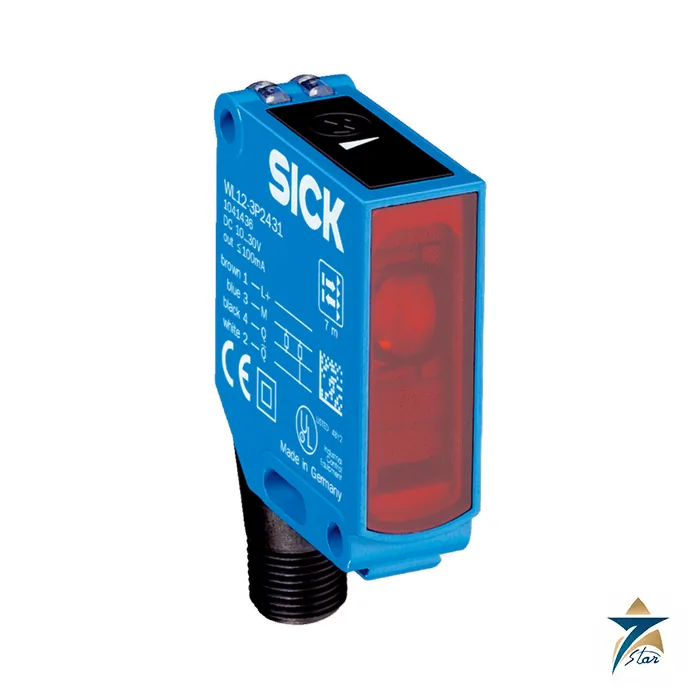
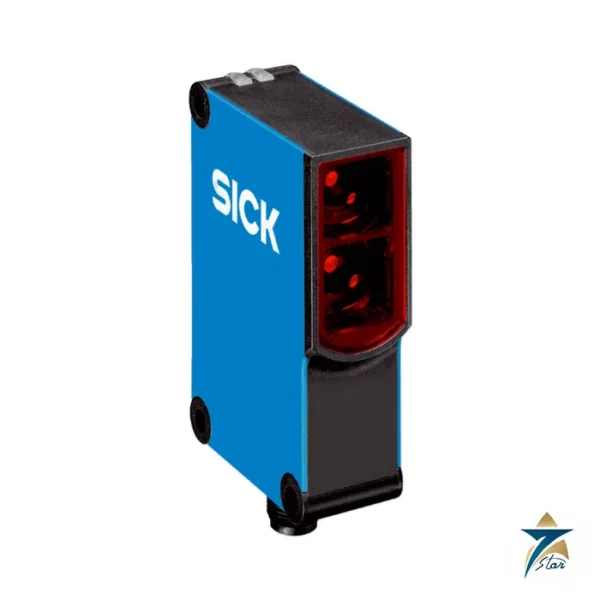
The SICK WL12-3P2431 (part no. 1041436) is a W12 retro-reflective sensor with a polarisation filter and coaxial autocollimation optics, so it detects up to the reflector with no blind zone. Range is 0 m to 5 m (maximum 7 m) with a PL80A reflector, and the visible red LED beam shows a 100 mm spot at 3 m. It switches in 330 microseconds at up to 1,500 Hz.
The metal rectangular housing with M12 4-pin connector is rated IP66, IP67 and IP69K and works from -40 °C to +60 °C.
Technical specifications
| Parameter |
Specification |
| Manufacturer |
SICK |
| Type / family |
WL12-3P2431 / W12 |
| Part no. |
1041436 |
| Functional principle |
Photoelectric retro-reflective sensor, autocollimation (coaxial optics) |
| Sensing range max. / typical |
0 m … 7 m / 0 m … 5 m (reflector PL80A) |
| Polarisation filter |
Yes |
| Light source / type |
LED, visible red light, 640 nm |
| Light spot size / angle |
100 mm at 3 m; dispersion approx. 1.5 degrees |
| Adjustment |
Potentiometer, 5 turns |
| Items supplied |
2 x clamps BEF-KH-W12 with screws |
| Supply voltage UB |
10 V DC … 30 V DC |
| Ripple |
below 5 Vpp |
| Current consumption |
30 mA |
| Output |
PNP, complementary, light/dark switching |
| Output current Imax. |
100 mA |
| Response time / switching frequency |
330 microseconds max. / 1,500 Hz |
| Protection class |
III |
| Dimensions (W x H x D) |
15.6 mm x 48.5 mm x 42 mm |
| Housing / front screen |
Metal / plastic PMMA |
| Connection |
Male connector M12, 4-pin |
| Weight |
120 g |
| Enclosure rating |
IP66, IP67, IP69K |
| Ambient temperature |
-40 °C … +60 °C operation; -40 °C … +75 °C storage |
| MTTFD |
1,543 years (DCavg 0 %) |
| UL file no. |
NRKH.E181493 and NRKH7.E181493 |
Why coaxial optics help on packaging lines
Coaxial optics place emitter and receiver on the same axis, so the beam path to the reflector stays narrow even close to the sensor. That avoids the dead zone of a dual-lens sensor and is useful where the reflector sits only centimetres away, such as on a short conveyor section or a roller guard.
With IP69K and a cold-room temperature rating, the sensor handles washdown cycles in food plants. Use the potentiometer to adjust sensitivity, and wire the complementary outputs according to the pin assignment in the data sheet. Always check range against the reflector actually fitted: the 5 m figure is for the PL80A.
Ordering note
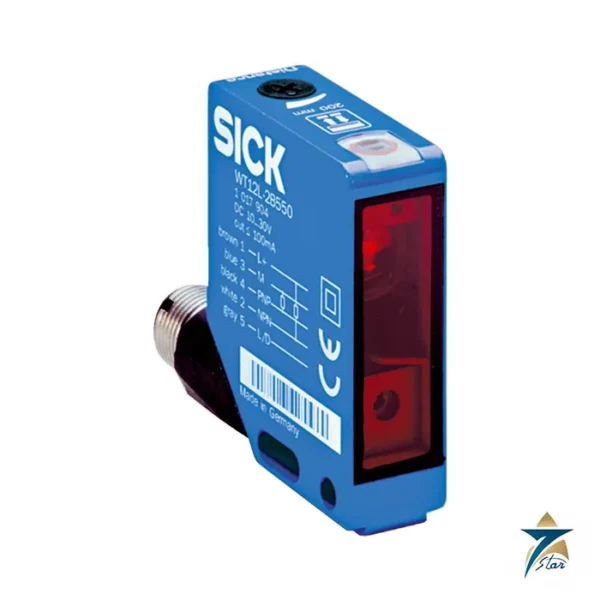
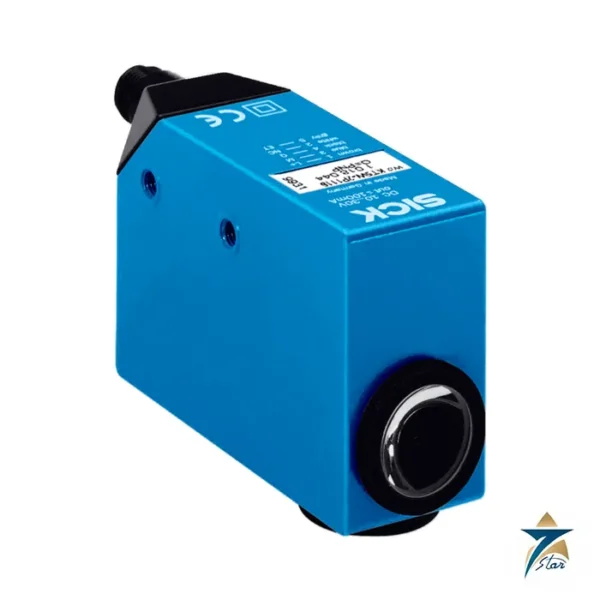
The order reference is WL12-3P2431, part no. 1041436. The WL12G-3B2531 and WL12L-2B530 in this order list are other W12 reflex types with different range, output and optics. Quote the part number rather than the family when ordering.
Key features of the WL12-3P2431
- Autocollimation (coaxial) optics with no blind zone in front of the sensor.
- Polarisation filter, which helps the sensor ignore shiny objects that would otherwise act as a reflector.
- Visible red 640 nm LED light, making alignment to the reflector straightforward.
- Complementary PNP outputs (light and dark switching available at the same time), up to 100 mA.
- Fast 330 µs response and 1,500 Hz switching frequency.
- Metal housing rated IP66, IP67 and IP69K, operating from −40 to +60 °C.
Choosing and positioning the reflector
The 0–5 m typical range is specified with a PL80A reflector. A smaller reflector reduces the usable range, while a reflector that is too large can make it harder to detect small objects. Because the sensor uses a polarisation filter, it must be used with a prismatic (corner-cube) reflector or a suitable reflective tape; ordinary mirrors and many reflective foils will not return the polarised light correctly. Mount the reflector square to the beam and protect it from damage by passing products.
Transparent and shiny objects
The polarisation filter is the key to reliable detection of shiny, metallised or wrapped products, which can confuse simple reflex sensors. Clear bottles and films are a different challenge: they may only slightly reduce the returned light. For such objects, check the application with a sample, and consider a sensor specifically designed for transparent object detection if the margin is too small.
Setting up the sensor
- Fix the sensor with the two BEF-KH-W12 clamps supplied and align the red spot onto the reflector.
- Use the 5-turn potentiometer to adjust sensitivity; reduce it if the sensor still switches with the object in the beam.
- Choose the light- or dark-switching output according to the PLC logic required.
- Test with the smallest and shiniest product that will pass the sensor.
Use in Oman and GCC facilities
The wide temperature range and IP69K rating suit food and beverage lines, cold stores and outdoor conveyors at ports and logistics centres. Dust and sand on the front screen or reflector reduce the received signal, so include cleaning of both in routine maintenance and set the sensitivity with enough reserve for local conditions.
What to include in your RFQ
State the type WL12-3P2431 and part number 1041436, the quantity, and whether you need reflectors (for example PL80A) or M12 cordsets. Add the delivery location and required date.
Maintenance and replacement
When a sensor is replaced, record the potentiometer setting and output wiring of the old unit first. Because the WL12 uses an M12 connector, the cordset can usually stay in place. After fitting the new sensor, realign it to the reflector, set the sensitivity with the real product and confirm the PLC input changes state correctly.
Documents and quotation
The official SICK data sheet for WL12-3P2431 (part no. 1041436) is attached to this page, and the figures in the table above are taken from it. Seven Star LLC is an independent supplier in Muscat and quotes SICK items against a written request. In your enquiry, give the exact type code, part number, quantity and delivery location, and say whether you need accessories such as a mounting bracket or matching M12 cordset. Data sheets carry a note that content is subject to change without notice, so confirm current details before ordering. More items are listed under sensors and transmitters, and you may also look at the SICK WTB4-3 miniature photoelectric sensor.












Reviews
There are no reviews yet.