- Automation & ControlView all 3,136 products
- Automation Accessories
- AC Drives
- PLC & I/O Cards
- Industrial Communications
- Vibration Monitoring
- Controllers & Data Acquisition
- Isolator & Barrier
- Safety Switches & Guard Locking
- Encoders
- Motor Soft Starters
- CCTV & Security
- Pneumatic Cylinders
- HMI Displays
- Servo Drives
- Industrial Computers
- Machine Vision
- Automation Software
- Robotics
Brand: SICK
SICK SIG200-0A0412200 IO-Link Master, 4 Ports, PROFINET, IP67
Description
Overview
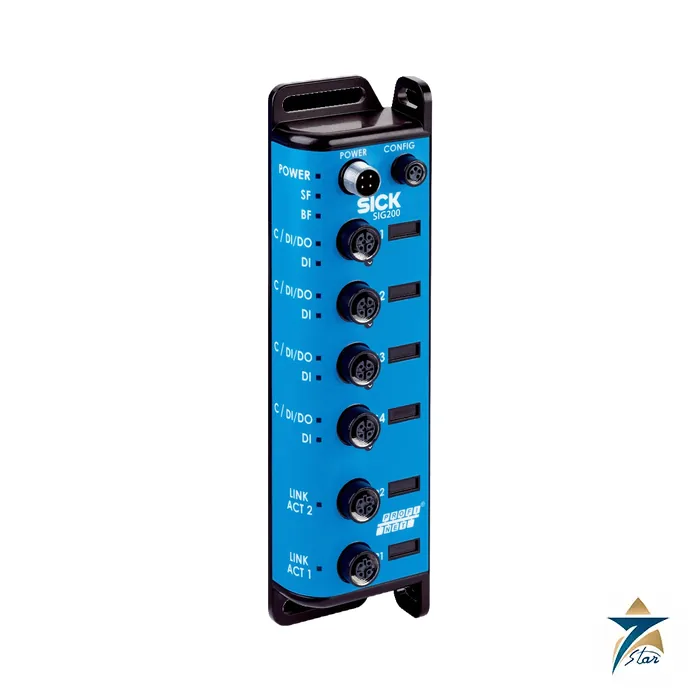
The SICK SIG200-0A0412200 is a Sensor Integration Gateway: an IP67 IO-Link master with four configurable ports that connects IO-Link devices, simple binary sensors and actuators to a PLC, a cloud application or an Ethernet network. It sits in the field next to the machine, so a handful of sensors can be reached through short M12 cables and a single Ethernet connection back to the control cabinet, instead of running a separate cable pair for each device.
What makes this code more than a plain I/O block is the software inside the zinc housing. A web server is integrated, a logic editor lets you define simple functions across several connected devices, and the gateway data are published to a controller or to a cloud application through a REST API as well as through PROFINET. The device can therefore act as a small standalone controller where a full PLC would be excessive.
Seven Star LLC is an independent supplier serving Oman and the GCC. This page is built from the manufacturer data sheet for part number 1089794.
Ports and interfaces of the SIG200-0A0412200
Four IO-Link ports are provided on A-coded 5-pin M12 female sockets, each of class A. Pin 4 of every port can be used as IO-Link, as a digital input or as a digital output, and pin 2 provides an additional digital input. The gateway supports IO-Link versions V1.1 and V1.0 with transmission types COM1, COM2 and COM3. In total it handles up to 8 PNP inputs of type 1, or 4 IO-Link devices, and up to 4 PNP outputs at a maximum output frequency of 50 Hz.
The network side uses two D-coded 4-pin M12 Ethernet sockets marked LINK/ACT, which allow line topology without an external switch. Power enters on a 4-pin A-coded M12 plug. A fourth connection labelled CONFIG is an M8 socket carrying USB 2.0 for configuration with the SOPAS ET engineering tool, and the delivered scope includes blind plugs for unused ports and a marking label set.
Technical specifications of the SICK SIG200-0A0412200
| Parameter | Value |
|---|---|
| Type / part number | SIG200-0A0412200 / 1089794 |
| Product category | IO-Link master |
| IO-Link ports | 4, class A, V1.1 and V1.0 |
| Transmission types | COM1, COM2, COM3 |
| Inputs | up to 8 PNP (type 1) or 4 IO-Link |
| Outputs | up to 4 PNP, 50 Hz maximum |
| IO-Link connections | 4 x M12, 5-pin female, A-coded |
| Power connection | 1 x M12, 4-pin plug, A-coded |
| Ethernet | 2 x M12, 4-pin female, D-coded |
| Configuration port | M8, 4-pin, USB 2.0 |
| Communication | IO-Link, USB, Ethernet, PROFINET, REST API |
| Supply voltage | 10 to 30 V DC without IO-Link, 18 to 30 V DC with IO-Link |
| Current consumption | 175 mA or less at 24 V DC without sensors; up to 3,000 mA total |
| Port output current | 500 mA supply pin, 200 mA output pin |
| Initialization time | 60 s plus IODD installation |
| Default IP address | 192.168.0.1 |
| Enclosure rating | IP67 |
| Protection class | III |
| Housing | Zinc, light blue and black |
| Dimensions (L x W x H) | 213.9 mm x 57 mm x 38.3 mm |
| Weight | 520 g |
| Operating temperature | minus 40 to plus 55 degrees Celsius |
| Storage temperature | minus 40 to plus 75 degrees Celsius |
| Relative humidity | 0 to 90 percent, non-condensing |
| Conformance / network load | Conformance Class B / network load class III |
How SIG200-0A0412200 differs from other SIG200 variants
The SIG200 family is offered with different fieldbus protocols and port counts. The SICK SIG200-0A0412200 is the PROFINET and REST API version with four ports. Variants for other industrial Ethernet systems share the same type of housing but are separate part numbers, with different conformance data, and they cannot be exchanged just because the outline matches.
The wording of the type also matters when planning supply. This version needs 18 to 30 V DC when IO-Link devices are used, but only 10 to 30 V DC when the ports are used for plain binary signals. Verify the control panel supply before assuming that a 12 V source will work.
Typical applications in Oman and the GCC
The gateway is useful wherever many small sensors are scattered along a machine: conveyor lines, filling and packaging stations, pump skids and valve manifolds. Reading IO-Link sensors through one network node cuts cable length and allows remote parameter changes, which saves trips into hot, dusty areas.
In water and wastewater plants it can collect level switches, flow switches and valve position signals from a tank farm; in manufacturing it can combine photoelectric sensors and light stacks near an assembly cell. The operating range of minus 40 to plus 55 degrees Celsius and the IP67 zinc housing are well matched to outdoor control boxes in the region.
Configuration and installation of the SICK SIG200-0A0412200
Mount the housing on a flat surface and connect the supply, ensuring the 10 V to 30 V range is respected; remember that the sum of all outputs plus the digital outputs must not exceed the maximum current consumption, so limit the current externally. Plug sensors into ports S1 to S4 and fit the supplied blind plugs on the unused sockets so the IP67 rating is kept.
Open the integrated web page at the default address 192.168.0.1 or connect a PC to the USB configuration port and start SOPAS ET, then assign IP data, port modes and the IODD descriptions of the connected devices. After switching on, wait about 60 seconds, plus additional time for IODD installation, before expecting the full data set. Use the logic editor for simple local functions such as combining two sensors into one output.
Care and spare handling for SIG200-0A0412200
The device has no serviceable parts. Check that the blind plugs and cable connectors are tight, since a missing plug defeats the IP67 protection. The LED rows show port status: green indicators for pin 4, yellow indicators for pin 2, link lights for the two Ethernet ports and dual-colour LEDs for bus and system errors.
When a device is replaced, back up the configuration with SOPAS ET first and restore it to the new unit. Keep the part number 1089794 on the maintenance record so the identical protocol version is reordered.
Related items you may also need: SICK UM18-217127111 UM18 Ultrasonic Sensor | SICK WTB2S-2P1151 Proximity Sensor | SICK IQ40-40NPSKC0S IQG Inductive Proximity Sensor | All SICK products.
Documents and quotation
The manufacturer data sheet for the SICK SIG200-0A0412200 accompanies this page and includes the connection diagrams, the dimensional drawing and the port characteristics.
Send your RFQ with the part number SIG200-0A0412200, the quantity and the delivery location in Oman or the GCC. Seven Star LLC will check availability of the SICK SIG200-0A0412200, and IO-Link sensors, M12 cables and power connectors can be added to the same request.
Datasheets & Documents
- Datasheet SICK SIG200-0A0412200 IO-Link Master, 4 Ports, PROFINET, IP67 Datasheet Download
Reviews (0)
How would you rate this product? Cancel reply
About brand
SICK is the German maker of industrial sensors: photoelectric and proximity sensors, safety laser scanners and light curtains, encoders, distance sensors, code readers and gas analysers. Erwin Sick, an optics engineer, founded it in Munich in 1946, and in 1952 it introduced its first marketable accident-prevention light curtain, which protected press operators by stopping the machine when a hand broke the light beam. The company moved to Waldkirch in the Black Forest in 1956 and is still headquartered there. It is a privately held company, and has been an Aktiengesellschaft (AG) since 1996.
SICK company profile
| Founded | 1946, Munich, Germany, by Erwin Sick (1909–1988) |
|---|---|
| Headquarters | Waldkirch, Baden-Württemberg, Germany (since 1956) |
| Ownership | Privately held; after the founder's death in 1988 his widow Gisela Sick became the main shareholder. Legal form SICK AG since 1996 |
| Size | More than 12,000 employees and group revenue of about EUR 2.3 billion (company figures for 2023) |
| First breakthrough | Accident-prevention light curtain for presses, shown in Hanover in 1952 |
| International growth | First foreign subsidiary in France in 1972, United States in 1976; today sales and service companies worldwide |
| Product families | Photoelectric, inductive, capacitive, magnetic and ultrasonic sensors; safety laser scanners, light curtains, safety controllers and relays; encoders and motor feedback systems; distance sensors and LiDAR; barcode and 2D code readers and machine vision; gas analysers, dust and flow measurement for process and emissions monitoring |
Milestones
- 1946: Erwin Sick receives a licence to run his engineering firm in Munich.
- 1952: The first marketable accident-prevention light curtain is presented in Hanover and goes into series production.
- 1956: The company moves to Waldkirch with 25 employees.
- 1972 and 1976: Subsidiaries are founded in France and the United States.
- 1996: SICK becomes an Aktiengesellschaft.
- Today: Sensors for factory and logistics automation, machine safety and process analysis, with a large share of revenue outside Germany.
Choosing a SICK sensor
For object detection, the sensing principle comes first. A retro-reflective sensor (WL series) sends light to a reflector and switches when an object breaks the beam; it is reliable over long distances and easy to align. A sensor with background suppression (WTB series) detects an object at a set distance and ignores what is behind it, which suits conveyors with shiny or dark backgrounds. A through-beam pair (WS/WE) gives the longest range and the highest reliability in dust. For transparent bottles and film, use a model built for transparent objects (for example WL12G-3B or WL150-P420). The digits in the code also matter: "P" usually means a PNP output and "N" NPN, and the last digits set the connector or cable. For machine guarding, a safety laser scanner such as nanoScan3 or microScan3 protects an area, while a safety controller such as Flexi Soft combines several safety devices.
Where SICK products are used
In Oman and the GCC, SICK sensors are used in packaging and bottling lines, food and beverage plants, logistics and airport baggage handling, cement and steel plants, ports and cranes, automated warehouses, and on machines built by European OEMs. SICK safety scanners guard robots and automated guided vehicles, and its encoders give position feedback on motors, hoists and conveyors.
SICK products we list
| Family | Examples |
|---|---|
| Photoelectric sensors | WL12-3P2431, WTB12-3P2431, GTB6-P4211, VL18-4P3240, WL12G-3B2531, WS/WE100, KT5W contrast, W26 IO-Link |
| Proximity, cylinder and ultrasonic sensors | IME12-08NPSZC0S, IME18-05BPSZC0S, MZT8, UM18 4-20 mA, UM30, UFN3 fork |
| Machine safety | nanoScan3, microScan3, S300 Professional, Flexi Soft FX3-CPU1, FX3-XTIO, ReLy OSSD |
| Encoders and motor feedback | DFS60B, AFM60 PROFINET, AFS60 SSI, ATM60 PROFIBUS, SRS50, EFS50 |
| Distance sensors and code readers | DT50, DL50, DT35, Lector632 |
Ordering SICK products: what we need
Send the type code and the 7-digit SICK part number from the label (for example WTB12-3P2431 together with its part number). For a replacement sensor, add the output (PNP or NPN), connection (M8, M12 or cable) and sensing distance. For encoders, add the interface (incremental, SSI, PROFIBUS, PROFINET), resolution and shaft type. For safety scanners, tell us the model and whether the existing configuration needs to be kept.
Frequently requested SICK models: SICK WTB4-3 Miniature Photoelectric Proximity Sensor, SICK IME18-08NPSZW2K Inductive Proximity Sensor, SICK DT35-B15251 Laser Distance Sensor, SICK microScan3 Safety Laser Scanner, SICK RZT7-03ZUS-KWB T-Slot Cylinder Sensor.
Facts checked against SICK's published company history and annual figures, October 2026.
Browse SICK products by category: Sensors & Transmitters.
FAQ
Questions about the SICK SIG200-0A0412200 IO-Link Master, 4 Ports,
Answers from our engineering team on installation, compatibility and integration.
01What is the SIG200-0A0412200?
It is an IP67 IO-Link master with 4 configurable class A ports, two Ethernet ports, an integrated web server and a logic editor.
02What protocols does the SIG200-0A0412200 support?
The data sheet lists IO-Link, USB, Ethernet, PROFINET and a REST API for passing gateway data to a PLC or cloud application.
03What supply voltage does the SIG200-0A0412200 need?
It needs 18 V to 30 V DC when IO-Link is used and 10 V to 30 V DC without IO-Link; typical consumption is 175 mA or less at 24 V.
04How is the SIG200-0A0412200 configured?
It can be configured with SOPAS ET over the USB CONFIG port or through the integrated web server at the default address 192.168.0.1.
05What temperature range does the SIG200-0A0412200 cover?
Operation is specified from minus 40 to plus 55 degrees Celsius, with IP67 protection and a zinc housing.


Reviews
There are no reviews yet.