
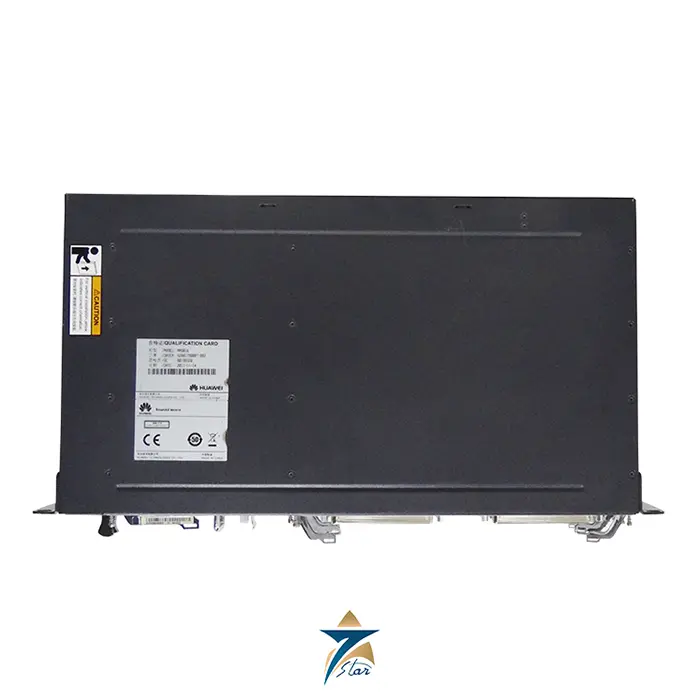
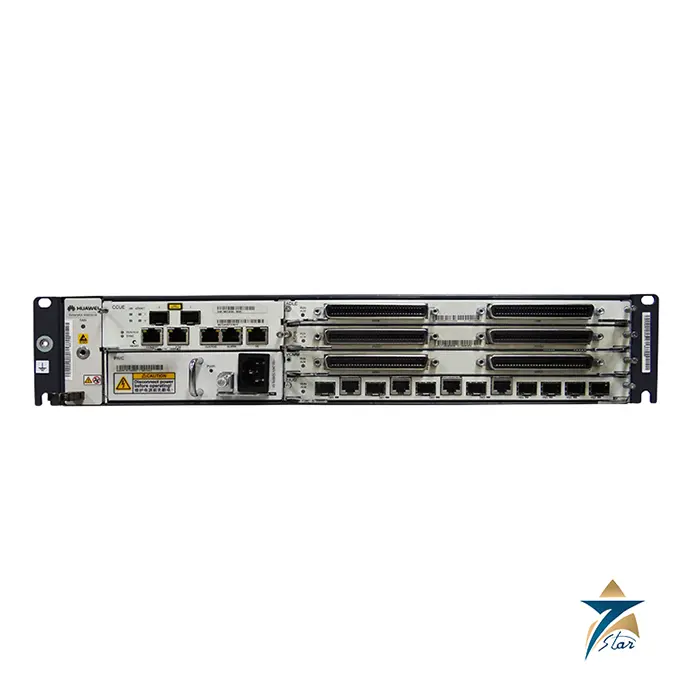
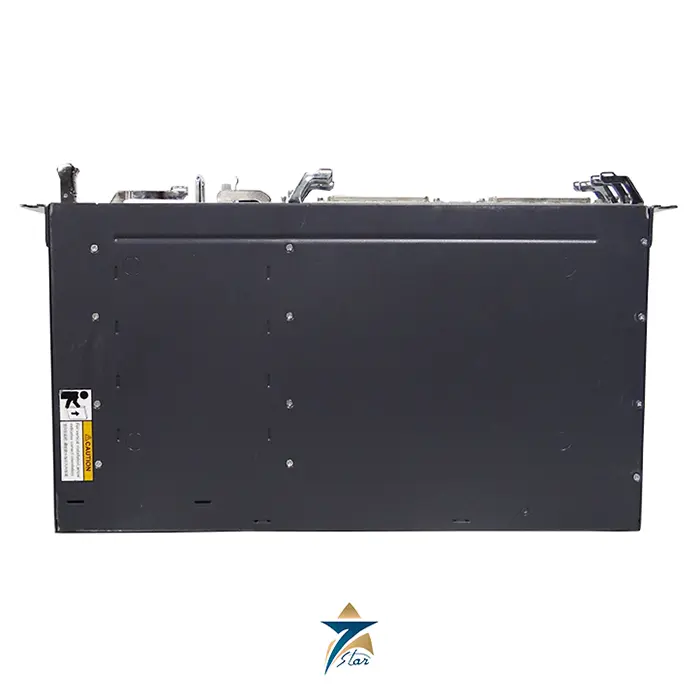
The Huawei MA5616 AC Chassis equipped with the CCUB Main Control Board and GP1A uplink board represents a highly versatile, multi-service access module engineered for high-availability communication infrastructures. As industrial automation architectures increasingly demand reliable, long-distance broadband backhaul for SCADA, remote telemetry, and distributed automation networks, this modular access node delivers high-density subscriber lines combined with flexible optical and electrical uplink topologies.
Seven Star LLC serves as a specialized technical supplier, commercial vendor, and B2B procurement partner, distributing this rugged telecom chassis to industrial operations, utility grids, and telecommunication infrastructure projects across the Sultanate of Oman, Muscat, and the wider GCC region. The architecture provides resilient, mission-critical Ethernet and fiber integration, allowing legacy network infrastructure to transition smoothly into modern smart grid frameworks without jeopardizing communication continuity.
The operational architecture of the network node focuses on seamless packet switching, high-performance aggregation, and multi-service traffic protocol transformation. The CCUB Main Control Board functions as the central nervous system of the system, coordinating the control plane, management plane, and data switching logic across all service slots. When remote telemetry, VoIP, or broadband data packets arrive from various subscriber interface cards within the chassis, the CCUB card processes the incoming frames using optimized hardware-based layer 2 and layer 3 routing algorithms.
Simultaneously, the GP1A daughter board manages the uplink convergence layer, provisioning one Gigabit Ethernet (GE) port alongside one Gigabit Passive Optical Network (GPON) interface. The card converts internal bus signals into encapsulated GPON encapsulation method (GEM) frames or standard Ethernet packets. This dual-uplink mechanism enables automatic path switching, enabling redundant configurations where the system can failover between fiber-optic GPON architectures and copper-based GE infrastructure to maintain an uninhibited data pipeline back to the central SCADA master unit.
The structural and electrical engineering design of the Huawei MA5616 AC chassis is explicitly optimized to ensure maximum operational uptime under severe, variable environmental exposures. Enclosed within a compact 2U, 19-inch rack-mountable industrial hardened chassis, the physical layout maximizes slot efficiency, offering four multi-service slots alongside dedicated spaces for control and power distribution boards.
This particular variant incorporates an integrated AC power module capable of handling wide voltage fluctuations typical in remote industrial substations, providing clean internal DC conversion to prevent component damage. Thermal management is driven by an intelligent, field-replaceable fan tray assembly that dynamically adjusts fan speeds based on real-time temperature data gathered by internal sensors. The communication backplane is engineered using high-speed multi-layer PCB design principles that mitigate crosstalk and signal attenuation, while gold-plated contact connectors protect interface pathways against the aggressive airborne salinity and localized humidity characteristic of coastal Oman industrial ports.
Highly scalable 2U multi-service access platform supporting high-density vectoring, VDSL2, ADSL2+, and POTS expansion.
Advanced CCUB main control board providing highly reliable system management, clock synchronization, and data switching.
Integrated GP1A uplink daughter card providing a versatile 1xGE electrical/optical port alongside 1xGPON link interface.
Built-in industrial-tier AC power supply module with wide input voltage tolerances and high surge protection metrics.
Intelligent dynamic fan control system ensuring optimal heat dissipation and minimized acoustic signatures in industrial enclosures.
Robust Layer 2 and Layer 3 packet processing with native support for VLAN tagging, IGMP snooping, and advanced QoS protocols.
Comprehensive operation, administration, and maintenance (OAM) diagnostic engines allowing secure remote software updates and troubleshooting.
The multi-service compatibility and robust field design of this communications platform make it exceptionally well-suited for mission-critical networking loops across various continuous industrial architectures. In the oil and gas upstream and midstream sectors of Oman, the system is widely deployed inside remote telemetry units (RTUs) and block valve stations to aggregate low-bandwidth pipeline monitoring data and high-definition surveillance feeds onto a singular fiber-optic backbone.
Power distribution networks and electrical utilities across the GCC implement this modular node inside high-voltage substations to establish reliable teleprotection links and grid monitoring networks. Sourced through the comprehensive procurement and commercial engineering network of Seven Star LLC, the unit is also integrated into large-scale desalination complexes and chemical processing infrastructure within the Sohar and Salalah industrial zones, ensuring that localized sensory data loops can interface continuously with cloud-based automation environments and remote centralized control centers.
The subrack of the Huawei MA5616 is organised around six physical positions: slot 0 is reserved for the control board, slots 1 to 4 accept service boards, and slot 5 carries the power board. That layout is what gives the platform its configuration flexibility, because the same chassis can be populated for very different access scenarios simply by changing the cards in the four service slots. Depending on the boards fitted, a single MA5616 supports up to 128 ADSL2+ lines, VDSL2 access on 24-channel or 16-channel boards, or up to 256 POTS voice ports, and SHDSL and Ethernet service boards are also available for leased-line and point-to-point industrial links.
The H831CCUB control board is itself a daughter-board carrier rather than a fixed-interface card. With the GP1A daughter board installed it presents one GPON port and one GE optical port upstream, while alternative daughter boards allow the same CCUB to be re-tasked for EPON or pure GE uplink and cascading as a network evolves. The CCUB additionally hosts voice daughter boards of the ASDA, ASDC, and ASDM families, and provides network time synchronisation with the ability to recover the line clock from the upstream port – a requirement for TDM voice and for teleprotection circuits where timing integrity matters as much as bandwidth.
The chassis occupies 88.1 mm × 442 mm × 245 mm and weighs 4.8 kg empty or 7.2 kg in full configuration, so it mounts in a standard 19-inch cabinet without special support. The AC variant accepts a wide 90 V to 264 V input, and the same platform is also produced in a −38.4 V to −72 V DC form for substation and telecom-room environments with central battery plant. The specified operating envelope of −40°C to +65°C and 5 to 95 percent non-condensing humidity is what qualifies the Huawei MA5616 for street-cabinet and remote-site deployment in Oman, where enclosure interiors routinely exceed ambient shade temperature during summer.
Functionally the unit is designed for fibre-to-the-building and fibre-to-the-curb architectures, terminating fibre at the cabinet and reusing existing copper for the final drop – the most cost-effective route when an industrial site or residential compound already has copper in the ground. Management is available locally through the command line and remotely through SNMP and Huawei’s network management system, allowing configuration, alarm collection, and software upgrade to be handled centrally rather than by site visit.
| Parameter | Specification |
| Chassis Dimensions | 88.1 mm × 442 mm × 245 mm (H × W × D); 2U, 19-inch |
| Main Control Architecture | Control and Core Unit Board (CCUB) |
| Uplink Interface Capabilities | 1x GPON Port + 1x Gigabit Ethernet (GE) Port (GP1A Board) |
| Power Supply Input Range | 100 VAC to 240 VAC (50/60 Hz) |
| Maximum Service Slots | 4x Multi-Service Interface Slots |
| Forwarding Capacity | Highly Optimized L2/L3 Wired-Speed Processing |
| Working Temperature Range | -40 °C to +65 °C; startup at -25 °C |
| Ambient Relative Humidity | 5% to 95% Non-Condensing |
| Ingress & Safety Compliance | IEC 60950-1, EN 55022 Class A, CE Certified |
| Network Management Interface | SNMPv1, SNMPv2 and SNMPv3; Telnet and SSHv2; CLI |
| Weight | 4.8 kg (empty chassis); 7.2 kg (full configuration) |
| Maximum Subscriber Capacity (CCUB) | Up to 256 POTS ports or 128 ADSL2+ ports |
| GPON Uplink | ITU G.984 compliant; 8 T-CONTs and 128 GEM ports (CCUB) |
| VLAN and MAC Capacity | 4K VLANs with QinQ and VLAN stacking; 4K MAC addresses |
| Multicast | IGMPv2/v3, IGMP proxy and snooping; up to 1024 multicast programs and 256 multicast users |
| Voice Protocols | SIP and H.248 |
| Lightning Protection | 6 kV |
| Backup Power | 48 V backup power (lead-acid or LiFePO4 batteries) |
Service Boards Supported With the CCUB Control Board
Huawei lists four service slots and ten service boards for an MA5616 fitted with the CCUB control board: three 24-channel VDSL2 boards (profile 17a, over POTS with built-in or external splitter, or over ISDN with external splitter), a 16-channel VDSL2 board (profile 30a), a 32-channel ADSL2+ board, a 32-channel combo board carrying 32 POTS and 32 ADSL2+ ports, 64-channel and 32-channel POTS boards, an 8-channel ISDN board and a 16-channel G.SHDSL board supporting ATM and PTM. The 16-channel FE board, the 4 GE + 4 FE P2P board and the 48-channel VDSL2 board are listed only for the CCUC control board.
With the CCUB control board Huawei states a maximum of 256 POTS ports or 128 ADSL2+ ports, and the combo board allows 128 POTS and 128 ADSL2+ users to be served at the same time. Service boards are slot compatible, so port types can be mixed across the four slots. Voice is supported with SIP and H.248, ADSL2+ complies with ITU-T G.992.1 to G.992.5 including Annex M, and VDSL2 complies with G.993.2 with profiles 8a to 30a. The chassis also supports 48 V backup power from lead-acid or LiFePO4 batteries.
How the GP1A Uplink Ports Are Used
According to Huawei, the GP1A daughter board gives the CCUB one GPON port and one GE port. The PON port is used for upstream transmission, while the GE port can be used either for upstream transmission or for subtending another device, so three upstream modes are possible: through the PON port, through the GE port, or through both. The GE port exists in hardware as one optical and one electrical connector sharing a single internal channel; only one can be used at a time, selected as optical, electrical or auto-adaptation in the command line. Only one CCUB can be fitted in the MA5616, and it is hot swappable.
Request a Quote for Huawei MA5616 AC Chassis with CCUB Main Control Board and GP1A Uplink
To submit a formal Request for Quote (RFQ), check current availability and lead time, or request technical engineering datasheets for the Huawei MA5616 AC Chassis configuration, please contact the B2B industrial procurement and communications division at Seven Star LLC today. Our application engineering specialists in Oman are standing by to assist you with system provisioning, network compatibility checks, and swift commercial sourcing execution across the GCC region.
Browse Huawei products by category: Industrial Communications.
Choose the option that best fits your needs to get the fastest response from our team.
Automatically fill the RFQ form with this product's details for a faster process.
Manually enter multiple part numbers, specific brands, or custom requirements.









Reviews
There are no reviews yet.