Overview
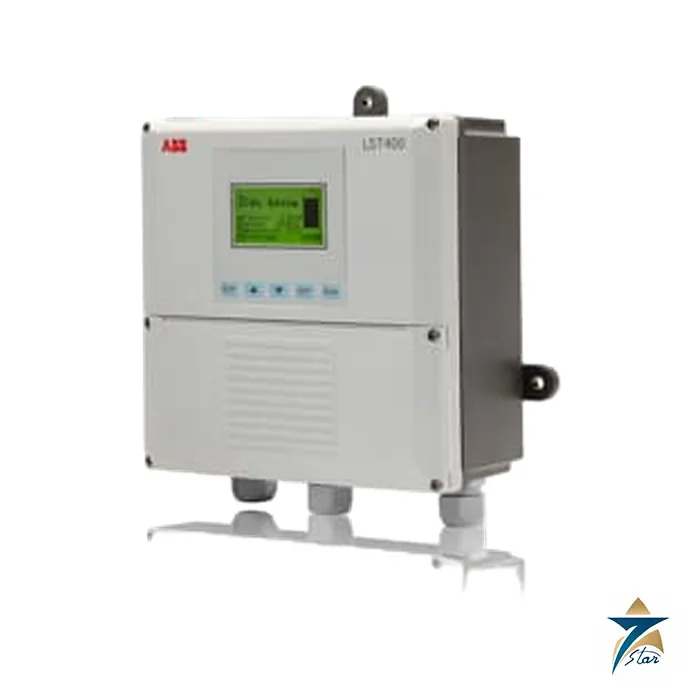
The ABB LST400 is a high-performance ultrasonic level transmitter engineered for non-contact level monitoring of liquids and solids across a wide range of industrial applications. Using ultrasonic pulses to detect level changes without any moving parts, the LST400 is ABB’s longer-range ultrasonic model, measuring up to 15 meters – positioned above the compact LST300 for tanks, silos, and open channels that exceed the compact model’s measurement span.
Seven Star LLC supplies the ABB LST400 to water treatment, chemical processing, and food production operators across Oman and the wider GCC as an experienced supply partner for genuine ABB instrumentation. Every unit is supplied with manufacturer documentation and supported locally with range and mounting guidance.
Operating Principle
The LST400 emits ultrasonic pulses toward the process surface and measures the time for the echo to return, converting that time-of-flight into a level reading without any part of the sensor contacting the process material. Because it has no moving parts, the LST400 drastically reduces maintenance requirements and enhances long-term reliability compared to contact-based level measurement technologies.
Built-in temperature compensation and advanced echo processing technology improve precision and minimize false readings, even in turbulent or dusty conditions where a weaker echo-processing algorithm might mistake surface disturbance or airborne particulates for a level change. Accuracy is rated at 0.25% of full span with temperature compensation, or 3 mm, whichever is greater, with a beam angle of 7° (at −3 dB) that focuses the acoustic energy tightly on the target surface to reduce false echoes from tank walls or internal structures.
Engineering Design of the ABB LST400
The rugged housing and IP-rated protection make the LST400 ideal for outdoor or corrosive settings, including water treatment plants, chemical processing units, and food production facilities. Installation is simple, with intuitive software for easy calibration and configuration, and the sensor measures ranges from 0.5 to 15 m (S15/C15/F15 sensors) or 1.5 to 30 m (S30 sensor for the largest vessels) with high accuracy. The enclosure is rated IP65/NEMA 4X in glass-loaded polycarbonate, operating from −20°C to 65°C ambient (sensor element rated −40°C to 90°C), and is powered from either 110/240 VAC ±15% or 20–30 VDC depending on the ordering configuration.
The LST400 supports multiple output formats including analog 4–20 mA with integrated HART 7 digital communication, allowing seamless communication with existing control systems – giving engineers integration flexibility regardless of a plant’s existing instrumentation standard. Process connection options include 1-inch NPT threaded or ANSI/ASME and metric flanges from 76 mm to 152 mm, letting the LST400 mount directly onto most existing tank or channel nozzles.
Key Features
- Non-contact ultrasonic level measurement, no moving parts
- Extended measurement range up to 15 meters
- Built-in temperature compensation and advanced echo processing
- Rugged, IP-rated housing for outdoor and corrosive environments
- Intuitive software for calibration and configuration
- Analog (4-20mA) and digital output protocols
- Suited to turbulent or dusty process conditions
- Low maintenance, long-term reliability
- Accuracy of 0.25% full span or 3 mm (whichever is greater), 7° beam angle
- IP65/NEMA 4X enclosure; sensor rated −40°C to 90°C
- 1-in. NPT threaded or ANSI/metric flanged process connection (76–152 mm)
Industrial Applications
The LST400 is suitable for tanks, silos, and open channels across water treatment plants, chemical processing units, and food production facilities – particularly larger vessels or channels where its 15-meter range exceeds what a compact ultrasonic transmitter like the LST300 can cover.
Across Oman’s water treatment and industrial processing sectors, and throughout the wider GCC, Seven Star LLC supplies the LST400 as a trusted supplier of ABB products to facilities in Muscat, Sohar, and Salalah that require dependable, factory-genuine long-range ultrasonic level transmitters with full local support.
Technical Specifications
| Parameter |
Specification |
| Model |
ABB LST400 |
| Measurement Type |
Ultrasonic, non-contact |
| Measurement Range |
0.5–15 m (S15/C15/F15); 1.5–30 m (S30) |
| Accuracy |
0.25% of full span or 3 mm, whichever is greater |
| Beam Angle |
7° (at −3 dB) |
| Media |
Liquids and solids |
| Power Supply |
110/240 VAC ±15% or 20–30 VDC |
| Operating Temperature |
−20°C to 65°C ambient; sensor to 90°C |
| Process Connection |
1 in. NPT; ANSI/metric flange 76–152 mm |
| Outputs |
4–20 mA with HART 7 |
| Enclosure |
IP65/NEMA 4X, glass-loaded polycarbonate |
| Application |
Tanks, silos, open channels |
Request a Quote for ABB Ultrasonic Level Transmitter LST400
Contact Seven Star LLC for a quotation on the ABB LST400 ultrasonic level transmitter, with manufacturer documentation and local support across Oman and the GCC.
Choosing a Mounting Position for the LST400
Most ultrasonic level problems are installation problems, so the mounting point deserves as much attention as the model code. Pick the sensor variant from the maximum distance to the lowest level you need to measure, then check that the highest level will stay outside the blocking distance at the sensor face. Keep the transducer perpendicular to the liquid surface and position it so the narrow beam has a clear path, away from inlet streams, agitator blades, ladders and weld seams on the tank wall.
- Avoid mounting directly above a fill stream, where falling product and foam scatter the echo.
- On nozzle mounting, keep the nozzle short and smooth inside so it does not create its own echo.
- In open channels, install at the correct distance upstream of the flume or weir as required by the primary element.
- Shade the sensor from direct sun where possible, since temperature gradients in the air column affect the speed of sound.
Commissioning and HART Configuration
After wiring and power-up, set the empty and span distances measured from the sensor face, not from the top of the tank. Use the echo profile to confirm that the true surface echo is being tracked, and suppress fixed false echoes from internal structures while the vessel is at a low level. HART access lets you make these settings and check diagnostics from the control room or a handheld communicator, and the 4–20 mA loop should be verified against the DCS reading before the loop is handed over.
Maintenance and Troubleshooting
- Loss of echo: check for heavy foam, condensation on the sensor face or a product level inside the blocking distance.
- Reading stuck at a fixed value: a new obstruction or build-up may be producing a false echo; review the echo profile and re-map false echoes.
- Slow drift through the day: look at temperature stratification or vapour in the head space.
- Routine: inspect cable glands and the housing seal, and clean deposits from the transducer face during planned shutdowns.
Typical Duties in Oman and the GCC
In the region the LST400 is well suited to water and wastewater lift stations, treated effluent and reservoir tanks, desalination chemical dosing tanks, and open channel flow monitoring. Its non-contact measurement suits dirty or corrosive liquids where a probe would foul, and the enclosure handles outdoor installation, though sun shading remains good practice in Gulf summers.
Sourcing Through Seven Star LLC
Seven Star LLC supplies the LST400 and its sensor options to plants across Oman and the GCC. Send us the tank or channel dimensions, process medium and the required power supply, and we will confirm the correct ordering code and lead time.
Related Products




























Reviews
There are no reviews yet.