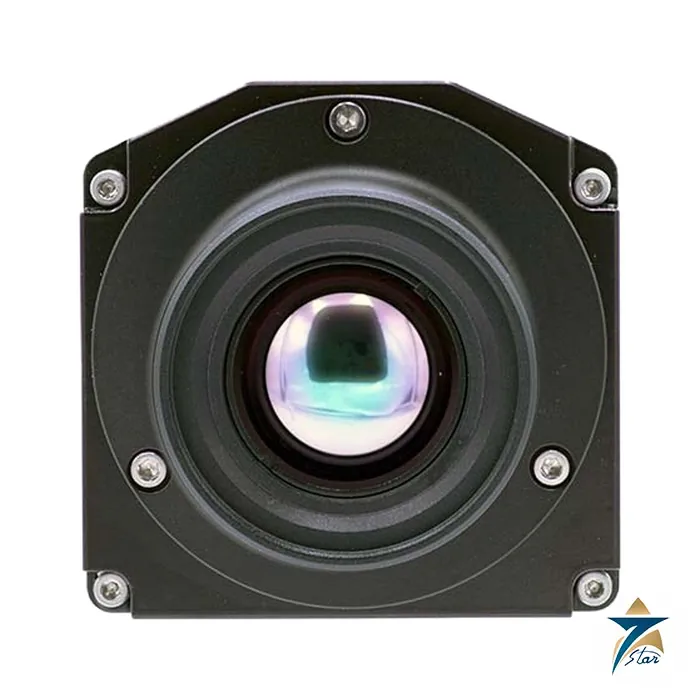
LWIR-640 fixed long-wave thermal imaging camera for process monitoring
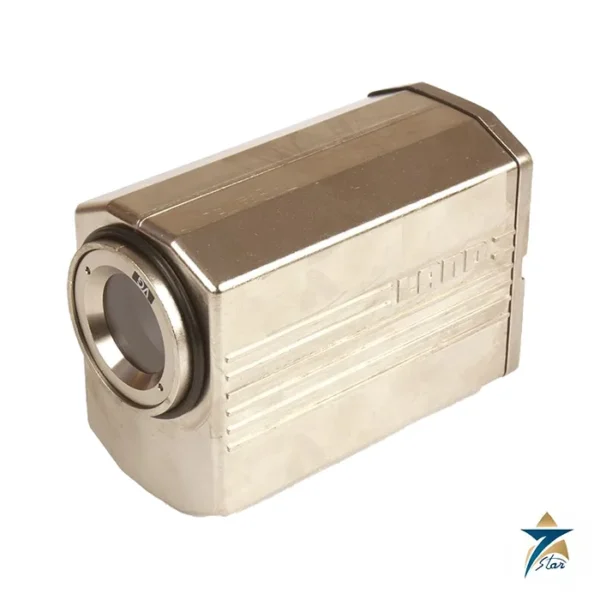
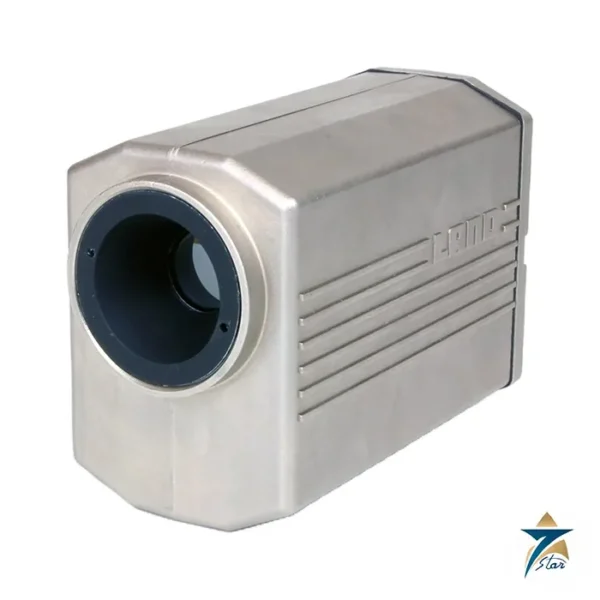
The AMETEK Land LWIR-640 is a fixed, stationary thermal imaging camera that returns a calibrated temperature value for every pixel of a 640 × 480 image. It works in the long-wave infrared band (8 to 14 µm) and covers -20 to 1500°C, split across four measurement ranges. Because the LWIR-640 outputs true temperature rather than a picture that must be interpreted by eye, it can feed alarms, trends and control loops directly. Seven Star LLC supplies the LWIR-640 in Oman and the GCC as an independent supplier based in Muscat.
Read the name as follows: "LWIR" stands for the long-wavelength infrared detector band and "640" is the horizontal pixel count of the sensor. Range and lens are not part of the model name; they are chosen as configuration options, which is why the selection checklist further down matters.
LWIR-640 technical specifications
| Parameter |
Specification |
| Manufacturer / part number |
AMETEK Land (LAND Instruments International) / LWIR-640 |
| Detector |
Uncooled microbolometer, 17 µm pixel pitch |
| Pixel resolution |
640 × 480 |
| Spectral response |
8 to 14 µm |
| Measurement ranges |
-20 to 120°C (25°, 12°, 6° optics); 0 to 500°C (all optics); 100 to 1000°C (all optics); 150 to 1500°C (25° and 12° optics) |
| Optics (HFOV × VFOV) |
48° × 36°, 25° × 19°, 12° × 9°, 6° × 4° |
| Focus range |
Motorised; 0.3 m to infinity (48° and 25°), 0.75 m to infinity (12°), 10 m to infinity (6°) |
| Frame rate |
HF version 60 Hz (subject to export licence review); LF version 7.5 Hz |
| Accuracy |
1.5 % or 2°C of reading |
| Noise / NETD |
0.5°C RMS / 40 mK at 20°C |
| Power |
12 to 24 V DC ±10 %, 12 W, or IEEE 802.3at PoE+ |
| Size / weight |
80 × 80 × 222 mm maximum including lens / 1.6 kg |
| Ambient / enclosure rating |
-20 to 60°C, 0 to 95 % humidity non-condensing / IP66, NEMA 4 |
| Digital interface |
M12 X-coded connector, 10/100/1000 Ethernet with PoE+ |
| Analog / logic I/O |
1 × 4–20 mA output; 1 × 4–20 mA output or relay; 1 × 4–20 mA input, digital input or relay; 6 pins assignable to image-processing functions |
| Compliance listed |
EMC to EN 61326-1; vibration tested to BS EN 60068 |
How the LWIR-640 turns infrared radiation into temperature
Every object radiates infrared energy in proportion to its temperature. The uncooled microbolometer array behind the lens absorbs that energy in the 8 to 14 µm window, and the camera electronics convert the signal of each of the 307,200 pixels into a temperature using the calibration stored for the selected range. Noise is specified at 0.5°C RMS, so small differences across a surface remain visible, and the 40 mK NETD describes the weakest temperature step the sensor can resolve at 20°C.
The unit contains an integrated web server. Through a normal browser you can open a live thermal image, set up to three regions of interest, and assign the on-board inputs and outputs to those regions. In that mode the LWIR-640 can run autonomously: a region that exceeds its limit can drive a relay or a 4–20 mA signal without a PC in the loop. For larger systems the camera is configured and analysed from ImagePro software, which can manage up to sixteen LAND imagers, and data can be shared over Open Data Interface, Modbus TCP or a Moxa I/O unit.
Where the LWIR-640 fits in a thermal monitoring system
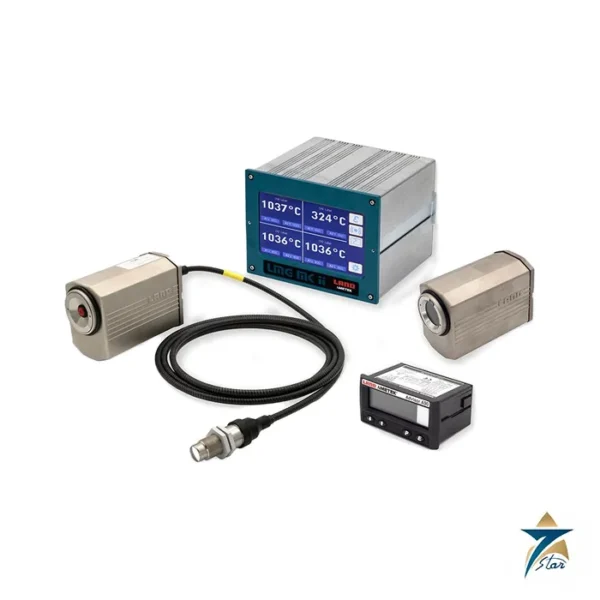
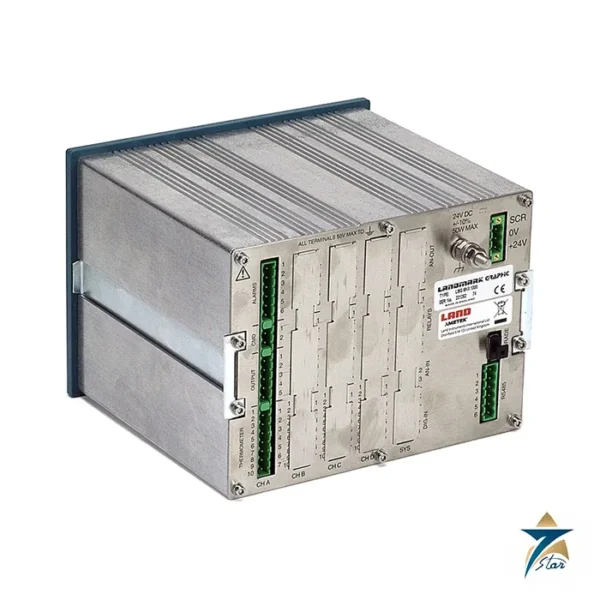
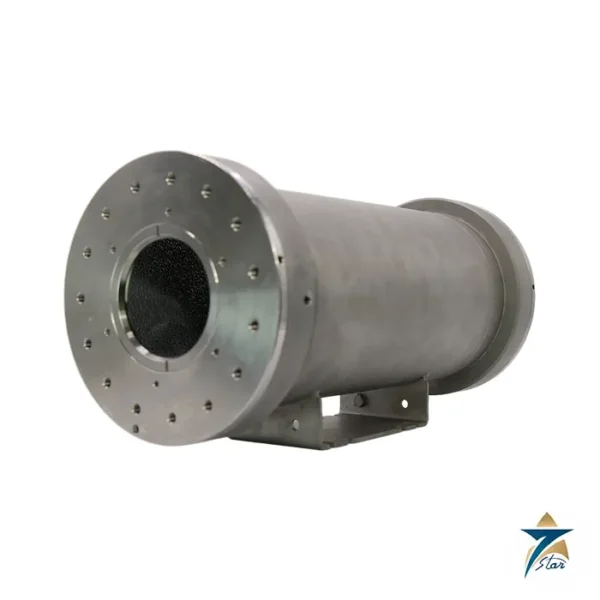
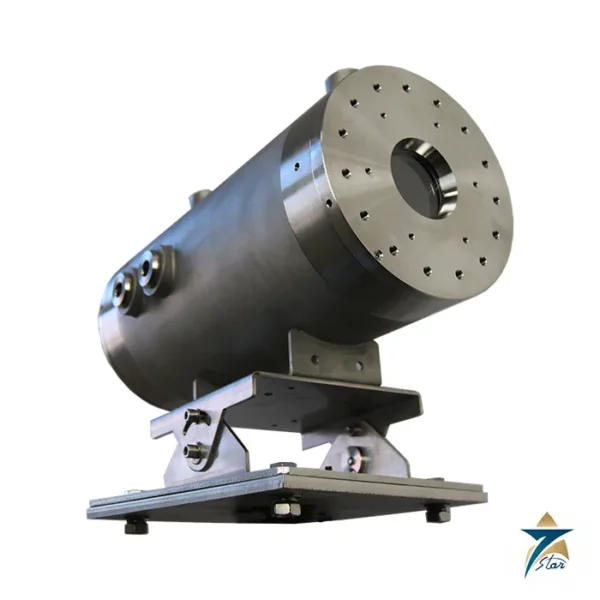
A complete installation is more than the camera body. The datasheet lists a thermal imaging PSU module (power, gigabit Ethernet switch with PoE+, fibre-optic data link; IP65 / NEMA 4; 380 × 380 × 211 mm; 15 kg), and optional accessories such as industrial housings with purge, light housings with purge, cables, brackets, a blower system, software and a PC workstation. The brochure also mentions a hazardous-area accessory option for Zones 1 and 21 that provides cooling and protection. Water and instrument air are the services needed by the optional cooling enclosures.
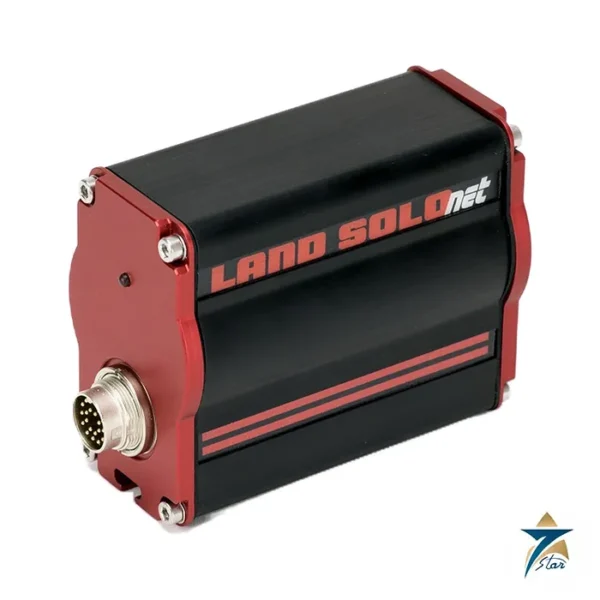
Within the same AMETEK Land family, the NIR-b-640 is the short-wave borescope camera for furnaces in the 600 to 2000°C range, while the LWIR-640 is the choice when the target is cooler or is viewed through open air, for example a flare flame, a hot surface, a kiln shell or a process line. Choose by temperature of the target, not by price of the camera.
Selecting a LWIR-640: checklist
- Target temperature: pick the range that brackets the lowest and highest temperatures you must see; the 150 to 1500°C range is only offered with the 25° and 12° lenses.
- Field of view and distance: a 48° lens suits close work and wide scenes; a 6° lens suits distant targets, with focus from 10 m to infinity.
- Frame rate: HF (60 Hz) for moving product, LF (7.5 Hz) for slow or static processes. HF units go through an export licence review.
- Power and network: 12 to 24 V DC or PoE+, and a gigabit Ethernet route (copper or fibre) back to the control room.
- Environment: ambient above 60°C, dust, spray or a hazardous zone calls for an enclosure, purge or cooling accessory.
- Outputs: decide whether the camera alarms on its own through relays and 4–20 mA, or only streams images to a PLC or DCS.
Installation, commissioning and maintenance
Mount the camera on a rigid bracket so that the field of view does not drift with vibration; the unit was tested for sinusoidal vibration of 3 g peak at 300 Hz and random vibration of 2.95 GRMS between 10 and 300 Hz. Aim and focus using the live view in the web page, then draw the regions of interest on the real target. Set emissivity for the surface being measured: a shiny metal and a painted steel plate at the same temperature will read differently if the setting is wrong, and this is the most common reason for readings that disagree with a contact probe.
Three status LEDs show power and status, Ethernet communication and internal camera temperature, which gives a quick first diagnosis on site. Keep the lens or window clean, check purge or cooling air before the summer season, and store the camera configuration so that a replacement can be set up identically. Keep a record of the serial number and range configuration before ordering any spare unit.
Typical applications of the LWIR-640 in Oman and the GCC
Oil and gas sites use long-wave imagers for flare stack and pilot flame monitoring, hot-spot checks on process equipment and heater shells. Power and desalination plants look at boiler casings, steam lines and hot electrical enclosures. Petrochemical and metals plants use continuous images to document batch temperatures and to detect uneven heating. In Gulf conditions the practical points are high ambient temperature (the camera is specified to 60°C), fine dust on optics and direct sun on outdoor housings, so the accessory choice for housing, purge and shading deserves as much attention as the camera itself.
LWIR-640 range and optics matrix
| Range |
Available optics |
Typical use |
| -20 to 120°C |
✓ 25°, 12°, 6° |
Low-temperature surfaces, ambient comparison |
| 0 to 500°C |
✓ 48°, 25°, 12°, 6° |
General process surfaces |
| 100 to 1000°C |
✓ 48°, 25°, 12°, 6° |
Flames and hot processes |
| 150 to 1500°C |
✓ 25°, 12° |
Highest temperature targets |
Information to send with an RFQ for the LWIR-640
- Target description and its minimum and maximum temperature
- Distance from camera to target and the size of the area to be seen
- Required range and lens (HFOV), frame rate HF or LF
- Power available (DC or PoE+) and network type (copper or fibre)
- Ambient conditions and whether the area is classified as hazardous
- Housing, purge, bracket and software requirements, and the number of cameras
Documents and quotation
A datasheet for the LWIR-640 is attached on this page. It lists the ranges, optics and electrical data summarised above, so you can check them against your duty before ordering.
Send us the part number LWIR-640 together with the information above and Seven Star LLC will prepare a quotation for delivery in Oman and the GCC.



















Reviews
There are no reviews yet.