
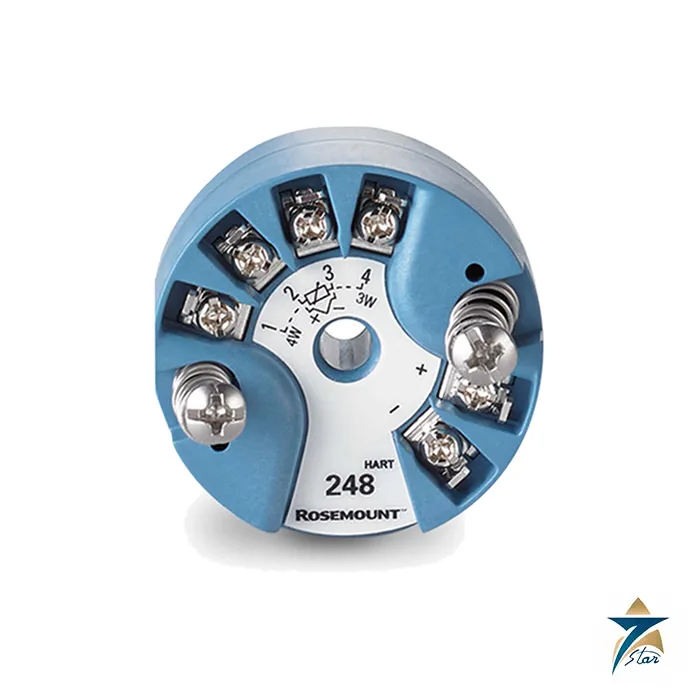
The Rosemount 248 is a basic HART temperature transmitter designed as a reliable, cost-effective solution for temperature monitoring points. Built as a DIN B style head mount unit, it converts a single RTD, thermocouple, millivolt or resistance input into a 2-wire 4 to 20 mA signal with a superimposed HART digital signal. Emerson positions it as a better alternative to wiring sensors directly back to the control system, because transmitting a conditioned 4 to 20 mA signal removes the need for expensive extension wires and multiplexers and improves measurement accuracy and reliability.
Seven Star LLC supplies the Rosemount 248 to process plants, utilities and oil and gas facilities in Oman and the GCC. Our team in Muscat helps engineers pick the right sensor input, enclosure, approval and calibration options from the official Rosemount 248 datasheet, and can combine the transmitter with matching RTDs, thermocouples and thermowells so it arrives as a complete, installation-ready temperature point.
A temperature sensor changes either its resistance (RTD) or its generated voltage (thermocouple) as process temperature changes. The Rosemount 248 measures this signal through a user-selectable input, linearizes it against the standard curve for the configured sensor type, and applies cold junction compensation for thermocouples. Its analog-to-digital circuitry self-calibrates at every temperature update by comparing the measurement to stable internal reference elements, and the result is output as a linear 4 to 20 mA current and a HART digital value with an update rate under 0.5 seconds.
For RTDs, transmitter-sensor matching uses the Callendar-Van Dusen constants of a specific calibrated sensor, which reduces the combined error of the measuring point. Open and short sensor diagnostics detect problems in the sensor loop and drive the output to the configured alarm level, with NAMUR NE43 compliant fail-high or fail-low values. Ambient temperature compensation keeps the reading stable as conditions around the head change, which is relevant for outdoor installations in hot climates.
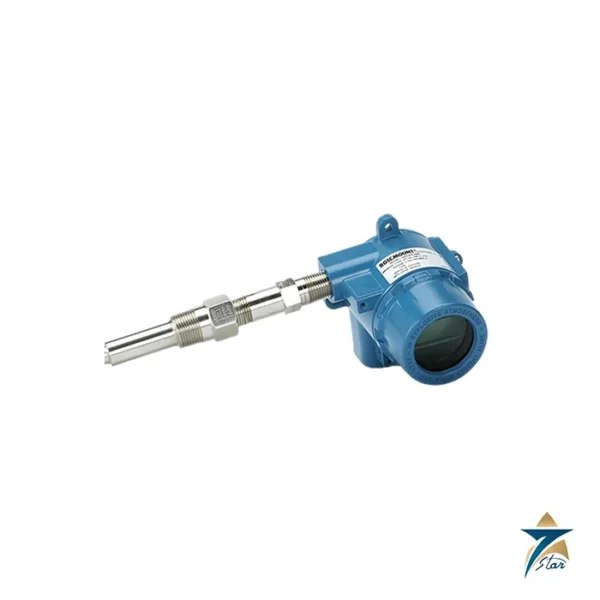
The transmitter puck, model 248H, weighs about 50 g and has a glass-reinforced polyphenylene ether and polystyrene housing. It installs in a connection head or universal head mounted directly on a sensor, or remotely from the sensor in a universal head, and can also mount on a DIN rail with an optional clip. Enclosure choices include aluminum or stainless steel Rosemount connection heads, universal heads, three-entry junction boxes rated IP66/IP68, an aluminum or polypropylene BUZ head rated IP65, and a polished stainless steel sanitary DIN A head.
The Rosemount 248 runs on 12.0 to 42.4 Vdc at the terminals, with a minimum 17.75 Vdc supply needed for a 250 ohm HART load. Input and output isolation is tested to 500 Vac rms, and the device meets EN 61326 and NAMUR NE 21, NE 43, NE 53, NE 89 and NE 107. The standard operating temperature is –40 to 85 °C, extended to –51 °C or –60 °C with the BR5 or BR6 cold temperature options, and vibration testing to IEC 60770-1 showed no effect on performance.
The Rosemount 248 datasheet lists the following features for general temperature monitoring.
The Rosemount 248 fits the many temperature points in a plant that need dependable monitoring without advanced dual-sensor features. Typical uses include pipeline and tank temperature monitoring, pump and compressor bearing and casing temperatures, heat exchanger inlet and outlet points, utility water, steam and cooling circuits, HVAC and district cooling plants, and skid-mounted packages supplied by OEMs. In the Sultanate of Oman these points appear across oil and gas production stations, gas-fired power and desalination plants, refineries and petrochemical units in Sohar and Duqm, and food processing and water utilities around Muscat and Salalah.
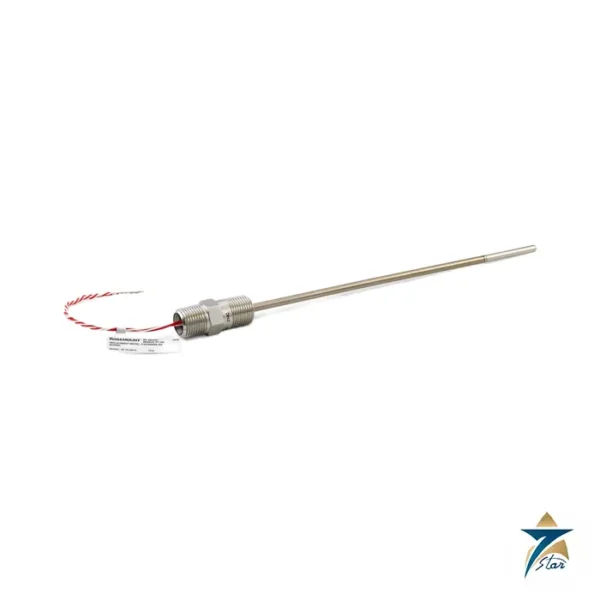
Seven Star LLC supports temperature instrumentation projects across Oman and the GCC with complete point selection and regional delivery. For dual-sensor redundancy and advanced diagnostics, compare the Rosemount 248 with the Rosemount 3144P temperature transmitter. Matching sensors include the Rosemount 214C RTD temperature sensor, and for points without signal cabling the Rosemount 648 wireless temperature transmitter is an option.
A higher-specification head mount option is the Rosemount 644 head mount temperature transmitter.
The table below summarizes Rosemount 248 data from Emerson product data sheet 00813-0100-4825.
| Parameter | Specification |
|---|---|
| Model | Rosemount 248H head mount temperature transmitter |
| Inputs | 2-, 3-, 4-wire RTD; thermocouple B, C, E, J, K, L, N, R, S, T, U; –10 to 100 mV; 0 to 2,000 ohm |
| Output | 2-wire 4–20 mA with HART (Revision 5 default, Revision 7 selectable) |
| Pt 100 digital accuracy | ±0.15 °C; D/A accuracy ±0.1% of span |
| Stability (RTD) | ±0.25% of reading or 0.25 °C for 5 years |
| Power supply | 12.0 to 42.4 Vdc at terminals |
| Isolation | Input/output tested to 500 Vac rms |
| Update rate | Less than 0.5 seconds |
| Damping | Up to 32 seconds; 5 seconds default |
| Operating temperature | –40 to 85 °C; –51 °C (BR5) or –60 °C (BR6) options |
| Humidity | 0 to 95% RH, non-condensing |
| Enclosures | Aluminum or SST connection heads, universal heads and junction boxes (IP66/IP68); BUZ head (IP65) |
| Conduit entries | M20 × 1.5 or 1/2 inch NPT |
| Safety | SIL 2 capable per IEC 61508 (option QT) |
| Weight (puck) | 50 g |
For a formal RFQ on the Rosemount 248, send Seven Star LLC your sensor type and range, enclosure and conduit entry, hazardous area approval, HART revision, alarm configuration, calibration certificate needs and whether the transmitter should be assembled to an RTD, thermocouple or thermowell. Our instrumentation division will confirm the model code against the Rosemount 248 datasheet, confirm availability and lead time, provide the data sheet for download and support temperature projects from Muscat across Oman and the GCC.
Browse Rosemount products by category: Pressure Instrumentation, Temperature Instrumentation, Level Transmitter, Liquid Analysis Sensors, Flowmeters.
Choose the option that best fits your needs to get the fastest response from our team.
Automatically fill the RFQ form with this product's details for a faster process.
Manually enter multiple part numbers, specific brands, or custom requirements.















Reviews
There are no reviews yet.