Moore Industries SPT/TPRG/PRG/U/-C [DIN] overview
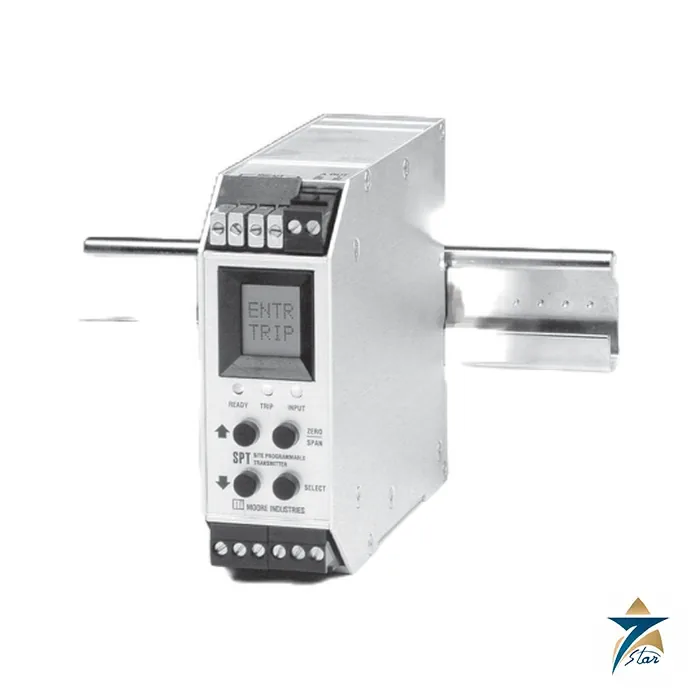
The Moore Industries SPT/TPRG/PRG/U/-C [DIN] is a site-programmable, isolated temperature transmitter from Moore Industries. It accepts RTD, thermocouple, millivolt or ohms input and produces an isolated, process-ready output that the user selects as 4-20 mA or 1-5 V.
The manufacturer describes the SPT as an ideal plant standard and universal spare for temperature applications. Setup is done with four front-panel pushbuttons and a large backlit LCD that guides the user through plain-language menus; all settings are held in non-volatile memory.
The -C option adds an alarm relay (SPDT, form C) that follows a trip point you set, with failsafe or non-failsafe action selected by a switch.
The part number SPT/TPRG/PRG/U/-C [DIN] follows the ordering pattern of the manufacturer datasheet, which lists the fields in this order: unit, input, output, power, option and housing (Unit / Input / Output / Power / Option [Housing]). The string written as SPT/TPRG/PRG/U/-C [DIN] is the model example printed in that datasheet, so it describes one complete configuration. If your plant needs a different input, output, supply, option or housing, send the configuration with your RFQ and it will be checked against the ordering table.
- SPT: site-programmable temperature transmitter
- TPRG: programmable temperature input: RTD, thermocouple, millivolt or ohms
- PRG: user-set output, 4-20 mA or 1-5 V, internally or externally powered
- U: universal auto-sensing power, 22 to 300 Vdc or 90 to 260 Vac
- -C: contact closure relay output (SPDT, form C)
- [DIN]: DIN-style housing for G-type and Top Hat rail
Key features of the Moore Industries SPT/TPRG/PRG/U/-C [DIN]
- Accepts RTD, thermocouple, millivolt and ohms inputs with 2-, 3- and 4-wire RTD connections, multiple sensor averaging and dual-sensor differential.
- Output switchable between 4-20 mA and 1-5 V, internally or externally powered.
- Power auto-sensing for 22-300 Vdc or 90-260 Vac.
- Front-panel menus on a 2 x 4 character backlit LCD, with parameters viewable without affecting operation.
- Programmable burnout protection, upscale or downscale.
- Compact DIN-style housing that mounts on G-type (EN50035) and Top Hat (EN50022) rail.
- FM non-incendive Class I, Division 2, Groups A, B, C, D; CSA general location.
Technical specifications for SPT/TPRG/PRG/U/-C [DIN]
| Parameter |
Value |
| Model string |
SPT/TPRG/PRG/U/-C [DIN] |
| RTD range |
100 to 1000 ohms, -200 to +850 degrees C (-328 to +1562 degrees F) |
| Thermocouple range |
-270 to +1836 degrees C (-454 to +3308 degrees F); ISA types J, K, E, T, R, S, N, B |
| Millivolt range |
-10 to 120 mV |
| Ohms range |
0 to 4000 ohms |
| Output |
4-20 mA or 1-5 V, user-set, internally or externally powered |
| Output accuracy |
plus or minus 0.03% of output span |
| Cold junction reference accuracy |
plus or minus 0.25 degrees C |
| Stability |
plus or minus 0.1% of calibrated span over six months, maximum |
| Output response |
800 ms maximum to reach full scale for a full-scale step |
| Alarm response |
700 ms maximum |
| Load capability |
1200 ohms maximum (source mode); 2000 ohms maximum (sink mode) |
| Isolation |
1000 Vrms between case, input, output and power |
| Input over-voltage protection |
plus or minus 5.0 Vdc |
| Power |
22-300 Vdc or 90-260 Vac; 2 to 3 W nominal |
| Alarm relay (-C) |
SPDT form C, 5 A at 250 Vac or 24 Vdc, or 0.5 A at 125 Vdc, non-inductive |
The values above come from the manufacturer datasheet for the SPT family. Specifications can differ by input type and option, so read the matching page of the datasheet before finalising a purchase specification and keep the complete model string on your purchase documents. Where a value is not listed here it was not stated clearly enough in the datasheet to repeat.
Typical applications of the SPT/TPRG/PRG/U/-C [DIN] in Oman and the GCC
The SPT suits motor and generator winding temperature monitoring, where the datasheet lists an SP2 option for noisy 10 ohm copper stator RTDs, as well as general process temperature loops.
In oil and gas, petrochemical and power plants, a temperature transmitter such as the SPT/TPRG/PRG/U/-C [DIN] converts the weak signal of an RTD, thermocouple, millivolt or resistance source into a robust signal that travels long distances to the control system with isolation from ground loops.
Typical uses include turbine and motor winding and bearing temperatures, furnace and heater skin temperatures, heat exchanger and pipeline temperatures, and process temperatures in water and wastewater plants. In the hot climate of Oman and the GCC, the wide ambient range of the unit is a practical advantage for outdoor panels.
Because the SPT/TPRG/PRG/U/-C [DIN] is configured on site rather than set at the factory, one unit can act as a universal spare for many sensor types.
Selection and compatibility notes for SPT/TPRG/PRG/U/-C [DIN]
Check the sensor type, range and wiring, the required output and the supply available. The -C option is needed if the same unit must also trip an alarm at a set temperature.
Confirm the sensor type and wiring scheme that the application uses: RTD with 2, 3 or 4 wires, thermocouple type, millivolt or resistance input. Check that the required span is within the range stated in the specifications table.
Check the required output type and the load the receiving device presents, and confirm that the power supply available in the cabinet matches the supply field of the model string.
When replacing an existing unit, send the nameplate model string and the current configuration with the RFQ so the configuration can be reproduced.
Installation and commissioning
Mount the SPT/TPRG/PRG/U/-C [DIN] on its rail or bracket in a panel that is not exposed to direct sun or heavy vibration. Use the terminal drawing in the manufacturer manual to wire the sensor, output and supply connections.
For thermocouples use the correct extension wire and keep the cold junction area free of draughts and heat sources. For RTDs use the lead wire configuration that matches the sensor and keep lead resistances balanced.
Configure the sensor type, range, burnout direction and output, then simulate the sensor with a calibrator at several points and check the output against the expected value before putting the loop in service.
Maintenance and spares
Verify the loop with a temperature calibrator at the interval your plant calibration policy requires, compare the as-found and as-left values, and adjust through the front panel menu only when the error exceeds your tolerance.
Check terminals and sensor wiring during outages, since most apparent transmitter faults are traced to sensor or wiring problems rather than the electronics.
Related products and ordering notes
Related temperature products from the same manufacturer include the TMZ, THZ and TDZ families. The datasheet is available on request.
Unit and accessory part numbers such as those named above are separate line items. Please list each one with its quantity so that the quotation covers the complete package. Seven Star LLC is an independent supplier serving Oman and the GCC and is not affiliated with the manufacturer.
Frequently asked questions about SPT/TPRG/PRG/U/-C [DIN]
- What inputs does the SPT/TPRG/PRG/U/-C [DIN] accept? It accepts RTD, thermocouple, millivolt and ohms inputs, selected through the front-panel menu.
- What outputs does the SPT/TPRG/PRG/U/-C [DIN] provide? The user selects a 4-20 mA or 1-5 V output, with internal or external loop power.
- What does -C mean on the SPT/TPRG/PRG/U/-C [DIN]? It adds a contact closure relay output, SPDT form C, rated 5 A at 250 Vac or 24 Vdc.
- What power can the SPT/TPRG/PRG/U/-C [DIN] use? It auto-senses 22 to 300 Vdc or 90 to 260 Vac.
- How do I order the SPT/TPRG/PRG/U/-C [DIN]? Send an RFQ with the part number, quantity and delivery location in Oman or the GCC.
Documents and quotation
The manufacturer datasheet for the SPT family is available from us on request and a copy is attached to this page. It contains the full ordering table, specifications and dimension drawings, and we suggest reading it before you decide on the final configuration.
To request a quotation, send an RFQ that includes the part number SPT/TPRG/PRG/U/-C [DIN], the quantity, the delivery location in Oman or the GCC and any special requirement such as certification documents or a required delivery date. Our team will confirm availability and lead time and reply with a written offer.
























Reviews
There are no reviews yet.