- Automation & ControlView all 3,060 products
- Automation Accessories
- AC Drives
- PLC & I/O Cards
- Industrial Communications
- Vibration Monitoring
- Isolator & Barrier
- Controllers & Data Acquisition
- Safety Switches & Guard Locking
- Motor Soft Starters
- Encoders
- CCTV & Security
- Pneumatic Cylinders
- HMI Displays
- Servo Drives
- Industrial Computers
- Machine Vision
- Automation Software
- Robotics
Brand: RKI
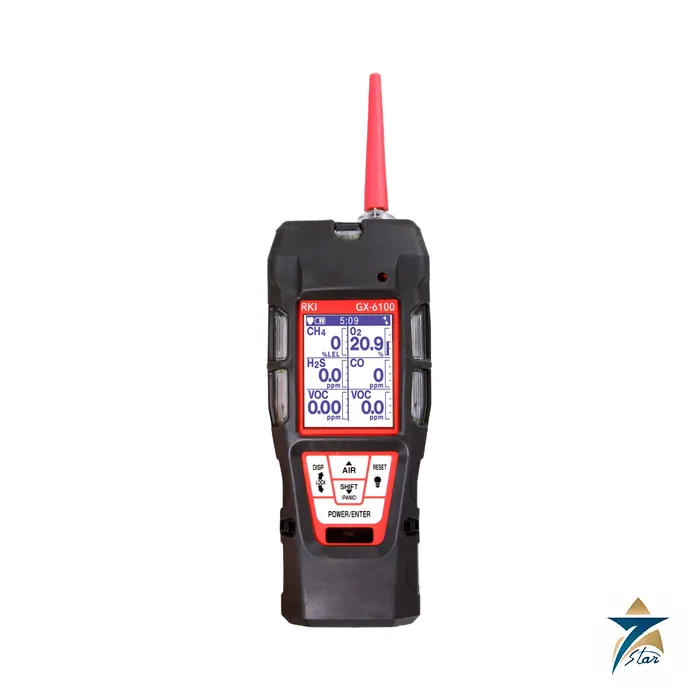
RKI GX-6100 Six-Gas Sample-Draw Detector with PID
Description
A six-gas sample-draw monitor with PID, infrared and toxic options
The RKI GX-6100 is a hand-held sample-draw instrument that monitors up to six gases at once. Besides the four standard confined-space channels (combustibles, oxygen, CO and H2S) it has two interchangeable smart-sensor slots that accept PID, PPM, infrared or super-toxic sensors, so a single unit can be configured as a PID-only VOC detector or as a multi-gas tool. RKI says it can measure combustibles in the ppm range and in % volume in the same monitor.
An internal pump (0.45 L/min, 100 ft sample range), man-down and panic alarms, an LED flashlight and an IP-67 rubber-booted case make it a field tool for confined-space entry, leak detection, hazmat response and wing-tank entry. A benzene-specific version uses a pre-filter tube.
Technical specifications
| Parameter | Specification |
|---|---|
| Manufacturer / model | RKI Instruments, GX-6100 six-gas sample-draw detector |
| Channels | Up to 6; 2 interchangeable smart-sensor slots (auto-recognised) |
| Sampling | Internal pump, 0.45 L/min, sample range up to 100 ft |
| PID options | 10.6 eV (0-40,000 ppb or 0-4,000 ppm), 10.0 eV (0-100 ppm; benzene-specific 0-50 ppm), 11.7 eV (0-1,000 ppm); library of over 600 VOCs |
| Oxygen (EC) | 0-40.0 vol%, 0.1 vol%; plus/minus 0.5% O2 |
| Carbon monoxide | 0-2,000 ppm, 1 ppm |
| Hydrogen sulfide | 0-200 ppm, 0.1 ppm |
| Combustibles | R sensor 0-100% LEL (1% LEL); NDIR methane 0-100% LEL or 0-100% vol; MOS methane 0-5,000 ppm; TE 0-100 vol% CH4 |
| Other sensors | NH3 0-400 ppm; Cl2 0-10 ppm; HCN 0-15 ppm; NO2 0-20 ppm; PH3 0-20 ppm; SO2 0-99.9 ppm; CO2 NDIR 0-10 vol% |
| Alarms | Low and high adjustable; man-down; panic; trouble (low flow, sensor connection, low battery, circuit error, calibration failure); 95 dB at 1 ft |
| Display / communication | Digital LCD with auto backlight, peak bar, auto rotation; Bluetooth, IrDA |
| Battery | Li-ion pack: 28 hours, recharge in 6 hours; alkaline pack (3 AA): 8 hours |
| Operating conditions | -4 to 122 F (-20 to +50 C); 0-95% RH non-condensing |
| Dimensions / weight | 2.6 W x 7.9 H x 2.2 D in (68 x 200 x 56 mm); 17.6 oz (500 g) with Li-ion pack |
| Enclosure | IP-67 (excluding sample hose and probe) |
| Approvals | IECEx, ATEX, TIIS, cCSAus; Ex ia IIC T4 Ga; CE |
| Manufacturer warranty | 3 years material and workmanship (including R sensors); 2 years IR and most EC; 1 year TE, Cl2 and PID (2 months for 11.7 eV lamp) |
Configuring the GX-6100
Order by the sensors needed in slots 5 and 6. Any two PID sensors can be installed, and PID sensors are described as resistant to humidity. The PID unit keeps a favourites list of 30 VOCs and the last 8 used. The MOS methane and isobutane sensors must be recalibrated after H2S exposure, so avoid them where H2S is likely. Standard accessories include a rubber boot, hand strap, belt clip, probe with filter and 3 ft Teflon-lined hose; an SDM-6100 calibration station, flexible probes and sample hoses up to 100 ft are options.
Confirm before ordering: target gases and ranges, PID lamp energy, benzene-specific need, battery type, approval marking required, and a calibration plan with the correct gas.
How the RKI GX-6100 works
A sample-draw detector pulls air from the area through a hose and a probe by an internal pump, and passes it over the sensors in the monitor. This lets a worker test a confined space, a tank or a leak point from outside, before entering. The GX-6100 has four standard channels for combustible gas, oxygen, carbon monoxide and hydrogen sulfide, and two smart-sensor slots that accept PID, PPM, infrared or super-toxic sensors. The slots recognise the sensor automatically, so the monitor can be changed to suit the job.
Where the GX-6100 is used
- Confined space entry.
- Leak detection.
- Hazmat response.
- Wing-tank and tank entry.
- VOC surveys with the PID sensor.
Selection checklist for the GX-6100
- Choose the two optional sensors: PID, NDIR methane, toxic or others.
- PID lamp of 10.6, 10.0 or 11.7 eV.
- Combustible range in % LEL, ppm or % volume.
- Internal pump of 0.45 L/min and a sample range of up to 100 ft.
- Battery: Li-ion pack with 28 hours, or alkaline pack with 8 hours.
- Alarms: low, high, man-down, panic and trouble.
- Bluetooth and IrDA communication.
- Operating range of -20 to +50 degrees C.
- IP-67 enclosure, excluding the hose and probe.
- Approvals: IECEx, ATEX, TIIS and cCSAus.
Installation, commissioning and maintenance notes
Before each use, do a bump test and check the sample flow, the filters and the battery. Calibrate the sensors at the intervals set by the site procedure, and use the correct gas for each sensor. Keep the probe and hose clean and dry, since water or dust can block the flow and trigger the low-flow alarm. Record the calibration date and the sensor configuration for each unit.
Requesting a quotation for the RKI GX-6100
Send the gases to be measured, the ranges and the sensor options. Seven Star LLC serves industrial customers in Oman and the GCC and replies with a quotation based on the information provided.
PID sensor options
The PID sensor comes with a 10.6 eV lamp for 0 to 40,000 ppb or 0 to 4,000 ppm, a 10.0 eV lamp for 0 to 100 ppm, and an 11.7 eV lamp for 0 to 1,000 ppm. A library of over 600 VOCs is stored in the unit.
Alarms and safety functions
Man-down and panic alarms, an LED flashlight and a 95 dB buzzer at 1 ft support the worker in the field.
Size and weight
The monitor measures 68 x 200 x 56 mm and weighs about 500 g with the Li-ion pack.
Detector records
Record the sensor list, the serial number and the calibration dates of each detector.
Choosing the GX-6100 sensor configuration
List the gases that the crew must test before deciding on the two smart-sensor slots. For solvent and fuel vapours, the PID sensor with a library of over 600 VOCs is the choice, and for methane in % volume the infrared or thermal conductivity sensors are options. Other sensors cover ammonia, chlorine, hydrogen cyanide, nitrogen dioxide, phosphine, sulfur dioxide and carbon dioxide. A benzene-specific version uses a pre-filter tube, so state this need in the enquiry.
Display and datalogging
The LCD has an automatic backlight, a peak bar and automatic rotation of the readings, and the unit talks by Bluetooth and IrDA.
Documents and quotation
The attached RKI datasheet lists features, sensors and specifications. Send the gases, ranges and approval requirement for a quotation. See more fire and gas detectors.
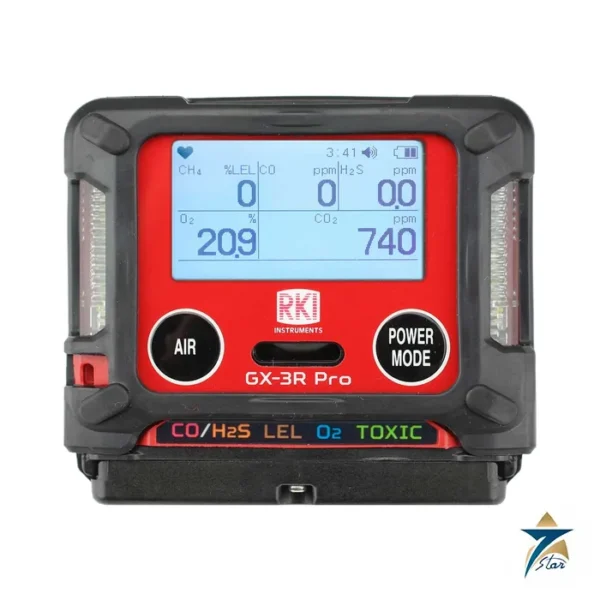
See also: RKI GX-3R Pro Five-Gas Personal Monitor.
Datasheets & Documents
- Datasheet RKI GX-6100 datasheet (EN) Download
Reviews (0)
How would you rate this product? Cancel reply
About brand
RKI Instruments is an American maker of portable and fixed gas detection equipment, established in 1994 and based in Union City, California. It designs its own instruments and accessories around sensors from its Japanese partner Riken Keiki, and it is the exclusive North American supplier of Riken Keiki products. RKI detectors are used for combustible gases, oxygen, toxic gases and VOCs in oil and gas, wastewater, utilities and confined spaces.
Seven Star LLC is an independent supplier in Muscat. We list RKI gas detection equipment for oil and gas, utilities and industrial safety in Oman and the GCC.
RKI company profile
| Founded | 1994, USA |
|---|---|
| Headquarters | Union City, California |
| Partner | Riken Keiki Co., Ltd., Japan (sensor technology) |
| Role | Exclusive North American supplier of Riken Keiki products |
| Product families | GX-3R and GX-3R Pro personal monitors, GX-2009 and GX-6000 multi-gas detectors, Eagle 2 sample-draw detectors, single-gas monitors, fixed detector heads and Beacon gas monitoring controllers |
RKI product series
Portable monitors include the GX-3R Pro five-gas personal monitor, the GX-Force sample-draw four-gas monitor and the GX-6100 six-gas sample-draw detector with PID for VOCs.
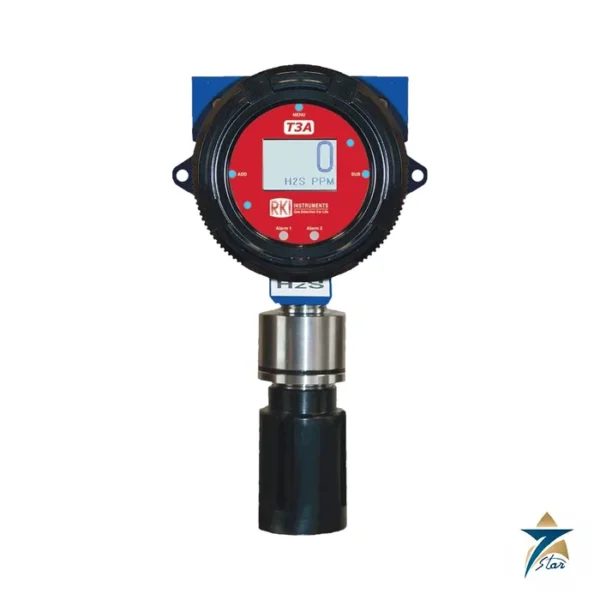
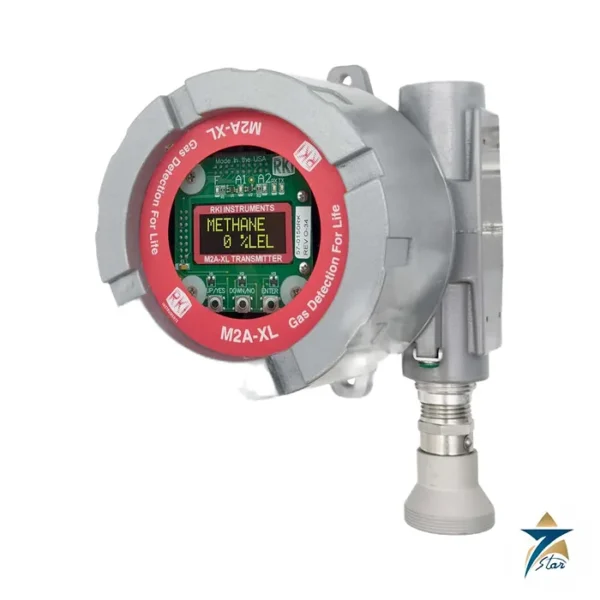
Fixed systems include the M2A-XL explosion-proof stand-alone transmitter, the T3A three-wire explosion-proof transmitter and the Beacon 800 eight-channel and Beacon 3200 32-channel gas detection controllers.
Personal monitors protect individual workers, sample-draw monitors check confined spaces before entry, and fixed transmitters with controllers provide continuous monitoring with alarms and relay outputs. Sensors are chosen for each gas, such as catalytic or infrared for combustibles and electrochemical for toxic gases.
Where RKI equipment is used
Confined space entry, personal protection of operators, leak detection, and fixed monitoring of combustible and toxic gases in plants, pump stations and wastewater facilities.
RKI products we list
Ordering RKI equipment: what we need
Send the model, the gases and ranges, the hazardous-area class, power supply and outputs, and calibration gas and accessories needed.
Facts checked against RKI Instruments' company profile and product catalogue, October 2026.
Browse RKI products by category: Fire & Gas Detectors, Logic Controllers.
FAQ
Questions about the RKI GX-6100 Six-Gas Sample-Draw Detector with PID
Answers from our engineering team on installation, compatibility and integration.
01How many gases can the RKI GX-6100 monitor?
Up to six: four standard channels (combustibles, O2, CO, H2S) plus two smart-sensor slots for PID, PPM, IR or super-toxic sensors.
02What PID options are offered?
10.6 eV in two ranges, 10.0 eV (including a benzene-specific version) and 11.7 eV lamps, with a library of over 600 VOCs.
03How does it sample?
An internal pump at 0.45 L/min with a sample range of 100 feet.
04What is the battery life?
28 hours on the lithium-ion pack (6-hour recharge) and 8 hours on the alkaline pack.
05Which approvals does it carry?
IECEx, ATEX, TIIS and cCSAus, with explosion class Ex ia IIC T4 Ga and CE marking.


Reviews
There are no reviews yet.