
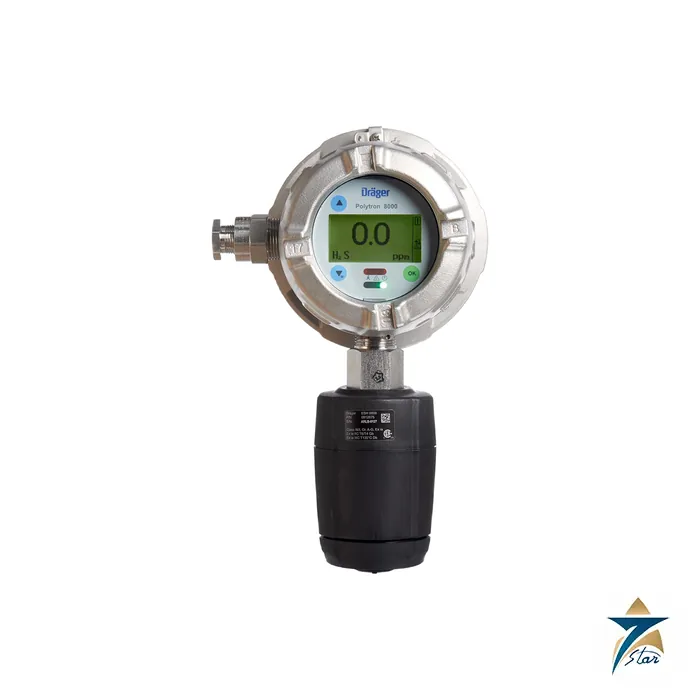
The Dräger Polytron 8100 EC is the explosion-proof transmitter Dräger positions at the top of its Polytron line for toxic gas and oxygen detection. It pairs a robust flameproof housing with a plug-and-play electrochemical DrägerSensor that is selected for one specific target gas, so the same transmitter body can be configured for carbon monoxide, hydrogen sulphide, chlorine, ammonia, oxygen and many other substances. Output is a 3-wire 4 to 20 mA analogue signal with optional relays, and HART, Modbus and fieldbus options let it connect to nearly any control system found in a process plant.
Seven Star LLC supplies the Dräger Polytron 8100 EC to refineries, gas processing sites, water utilities and chemical plants across the Sultanate of Oman and the wider GCC. As a trusted supplier of Dräger gas detection equipment, we supply on request and provide engineering support in Muscat, helping safety engineers match the correct sensor, housing and communication option to each measuring point before an order is placed.
The detection element is an electrochemical DrägerSensor. Target gas diffuses into the cell, reacts at the sensing electrode and produces a current proportional to the gas concentration, which the transmitter converts into a reading and a 4 to 20 mA signal. Dräger states that its electrochemical sensors can detect over 100 toxic gases and oxygen, and that they provide continuous detection under harsh conditions across a temperature range of -40 °C to +65 °C.
Each sensor carries a built-in memory that holds its calibration and configuration data. Because of this, every sensor used with the Dräger Polytron 8100 EC ships pre-calibrated and are ready for immediate operation once connected, and a replacement can be fitted without recalibrating from scratch. An intelligent self-test function supports predictive maintenance, and the intrinsically safe sensor connection removes the need for a flame arrestor, which Dräger notes gives faster response times and higher sensitivity.
The transmitter housing is an epoxy coated, copper-free aluminium or SS316L stainless steel enclosure with a Class I, Division 1 explosion-proof rating. Dimensions are approximately 280 x 150 x 130 mm, with a weight of about 3.0 kg for aluminium and 5.0 kg for stainless steel. Two 3/4 inch NPT ports or M20 cable glands accept field wiring, and the enclosure carries NEMA 4X and 7 plus IP65/66/67 protection.
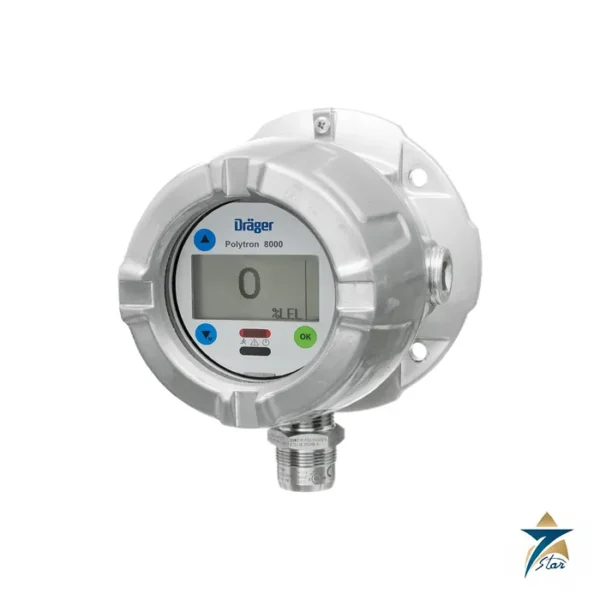
Operation of the Dräger Polytron 8100 EC is deliberately simple. A large graphic backlit display shows the measured concentration, the selected gas type and the unit, while green, yellow and red status LEDs signal normal, fault and alarm conditions. Settings are changed with a magnetic wand held over contact surfaces on the glass, so the enclosure never has to be opened in a hazardous area. The same layout is shared by every transmitter in the Polytron 8000 series, which reduces training and maintenance effort when a site mixes toxic, flammable and infrared measuring points.
The Dräger Polytron 8100 EC combines sensor intelligence with practical field features, including:
The Dräger Polytron 8100 EC suits any location where toxic gas or oxygen depletion must be detected continuously and reported to a control room: hydrogen sulphide around sour gas and refinery units, chlorine in water treatment and desalination plants, ammonia in refrigeration, and oxygen monitoring in confined or inerted areas. The wide temperature range of the Dräger Polytron 8100 EC makes it a sensible choice for Oman, where outdoor equipment sees high ambient heat, and the remote sensing head is useful for pits, trenches and elevated points that are awkward to reach.
Seven Star LLC supports facilities in Muscat, the Sohar and Salalah economic zones and elsewhere in the GCC with sensor selection, spare sensor planning and delivery coordination. The same platform covers oil and gas, petrochemical, power, pharmaceutical and food processing sites, so a plant can standardise on the Dräger Polytron 8100 EC and its siblings for many different toxic gas hazards and keep a small, common spare parts pool.
The table below summarises the published data for the Dräger Polytron 8100 EC, taken from the Dräger product data sheet.
| Parameter | Specification |
|---|---|
| Model | Dräger Polytron 8100 EC |
| Type | Explosion-proof (flameproof enclosed, “d”) transmitter |
| Gases | Toxic gases and oxygen, depending on the sensor used |
| Display | Backlit graphic LCD, three status LEDs (green/yellow/red) |
| Analogue output | 4 to 20 mA, 3- or 4-wire, sink or source; maintenance 3.4 mA; fault below 1.2 mA |
| Digital output | HART, PROFIBUS PA, FOUNDATION fieldbus H1, Modbus RTU |
| Power supply | 10 to 30 V DC; max 80 mA at 24 V without relay, 100 mA with relay or remote sensor |
| Relays (option) | 2 alarm and 1 fault, SPDT, 5 A at 230 V AC or 30 V DC |
| Temperature | -40 to 65 °C (-40 to 149 °F), with or without relay |
| Pressure / humidity | 700 to 1,300 mbar; 0 to 100 % r.h., non-condensing |
| Housing | Epoxy coated copper-free aluminium or SS316L; polyamide sensor housing |
| Protection | NEMA 4X and 7, IP65/66/67; 3/4″ NPT or M20 cable entry |
| Dimensions / weight | 280 x 150 x 130 mm; about 3.0 kg aluminium, 5.0 kg SS316L |
| Approvals | UL/CSA Class I Div 1; IECEx and ATEX Ex db [ia] IIC T6/T4 Gb; SIL 2 (TUEV Sued); DNV GL, ABS, LR, CSS, RMRS |
Dräger lists four standard transmitter configurations, all with 4 to 20 mA and HART: order number 8344403 (aluminium, no relay, approval code ETR 0400), 8344404 (aluminium with relay, ETR 0401), 8344412 (stainless steel, ETR 0500) and 8344413 (stainless steel with relay, ETR 0501). Custom configurations such as Modbus use the kit number 8344800. The Dräger Polytron 8100 EC is ordered together with a DrägerSensor, for example CO (6809605), H2S LC (6809610), Cl2 (6809665), NH3 LC (6809680), NO2 (6809655), SO2 (6809660) or O2 LS (6809630). Accessories include a magnetic wand (4544101), splash guard (6812510), pipe mount bracket (4544198) and duct mount kit (6812725). Please confirm the exact configuration with us before ordering.
For a different measuring technology on the same site, see the Dräger Polytron 7000 gas detector, browse the complete Dräger range, or pair the Dräger Polytron 8100 EC with flammable gas measurement from our fire and gas detector catalogue.
Companion Polytron 8000 series transmitter: Dräger Polytron 8200 CAT flammable gas transmitter.
To request a formal quotation for the Dräger Polytron 8100 EC, check current availability and lead time, or download the Dräger datasheet, contact the instrumentation team at Seven Star LLC. We are a trusted supplier of Dräger equipment in Oman and the GCC, and our engineers can confirm which sensor, housing and output of the Dräger Polytron 8100 EC fit your toxic gas or oxygen application.
Browse Dräger products by category: Fire & Gas Detector, Gas Analyzer Accessories.
Choose the option that best fits your needs to get the fastest response from our team.
Automatically fill the RFQ form with this product's details for a faster process.
Manually enter multiple part numbers, specific brands, or custom requirements.














Reviews
There are no reviews yet.