Total chlorine, free plus combined, from one membrane-covered sensor
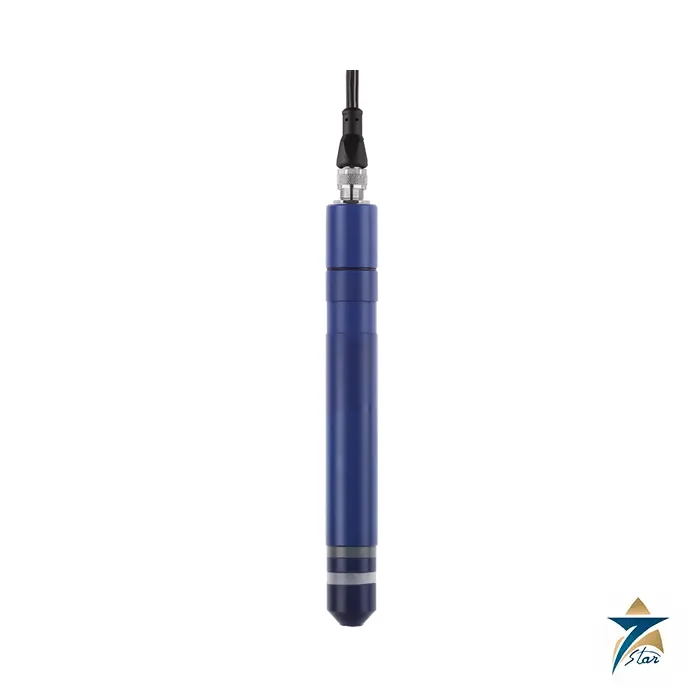
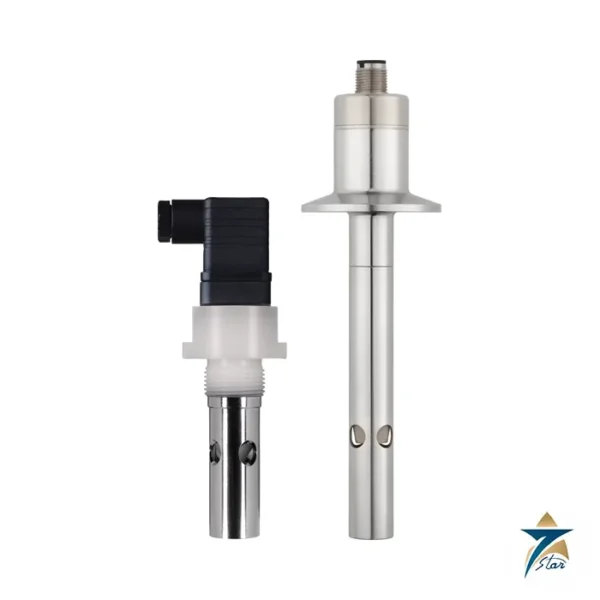
The JUMO tecLine TC (type 202631) is a membrane-covered, amperometric sensor that adds up free chlorine (gas, hypochlorite) and combined chlorine (chloramines and organically bound chlorine) in water. Its integrated electronics deliver a temperature-compensated 4 to 20 mA signal (version /44) or a Modbus RTU signal over an M12 connector (version /52), and the sensor works on a potentiostatic three-electrode principle with no zero-point adjustment. The datasheet lists drinking water, swimming-pool water, service and process water and seawater as the application areas, and the sensor tolerates pH 4 to 12 with strongly reduced pH dependence. JUMO also warns that the sensor cannot confirm the absence of chlorine, that absence of disinfectant is tolerated for a maximum of 24 hours, and that corrosion inhibitors and water-hardness stabilisers can distort readings.
Technical specifications
| Parameter |
Specification |
| Type |
202631 JUMO tecLine TC; /44 two-wire 4 to 20 mA; /52 digital Modbus RTU |
| Measurand |
Total chlorine (free plus combined chlorine) |
| Chlorination agents |
NaOCl, Ca(OCl)2, chlorine gas, electrolytically produced chlorine |
| Measuring principle |
Membrane-covered amperometric, potentiostatic three-electrode, integrated electronics |
| Measuring ranges (order code) |
10: 0 to 0.5 mg/l; 20: 0 to 2 mg/l; 25: 0 to 5 mg/l; 35: 0 to 10 mg/l; 37: 0 to 20 mg/l |
| Resolution and accuracy |
0.01 mg/l (0.001 mg/l on 2 mg/l range); under 2 % at 0.4 and 1.6 mg/l (2 mg/l range); under 1 % at 4 mg/l and under 3 % at 16 mg/l (20 mg/l range) |
| Supply |
/44: DC 12 to 30 V, burden (UB – 7.5 V)/0.02 A; /52: DC 22.5 to 26 V, 20 mA, galvanically isolated |
| Response and drift |
t90 about 2 min; settling about 2 h at first start; slope drift about -1 % per month |
| Inflow |
About 15 cm/s, about 30 l/h in JUMO flow fitting 00392611 |
| Temperature |
Water 0 to 45 °C (no ice crystals); environment 0 to 55 °C; automatic compensation |
| pH range and interference |
pH 4 to 12; ClO2 factor 1, O3 factor 1.3 |
| Pressure |
Absolute max. 4 bar, relative max. 3 bar; pressure-free operation recommended |
| Materials and size |
Microporous hydrophilic membrane, PVC-U, PEEK, stainless steel 1.4571; Ø 25 mm, 220 mm (/44) or 205 mm (/52); about 125 g |
| Service |
Membrane cap and electrolyte replaced yearly; inspect signal at least weekly; slope adjusted by DPD-4 (DPD-1 + DPD-3) |
| Standards |
EMC to EN 61326-1 and EN 61326-2-3 |
Order code and stock options
The code is short: 202631/ extension – range, as in the datasheet example 202631/44-20. Extension 44 is the 4 to 20 mA two-wire sensor with 2-pole terminals (2 x 1 mm2), 52 is the digital sensor with a 5-pole M12 flange connector. JUMO states that the order code is not modular and that free combinations require a technical feasibility check. Manufacturing versions with a 10 working day delivery include 202631/44-10 (00687809), 202631/44-20 (00687811) and 202631/44-37 (00687812). The package contains the sensor, a membrane cap, electrolyte, special abrasive paper for cathode cleaning and the operating manual. Spares include a parts set (00687804), a seawater parts set (00687805) and 100 ml of special electrolyte (00585104). Fittings are a combination fitting for several electrochemical sensors (00607325), an individual flow fitting (00392611), a mounting bracket (00455706) and a flow monitor (00605507).
Reading it with the right instrument
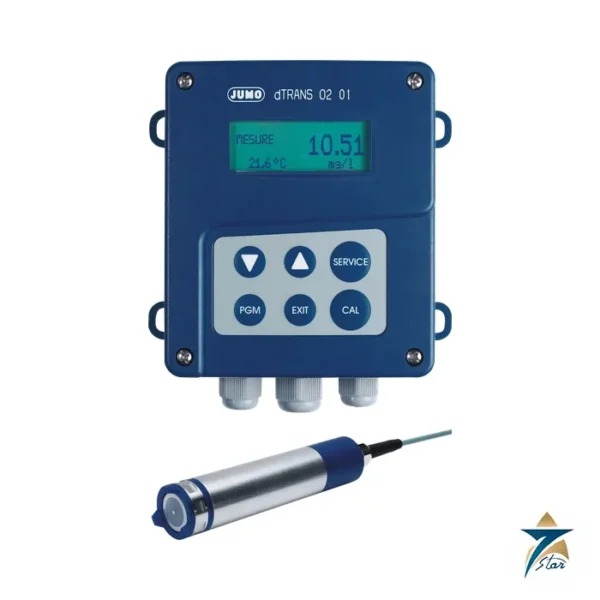
The 4 to 20 mA version pairs with the JUMO AQUIS 500 AS or with the published dTRANS AS 02; the digital version suits the AQUIS 500 RS and the AQUIS touch S or P, which can supply sensor power and handle calibration. When several digital sensors share an AQUIS touch, a digiLine hub and an external power supply are needed. In warm-climate pools, hotel water systems and desalinated drinking-water networks the usual practice is a bypass line with the flow fitting and flow monitor, so the controller goes to HOLD if sample flow drops and avoids false dosing. Operators should plan for the weekly signal check and yearly membrane and electrolyte change that JUMO prescribes. Browse the liquid analysis sensors category for matching free-chlorine and ClO2 sensors.
When requesting a quotation, specify the analog or digital version, the measuring range code from 0.5 up to 20 mg/l, and the chlorination agent in use. The water must stay between pH 4 and 12 and between 0 and 45 °C, free of ice crystals, so please mention any pH correction upstream. Tell us whether the sensor will sit in the JUMO flow fitting, and which transmitter or controller will read it. The datasheet advises a signal check each week, a new membrane cap and electrolyte once a year, and a slope adjustment after replacement. Plan stock of these consumables together with the sensor.
Total chlorine includes combined chloramines, so the sensor is often used in hotel, hospital and pool systems where the combined fraction must be watched. Compare with the free chlorine sensor from the same series when only the active disinfectant is of interest.
Documents and quotation
The hosted document is JUMO data sheet 202631 (9 pages, English). The sheet also lists digital total-chlorine part numbers under a type code that appears inconsistent with the basic type, so confirm digital versions with the manufacturer before ordering. Seven Star LLC is an independent supplier in Muscat; send the code, range and water type for a quotation.












Reviews
There are no reviews yet.