
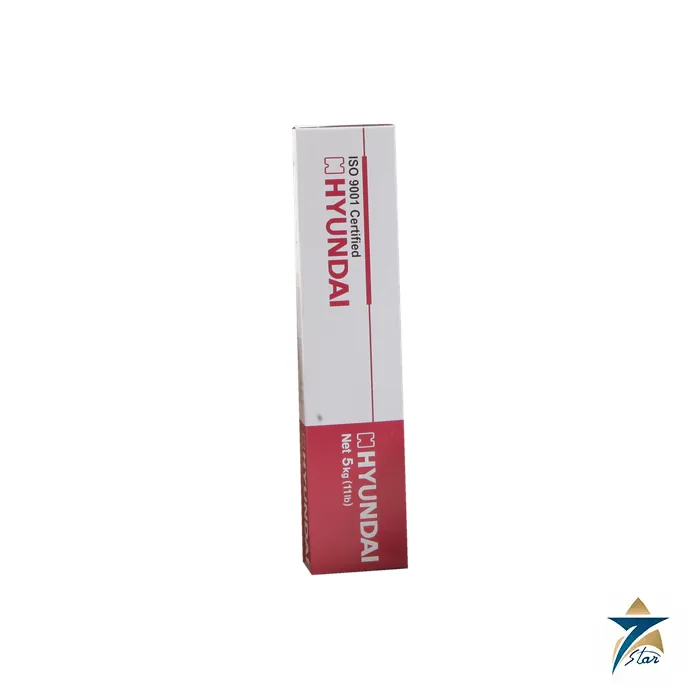
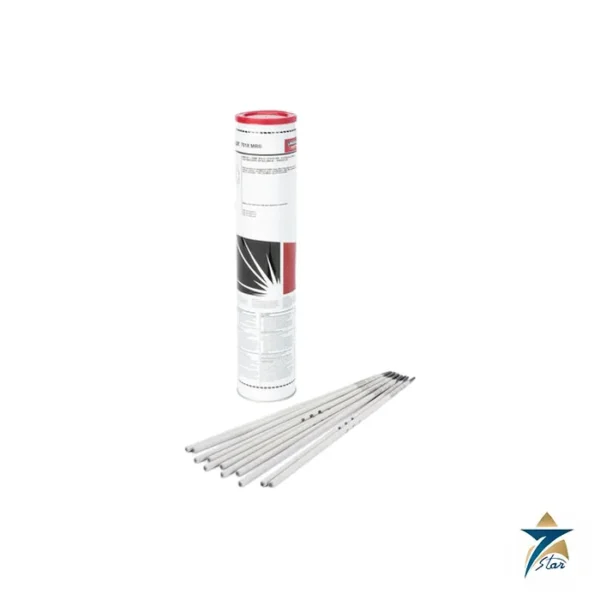
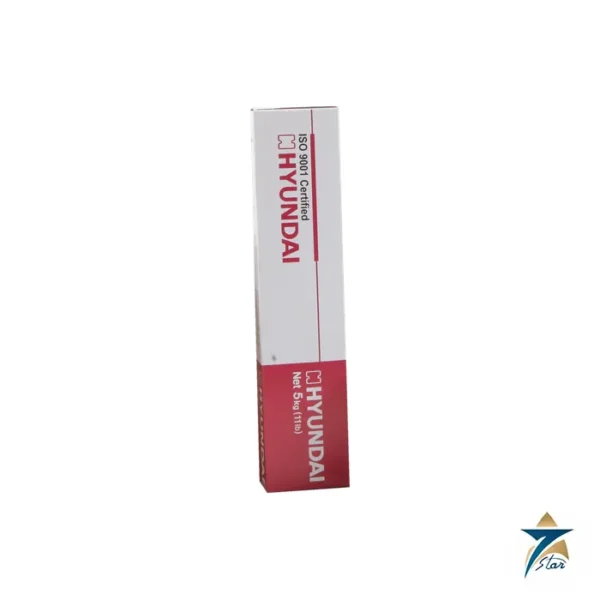
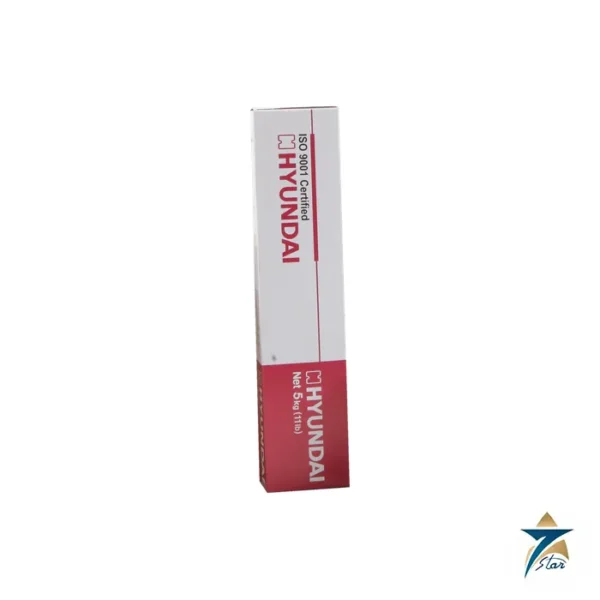
The Hyundai Welding S-7010.P1 is a cellulosic stick electrode classified to AWS A5.5 / ASME SFA-5.5 E7010-P1, the pipeline grade of the low-alloy electrode specification. It builds on the familiar E6010 arc character, with deep penetration and a fast-freezing deposit, but delivers a 70 ksi class weld metal that suits pipe steels where the root and hot pass need more strength than a basic E6010 provides.
Seven Star LLC supplies the Hyundai Welding S-7010.P1 from Muscat to pipeline spreads, tie-in crews and fabrication yards in Oman and the GCC. The product datasheet is attached to this page, and the sections below explain its published data together with general cellulosic welding practice, which is identified as general knowledge where it is not taken from the manufacturer.
Generally speaking, a cellulosic coating produces a gas-dominated shield and very little slag. The arc is forceful and drives the puddle into the root, while the thin slag freezes quickly so that the deposit can be carried downhill at high travel speed. On cross-country pipelines this vertical-down technique, often called stovepipe welding, lets several welders work around a joint at once and keeps the spread moving.
The trade-off is diffusible hydrogen. Cellulosic deposits contain far more hydrogen than basic low-hydrogen deposits, so pipeline codes control preheat, the delay between passes and the strength of the pipe on which such electrodes may be used. The Hyundai Welding S-7010.P1 should therefore be used inside a qualified procedure that sets these limits for your pipe grade and wall thickness.
The datasheet confirms DC+ polarity and positions 1G, 2F, 3G and 4G, with pipe positions 5G-up and 5G-down applicable. Its listed features are standard use in the pipe welding industry, deep penetration and a highly ductile deposit for the root pass. Typical all-weld-metal chemistry is 0.17 % C, 0.24 % Si, 0.68 % Mn, 0.017 % P, 0.007 % S, 0.18 % Ni, 0.03 % Cr, 0.01 % Mo and 0.01 % V.
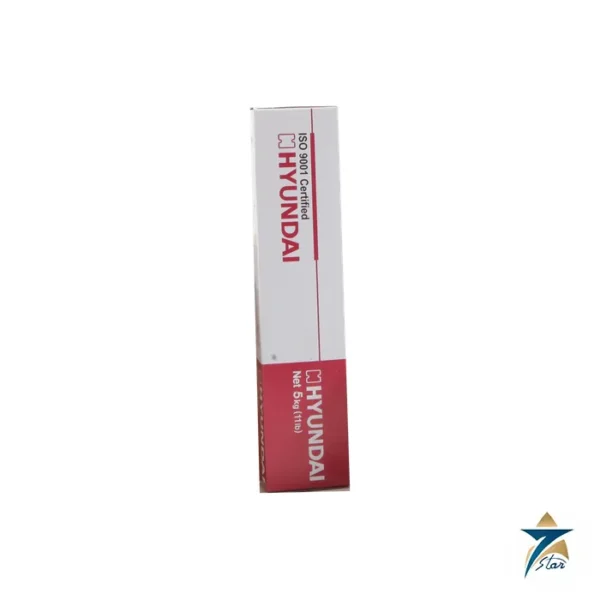
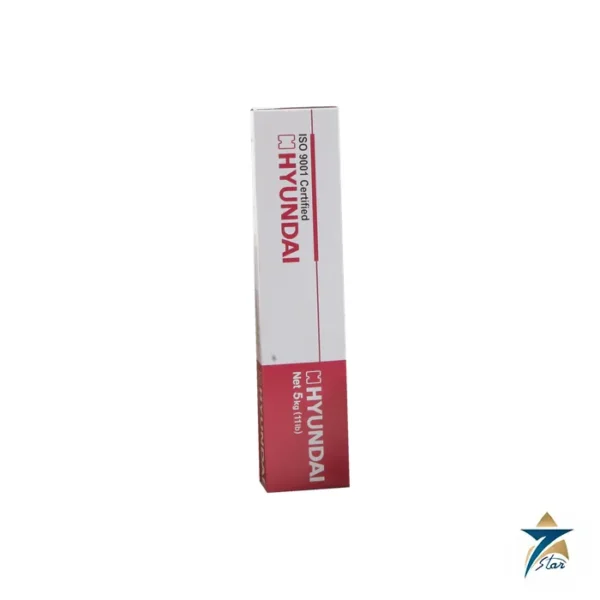
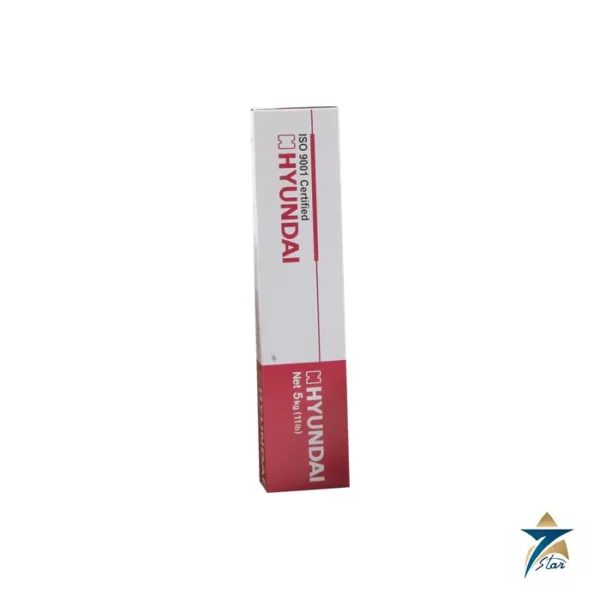
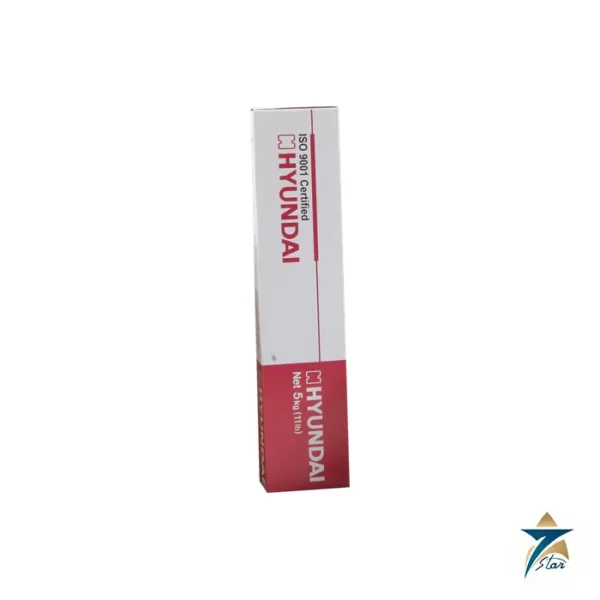
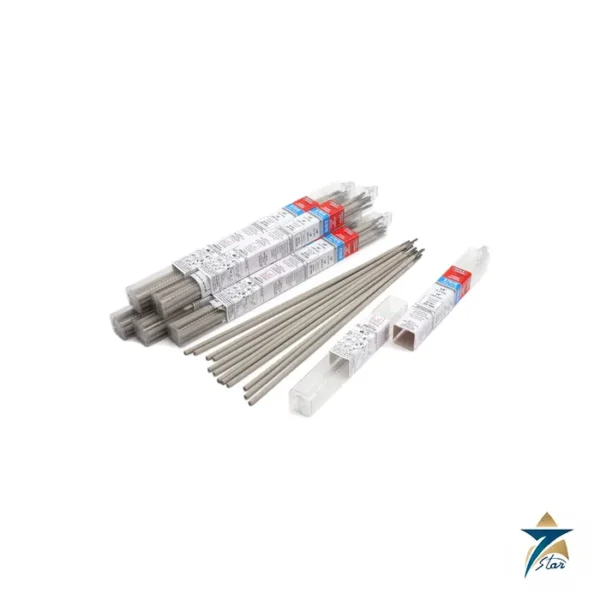
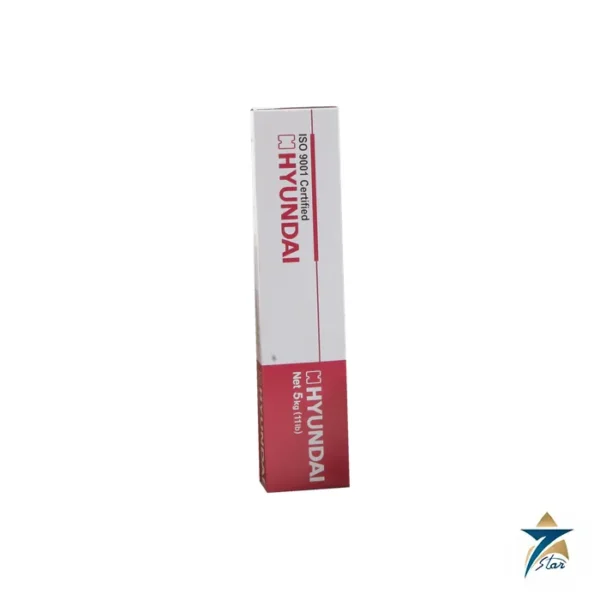
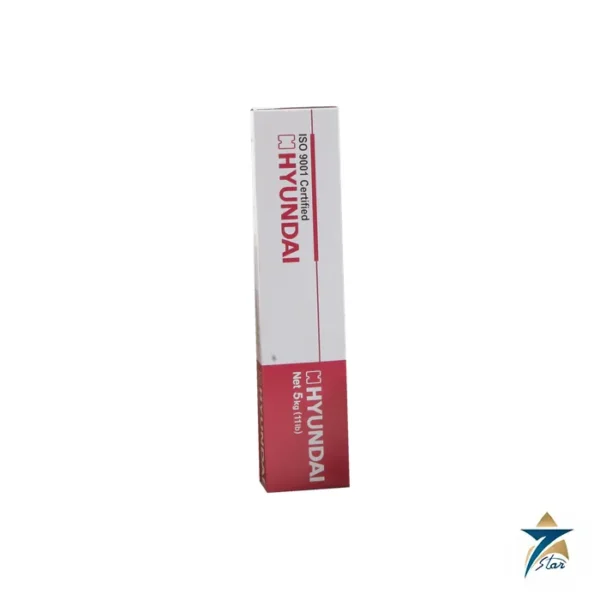
Typical mechanical results reported for the Hyundai Welding S-7010.P1 are 421 MPa (61 ksi) yield, 523 MPa (76 ksi) tensile and 26 % elongation, with 47 J (35 ft·lbs) Charpy toughness at -30 °C (-20 °F). The approval row of the datasheet shows CWB. Diameters run from 2.6 mm to 5.0 mm in 300 mm and 350 mm lengths, packed in standard or vacuum 5 kg packets and 20 kg cartons, and the redrying instruction is 70 to 100 °C for 0.5 to 1 hour.
From the manufacturer datasheet, the Hyundai Welding S-7010.P1 offers:
Typical work for the Hyundai Welding S-7010.P1 includes root and hot passes on oil, gas and water transmission pipelines, flowlines between wellpads and gathering stations, and station piping where the line pipe strength calls for a 70 ksi class root. Contractors working on the networks that link Oman’s interior fields with processing plants and coastal terminals use this class of electrode because it combines vertical-down speed with dependable root fusion.
For the complete job, Seven Star LLC can also supply welding power sources such as the Lincoln Electric Power Wave S500 and the ESAB Rebel EMP 285ic, plus fill-and-cap consumables such as the Lincoln Electric SuperArc L-59 solid wire. Related products are listed in the welding electrodes category.
Hyundai Welding publishes three cellulosic pipe electrodes that are often compared. The S-6010.D (AWS A5.1 E6010) gives typical 590 MPa tensile and is the general-purpose root rod. The Hyundai Welding S-7010.P1 sits in the middle with a pipeline-specific A5.5 classification and lower out-of-position current ranges, while the S-8010.P1 reaches typical 613 MPa tensile with a nickel-bearing deposit. The right grade depends on the pipe material, the code and the pass being welded, so the final choice belongs in the welding procedure specification rather than on a product page.
A practical approach used by many contractors is to qualify one cellulosic grade for root and hot pass and a matching grade for fill and cap, then keep both on the same spread so that welders do not mix boxes. Clear labelling of packets by classification helps avoid errors in the field.
The Hyundai Welding S-7010.P1 specification below is taken from the manufacturer datasheet; all chemical and mechanical figures are typical values.
| Parameter | Specification |
|---|---|
| Model | S-7010.P1 |
| Coating type | Cellulosic (SMAW) |
| Classification | AWS A5.5 / ASME SFA-5.5 E7010-P1 |
| Polarity | DC+ |
| Welding positions | 1G, 2F, 3G, 4G; 5G-up and 5G-down applicable |
| Application areas | Pipeline root pass, general fabrication, vertical down welding |
| Approval shown | CWB |
| Redrying | 70 to 100 °C (158 to 212 °F), 0.5 to 1 hour |
| Chemistry (wt %) | C 0.17, Si 0.24, Mn 0.68, P 0.017, S 0.007, Ni 0.18, Cr 0.03, Mo 0.01, V 0.01 |
| Yield / tensile | 421 MPa (61 ksi) / 523 MPa (76 ksi) |
| Elongation | 26 % |
| Charpy impact | 47 J (35 ft·lbs) at -30 °C (-20 °F) |
| Packing | 5 kg (11 lbs) packet, standard or vacuum; 20 kg (44 lbs) carton |
| Diameter mm (in) | Length mm (in) | F and HF (A) | V-up, OH (A) |
|---|---|---|---|
| 2.6 (3/32) | 300 (12) | 50-75 | 40-70 |
| 3.2 (1/8) | 350 (14) | 75-125 | 65-115 |
| 4.0 (5/32) | 350 (14) | 90-165 | 90-145 |
| 5.0 (3/16) | 350 (14) | 140-220 | 125-185 |
As a general rule for cellulosic products, keep packets closed until the shift needs them and do not hold the rods in high-temperature ovens meant for basic electrodes, because over-drying spoils the arc. Where conditioning is needed, follow the Hyundai Welding S-7010.P1 redrying setting of 70 to 100 °C for 0.5 to 1 hour. Protect open packets from dew and wind-blown sand, both common on desert pipeline routes.
Download the Hyundai Welding S-7010.P1 datasheet from this page for the full manufacturer data on classification, positions, approvals, chemistry, mechanical properties, parameters and packaging.
Request a quotation for the Hyundai Welding S-7010.P1 by sending Seven Star LLC the diameters, tonnage and documentation your project requires. Our Muscat team supports pipeline and fabrication contractors throughout Oman and the GCC with technical help on consumables and welding equipment.
Choose the option that best fits your needs to get the fastest response from our team.
Automatically fill the RFQ form with this product's details for a faster process.
Manually enter multiple part numbers, specific brands, or custom requirements.
Reviews
There are no reviews yet.