Endress+Hauser CPC310 Topcal S Automatic pH Cleaning and Calibration

Description

CPC310 Topcal S: the controller that cleans and calibrates the pH electrode for you

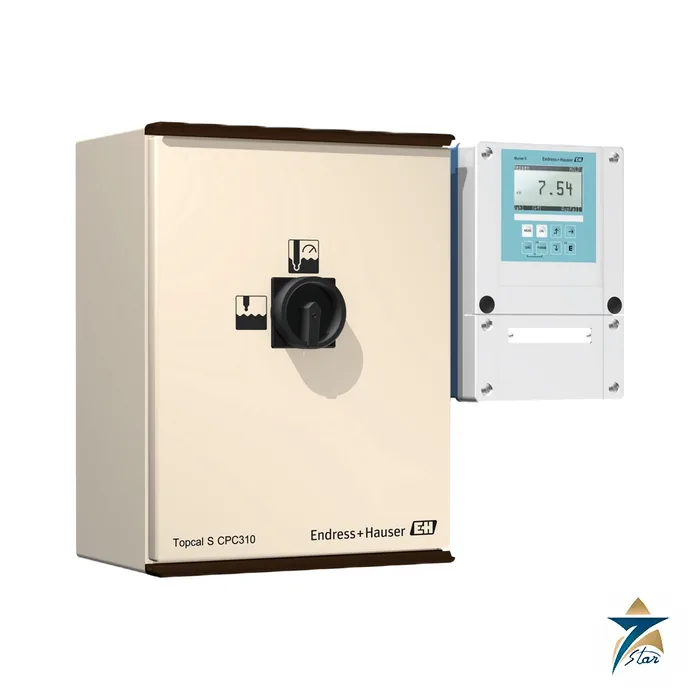
Endress+Hauser CPC310 Topcal S is a fully automated measuring, cleaning and calibration system for pH and ORP, available for hazardous and non-hazardous areas. It combines a Mycom S CPM153 transmitter, a CPG310 control unit that turns commands into pneumatic signals, a rinsing block and pumps that convey buffer solutions and cleaner, all working with a retractable Cleanfit assembly. The manufacturer lists process, wastewater, food and pharmaceutical industries as target fields.

Seven Star LLC is an independent supplier serving Oman and the GCC and is not affiliated with the manufacturer. The datasheet we summarise is TI00404C, edition 13.15.

CPC310 system specification

Parameter Value
System parts CPG310 control unit, Mycom S CPM153 transmitter, rinsing block, buffer and cleaner pumps
Communication PROFIBUS PA (Profile 3.0) and HART; Memosens
Supply 100 to 230 V AC or 24 V AC/DC depending on version; hazardous-area CPG310 powered from the CPM153
Power consumption CPM153 up to 10 VA; CPG310 up to 12 VA
Current output 0/4 to 20 mA; alarm 2.4 or 22 mA
Compressed air 4 to 6 bar, 50 micrometre, oil and condensate free; OD 6 mm gland
Rinse water Tap water 3 to 6 bar, 100 micrometre filter
Rinsing block thread G 1/4 or NPT 1/4 inch external
Ambient Minus 10 to 55 degrees C (minus 10 to 50 degrees C Ex)
Protection CPM153 IP 65; CPG310 IP 54
Weight CPM153 up to 6 kg; CPG310 about 15 kg
Wetted CPG310 parts PU and PTFE hoses; PP and PVDF pumps
Ex approval ATEX II (1) 2G, EEx em ia/ib IIC T4, EC system approval, depending on version

Programs and control modes

Predefined programs cover Clean, Clean S (sterilise), Clean C (clean and calibrate), Clean CS (clean, calibrate and sterilise) and a User 3 quick check, with User 1 and 2 free for custom steps. Control choices are the weekly automatic program, a cleaning response to an SCS alarm, an emergency program after power, air, water or communication failure, an external start from a control system and an interval program with a period up to one day. A validation function compares target and actual values to decide whether calibration is needed.

How CPC310 differs from other pH accessories

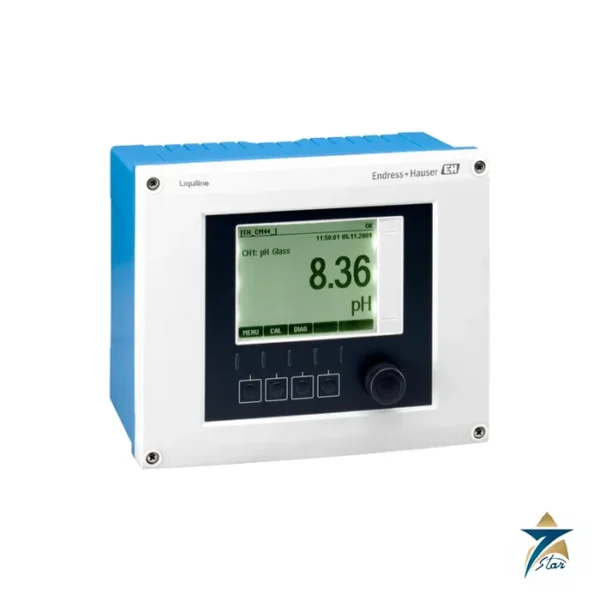
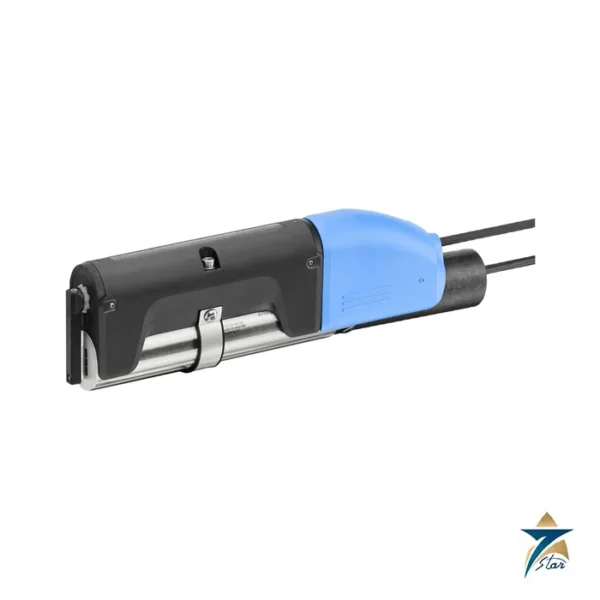
Assemblies such as CPA472D, CPA473 and CPA474 are the mechanical retractable holders; CPC310 is the brain and the pumps that drive them. A plain transmitter like CM42B does not run buffer pumps or assembly movement. CPC310 also differs from Topclean CPC30, which is mentioned as an alternative controller, by integrating the Mycom S transmitter with its Sensor Check System, Process Check System and Sensor Condition Check functions.

Diagnostics built into CPC310

  • SCC monitors electrode aging and reports Electrode OK, Low wear or Replace electrode after each calibration.
  • SCS detects glass breakage or ISFET leakage and, for analog sensors, shows glass or reference resistance.
  • PCS raises an alarm when the measuring signal stagnates because of fouling or blocking.
  • Logbooks keep the last 30 error, operation and calibration entries, and data loggers store 500 values for two parameters.
  • Quick Setup reaches the first measured value in about one minute.

Use in Oman and Gulf processes

Neutralisation pits, scrubber loops, desalination chemical dosing and paper or food lines see coatings that blind electrodes. A fully automatic clean-and-calibrate cycle removes the need to pull the electrode by hand, which is useful at remote or hazardous locations. For fibrous media, combine CPC310 with a ball valve assembly and the back pressure water function.

CPC310 installation and utilities checklist

Before the control cabinet arrives, prepare three services. Compressed air must be 4 to 6 bar, filtered to 50 micrometres and free of oil and condensate, brought to a 6 mm bulkhead gland on the CPG310 where a supplied pressure reduction valve is fitted. Rinse water is ordinary tap water at 3 to 6 bar, filtered to 100 micrometres through the filter supplied, and connected to the rinsing block through a 6 mm gland. Power is 100 to 230 V AC or 24 V AC/DC depending on the version, and in hazardous areas the CPG310 draws its power from the Mycom S CPM153-G. The datasheet also lists limit position switch feedback cables, a hold input and six relay contacts with two current outputs in the hazardous-area drawing.

The CPG310 has two user-configurable output contacts to drive pneumatic valves for hot or aggressive media, including steam, so a sterilising program can be added without a second controller. Buffer and cleaner canisters are monitored by level signals that return to the control room.

Ordering Endress+Hauser CPC310

The complete measuring point also needs a pneumatic Cleanfit assembly with limit switches, a pH or ORP sensor, measuring cables, buffers and cleaning agent. CPC310 is configured by version for hazardous or non-hazardous areas, so tell us the zone, supply voltage and fieldbus when you ask for a price.

CPC310 questions answered briefly

What does Endress+Hauser CPC310 consist of? A Mycom S CPM153 transmitter, a CPG310 pneumatic control unit, a rinsing block and pumps for buffer and cleaner, used with a pneumatic retractable assembly.

Which cleaning programs does CPC310 offer? Clean, Clean S for sterilising, Clean C for cleaning and calibrating, Clean CS for cleaning, calibrating and sterilising, a User 3 quick check, and two free User programs.

How can CPC310 programs be started? Automatically by weekday program, by an SCS alarm, as an emergency program after power, air, water or communication failure, or externally from a control system.

What utilities does the CPC310 need? Compressed air 4 to 6 bar filtered to 50 micrometres, oil free, rinse water at 3 to 6 bar filtered to 100 micrometres, and 100 to 230 V AC or 24 V AC/DC power.

What is the back pressure water function in CPC310? It opens a valve before the assembly leaves the process so counterpressure keeps fibrous or sticky medium out of the rinse chamber of ball valve assemblies such as CPA473 or CPA474.

Documents and quotation

The datasheet for CPC310 is attached to this page. Send an RFQ with CPC310, the area classification, supply voltage, assembly type and quantity.

Other Models in the Automation Range

Seven Star LLC supplies models from the Automation range in Oman and the GCC. Compare the related models below and request a quote for the one that matches your application.

ModelCategory
Endress+Hauser CPC310 Topcal S Automatic pH Cleaning and CalibrationLiquid Analytical SystemsYou are viewing this model
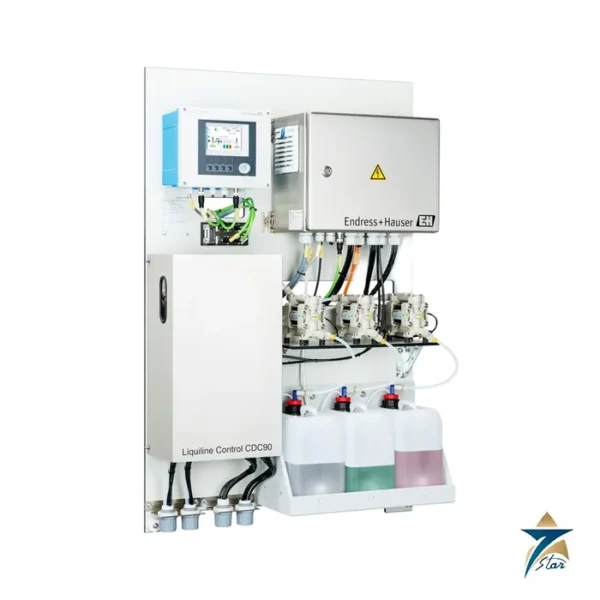
Endress+Hauser CDC90 Liquiline Control Memosens pH/ORP AutomationLiquid Analytical SystemsView details
Datasheets & Documents
  • PDF Datasheet Endress+Hauser CPC310 Topcal S Automatic pH Cleaning and Calibration Datasheet Download
Reviews (0)

Reviews

There are no reviews yet.

How would you rate this product?

It takes about 10 seconds — just tap a star. Your email is never published.

About brand

Endress+Hauser makes process measurement instruments for flow, level, pressure, temperature and liquid analysis. Georg H. Endress and Ludwig Hauser started the business in Lörrach, Germany, on 1 February 1953, first selling level meters, and the Endress+Hauser name has been used since 1957. The group is headquartered in Reinach, Switzerland, and has been wholly owned by the Endress family since 1975.

Seven Star LLC is an independent supplier listing Endress+Hauser flowmeters, level and pressure transmitters, temperature assemblies and liquid analysis products for buyers in Oman and the GCC. Instruments are matched from the full order code on the nameplate.

Endress+Hauser company profile

Origin Founded in Lörrach, Germany, on 1 February 1953 by the Swiss engineer Georg H. Endress and Ludwig Hauser
Headquarters Endress+Hauser AG, Reinach (Basel-Landschaft), Switzerland
Ownership Family owned; the Endress family has been the sole shareholder since 1975, and a family charter commits the company to stay family owned
Size About 16,500 employees and sales of about EUR 3.7 billion (2023, as reported by the company)
Product families Proline flowmeters, Micropilot and Levelflex radar, Liquiphant switches, Cerabar and Deltabar pressure, iTEMP and iTHERM temperature, Liquiline and Memosens liquid analysis

Milestones

  • 1953: Georg H. Endress and Ludwig Hauser start the business in Lörrach on 1 February, first selling level meters.
  • 1957: The Endress+Hauser name comes into use.
  • 1975: The Endress family becomes sole shareholder.
  • 2023: About 16,500 employees and sales of about EUR 3.7 billion, as reported by the company.

Endress+Hauser product lines

Line Measuring principle Typical use
Promass F 300, Promass 80F, 83F/84F Coriolis mass flow Direct mass flow and density of liquids and gases, hydrocarbon transfer and chemical dosing
Promag P 300, P 500, H 300, W 400, W 10, 50P Electromagnetic flow Water, wastewater, slurries and other conductive liquids
Prowirl F 200, 72F Vortex flow Steam, gas and low-viscosity liquids
Prosonic Flow 92F, t-mass 65F Ultrasonic and thermal mass flow Water lines; compressed air and industrial gases
Micropilot FMR62, FMR67, FMR60, FMR10B, FMR20, FMR50, FMR52 Free-space radar level, 80 GHz and 26 GHz Tanks, process vessels, silos and open water channels
Levelflex FMP51, FMP50, FMP54, FMP55 Guided wave radar level Level and interface in vessels, separators and bypass chambers
Liquiphant FTL51, Prosonic S FMU90 Vibronic point level; ultrasonic level High and low level alarms, pump protection, open channel flow
Cerabar PMC71B, PMP51B, PMP71, Deltabar PMD78B, PMD75 Pressure and differential pressure Process pressure, hydrostatic level and DP flow
iTEMP TMT82, TMT162, iTHERM TM101, TR66, TR10 Temperature transmitters and thermometers RTD and thermocouple points with thermowells
Liquiline CM444, CM442, Memosens CPS11E, Stamolys reagents Liquid analysis pH, ORP, conductivity, dissolved oxygen and nutrient analysis in water treatment and process

Where Endress+Hauser instruments are used

In Oman and the GCC, Endress+Hauser instruments are common in oil and gas production and processing, refineries and petrochemicals, desalination and water networks, wastewater treatment, power plants and food and beverage plants. Coriolis meters measure hydrocarbon and chemical flows, electromagnetic meters cover water and wastewater, radar transmitters handle tank and silo level, and Liquiline analysers monitor water quality. Proline 300 and 500 flowmeters include Heartbeat Technology for in-situ verification, which reduces the need to remove a meter for checks.

Ordering Endress+Hauser instruments: what we need

The order code on the nameplate (for example PMP71-1QA1S11RDADU) defines every option: measuring range, process connection, materials, output, approvals and display. Send it with the serial number; Endress+Hauser can retrieve the original configuration from the serial number. For a new instrument add the medium, operating and design pressure and temperature, range, line size or tank geometry, process connection, wetted materials, output or protocol (4-20 mA HART, PROFIBUS, FOUNDATION Fieldbus, Modbus) and the hazardous-area approval required. Older models such as Promass 80/83 or Micropilot M are replaced by current Proline or 80 GHz Micropilot devices.

Facts checked against Endress+Hauser company history and product information, October 2026.

FAQ

Questions about the Endress+Hauser CPC310 Topcal S Automatic pH

Answers from our engineering team on installation, compatibility and integration.

01What does Endress+Hauser CPC310 consist of?
A Mycom S CPM153 transmitter, a CPG310 pneumatic control unit, a rinsing block and pumps for buffer and cleaner, used with a pneumatic retractable assembly.
02Which cleaning programs does CPC310 offer?
Clean, Clean S for sterilising, Clean C for cleaning and calibrating, Clean CS for cleaning, calibrating and sterilising, a User 3 quick check, and two free User programs.
03How can CPC310 programs be started?
Automatically by weekday program, by an SCS alarm, as an emergency program after power, air, water or communication failure, or externally from a control system.
04What utilities does the CPC310 need?
Compressed air 4 to 6 bar filtered to 50 micrometres, oil free, rinse water at 3 to 6 bar filtered to 100 micrometres, and 100 to 230 V AC or 24 V AC/DC power.
05What is the back pressure water function in CPC310?
It opens a valve before the assembly leaves the process so counterpressure keeps fibrous or sticky medium out of the rinse chamber of ball valve assemblies such as CPA473 or CPA474.