- Automation & ControlView all 2,301 products
- Automation Accessories
- AC Drives
- PLC & I/O Cards
- Industrial Communications
- Vibration Monitoring
- Controllers & Data Acquisition
- Isolator & Barrier
- CCTV & Security
- Safety Switches & Guard Locking
- Encoders
- Motor Soft Starters
- HMI Displays
- Pneumatic Cylinders
- Industrial Computers
- Servo Drives
- Machine Vision
- Automation Software
- Robotics
















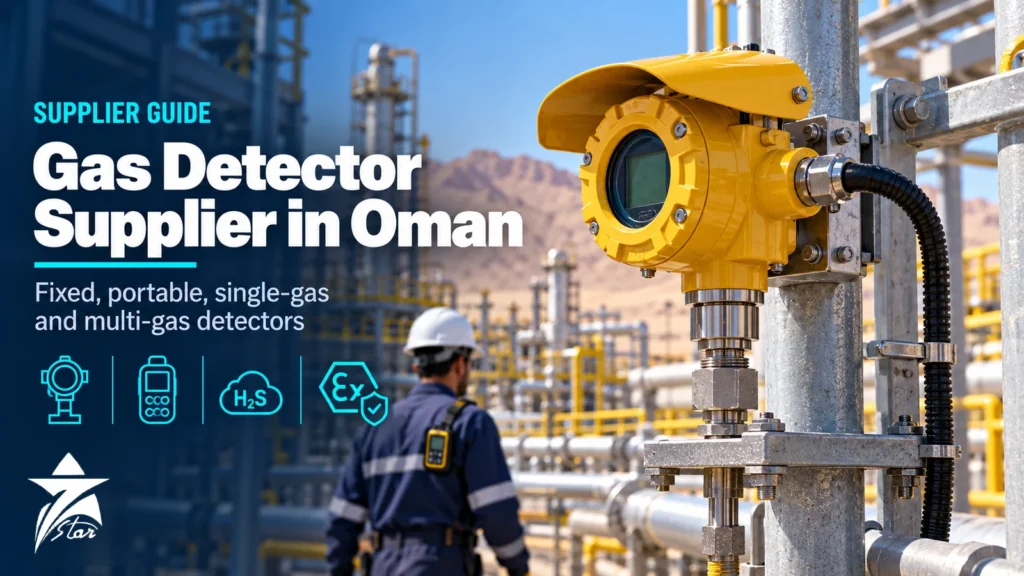
Gas detection is one of the most frequently requested safety items on oil and gas, petrochemical, water and utility sites in Oman. Sour crude and gas fields bring hydrogen sulphide (H2S) into daily work, tank farms and compressor stations need flammable gas coverage, and confined space entry needs a personal monitor on every worker. Buyers looking for a gas detector supplier in Oman usually need one of three things: replacement detectors that match an existing fire and gas system, new detectors for a project, or portable monitors for a maintenance crew. This guide explains the main detector types, which sensor technology suits which gas, the certifications to check and the information that gets you an accurate quotation quickly.
Fixed, Portable and Area Gas Detectors: Which One You Need
The first decision is not the brand but the job the detector does. Fixed detectors protect a location continuously and report to a control panel, a PLC or a fire and gas system. Portable detectors protect the person wearing them. Transportable area monitors sit between the two and are used for temporary work such as shutdowns and tank cleaning.
| Detector type | What it protects | Typical use in Oman | Examples |
|---|---|---|---|
| Fixed point detector | A defined location, 24 hours a day | Wellheads, compressor and pump stations, analyser houses, battery rooms, chiller plant rooms | General Monitors S4000CH, Dräger Polytron 8100 EC, MSA Ultima X5000 |
| Open path detector | A line up to many tens of metres | Perimeters of process units, tank farms, pipe racks | Honeywell Searchline Excel Plus, General Monitors IR5500 |
| Ultrasonic gas leak detector | An area, by hearing the leak itself | High-pressure gas plant in open, windy locations | General Monitors Observer-i |
| Portable multi-gas monitor | The worker wearing it | Confined space entry, permit-to-work, maintenance crews | MSA ALTAIR 4XR, Dräger X-am 2500, Industrial Scientific Ventis Pro5 |
| Portable single-gas monitor | The worker, for one gas (often H2S) | General site access on sour fields | Dräger Pac 8000, Industrial Scientific Tango TX1, Crowcon Gasman |
| Transportable area monitor | A temporary work area | Shutdowns, tank cleaning, hot work perimeters | Industrial Scientific Radius BZ1, Oldham BM 25A |
Sensor Technologies and the Gases They Detect
Each sensor principle has strengths and blind spots. Matching the sensor to the gas, the climate and the hazard is more important than any single specification on a datasheet.
- Catalytic bead (pellistor) sensors measure combustible gases in %LEL. They respond to hydrogen and most hydrocarbons but need oxygen to work and can be poisoned by silicones, lead compounds and high H2S, so they need regular checks. Example: Det-Tronics CGS catalytic sensor.
- Point infrared (IR) sensors measure hydrocarbon gases without being poisoned and fail safe if the optics are blocked. They do not detect hydrogen. Examples: Det-Tronics PointWatch Eclipse, Dräger PIR 7000, Simtronics GD10P.
- Open path IR measures the amount of gas along a beam, in LEL·metres, and covers a long boundary with one transmitter and receiver.
- Electrochemical cells measure toxic gases such as H2S, CO, SO2, NH3 and Cl2, and oxygen. They are accurate and low power but have a limited life, and very hot, dry conditions shorten that life, so plan replacement sensors as spares.
- Metal-oxide semiconductor (MOS) sensors are used for H2S on some sites in hot, dry climates where electrochemical cells dry out faster. They need careful selection because they can respond to other gases.
- Photoionisation (PID) detectors measure volatile organic compounds at ppm level, for example around solvent handling and fuel loading. Example: Honeywell RAEGuard 2 PID.
- Ultrasonic detectors hear the high-frequency noise of a pressurised gas leak, so they work even when wind disperses the gas cloud before it reaches a point detector.
- Hydrogen-specific sensors are needed for battery rooms, electrolysers and hydrogen projects, because IR cannot see hydrogen. Example: H2scan HY-ALERTA 600B.
H2S Detection on Oman’s Oil and Gas Sites
H2S is the gas that drives most detector orders in the region. It is heavier than air, collects in low points, pits and enclosed modules, and deadens the sense of smell at higher concentrations, so nobody should rely on smell as a warning. A typical sour-site arrangement combines fixed H2S detectors at likely release points, wired to alarms and beacons, with a personal single-gas or four-gas monitor for every person in the area.
Alarm set points must follow your company’s HSE standard and the operator’s requirements, not the factory defaults. Many four-gas monitors ship with default H2S alarms such as 10 ppm and 15 ppm, while many operators set lower values, so confirm the required alarm levels when ordering and ask for the instruments to be configured before delivery. For deeper background on choosing fixed H2S, flammable gas and flame detectors, see our gas detector selection guide for oil and gas facilities, and for personal monitors, our portable gas detector guide on bump testing and calibration.
Certifications and Standards to Ask For
- Hazardous area approval: ATEX and IECEx certification with the right gas group and temperature class for the zone. Check the full marking, not just the logo.
- Performance standards: flammable gas detectors tested to EN/IEC 60079-29-1 and toxic gas detectors to EN 45544 give confidence that the measurement performance has been verified, not only the explosion protection.
- Functional safety: where detectors are part of a safety instrumented function, ask for SIL capability (for example SIL 2) and the safety manual. Example: Crowcon SMART 3G-D2 SIL 2 fixed detector.
- Outputs and protocols: 4–20 mA with HART, Modbus RTU, relays or a specific fire and gas panel protocol. A detector that cannot talk to your existing system is not a like-for-like replacement.
- Ingress and environment: IP66 or better, the stated operating temperature range, and protection against direct sun such as weather and sun shields for outdoor heads.
Flame Detectors in the Same Fire and Gas System
Gas detectors are usually ordered alongside flame detectors, because both report to the same fire and gas system. Multi-spectrum IR (IR3) detectors resist false alarms from sunlight and hot surfaces, which matters in Oman’s climate, while UV/IR detectors respond quickly to hydrocarbon fires. Examples include the Det-Tronics X3301, the General Monitors FL4000H and the Dräger Flame 2700.
Spares, Calibration Gas and Service Items
A gas detection system only protects people if it is tested and maintained. When you ask a gas detector supplier in Oman for a quotation, include:
- Replacement sensor cells and sensor heads for each detector model, sized to the expected sensor life.
- Calibration gas cylinders with the right gas, concentration and balance gas, plus regulators and calibration adaptors.
- Bump test or docking stations for portable fleets, so every monitor is tested before use and records are kept.
- Weather protection, sun shields, collector cones for lighter-than-air gases, and remote calibration kits for detectors mounted out of reach.
- Batteries, belt clips and protective boots for portable monitors.
Gas Detectors We Supply
As a gas detector supplier in Oman, we quote fixed, open path, ultrasonic and portable detectors from the makers most often specified locally, including General Monitors, MSA, Honeywell, Crowcon, Industrial Scientific, Det-Tronics and Oldham. The full range is in our fire and gas detectors category.
| Product | Type | Where it fits |
|---|---|---|
| General Monitors S4000CH Intelligent Combustible Gas Detector | Fixed catalytic detector | Combustible gas at process equipment. |
| MSA Ultima X5000 Gas Monitor | Fixed multi-sensor monitor | Toxic, oxygen and combustible gas points. |
| Dräger Polytron 8100 EC Toxic Gas Transmitter | Fixed toxic gas transmitter | H2S and other toxic gas points. |
| Det-Tronics PIRECL PointWatch Eclipse IR Gas Detector | Fixed point IR detector | Hydrocarbon gas without poisoning risk. |
| Crowcon Xgard Bright Fixed Gas Detector | Fixed detector with display | Plant rooms and process areas. |
| Oldham OLCT 710 Fixed Gas Detector | Fixed gas detector | Industrial and utility sites. |
| Honeywell Searchline Excel Plus Open Path Gas Detector | Open path IR | Unit perimeters and tank farms. |
| General Monitors Observer-i Ultrasonic Gas Leak Detector | Ultrasonic leak detector | High-pressure gas in open areas. |
| MSA ALTAIR 4XR Multigas Detector | Portable 4-gas monitor | Confined space and permit work. |
| Industrial Scientific Ventis Pro5 Multi-Gas Monitor | Portable multi-gas monitor | Up to five gases for maintenance crews. |
| Dräger Pac 8000 Single-Gas Detector | Portable single-gas monitor | Personal H2S or other toxic gas. |
| Industrial Scientific Radius BZ1 Area Monitor | Transportable area monitor | Shutdowns and temporary work areas. |
For a quotation, send the detector model and part number from the label (or the gas, range and output you need), the hazardous area classification, the quantity, any required alarm set points and the calibration gas and spares you want included, through our quote request form or to [email protected].
Buying Gas Detectors in Oman Through Seven Star LLC
Seven Star LLC is an independent gas detector supplier in Oman for oil and gas, petrochemical, utility and building projects. We quote fixed, open path, ultrasonic and portable detectors, flame detectors, replacement sensors, calibration gas and accessories, matching the make named in your specification or offering comparable alternatives where a model is obsolete. We also help cross-check part numbers, sensor options and outputs against your existing fire and gas system. Availability and lead time are confirmed at quotation.
Send us the detector label, the fire and gas schedule or simply the gas, range and area classification, and we will prepare a matching quotation for detectors, sensors and calibration items.
Frequently asked questions
What is the difference between a fixed and a portable gas detector?
A fixed gas detector is mounted at a location and monitors it continuously, sending its signal to a control panel or fire and gas system. A portable gas detector is worn by a person and warns that person directly. Most hazardous sites in Oman use both: fixed detectors at likely leak points and portable monitors for everyone entering the area.
Which gases does a standard four-gas monitor measure?
A typical four-gas monitor measures combustible gas in %LEL, oxygen, hydrogen sulphide and carbon monoxide. Five- and six-gas monitors add sensors such as SO2, NH3 or a PID for VOCs, depending on the hazards on site.
Can an infrared gas detector detect hydrogen?
No. Infrared detectors measure hydrocarbon gases that absorb infrared light, and hydrogen does not. Hydrogen needs a catalytic bead sensor or a hydrogen-specific sensor, which is why battery rooms and hydrogen systems are usually fitted with dedicated hydrogen detectors.
How often should gas detectors be bump tested and calibrated?
Manufacturers generally recommend bump testing portable monitors before each day’s use and calibrating them at the interval in the manual or whenever a bump test fails. Fixed detectors are calibrated on a schedule set by the manufacturer and the site maintenance plan, often every few months. Follow your HSE standard where it is stricter.
What certifications should a gas detector have for hazardous areas?
For hazardous areas, look for ATEX or IECEx certification with the correct gas group and temperature class. Performance approval to EN/IEC 60079-29-1 for flammable gas or EN 45544 for toxic gas, and SIL capability where the detector is part of a safety function, are also commonly specified.
Where can I buy gas detectors in Oman?
Seven Star LLC is an independent supplier in Oman that quotes fixed, open path, ultrasonic and portable gas detectors, flame detectors, sensors and calibration gas from makers such as General Monitors, MSA, Dräger, Honeywell, Crowcon, Industrial Scientific and Det-Tronics. Send the model, quantity and area classification through the quote request form or to [email protected].
Was this guide helpful?One click helps us write better guides for engineers.
Thank you! Glad it helped. Need this equipment for your project? Request a quotation
Thank you. We will use this to improve the guide.