
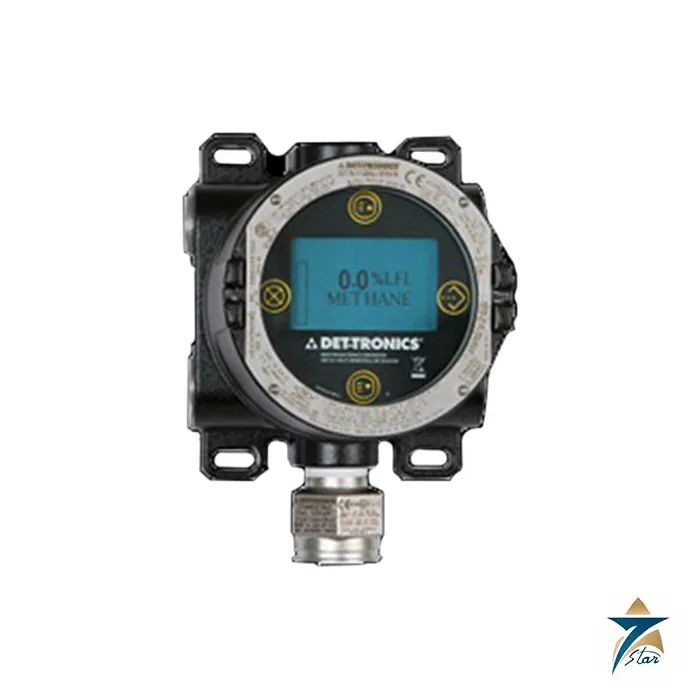
The Det-Tronics CGS is a catalytic bead combustible gas sensor designed for continuous detection of flammable hydrocarbon gases and hydrogen across the 0 to 100% LFL range in harsh industrial environments. Built around a pair of computer-matched pellistors inside a one-piece 316 stainless steel housing, the sensor combines a sinter-bonded flame arrestor, an integral thermal barrier and a standard poison-resistant performance rating, giving plant operators a proven, cost-effective point detector for leak detection around process equipment.
Seven Star LLC supplies the Det-Tronics CGS to refineries, gas plants, terminals and utilities across the Sultanate of Oman and the wider GCC, backed by engineering support in Muscat. Our instrumentation team helps engineers match the sensor to the correct Det-Tronics transmitter or controller, the right thread type and the right accessories, so that replacement sensors and new installations arrive ready to fit into existing fire and gas systems.
Detection in the Det-Tronics CGS relies on the heat released when a combustible gas oxidizes on a heated catalyst. The active bead in the sensor is coated with catalyst; when flammable gas diffuses through the flame arrestor, gas molecules burn on the active bead surface, raising its temperature and therefore its electrical resistance. The second, inactive reference bead is matched to the active bead and sits in the same environment, so it balances the bridge circuit and compensates for normal changes in ambient temperature and humidity. The resulting bridge imbalance is proportional to the gas concentration and is converted by the connected transmitter into a calibrated LFL reading.
Because the reaction depends on oxidation, catalytic sensors need oxygen to measure accurately; Det-Tronics states that response and accuracy decline when oxygen falls below 10% by volume, so the sensor should not be used in oxygen-deficient areas. The integral thermal barrier between the beads prevents bead interaction, and the catalytic principle responds to virtually all combustible gases and vapors, including hydrogen, which many infrared detectors cannot see. Correct calibration of the Det-Tronics CGS for the target gas is supported by a published list of conversion K factors.
The Det-Tronics CGS uses a one-piece 316 stainless steel body with a sinter-bonded flame arrestor that also provides superior protection against electromagnetic interference. Each Det-Tronics CGS carries a laser-etched identification and approvals label made to withstand harsh outdoor conditions. The sensor screws into the host enclosure through a 3/4 inch NPT, M20 or M25 thread, and is supplied with six-inch wire leads as standard or optional 30-inch leads. Both constant-voltage and constant-current sensor types are available to suit the electronics it will be connected to.
The Det-Tronics CGS is not a stand-alone device. It is certified to be mounted only into the enclosures of the FlexVu UD10 display, FlexVu UD30, Infiniti U9500 gas transmitter, Model 505 combustible gas transmitter, the EQ22xxDCUEX digital communication unit used on Eagle Quantum Premier systems, or the STB sensor termination box. The STB option allows the Det-Tronics CGS to be separated from its transmitter, and the Det-Tronics product page notes sensor distances of up to 500 feet from the display, which is useful where the leak point is difficult to reach. Det-Tronics recommends mounting the Det-Tronics CGS pointing downward, within 15 degrees of vertical.
The Det-Tronics CGS brings the following documented features to a fixed combustible gas detection system:
The Det-Tronics CGS is widely used where hydrocarbon and hydrogen releases must be detected quickly at the point of leakage: compressor and pump seals, gas metering skids, wellhead and manifold areas, fuel gas trains for gas turbines, battery rooms and hydrogen generation units. In Oman, typical installations include upstream production stations, gas processing plants, refinery units in Sohar, export terminals, and power and desalination plants that burn natural gas. Its hydrogen response also makes it a natural choice for electrolysis, hydrogen storage and fuel-cell projects now planned in the Duqm and Salalah economic zones.
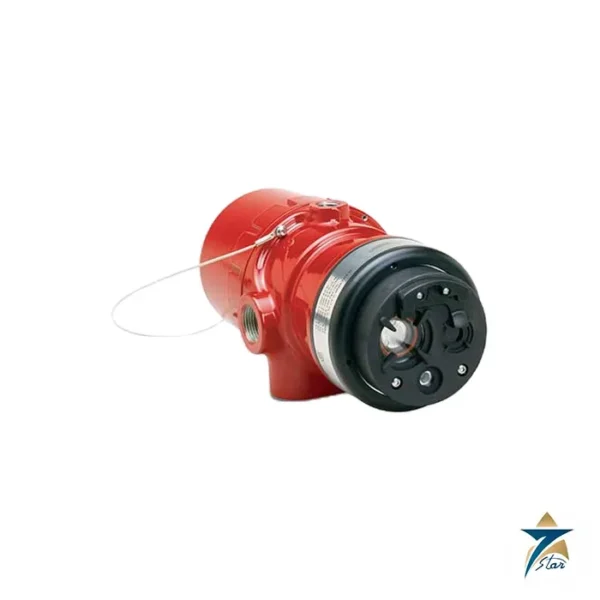
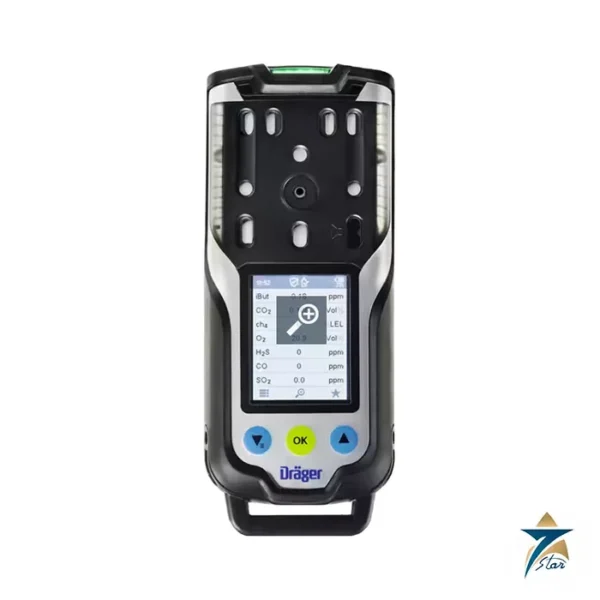
Because catalytic beads can be degraded by silicones, sulfur compounds, halogenated hydrocarbons and other contaminants, Det-Tronics specifies a calibration 30 days after initial calibration and every 90 days thereafter, or as the application requires. Seven Star LLC helps maintenance teams across the GCC plan spare Det-Tronics CGS sensors, calibration accessories and dust or splash protection for these routines. Many sites combine catalytic point detectors with infrared detection and flame detection, for example the Det-Tronics X3301 multispectrum IR flame detector, and other fixed detectors such as the Dräger Polytron 7000 gas detector or the Sieger Optima Plus gas detector.
Related Det-Tronics equipment in the same safety system includes the Det-Tronics PIRECL PointWatch Eclipse IR gas detector and Eagle Quantum Premier safety system controller.
The table below summarizes Det-Tronics CGS performance data from the official specification sheet 90-1041 (revision 9.2):
| Parameter | Specification |
|---|---|
| Model | Det-Tronics CGS catalytic combustible gas sensor |
| Detection principle | Catalytic bead (matched active and reference pellistors) |
| Gases detected | Virtually all combustible gases and vapors, including hydrogen |
| Operating temperature | –55°C to +125°C (–67°F to +257°F) |
| Performance temperature | –40°C to +75°C (–40°F to +167°F) |
| Humidity | 0 to 99% RH, non-condensing |
| Response time (100% LFL) | Methane T50 <10 s, T90 <30 s; hydrogen T50 <5 s, T90 <10 s |
| Recovery time | <30 seconds after exposure to pure methane |
| Accuracy / linearity | ±3% LFL from 0 to 50% LFL; ±5% LFL from 51 to 100% LFL |
| Repeatability | ±1% LFL |
| Long-term stability | Zero and span <1% LFL per month (clean air) |
| Sensor life | 3 to 5 years in an environment free of poisoning substances |
| Thread options | 3/4 inch NPT, M20, M25 |
| Housing | 316 stainless steel |
| Hazardous area | FM/CSA Class I, Div. 1, Groups B, C & D; ATEX/IECEx Ex db IIC T3/T5 |
| Functional safety | SIL 2 per IEC 61508 with UD10/UD30 SIL 2 models |
To order the Det-Tronics CGS for a project or maintenance stock in Oman or the GCC, send Seven Star LLC a formal RFQ stating the host transmitter, thread type, sensor type and lead length, together with any required accessories such as rain shields, dust covers or calibration cups. Download the official specification data sheet from this page, then contact our instrumentation division in Muscat for current availability, delivery lead times and engineering support for your fire and gas detection system.
Browse Det-Tronics products by category: Fire & Gas Detector.
Choose the option that best fits your needs to get the fastest response from our team.
Automatically fill the RFQ form with this product's details for a faster process.
Manually enter multiple part numbers, specific brands, or custom requirements.













Reviews
There are no reviews yet.