- Industrial Communications
- AC Drives
- Vibration Monitoring
- PLC & I/O Cards
- Automation Accessories
- Controllers & Data Acquisition
- CCTV & Security
- Encoders
- Industrial Computers
- Safety Switches & Guard Locking
- HMI Displays
- Motor Soft Starters
- Isolator & Barrier
- Pneumatic Cylinders
- Servo Drives
- Automation Software
- Robotics
- Machine Vision
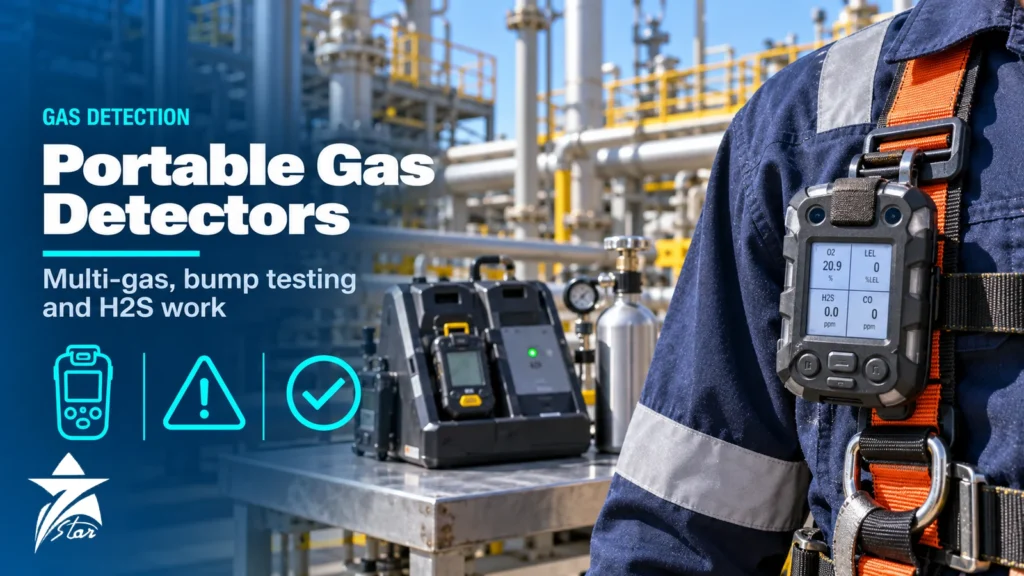
A portable gas detector is often the only thing standing between a worker and an H2S release, an oxygen-deficient vessel or a flammable pocket in a drain. Fixed detection protects the plant; the personal monitor protects the person who walks into places fixed heads cannot see – tank interiors, pits, wellheads, manholes and pipe racks during a leak. Yet many incidents involve detectors that were switched on but not bump-tested, calibrated with expired gas, worn on a belt below a heavy-gas layer or fitted with sensors that could not respond to the gas present. This guide covers single-gas versus multi-gas instruments, the sensor technologies inside them, alarm set points, bump testing and calibration, and the specific practices that matter for H2S work in the GCC.
Single-Gas vs Multi-Gas Detectors
Single-gas detectors monitor one hazard, most often H2S, CO or O2. Many are maintenance-free units with a fixed operating life of around two to three years, after which they are discarded; others are serviceable with replaceable sensors and batteries. They are light, simple and ideal as a personal H2S monitor for everyone on a sour-gas site.
Multi-gas detectors combine several sensors, the classic four-gas set being flammable gas (%LEL), O2, CO and H2S. Five- and six-gas instruments add sensors such as SO2, NO2, NH3, Cl2, CO2 or a photoionisation detector (PID) for volatile organic compounds. They are the standard choice for confined-space entry, hot-work permits and leak response, where the hazard is not known in advance.
| Feature | Single-gas | Four-gas multi | Multi-gas with PID |
|---|---|---|---|
| Typical gases | H2S, CO or O2 | LEL, O2, CO, H2S | Four-gas plus VOCs at ppm level |
| Main use | Personal monitor all day | Confined space, permits, general plant | Benzene/VOC exposure, leak tracing, tank cleaning |
| Maintenance | Minimal; often disposable | Bump test, calibration, sensor replacement | As four-gas plus lamp cleaning and PID calibration |
| Sampling | Diffusion | Diffusion or internal pump | Usually pumped |
| Weakness | Blind to all other gases | Catalytic LEL needs oxygen and can be poisoned | PID is non-specific; humidity affects readings |
Sensor Technologies Inside the Instrument
Catalytic bead (pellistor) for %LEL
A heated bead oxidises flammable gas and the temperature rise changes its resistance. It responds to most combustibles, including hydrogen, but needs adequate oxygen to work correctly, can be permanently poisoned by silicones and lead compounds, and is temporarily inhibited by H2S and halogenated compounds. Readings depend on the calibration gas: an instrument calibrated on methane will read differently on pentane or hexane, so correction factors from the manufacturer must be applied.
Infrared (NDIR) for %LEL, %vol and CO2
Infrared sensors measure absorption by hydrocarbon bonds, so they cannot be poisoned and work in inert or oxygen-free atmospheres such as purged vessels. They do not detect hydrogen, and their response varies by hydrocarbon. Many modern multi-gas instruments use IR for LEL for exactly these reasons.
Electrochemical for toxic gases and oxygen
Electrochemical cells generate a current proportional to the target gas. They are specific but not perfectly so: cross-sensitivities exist (hydrogen on CO sensors, for example), and they can saturate or recover slowly after a large exposure. Their life is finite and shortened by heat and dry air.
Photoionisation (PID) for VOCs
A UV lamp, commonly 10.6 eV, ionises organic vapours down to ppm or ppb levels. A PID gives a total reading, not a compound-specific one, so correction factors or a benzene-specific tube are needed for compliance measurements.
Alarm Set Points and Exposure Limits
Set points come from company policy and local regulation, but typical values used in the oil and gas industry are:
- H2S – low alarm at 5 or 10 ppm, high alarm at 10 or 15 ppm, plus TWA and STEL alarms. For reference, the ACGIH TLV is 1 ppm TWA and 5 ppm STEL, OSHA sets a 20 ppm ceiling with a 50 ppm peak for up to 10 minutes, and NIOSH lists 100 ppm as immediately dangerous to life or health (IDLH).
- O2 – low alarm at 19.5 % and high alarm at 23.5 % by volume.
- Flammable gas – low alarm at 10 % LEL and high at 20 % LEL is common; hot-work permits are often stricter.
- CO – set points around 25–35 ppm low and higher for the second stage, depending on the applicable exposure limit.
H2S deadens the sense of smell at high concentrations, so the detector – not the nose – must decide when to leave.
Bump Testing vs Calibration
Industry guidance, including the ISEA statement on verifying direct-reading portable gas monitors, separates three activities:
- Bump test (function check) – a brief exposure to a known gas that confirms the sensors respond and the alarms (audible, visual and vibration) activate. It does not adjust anything.
- Calibration check – exposure to a known concentration to confirm the reading lies within the manufacturer’s tolerance.
- Full calibration – adjustment of the instrument’s response to match a certified concentration, after zeroing in clean air.
ISEA recommends a bump test or calibration check before each day’s use, in line with the manufacturer’s instructions; if the instrument fails, it must be fully calibrated or removed from service. Full calibration follows the interval set by the manufacturer and whenever a bump test fails, after exposure to high concentrations or poisons, or after a sensor change.
Getting calibration gas right
- Use certified gas within its expiry date; reactive gases such as H2S, Cl2 and NO2 have shorter shelf lives.
- Match the cylinder mix and concentrations to the instrument configuration, including the LEL calibration species.
- Use the correct regulator: fixed-flow regulators for diffusion instruments as specified, demand-flow regulators for pumped instruments.
- Zero in truly clean air, not in a plant area with background gas.
- Docking stations automate bump tests, calibration and record keeping, which makes audit trails much easier.
For setting intervals and keeping traceability across all test equipment, see our instrument calibration program guide.
Using Portable Detectors for Confined Space and H2S Work
- Bump test the instrument before the shift and confirm battery and sensor status.
- Wear personal monitors in the breathing zone – on the collar or chest strap, not on a belt or inside clothing.
- For pre-entry testing, use a pumped instrument with sample tubing and allow the manufacturer’s sampling time, which grows with tubing length.
- Test at several levels: H2S is heavier than air and collects low; methane rises; other gases depend on temperature and ventilation.
- Test in order – oxygen first, then flammables, then toxics – since a catalytic LEL reading is unreliable in oxygen-deficient air.
- Monitor continuously during the work, not only at entry.
- On alarm, stop, leave upwind or crosswind, and do not re-enter without supplied-air respiratory protection and authorisation.
Portable detectors complement, but never replace, fixed detection. For fixed H2S, flammable and flame detector choices, see our guide to gas detector selection for oil and gas facilities.
Hazardous-Area Approvals and Performance Standards
A portable detector carried into a classified zone must itself be certified for that zone, typically intrinsically safe (Ex ia) under ATEX or IECEx, or approved for Class I Division 1 under North American schemes. Check the certificate gas group and temperature class against the area classification. Performance standards are separate from Ex certification: IEC 60079-29-1 covers flammable gas detector performance, EN 45544 covers toxic gas detectors and EN 50104 covers oxygen detectors, while IEC 60079-29-2 gives guidance on selection, use and maintenance.
GCC Conditions: Heat, Dust and Humidity
- Electrochemical sensors dry out and age faster in sustained heat; do not leave detectors on vehicle dashboards or in sun-exposed toolboxes.
- Check the instrument’s operating temperature range against summer site conditions, which can exceed 50 °C in direct sun.
- Dust blocks sensor filters and pump inlets; replace filters on schedule and check for blocked diffusion ports when bump tests show slow response.
- High coastal humidity and condensation affect PID readings and can flood pump lines; use moisture traps when sampling wet spaces.
- Battery capacity falls in heat; plan charging so a 12-hour shift is covered with margin.
Planning sensor replacement
Electrochemical sensors typically last around two to three years in service, and oxygen sensors based on older lead-anode designs may be shorter; catalytic and infrared sensors usually last longer. Rising zero drift, slow recovery after a bump test or repeated calibration failures are signs that a sensor is near the end of its life. Recording the installation date of every sensor and keeping matched spares for a fleet avoids instruments sitting out of service while parts are ordered.
Common Mistakes
- Skipping bump tests because the detector “was fine yesterday”.
- Using a methane-calibrated LEL sensor to clear a vessel that held heavier hydrocarbons without applying correction factors.
- Relying on a catalytic LEL reading inside a nitrogen-purged vessel.
- Ignoring sensor poisoning after silicone sealant or lubricant use nearby.
- Disabling or muting alarms, or using expired calibration gas to pass audits.
Portable Gas Detector Selection Checklist
- Gases expected, including sour gas, VOCs or toxics specific to the process
- Single-gas personal monitor, multi-gas, or both
- Diffusion or pumped sampling, and tubing length for confined spaces
- LEL sensor technology (catalytic or IR) and calibration species
- Alarm set points matching company and regulatory limits
- Ex certification matching area classification
- Docking station and calibration gas supply
- Operating temperature, ingress protection and battery life for site conditions
- Data logging and event download for incident investigation
Sourcing Portable Gas Detectors Through Seven Star LLC
Seven Star LLC supplies portable and fixed gas detectors, sensors, calibration gas accessories and docking stations on request, from manufacturers such as Honeywell, MSA, Dräger and Industrial Scientific. See our fire and gas detectors, portable test and measurement and respiratory protection ranges. We help with selection and cross-checking sensor part numbers, and availability and lead time are confirmed at quotation.
Need replacement sensors, a docking station or a fleet of H2S monitors? Send us the detector model and serial label, the gas configuration you need or your RFQ, and we will reply with matched options and a clear quotation.
Frequently asked questions
What is the difference between a bump test and a calibration?
A bump test briefly exposes the sensors to a known gas to prove they respond and that the alarms work; it changes nothing. A calibration zeroes the instrument and adjusts its response so the reading matches a certified gas concentration.
How often should a portable gas detector be bump tested?
Industry guidance from ISEA recommends a bump test or calibration check before each day's use, following the manufacturer's instructions. If the instrument fails, it must be fully calibrated or taken out of service.
Why can a catalytic LEL sensor give a wrong reading in a purged vessel?
Catalytic bead sensors need oxygen to burn the gas on the bead. In a nitrogen-purged or oxygen-deficient atmosphere they read low or not at all, so an infrared LEL sensor is used for inert atmospheres and oxygen should always be checked first.
What H2S alarm levels are typical on personal monitors?
Many oil and gas operators set the low alarm at 5 or 10 ppm and the high alarm at 10 or 15 ppm, with TWA and STEL alarms as well. The exact values follow company policy and local regulation, with reference to limits such as the ACGIH TLV of 1 ppm TWA and 5 ppm STEL.
Where should a personal H2S monitor be worn?
In the breathing zone, typically on the collar or upper chest, so it samples the air the worker breathes. A detector on a belt or under clothing can respond late or not at all.
Can a single-gas H2S monitor replace a four-gas detector for confined space entry?
No. Confined space entry requires checking oxygen, flammable gas and relevant toxic gases before and during entry. A single-gas H2S monitor is a personal alarm for one hazard, so a multi-gas instrument is used for entry testing.
Was this guide helpful?One click helps us write better guides for engineers.
Thank you! Glad it helped. Need this equipment for your project? Request a quotation
Thank you. We will use this to improve the guide.