
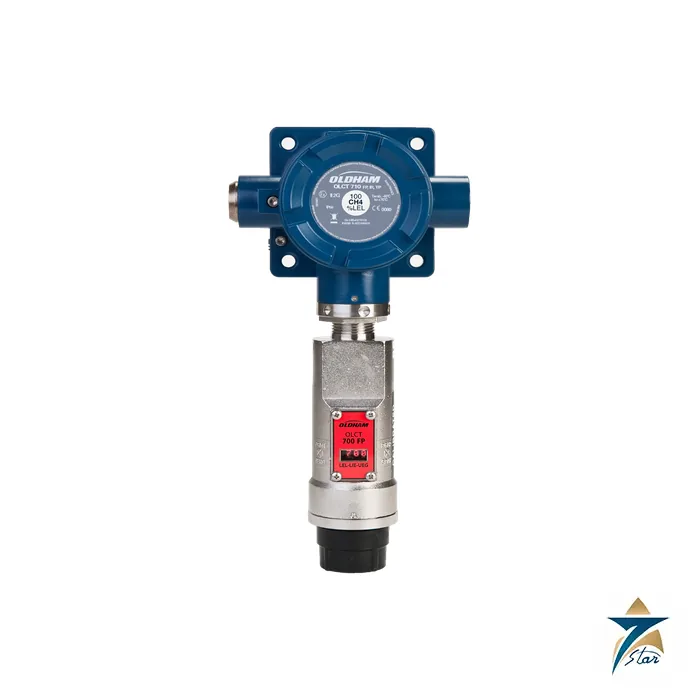
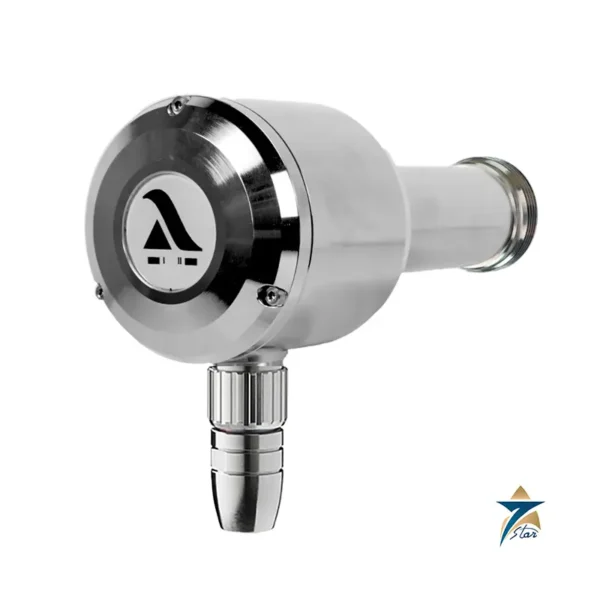
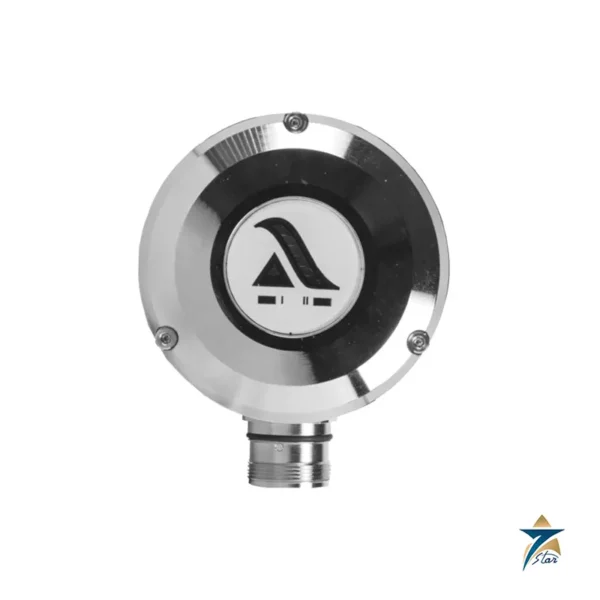
The Oldham OLCT 710 is an intelligent fixed gas detector from Teledyne Oldham Simtronics, part of the OLCT 700/710 series designed for harsh and extreme industrial locations. It consists of an OLCT 700 smart sensor module attached to a flameproof junction box with terminal blocks and an optional surge protection board, and the complete assembly is flameproof (Ex d) certified with ATEX approval. Depending on the plug-in sensor, the detector monitors combustible hydrocarbons, carbon dioxide or hydrogen sulfide, and it is SIL2 certified according to IEC 61508 (except the CO2 version).
Seven Star LLC supplies the Oldham OLCT 710 to oil and gas producers, gas processing plants, refineries, terminals, water and wastewater utilities and power stations in Oman and across the GCC. We provide engineering support in Muscat to help customers choose the sensor technology, range and accessories for their hazardous areas in Sohar, Duqm, Salalah and the interior fields.
Three sensor technologies are available for the Oldham OLCT 710. The IR version uses a non-dispersive infrared (NDIR) cell with an infrared lamp, an optical chamber and two pyroelectric detectors: an active detector filtered to the absorption band of the target gas and a reference detector filtered to a non-absorbing band. The ratio of the two signals gives the gas concentration and cancels drift from lamp ageing or changes in reflectivity. IR sensors are immune to poisoning by corrosive gases, work without oxygen and have an expected service life of five years or more, but they respond only to hydrocarbon gases, not to hydrogen, ammonia, CO or H2S.
The FP version of the Oldham OLCT 710 uses a matched pair catalytic bead sensor for non-selective combustible gas detection from 0 to 100% LEL. The TP version detects hydrogen sulfide with a CHEMFET MOS solid-state sensor suitable for wide temperature and humidity ranges, with ranges of 0 to 20, 50, 100 or 200 ppm and a five-year sensor warranty. A CO2 infrared version measures 0 to 5% vol as standard. Sensors are plug-in components with gold-plated connections and can be changed in the field by releasing a locking screw and unthreading the housing bottom.
All metal parts of the Oldham OLCT 710 sensor module are electropolished 316 stainless steel, and the microprocessor electronics are fully encapsulated, which removes failures from water ingress, corrosion and vibration. Multi-layer transient spike protection protects the circuitry, and the junction box can carry an optional surge protection termination module. A scrolling alphanumeric LED display behind a corrosion-resistant lens shows the reading, status and scripted messages, and an integral calibration port and splashguard are fitted at the sensor end.
The operator interface of the Oldham OLCT 710 is non-intrusive: a small handheld magnet activates two programming switches through the housing, so calibration and configuration are done without opening the enclosure. An auto zero and auto span sequence guides the technician step by step. The detector runs on 11.5 to 28 VDC with typical consumption below 2 W and provides both a linear 4-20 mA analog output and a Modbus RTU RS-485 serial output. Pre-emptive diagnostics monitor input voltage, operating temperature, detector signal amplitude, output loop integrity and remaining sensor life and report them through both outputs.
According to the Teledyne Oldham Simtronics user manual, the Oldham OLCT 710 must only be installed in areas whose classification matches its ATEX label. Cable glands must be flameproof (Ex d) certified, of M20 × 1.5 thread with at least five threads engaged, and must keep the ingress protection at IP66 or better. Cables should be rated for an operating temperature of 80 °C or more, and only non-hardening, non-corrosive lubricants without volatile solvents may be used on the threaded joints.
Infrared units leave the factory calibrated for methane; for any other hydrocarbon the detector must be span calibrated and configured for that gas. Compared with catalytic sensors, the IR sensor shows better long-term zero and span stability: typical zero checks are quarterly to semi-annual and span checks semi-annual to annual, although field experience should set the final interval. Replacement IR and CO2 sensors have an unlimited shelf life, carry a two-year warranty and have an expected service life of five years or more.
The Oldham OLCT 710 provides the following advantages for fixed gas detection:
The Oldham OLCT 710 is suited to wellheads, gathering stations, compressor and pumping stations, gas processing and treatment units, tank farms, loading facilities, refineries and petrochemical plants. Infrared hydrocarbon sensors suit areas where catalytic sensors could be poisoned by corrosive gases or where oxygen may be absent, while the solid-state H2S sensor is designed for sour gas facilities with high temperatures and changing humidity. The CO2 version monitors carbon dioxide in enclosed process and utility areas.
For Oman, this makes the Oldham OLCT 710 a strong fit for sour gas fields in the interior, export terminals and refineries on the coast, desalination and wastewater plants, and industrial projects in the Sohar, Duqm and Salalah zones. Seven Star LLC supplies the detector together with complementary fire and gas equipment such as the Oldham OLCT 100 fixed gas detector, the Oldham MX 62 gas detection controller and the Honeywell Sensepoint XRL gas detector.
The Oldham OLCT 710 values below are taken from the Teledyne Oldham Simtronics OLCT 700/710 brochure.
| Parameter | Specification |
|---|---|
| Model | Oldham OLCT 710 (OLCT 700 sensor module with flameproof junction box); IR, FP and TP versions |
| IR version | Combustible hydrocarbons 0-100% LEL or CO2 0-5% vol (standard ranges) |
| FP version | Matched pair catalytic bead, combustible gas 0-100% LEL |
| TP version | H2S solid-state metal oxide semiconductor, 0-20, 0-50, 0-100 or 0-200 ppm |
| Accuracy | FP and IR: ±3% LEL (0-50% LEL), ±5% LEL (50-100% LEL); TP: ±10% of reading or ±2 ppm; IR-CO2: ±5% FS |
| Response time | FP and IR-CH: T50 <10 s, T90 <30 s; TP: T50 <30 s, T80 <60 s; IR-CO2: T50 <15 s, T90 <40 s |
| Operating temperature | -40 to +75 °C |
| Input voltage / power | 11.5 to 28 VDC; <2 W typical |
| Outputs | Linear 4-20 mA DC; RS-485 Modbus RTU |
| Dimensions (OLCT 710) | 349 mm H × 127 mm W × 130 mm D |
| Weight (OLCT 710) | 3.36 kg aluminium version; 7.44 kg stainless steel version |
| Approvals | ATEX II 2G Ex d IIB+H2 T4 Gb; SIL2 to IEC 61508 (except CO2) |
| Warranty | 2 years electronics; 2 years IR and catalytic sensors; 5 years H2S sensor |
To order the Oldham OLCT 710, send Seven Star LLC an RFQ with the target gas, range, sensor technology, junction box material and whether you need the surge protection module, together with the controller or DCS it will connect to. Our team in Muscat will confirm the part number, availability and lead time, and the OLCT 700/710 brochure can be downloaded from this page. Seven Star LLC supplies Teledyne Oldham Simtronics gas detection across Oman and the GCC with engineering support in Muscat.
Browse Oldham products by category: Fire & Gas Detector, Logic Controller.
Choose the option that best fits your needs to get the fastest response from our team.
Automatically fill the RFQ form with this product's details for a faster process.
Manually enter multiple part numbers, specific brands, or custom requirements.











Reviews
There are no reviews yet.