- Automation & ControlView all 2,803 products
- Automation Accessories
- AC Drives
- PLC & I/O Cards
- Industrial Communications
- Vibration Monitoring
- Controllers & Data Acquisition
- Isolator & Barrier
- Safety Switches & Guard Locking
- Motor Soft Starters
- CCTV & Security
- Encoders
- Pneumatic Cylinders
- HMI Displays
- Servo Drives
- Industrial Computers
- Machine Vision
- Automation Software
- Robotics
Brand: Endress+Hauser (E & H)
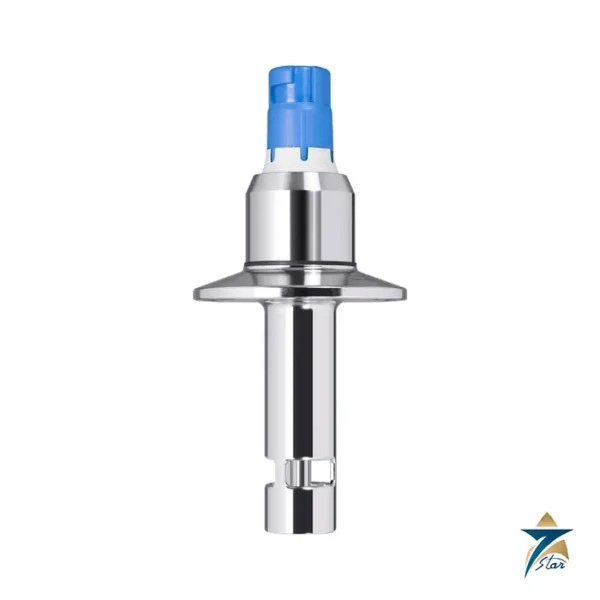
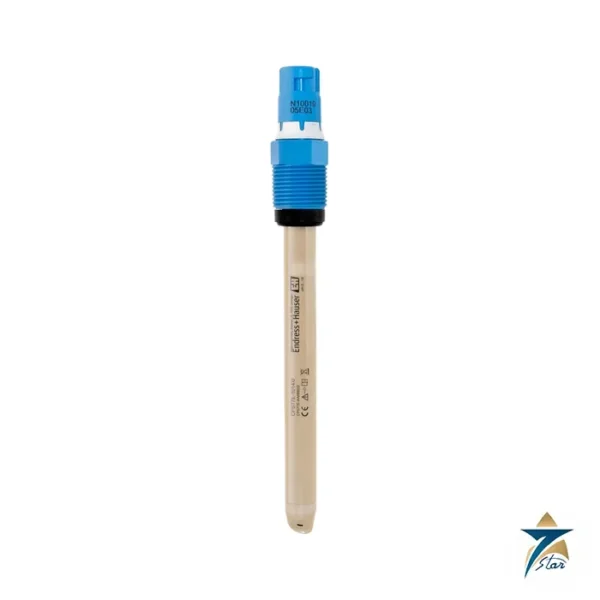
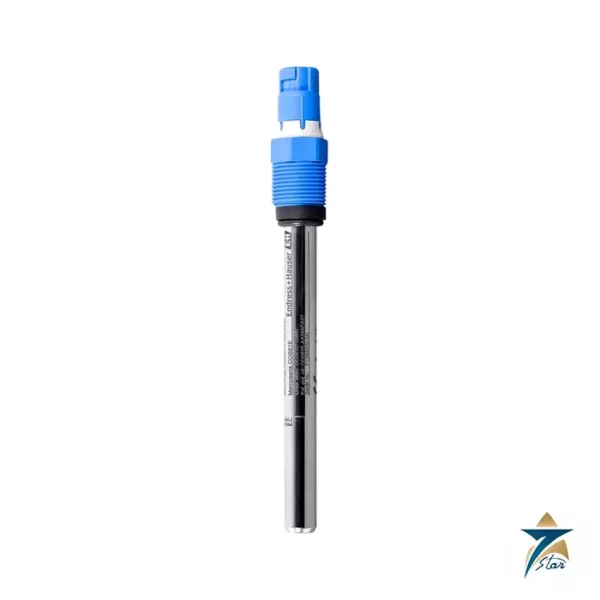
Endress+Hauser CPS47E Memosens ISFET pH Sensor
Description
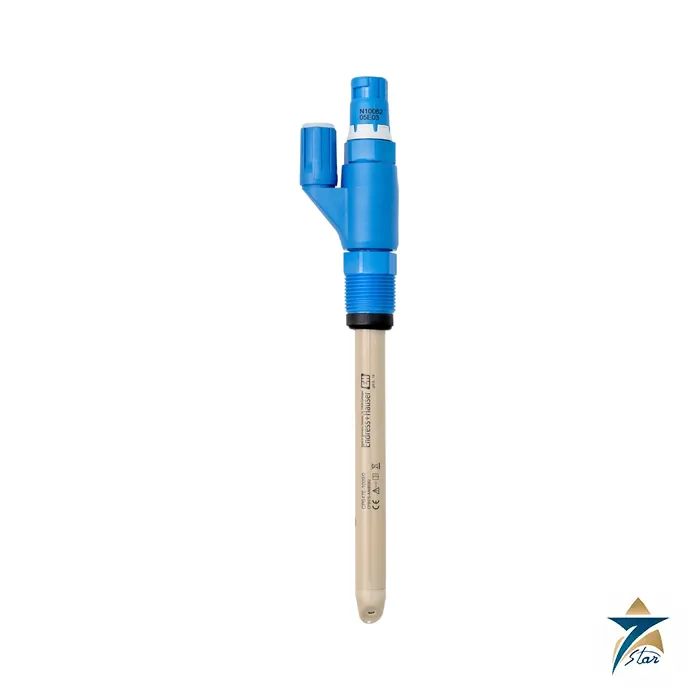
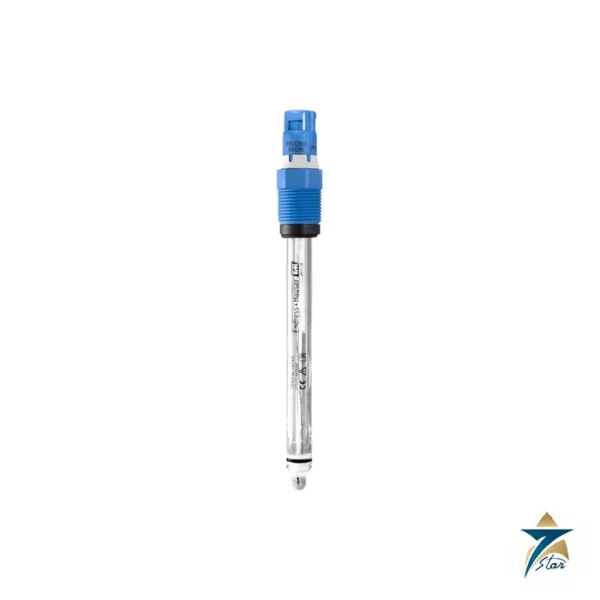
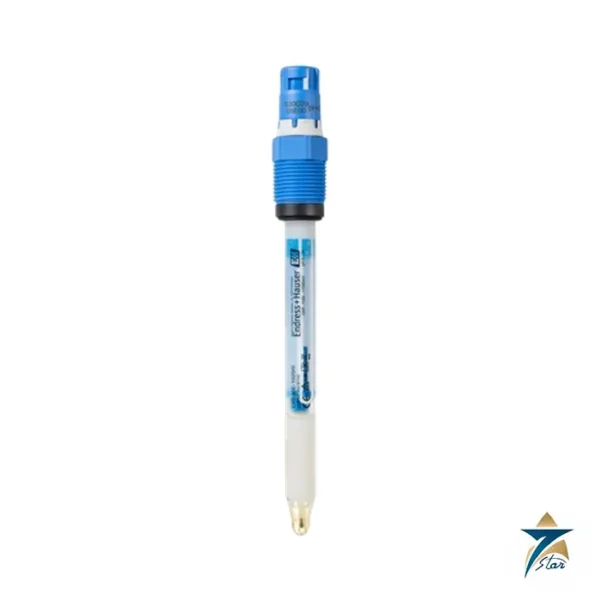
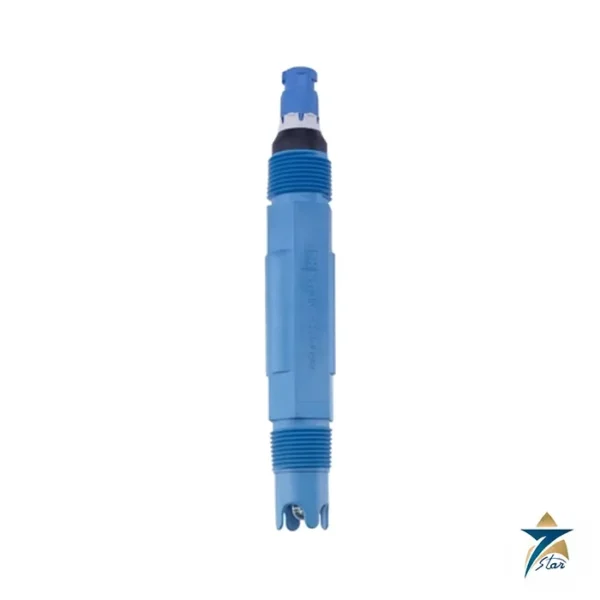
CPS47E is a pH sensor with no glass bulb
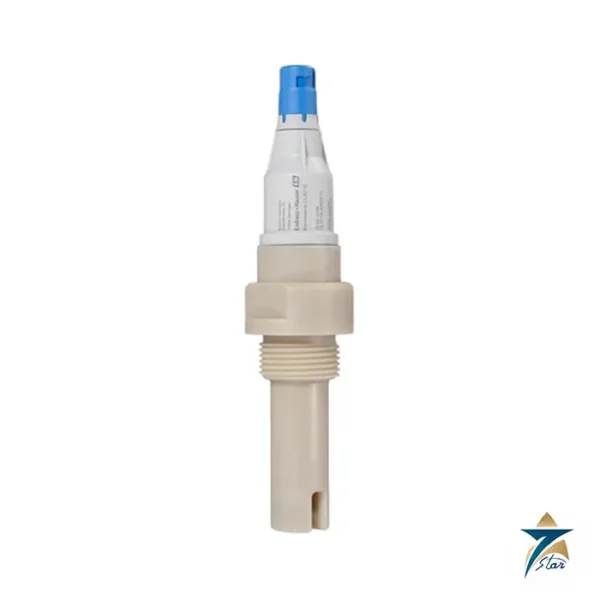
Endress+Hauser CPS47E measures pH with an ion-sensitive field-effect transistor. The sensitive layer is a metal oxide based on tantalum pentoxide on an ISFET chip, mounted in a PEEK shaft together with the reference and a ceramic zirconium-dioxide junction. Only the chip and reference touch the medium, which gives the sensor its headline property: break resistance.
It is a Memosens 2.0 digital device, so the Pt1000 temperature element (class A to DIN IEC 60751) and the electronics sit in the plug-in head. The reference is Ag/AgCl with a 3 M, AgCl-free liquid KCl bridge that is refilled from a storage vessel. Seven Star LLC is an independent supplier serving Oman and the GCC and is not affiliated with the manufacturer.
Measured performance of CPS47E
The datasheet quantifies what ISFET technology buys. Between pH 1 and pH 13 the average measured error is 0.02 pH at 25 C, essentially the detection limit, because few foreign ions can accumulate at the gate and acid and alkaline errors almost vanish. Repeatability is 0.01 pH. Response time t90 is under 5 seconds, and there is no equilibrium delay at low temperature, which suits cold-water and CIP-return duties. Calibration intervals are longer than with glass electrodes and hysteresis after temperature steps is shorter.
CPS47E technical specifications
| Parameter | Value |
|---|---|
| pH range | 0 to 14 |
| Temperature range | minus 15 to 135 C (5 to 275 F) |
| Process pressure | 0.8 to 11 bar absolute (11.6 to 159.5 psi) |
| Minimum conductivity | 5 microsiemens per cm |
| Sensing element | ISFET chip, metal oxide on tantalum pentoxide |
| Reference | Ag/AgCl, 3 M KCl liquid, AgCl-free |
| Repeatability | 0.01 pH |
| Response t90 | under 5 s (pH 4 to pH 7) |
| Temperature sensor | Pt1000 class A |
| Installed length | 120, 225, 360 mm |
| Weight | 71, 84, 102 g |
| Shaft | PEEK, 11.9 mm diameter |
| Seals | FFKM seal, FKM O-ring on thrust collar |
| Process coupling | PPS fibre-glass reinforced |
| Surface roughness | Ra under 0.76 micrometre |
| Ingress protection | IP 68, 10 m, 25 C, 45 days, up to 135 C |
| Plug-in head | Memosens, 16 bar relative |
| Process connection | Pg 13.5 |
How CPS47E differs from other Memosens pH sensors
Against CPS41E, which shares the 135 C ceiling and the liquid KCl bridge, CPS47E replaces glass with silicon and PEEK: a lower installed-length offering (no 425 mm), a Pt1000 instead of NTC 30K, and far faster response. Against CPS91E, designed for dirt, it is more sensitive to abrasion; the datasheet says ISFET sensors are not designed for abrasive media. Approvals are wider than CPS41E, adding UKCA and Korea Ex to ATEX, IECEx, CSA C/US, NEPSI, JPN Ex and INMETRO.
Where CPS47E earns its place in Oman and the GCC
Think of places where glass is a liability: food and beverage lines with broken-glass rules, pharmaceutical and fine-chemical skids with high solvent loads, pressurised tanks and low-conductivity condensate. In oil and gas and petrochemical sites it suits solvent-rich streams where fast response keeps a dosing loop tight. The longer calibration interval cuts site visits in remote plants.
Selection and compatibility of CPS47E
The sensor demands a Memosens transmitter such as Liquiline CM44x and cable CYK10 or CYK20. A hygienic version follows Special Documentation for hygienic application. Check the medium: at high temperature alkalis can irreversibly attack the gate oxide, and the datasheet marks combinations of temperature and pH as normal, limited life or not recommended.
Installing and commissioning CPS47E
Align the chip using the serial-number engraving on the plug-in head, which lies in the same plane as the chip and nameplate. Tighten at 3 Nm in Endress+Hauser assemblies. Upside-down installation is permitted only if the KCl vessel is free of air bubbles, and the installed sensor may stay dry for no more than 6 hours. Allow the settling times above after any interruption.
Maintenance of CPS47E
Keep the KCl vessel topped up, protect the chip from abrasive flow and let the stored sensor load guide replacement. Because the sensor can be calibrated in the lab and swapped as a pre-calibrated unit, downtime is minutes.
Quick answers about CPS47E
The questions we hear most are about glass and about speed. CPS47E has no glass membrane: the chip, PEEK shaft and ceramic junction make up the wetted side, and the datasheet calls resistance to breaking its most distinctive external feature. Speed is under 5 seconds for t90, and the integrated Pt1000 may lag in the event of extreme temperature changes, so regulate the sensor temperature before a calibration or measurement.
Another frequent question is orientation. Because there is no liquid internal lead, the ISFET can be installed in any position, but an upside-down mount can trap an air bubble in the reference system and interrupt contact between medium and junction. The datasheet therefore allows it only under stated basic conditions, namely a bubble-free KCl vessel, no vacuum emptying of the tank and no more than 6 dry hours. Surface roughness on the wetted PEEK is Ra below 0.76 micrometre, which helps cleanability in hygienic lines.
The sensor keeps its own history of operating hours and load, so a maintenance planner reading the transmitter can see how many hours were spent at high temperature or in aggressive pH before deciding to swap the unit.
Ordering notes for CPS47E
Quote the full order code in the RFQ, including installed length and Ex approval. Sister parts CPS41E and CPS91E are listed separately.
Documents and quotation
The Technical Information datasheet for CPS47E is attached to this page as a PDF. To request a quotation, send your RFQ with the exact CPS47E order code and the quantity you need, and we will reply with availability and lead time.
Spares and Lifecycle Considerations
For critical service, many plants hold one Endress+Hauser CPS47E as an operational spare rather than waiting for a failure. When you plan spares, look at how many identical liquid analysis sensors units are installed, how long a replacement would take to arrive, and the cost of an unplanned stop. Store spare units in their original packaging in a dry, temperature-controlled area and record the part number and serial number in your maintenance system. We can quote single units or a small spares package and confirm the lead time for each item in writing.
Other Models in the Memosens Ph Range
Seven Star LLC supplies models from the Memosens Ph range in Oman and the GCC. Compare the related models below and request a quote for the one that matches your application.
| Model | Category | |
|---|---|---|
| Endress+Hauser CPF81E Memosens Compact pH Sensor | Liquid Analysis Sensors | View details |
| Endress+Hauser CPS96E Memosens pH/ORP Sensor, Open Junction | Liquid Analysis Sensors | View details |
| Endress+Hauser CPS47E Memosens ISFET pH Sensor | Liquid Analysis Sensors | You are viewing this model |
Datasheets & Documents
- Datasheet Endress+Hauser CPS47E Memosens ISFET pH Sensor Datasheet Download
Reviews (0)
How would you rate this product? Cancel reply
About brand
Endress+Hauser makes process measurement instruments for flow, level, pressure, temperature and liquid analysis. Georg H. Endress and Ludwig Hauser started the business in Lörrach, Germany, on 1 February 1953, first selling level meters, and the Endress+Hauser name has been used since 1957. The group is headquartered in Reinach, Switzerland, and has been wholly owned by the Endress family since 1975.
Seven Star LLC is an independent supplier listing Endress+Hauser flowmeters, level and pressure transmitters, temperature assemblies and liquid analysis products for buyers in Oman and the GCC. Instruments are matched from the full order code on the nameplate.
Endress+Hauser company profile
| Origin | Founded in Lörrach, Germany, on 1 February 1953 by the Swiss engineer Georg H. Endress and Ludwig Hauser |
|---|---|
| Headquarters | Endress+Hauser AG, Reinach (Basel-Landschaft), Switzerland |
| Ownership | Family owned; the Endress family has been the sole shareholder since 1975, and a family charter commits the company to stay family owned |
| Size | About 16,500 employees and sales of about EUR 3.7 billion (2023, as reported by the company) |
| Product families | Proline flowmeters, Micropilot and Levelflex radar, Liquiphant switches, Cerabar and Deltabar pressure, iTEMP and iTHERM temperature, Liquiline and Memosens liquid analysis |
Milestones
- 1953: Georg H. Endress and Ludwig Hauser start the business in Lörrach on 1 February, first selling level meters.
- 1957: The Endress+Hauser name comes into use.
- 1975: The Endress family becomes sole shareholder.
- 2023: About 16,500 employees and sales of about EUR 3.7 billion, as reported by the company.
Endress+Hauser product lines
| Line | Measuring principle | Typical use |
|---|---|---|
| Promass F 300, Promass 80F, 83F/84F | Coriolis mass flow | Direct mass flow and density of liquids and gases, hydrocarbon transfer and chemical dosing |
| Promag P 300, P 500, H 300, W 400, W 10, 50P | Electromagnetic flow | Water, wastewater, slurries and other conductive liquids |
| Prowirl F 200, 72F | Vortex flow | Steam, gas and low-viscosity liquids |
| Prosonic Flow 92F, t-mass 65F | Ultrasonic and thermal mass flow | Water lines; compressed air and industrial gases |
| Micropilot FMR62, FMR67, FMR60, FMR10B, FMR20, FMR50, FMR52 | Free-space radar level, 80 GHz and 26 GHz | Tanks, process vessels, silos and open water channels |
| Levelflex FMP51, FMP50, FMP54, FMP55 | Guided wave radar level | Level and interface in vessels, separators and bypass chambers |
| Liquiphant FTL51, Prosonic S FMU90 | Vibronic point level; ultrasonic level | High and low level alarms, pump protection, open channel flow |
| Cerabar PMC71B, PMP51B, PMP71, Deltabar PMD78B, PMD75 | Pressure and differential pressure | Process pressure, hydrostatic level and DP flow |
| iTEMP TMT82, TMT162, iTHERM TM101, TR66, TR10 | Temperature transmitters and thermometers | RTD and thermocouple points with thermowells |
| Liquiline CM444, CM442, Memosens CPS11E, Stamolys reagents | Liquid analysis | pH, ORP, conductivity, dissolved oxygen and nutrient analysis in water treatment and process |
Where Endress+Hauser instruments are used
In Oman and the GCC, Endress+Hauser instruments are common in oil and gas production and processing, refineries and petrochemicals, desalination and water networks, wastewater treatment, power plants and food and beverage plants. Coriolis meters measure hydrocarbon and chemical flows, electromagnetic meters cover water and wastewater, radar transmitters handle tank and silo level, and Liquiline analysers monitor water quality. Proline 300 and 500 flowmeters include Heartbeat Technology for in-situ verification, which reduces the need to remove a meter for checks.
Ordering Endress+Hauser instruments: what we need
The order code on the nameplate (for example PMP71-1QA1S11RDADU) defines every option: measuring range, process connection, materials, output, approvals and display. Send it with the serial number; Endress+Hauser can retrieve the original configuration from the serial number. For a new instrument add the medium, operating and design pressure and temperature, range, line size or tank geometry, process connection, wetted materials, output or protocol (4-20 mA HART, PROFIBUS, FOUNDATION Fieldbus, Modbus) and the hazardous-area approval required. Older models such as Promass 80/83 or Micropilot M are replaced by current Proline or 80 GHz Micropilot devices.
Facts checked against Endress+Hauser company history and product information, October 2026.
Browse Endress+Hauser products by category: Flowmeters, Level Transmitter, Pressure Instrumentation, Temperature, Liquid Analysis Sensors, Liquid Analytical Systems.
FAQ
Questions about the Endress+Hauser CPS47E Memosens ISFET pH Sensor
Answers from our engineering team on installation, compatibility and integration.
01Is Endress+Hauser CPS47E made of glass?
No. The measuring element is an ISFET chip with a tantalum pentoxide gate embedded in a PEEK shaft, so there is no glass membrane to break.
02How fast does CPS47E respond?
The datasheet states t90 under 5 seconds for a buffer change from pH 4 to pH 7 under reference conditions, with no temperature-dependent settling.
03What happens when CPS47E is switched on?
A closed control loop starts. Settling is 3 to 5 minutes after a voltage interruption, 5 to 8 minutes if the liquid film is interrupted, and up to 30 minutes after long dry storage.
04How should the ISFET chip face the flow?
Position the chip at roughly 30 to 45 degrees to the flow direction using the rotatable terminal head, and avoid direct impingement in abrasive media.
05What pressure and temperature does CPS47E handle?
0.8 to 11 bar absolute and minus 15 to 135 C, with use limited by pH value at high temperature because strong alkalis can damage the gate oxide.


Reviews
There are no reviews yet.