- Automation & ControlView all 2,895 products
- Automation Accessories
- AC Drives
- PLC & I/O Cards
- Industrial Communications
- Vibration Monitoring
- Controllers & Data Acquisition
- Isolator & Barrier
- Safety Switches & Guard Locking
- Motor Soft Starters
- CCTV & Security
- Encoders
- Pneumatic Cylinders
- HMI Displays
- Servo Drives
- Industrial Computers
- Machine Vision
- Automation Software
- Robotics
Brand: SICK
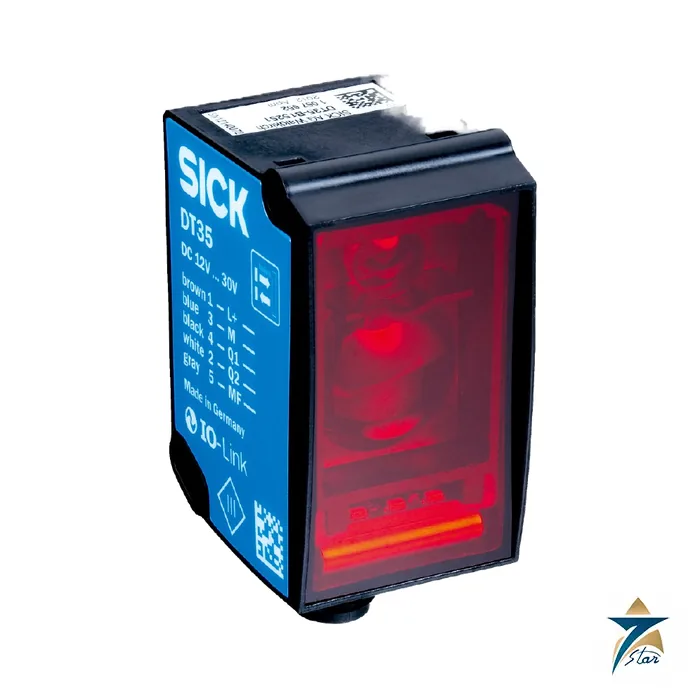
SICK DL35-B15552 Time-of-Flight Sensor, 35 m on Reflective Tape
Description
SICK DL35-B15552 for long-range tape or reflector targets
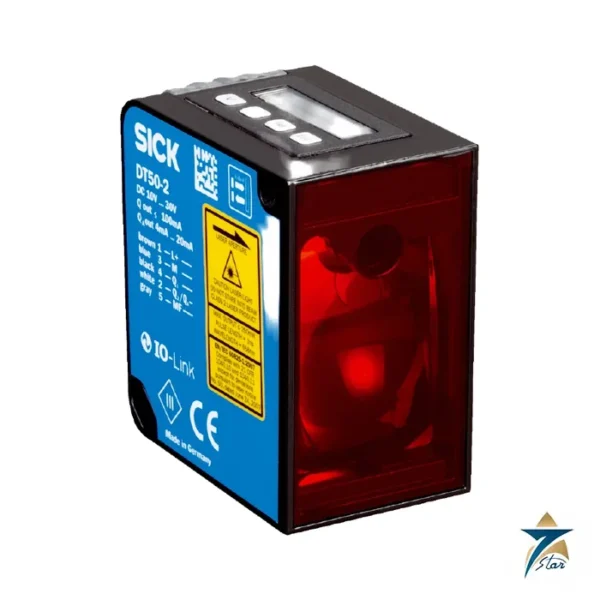
When a distance must be measured over tens of metres, natural surfaces are not enough. The SICK DL35-B15552 (part number 1057657) is the Dx35 variant that measures to reflective tape, delivering a range of 200 mm up to 35,000 mm on diamond-grade tape. It uses the same compact 32 x 58.67 x 42.7 mm plastic housing as the other Dx35 types and the same 5-pin M12 connection.
Reflector-based performance
A red 658 nm laser pulse returns from the tape and the time of flight is converted into distance. The datasheet states a typical accuracy of plus or minus 15 mm, resolution of 100 micrometres, repeatability from 0.5 mm and a typical spot of 15 x 15 mm at 2 m. The response time can be set from 2.5 ms to 96.5 ms, which corresponds to switching frequencies from 333 Hz down to 6 Hz, so it is faster than the natural-object DT35 types, while the output time ranges from 1 ms to 32 ms.
- Target: reflector, diamond-grade tape
- Hysteresis 0 to 34,950 mm
- Ambient light immunity 40 klx
- MTTFD 101 years, DCavg 0 percent
DL35-B15552 data table
| Parameter | Value |
|---|---|
| Part number | 1057657 |
| Principle | Time of flight, red laser 658 nm, class 1 |
| Target | Reflector (diamond-grade reflective tape) |
| Measuring range | 200 to 35,000 mm |
| Resolution / accuracy | 100 micrometres / typically plus or minus 15 mm |
| Response time | 2.5 to 96.5 ms |
| Supply | 12 V DC to 30 V DC, up to 1.7 W |
| Analog output | 4 to 20 mA or 0 to 10 V, 12 bit |
| Digital output | Push-pull PNP/NPN, up to 100 mA |
| IO-Link | V1.1, process data, parameterisation, diagnosis |
| Connection | M12 male connector, 5-pin |
| Dimensions / weight | 32 x 58.67 x 42.7 mm / 65 g |
| Enclosure rating | IP65, IP67 |
| Ambient temperature | Minus 30 to plus 55 C |
How DL35-B15552 differs from other Dx35 variants
The DT35-B15551 sees natural objects from 50 mm to 12 m; the DL35-B15552 needs tape but reaches 35 m, trades the near limit of 50 mm for 200 mm, and is quicker, with 2.5 ms against 4.5 ms for the fastest setting. Its switching modes refer to reflective tape: distance to reflector, switching window or object between sensor and background. The IO-Link function line lists process data, parameterisation and diagnosis, without the data storage entry given for the DT35.
Typical use
The sensor is used for positioning of cranes, gantries and shuttles on long rails, for stacker-crane position in high-bay storage and for monitoring the position of gates and carriages in port or yard areas. A strip of tape at the end of the travel provides a stable, unambiguous target, immune to colour and dirt variations on the moving object.
Selection hints
Specify diamond-grade tape of adequate size and keep it clean; the 35 m range assumes it. Choose between analog and IO-Link outputs depending on controller capability. For targets that cannot carry tape, select a DT35 or a DT50 type instead.
Setup
Align the sensor so that the laser strikes the tape square-on, teach near and far points for the analog output and set the speed according to the travel speed. Allow a warm-up of up to 20 minutes before critical measurements.
Maintenance
Clean both window and tape regularly. Seven Star LLC is an independent supplier serving Oman and the GCC and is not affiliated with the manufacturer.
Ambient conditions in Gulf outdoor yards include heat, dust and bright sunlight. The datasheet gives an ambient operating range of minus 30 to plus 55 degrees Celsius for supply voltage up to 24 V, relative humidity up to 95 percent without condensation and EMC conformity to EN 61000-6-2, EN 61000-6-3 and EN 61000-6-4. Install a sunshade where the housing could exceed the upper limit, and mount the tape in a position that is protected from mechanical abrasion. Also note that the device is a Class A product, meaning it may cause radio interference in residential areas, so use it in industrial zones. In an RFQ, quote DL35-B15552 and part number 1057657 with quantity and delivery location in Oman or the GCC.
Practical guidance for tape mounting: use one continuous piece of diamond-grade tape on a flat, rigid carrier, keep it free of oil film and condensation, and make it larger than the laser spot of about 15 x 15 mm at 2 m, which grows with distance. At 35 m the spot becomes considerably larger, so a tape strip of generous size avoids partial hits that would reduce signal and accuracy. Position the sensor so that the beam strikes the tape within a few degrees of perpendicular, and avoid mounting where passing vehicles or cranes could cross the beam and cause false readings.
Questions buyers ask about DL35-B15552
What does SICK DL35-B15552 measure to? Reflector targets: 200 mm to 35,000 mm on diamond-grade reflective tape, in contrast to the natural-object DT35 types.
How accurate is DL35-B15552? Typical measurement accuracy is plus or minus 15 mm with 100 micrometre resolution and repeatability from 0.5 mm.
What speeds can DL35-B15552 run at? Response time 2.5 to 96.5 ms in five steps, giving 333 Hz down to 6 Hz switching frequency, with output time 1 to 32 ms.
What outputs does DL35-B15552 have? IO-Link V1.1, push-pull PNP/NPN digital output and an analog 4 to 20 mA or 0 to 10 V output at 12 bit, set by adaptable Q2.
What laser data is given for DL35-B15552? A red 658 nm laser with maximum output 120 mW, pulse duration 4 ns and duty cycle 1 in 250, classified as laser class 1.
Documents and quotation
The manufacturer datasheet for DL35-B15552 comes with this listing. Send an RFQ with the part number DL35-B15552, quantity and delivery point in Oman or the GCC for availability and lead time.
Ordering Checklist for the SICK DL35-B15552
Before you ask for a quotation for the SICK DL35-B15552, check the full order code on the nameplate of the unit you are replacing, the supply voltage, and the process or signal ranges your system expects. If this is an upgrade rather than a like-for-like swap, tell us the existing make and model so that mounting, wiring and connection details can be checked against the inductive proximity sensors already installed. For multi-unit orders, list the quantity per site and the delivery location in Oman or the wider GCC, so packing, paperwork and lead time can be confirmed in a single quotation.
Datasheets & Documents
- Datasheet SICK DL35-B15552 Time-of-Flight Sensor, 35 m on Reflective Tape Datasheet Download
Reviews (0)
How would you rate this product? Cancel reply
About brand
SICK is the German maker of industrial sensors: photoelectric and proximity sensors, safety laser scanners and light curtains, encoders, distance sensors, code readers and gas analysers. Erwin Sick, an optics engineer, founded it in Munich in 1946, and in 1952 it introduced its first marketable accident-prevention light curtain, which protected press operators by stopping the machine when a hand broke the light beam. The company moved to Waldkirch in the Black Forest in 1956 and is still headquartered there. It is a privately held company, and has been an Aktiengesellschaft (AG) since 1996.
SICK company profile
| Founded | 1946, Munich, Germany, by Erwin Sick (1909–1988) |
|---|---|
| Headquarters | Waldkirch, Baden-Württemberg, Germany (since 1956) |
| Ownership | Privately held; after the founder's death in 1988 his widow Gisela Sick became the main shareholder. Legal form SICK AG since 1996 |
| Size | More than 12,000 employees and group revenue of about EUR 2.3 billion (company figures for 2023) |
| First breakthrough | Accident-prevention light curtain for presses, shown in Hanover in 1952 |
| International growth | First foreign subsidiary in France in 1972, United States in 1976; today sales and service companies worldwide |
| Product families | Photoelectric, inductive, capacitive, magnetic and ultrasonic sensors; safety laser scanners, light curtains, safety controllers and relays; encoders and motor feedback systems; distance sensors and LiDAR; barcode and 2D code readers and machine vision; gas analysers, dust and flow measurement for process and emissions monitoring |
Milestones
- 1946: Erwin Sick receives a licence to run his engineering firm in Munich.
- 1952: The first marketable accident-prevention light curtain is presented in Hanover and goes into series production.
- 1956: The company moves to Waldkirch with 25 employees.
- 1972 and 1976: Subsidiaries are founded in France and the United States.
- 1996: SICK becomes an Aktiengesellschaft.
- Today: Sensors for factory and logistics automation, machine safety and process analysis, with a large share of revenue outside Germany.
Choosing a SICK sensor
For object detection, the sensing principle comes first. A retro-reflective sensor (WL series) sends light to a reflector and switches when an object breaks the beam; it is reliable over long distances and easy to align. A sensor with background suppression (WTB series) detects an object at a set distance and ignores what is behind it, which suits conveyors with shiny or dark backgrounds. A through-beam pair (WS/WE) gives the longest range and the highest reliability in dust. For transparent bottles and film, use a model built for transparent objects (for example WL12G-3B or WL150-P420). The digits in the code also matter: "P" usually means a PNP output and "N" NPN, and the last digits set the connector or cable. For machine guarding, a safety laser scanner such as nanoScan3 or microScan3 protects an area, while a safety controller such as Flexi Soft combines several safety devices.
Where SICK products are used
In Oman and the GCC, SICK sensors are used in packaging and bottling lines, food and beverage plants, logistics and airport baggage handling, cement and steel plants, ports and cranes, automated warehouses, and on machines built by European OEMs. SICK safety scanners guard robots and automated guided vehicles, and its encoders give position feedback on motors, hoists and conveyors.
SICK products we list
| Family | Examples |
|---|---|
| Photoelectric sensors | WL12-3P2431, WTB12-3P2431, GTB6-P4211, VL18-4P3240, WL12G-3B2531, WS/WE100, KT5W contrast, W26 IO-Link |
| Proximity, cylinder and ultrasonic sensors | IME12-08NPSZC0S, IME18-05BPSZC0S, MZT8, UM18 4-20 mA, UM30, UFN3 fork |
| Machine safety | nanoScan3, microScan3, S300 Professional, Flexi Soft FX3-CPU1, FX3-XTIO, ReLy OSSD |
| Encoders and motor feedback | DFS60B, AFM60 PROFINET, AFS60 SSI, ATM60 PROFIBUS, SRS50, EFS50 |
| Distance sensors and code readers | DT50, DL50, DT35, Lector632 |
Ordering SICK products: what we need
Send the type code and the 7-digit SICK part number from the label (for example WTB12-3P2431 together with its part number). For a replacement sensor, add the output (PNP or NPN), connection (M8, M12 or cable) and sensing distance. For encoders, add the interface (incremental, SSI, PROFIBUS, PROFINET), resolution and shaft type. For safety scanners, tell us the model and whether the existing configuration needs to be kept.
Frequently requested SICK models: SICK WTB4-3 Miniature Photoelectric Proximity Sensor, SICK IME18-08NPSZW2K Inductive Proximity Sensor, SICK DT35-B15251 Laser Distance Sensor, SICK microScan3 Safety Laser Scanner, SICK RZT7-03ZUS-KWB T-Slot Cylinder Sensor.
Facts checked against SICK's published company history and annual figures, October 2026.
Browse SICK products by category: Sensors & Transmitters.
FAQ
Questions about the SICK DL35-B15552 Time-of-Flight Sensor, 35 m on
Answers from our engineering team on installation, compatibility and integration.
01What does SICK DL35-B15552 measure to?
Reflector targets: 200 mm to 35,000 mm on diamond-grade reflective tape, in contrast to the natural-object DT35 types.
02How accurate is DL35-B15552?
Typical measurement accuracy is plus or minus 15 mm with 100 micrometre resolution and repeatability from 0.5 mm.
03What speeds can DL35-B15552 run at?
Response time 2.5 to 96.5 ms in five steps, giving 333 Hz down to 6 Hz switching frequency, with output time 1 to 32 ms.
04What outputs does DL35-B15552 have?
IO-Link V1.1, push-pull PNP/NPN digital output and an analog 4 to 20 mA or 0 to 10 V output at 12 bit, set by adaptable Q2.
05What laser data is given for DL35-B15552?
A red 658 nm laser with maximum output 120 mW, pulse duration 4 ns and duty cycle 1 in 250, classified as laser class 1.


Reviews
There are no reviews yet.