- Automation & ControlView all 3,078 products
- Automation Accessories
- AC Drives
- PLC & I/O Cards
- Industrial Communications
- Vibration Monitoring
- Isolator & Barrier
- Controllers & Data Acquisition
- Safety Switches & Guard Locking
- Motor Soft Starters
- Encoders
- CCTV & Security
- Pneumatic Cylinders
- HMI Displays
- Servo Drives
- Industrial Computers
- Machine Vision
- Automation Software
- Robotics
Brand: SICK
SICK DBS60E-THEK01024 Incremental Encoder, 1024 PPR, 15 mm Hollow Shaft
Description
Overview
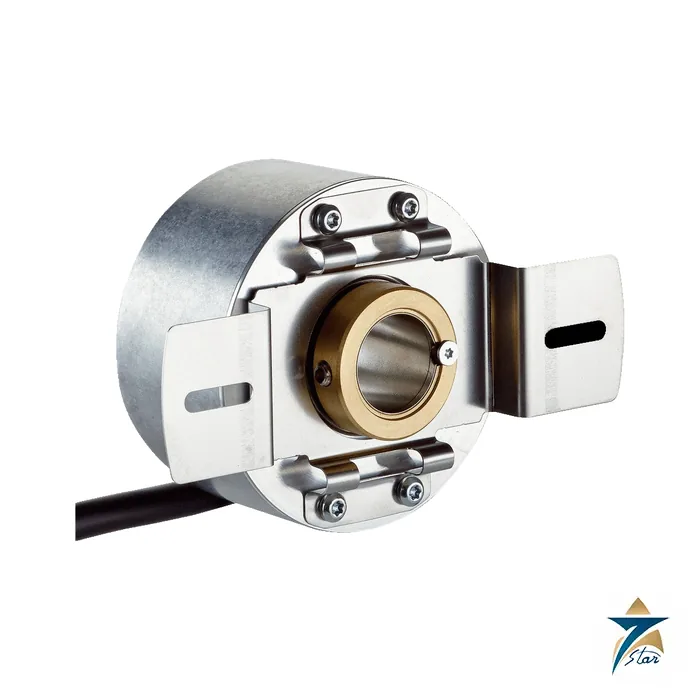
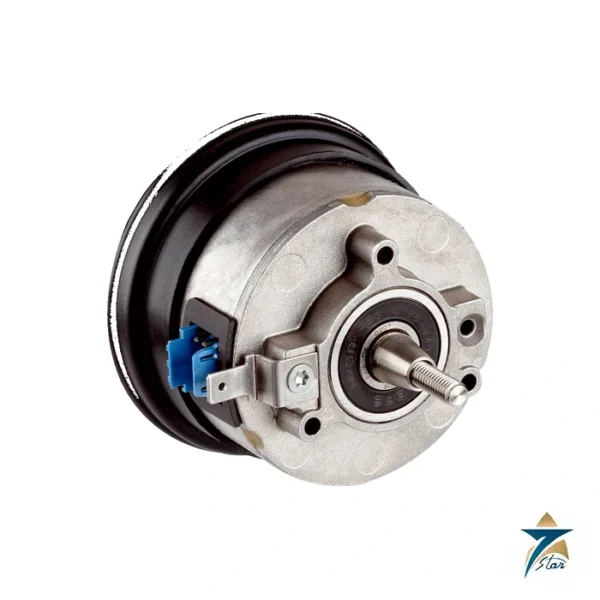
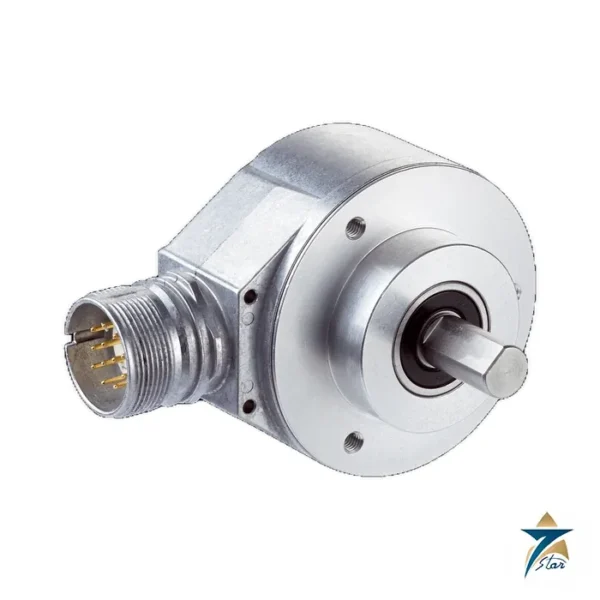
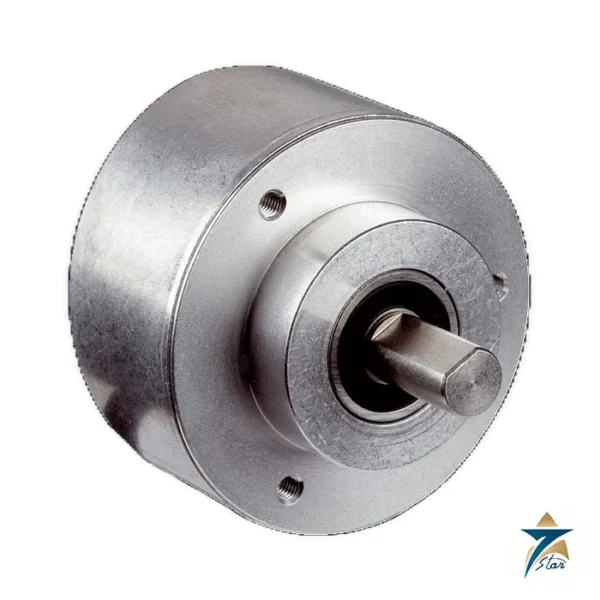
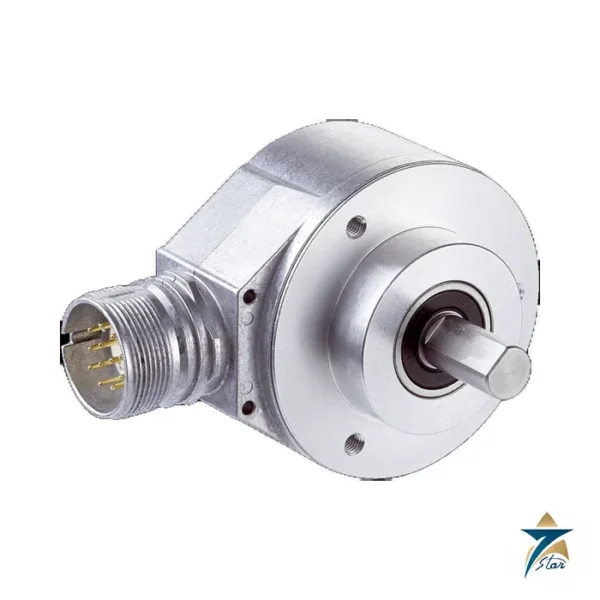
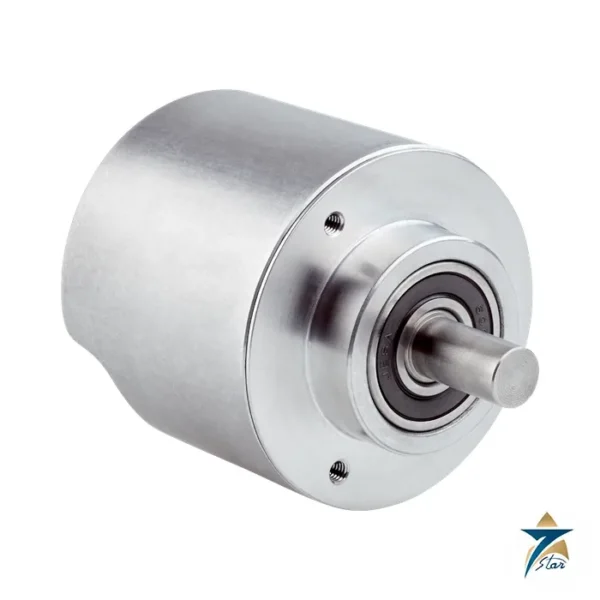
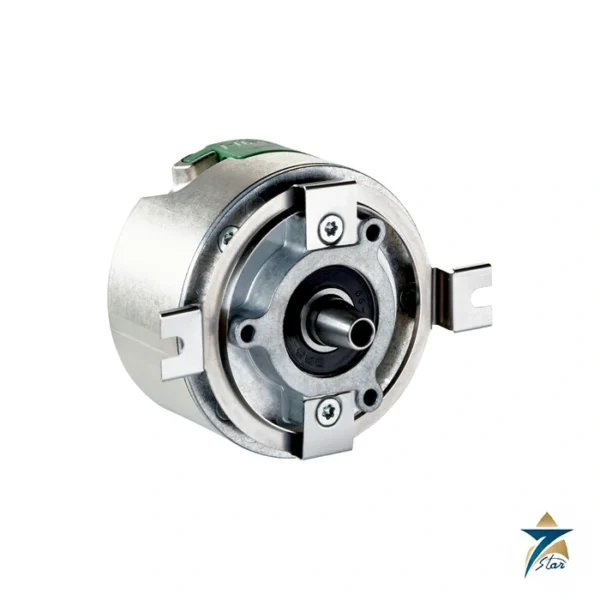
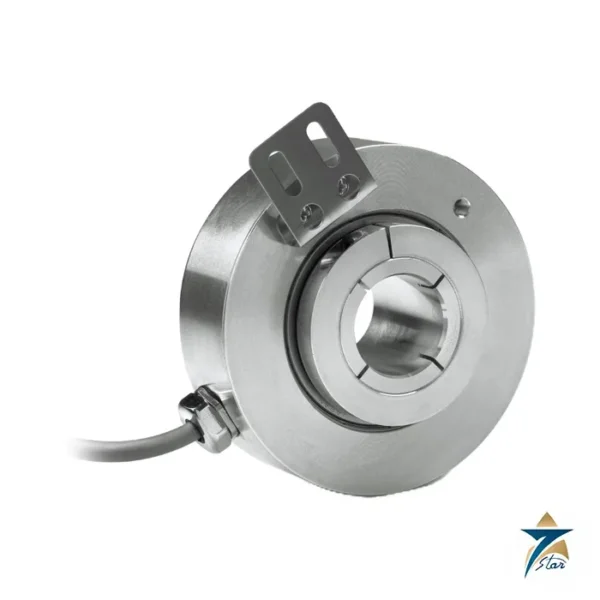
The SICK DBS60E-THEK01024 is an incremental rotary encoder with a through hollow shaft, taken from the DBS60 family. It converts shaft rotation into 1,024 pulses per revolution on a six-channel HTL push-pull output, and it is built to be pushed directly onto a motor or drive shaft instead of being coupled through a separate flexible coupling. Because the shaft is hollow, with a 15 mm bore and a front clamp, the encoder sits on the end of the machine shaft and is held against rotation by a two-sided stator coupling rather than by a rigid flange.
This is the version that suits drives, winders, fans and conveyor motors where a 15 mm shaft stub is available and the signal must travel over a long cable in an electrically noisy plant. The HTL output swings close to the supply voltage, which makes the pulse train far more tolerant of interference than a 5 V TTL signal.
Seven Star LLC is an independent supplier serving Oman and the GCC. Below you find the data of part number 1072470 as given in the manufacturer data sheet, with notes on fitting, wiring and maintenance.
Output signal and electrical data of the SICK DBS60E-THEK01024
Six channels means the encoder delivers the A and B tracks, a reference or zero pulse and the inverted version of each, which allows differential evaluation and cable-break detection in the controller. The reference signal is a single pulse per turn, positioned at 90 degrees electrical and logically gated with A and B. The duty cycle is 0.5 with a tolerance of 5 percent, and the measuring step is no more than 90 degrees electrical divided by the pulses per revolution, with a step deviation of plus or minus 18 degrees divided by the pulses per revolution.
The supply range is 10 V to 27 V, power consumption stays at or below 1 W without load and each channel can deliver up to 30 mA. Output frequency reaches 300 kHz, and the data sheet notes that up to 450 kHz is available on request. After switching on, valid signals appear within 5 ms. Short-circuit protection of the outputs and reverse polarity protection are fitted, with the note that a short to another channel, the supply or ground is permissible for a maximum of 30 seconds.
Technical specifications of the SICK DBS60E-THEK01024
| Parameter | Value |
|---|---|
| Type / part number | DBS60E-THEK01024 / 1072470 |
| Pulses per revolution | 1,024 |
| Output | Incremental, HTL / push-pull, 6-channel |
| Reference signal | 1 pulse, 90 degrees electrical, gated with A and B |
| Duty cycle | 0.5 plus or minus 5 percent |
| Supply voltage | 10 V to 27 V |
| Power consumption | 1 W or less without load |
| Load current | up to 30 mA per channel |
| Output frequency | up to 300 kHz (450 kHz on request) |
| Initialization time | less than 5 ms |
| Connection | Cable, 8-wire, universal, 1.5 m, PVC |
| Mechanical design | Through hollow shaft |
| Shaft diameter | 15 mm, front clamp |
| Flange / stator coupling | 2-sided stator coupling, slot, screw hole circle 63 to 83 mm |
| Weight | approximately 0.25 kg |
| Shaft material | Stainless steel |
| Flange and housing material | Aluminum |
| Start-up torque | about 0.5 Ncm at 20 degrees Celsius |
| Operating torque | 0.4 Ncm at 20 degrees Celsius |
| Operating speed | 6,000 per minute (9,000 per minute maximum) |
| Moment of inertia of rotor | 50 gcm2 |
| Bearing lifetime | 3.6 x 10 to the 9th revolutions |
| Angular acceleration | up to 500,000 rad/s2 |
| Enclosure rating | IP65 housing side and shaft side |
| Operating temperature | minus 20 to plus 85 degrees Celsius |
| Shock / vibration | 250 g, 3 ms / 30 g, 10 Hz to 2,000 Hz |
| MTTFD | 500 years |
Mounting a hollow-shaft encoder: notes for DBS60E-THEK01024
Slide the encoder onto the clean, burr-free drive shaft and tighten the front clamp as described in the mounting instructions. Fix the stator coupling to a stationary part of the machine so that the housing cannot turn but is free to follow small shaft movements. The data sheet allows static movement of plus or minus 0.3 mm radial and 0.5 mm axial, and dynamic movement of plus or minus 0.1 mm radial and 0.2 mm axial; shaft run-out or end float beyond these figures will shorten bearing life and distort the signal.
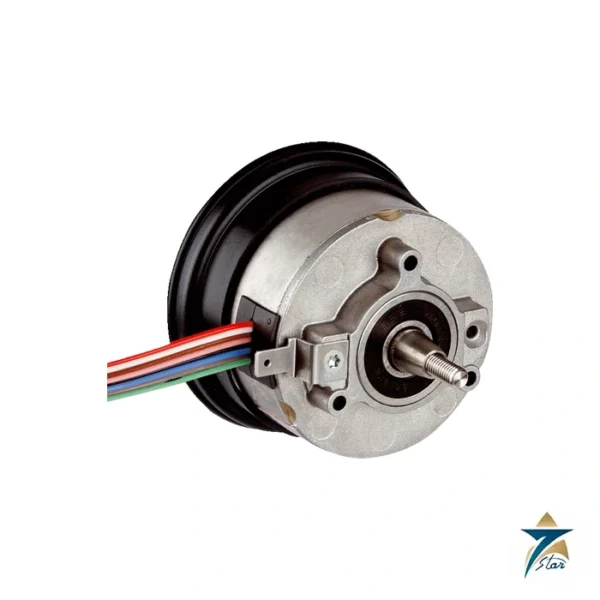
The universal cable exit is arranged so the 1.5 m cable can leave radially or axially without a tight bend. Route it away from power cables, use shielded cable for any extension and ground the shield at the controller end to keep within the EMC limits quoted for EN 61000-6-2 and EN 61000-6-3.
How DBS60E-THEK01024 differs from other DBS60 variants
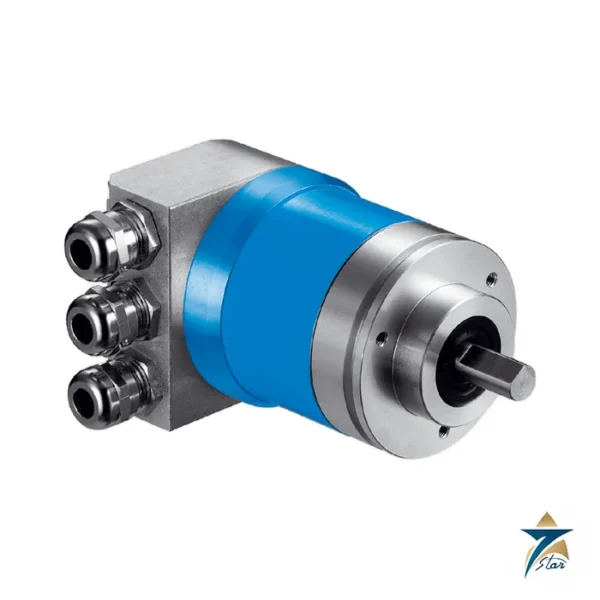
The DBS60 family covers many resolutions, outputs, shaft types and connections, and every combination has its own code. The SICK DBS60E-THEK01024 combines 1,024 pulses with HTL push-pull output, a 15 mm hollow shaft with front clamp and a fixed 1.5 m cable. A solid-shaft DBS60E with a flange adds a shaft that needs a coupling and has different allowable shaft loads, while a TTL version of the same resolution gives a 5 V differential output and a different supply window.
Select the code by checking four things: pulses per revolution, output level (HTL or TTL), shaft type and diameter, and connection. Changing any one of these means a different part number even though the housing looks identical.
Typical applications in Oman and the GCC
The encoder is a practical feedback device for variable-speed motors on pumps, fans and compressors in desalination and water-treatment stations, for cranes and hoists at ports, and for conveyors and rollers in manufacturing and logistics. Its IP65 housing resists washdown spray and dust, and the operating range up to plus 85 degrees Celsius covers motor-end temperatures in hot plant rooms.
On oil and gas sites it is commonly used on auxiliary drives outside hazardous areas, for speed monitoring and for positioning feedback to AC drives. Check the area classification of the installation separately, because this encoder is a standard industrial product.
Maintenance and service of the DBS60E-THEK01024
The only wear item is the bearing, rated for 3.6 x 10 to the 9th revolutions. At 6,000 revolutions per minute continuous running this represents many years of life, but heat, shock and misalignment reduce it. Allow for self-heating of 2.6 K per 1,000 rpm when judging the temperature at the bearing.
During a shutdown, check the clamp and stator coupling for looseness, inspect the cable jacket for abrasion and verify that pulses are clean on an oscilloscope. Keep the part number 1072470 and the type code at hand when replacing the unit so the identical resolution and output level are installed.
Related items you may also need: SICK IM30-20BPS-NC1 IMI Inductive Proximity Sensor | SICK MICS3-CBAZ40PZ1P01 microScan3 Safety Laser Scanner | SICK WTT12L-B2566 WTT12 PowerProx Diffuse Photoelectric Sensor | All SICK products.
Documents and quotation
The manufacturer data sheet for the SICK DBS60E-THEK01024 accompanies this page. It includes the dimensional drawing and the order data used in the notes above.
Send your RFQ with the part number DBS60E-THEK01024, the quantity and the delivery location in Oman or the GCC. Seven Star LLC will check availability of the SICK DBS60E-THEK01024 and can quote mating accessories such as cable extensions or stator couplings in the same request.
Datasheets & Documents
- Datasheet SICK DBS60E-THEK01024 Incremental Encoder, 1024 PPR, 15 mm Hollow Shaft Datasheet Download
Reviews (0)
How would you rate this product? Cancel reply
About brand
SICK is the German maker of industrial sensors: photoelectric and proximity sensors, safety laser scanners and light curtains, encoders, distance sensors, code readers and gas analysers. Erwin Sick, an optics engineer, founded it in Munich in 1946, and in 1952 it introduced its first marketable accident-prevention light curtain, which protected press operators by stopping the machine when a hand broke the light beam. The company moved to Waldkirch in the Black Forest in 1956 and is still headquartered there. It is a privately held company, and has been an Aktiengesellschaft (AG) since 1996.
SICK company profile
| Founded | 1946, Munich, Germany, by Erwin Sick (1909–1988) |
|---|---|
| Headquarters | Waldkirch, Baden-Württemberg, Germany (since 1956) |
| Ownership | Privately held; after the founder's death in 1988 his widow Gisela Sick became the main shareholder. Legal form SICK AG since 1996 |
| Size | More than 12,000 employees and group revenue of about EUR 2.3 billion (company figures for 2023) |
| First breakthrough | Accident-prevention light curtain for presses, shown in Hanover in 1952 |
| International growth | First foreign subsidiary in France in 1972, United States in 1976; today sales and service companies worldwide |
| Product families | Photoelectric, inductive, capacitive, magnetic and ultrasonic sensors; safety laser scanners, light curtains, safety controllers and relays; encoders and motor feedback systems; distance sensors and LiDAR; barcode and 2D code readers and machine vision; gas analysers, dust and flow measurement for process and emissions monitoring |
Milestones
- 1946: Erwin Sick receives a licence to run his engineering firm in Munich.
- 1952: The first marketable accident-prevention light curtain is presented in Hanover and goes into series production.
- 1956: The company moves to Waldkirch with 25 employees.
- 1972 and 1976: Subsidiaries are founded in France and the United States.
- 1996: SICK becomes an Aktiengesellschaft.
- Today: Sensors for factory and logistics automation, machine safety and process analysis, with a large share of revenue outside Germany.
Choosing a SICK sensor
For object detection, the sensing principle comes first. A retro-reflective sensor (WL series) sends light to a reflector and switches when an object breaks the beam; it is reliable over long distances and easy to align. A sensor with background suppression (WTB series) detects an object at a set distance and ignores what is behind it, which suits conveyors with shiny or dark backgrounds. A through-beam pair (WS/WE) gives the longest range and the highest reliability in dust. For transparent bottles and film, use a model built for transparent objects (for example WL12G-3B or WL150-P420). The digits in the code also matter: "P" usually means a PNP output and "N" NPN, and the last digits set the connector or cable. For machine guarding, a safety laser scanner such as nanoScan3 or microScan3 protects an area, while a safety controller such as Flexi Soft combines several safety devices.
Where SICK products are used
In Oman and the GCC, SICK sensors are used in packaging and bottling lines, food and beverage plants, logistics and airport baggage handling, cement and steel plants, ports and cranes, automated warehouses, and on machines built by European OEMs. SICK safety scanners guard robots and automated guided vehicles, and its encoders give position feedback on motors, hoists and conveyors.
SICK products we list
| Family | Examples |
|---|---|
| Photoelectric sensors | WL12-3P2431, WTB12-3P2431, GTB6-P4211, VL18-4P3240, WL12G-3B2531, WS/WE100, KT5W contrast, W26 IO-Link |
| Proximity, cylinder and ultrasonic sensors | IME12-08NPSZC0S, IME18-05BPSZC0S, MZT8, UM18 4-20 mA, UM30, UFN3 fork |
| Machine safety | nanoScan3, microScan3, S300 Professional, Flexi Soft FX3-CPU1, FX3-XTIO, ReLy OSSD |
| Encoders and motor feedback | DFS60B, AFM60 PROFINET, AFS60 SSI, ATM60 PROFIBUS, SRS50, EFS50 |
| Distance sensors and code readers | DT50, DL50, DT35, Lector632 |
Ordering SICK products: what we need
Send the type code and the 7-digit SICK part number from the label (for example WTB12-3P2431 together with its part number). For a replacement sensor, add the output (PNP or NPN), connection (M8, M12 or cable) and sensing distance. For encoders, add the interface (incremental, SSI, PROFIBUS, PROFINET), resolution and shaft type. For safety scanners, tell us the model and whether the existing configuration needs to be kept.
Frequently requested SICK models: SICK WTB4-3 Miniature Photoelectric Proximity Sensor, SICK IME18-08NPSZW2K Inductive Proximity Sensor, SICK DT35-B15251 Laser Distance Sensor, SICK microScan3 Safety Laser Scanner, SICK RZT7-03ZUS-KWB T-Slot Cylinder Sensor.
Facts checked against SICK's published company history and annual figures, October 2026.
Browse SICK products by category: Sensors & Transmitters.
FAQ
Questions about the SICK DBS60E-THEK01024 Incremental Encoder, 1024
Answers from our engineering team on installation, compatibility and integration.
01How many pulses per revolution does the DBS60E-THEK01024 output?
It produces 1,024 pulses per revolution on a six-channel HTL push-pull output with one reference pulse per turn.
02What shaft does the DBS60E-THEK01024 fit?
It is a through hollow-shaft encoder with a 15 mm shaft diameter, front clamp and a two-sided stator coupling with a screw hole circle of 63 to 83 mm.
03What supply voltage does the DBS60E-THEK01024 need?
The supply range is 10 V to 27 V DC, with power consumption of 1 W or less without load and up to 30 mA load current per channel.
04What is the operating temperature of the DBS60E-THEK01024?
The data sheet gives minus 20 to plus 85 degrees Celsius for operation, with IP65 protection on both the housing side and the shaft side.
05How is the DBS60E-THEK01024 connected?
It has an 8-wire universal PVC cable of 1.5 m length that can be routed radially or axially without bending.


Reviews
There are no reviews yet.