Honeywell DCP50 1/16 DIN controller programmer overview
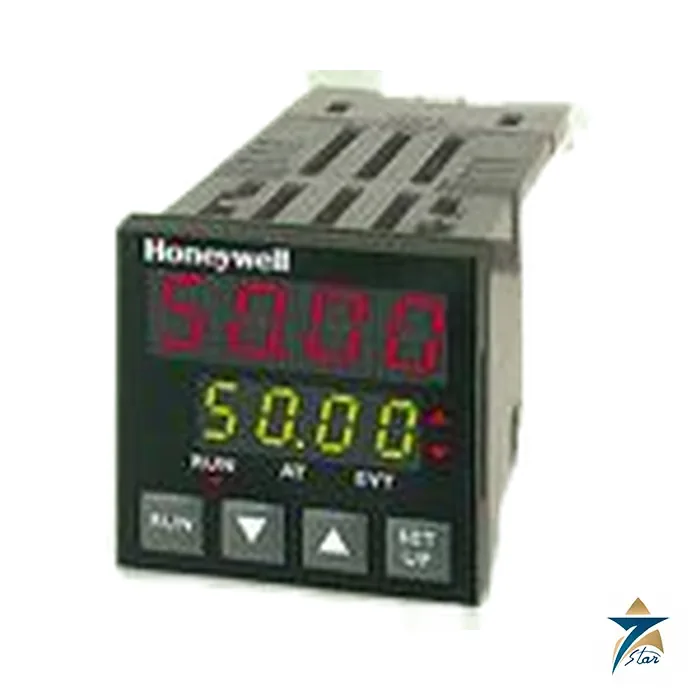
The Honeywell DCP50 is a microprocessor-based 1/16 DIN controller programmer. It combines a PID controller with a setpoint profiler that can store up to four program profiles of up to sixteen segments each, so a temperature, pressure or level setpoint can follow a ramp and soak pattern automatically. The manufacturer positions it for plastics, food, furnaces, packaging and environmental chambers.
The DCP50 uses the same Micro-Pro hardware concept as the UDC1200: a universal input, a dual four-digit LED display, plug-in output modules and a jumper-free configuration. The upper display always shows the process variable, and the lower display can show the setpoint, a ramping setpoint or be blank. A four-digit security code protects the configuration.
This page summarises the manufacturer documentation for the Honeywell DCP50 for buyers in Oman and the GCC. Seven Star LLC is an independent supplier serving Oman and the GCC and is not affiliated with the manufacturer.
Key features of the DCP50
The following features come from the manufacturer specification for the DCP50.
- Four program profiles with up to sixteen segments each, with segment times from 0 to 99 hours 59 minutes or 0 to 99 minutes 59 seconds.
- Guaranteed soak, which makes the profile check that the process is within range at the end of a ramp before the soak timer starts.
- Profile recovery for cold start or warm start after a power interruption, and profile cycling from no cycling up to infinite cycling.
- Universal input accepting thermocouples, RTDs and linear current or voltage signals, with accuracy of 0.25 percent of span plus or minus one digit.
- Up to three outputs, chosen from relay, solid state relay driver, solid state triac and linear types, with time proportional, current proportional and duplex algorithms.
- Two event alarms on PV or deviation, plus a loop alarm that detects faults in the control loop, and a digital input for remote run and hold.
- Optional RS485 Modbus RTU communication at up to 9600 baud, linking up to 32 units to a host computer.
- Support software kit with a Program Editor for graphical profile setup and a Configurator, using a connector on the underside of the unit.
DCP50 technical specifications
The table lists the main data for the DCP50 from the manufacturer specification sheet.
| Parameter |
Value |
| Model |
DCP50 |
| Format |
1/16 DIN, 110 mm deep case |
| Programs |
Up to four profiles |
| Segments |
Up to 16 per profile |
| Segment time |
0 to 99 h 59 min, or 0 to 99 min 59 s |
| Guaranteed soak |
Soak width 0 to 1000 units |
| Cycle count |
0 to 9999 or infinite |
| Accuracy |
0.25 percent of span plus or minus 1 LSD |
| Temperature stability |
0.01 percent of span per degC |
| Display |
Dual four-digit LED, 7 segment |
| Outputs |
Up to three: relay SPDT 2 A, SSR driver, SS triac, linear |
| Event alarms |
Two, PV or deviation high, low or absolute, plus loop alarm |
| Digital input (optional) |
Remote run and hold |
| Communication (optional) |
RS485 Modbus RTU, up to 32 units, up to 9600 baud |
| Power supply |
90 to 264 V ac, 50/60 Hz; 24/48 V ac/dc optional |
| Power consumption |
4 W |
| Weight |
210 g maximum |
| Operating temperature |
0 to 55 degC |
| Front face |
NEMA 3 and IP65 |
Typical applications in Oman and the GCC
The DCP50 is used when a process must follow a time-based setpoint profile in a small panel opening. Typical uses in Oman and the GCC include the following.
- Oil and gas: curing, drying and heat-soak cycles in workshops and laboratory ovens that support maintenance and testing.
- Utilities and power: stress-relief or pre-heat cycles for small components and controlled warm-up of test equipment.
- Water and wastewater: laboratory incubators and drying ovens for sample preparation.
- Manufacturing: plastics, food baking and drying, packaging and environmental test chambers that need repeatable ramp and soak profiles.
Selection and compatibility notes for the DCP50
Choose the DCP50 when the application needs a programmed profile in a 1/16 DIN cutout. If no profile is needed, the UDC1200 offers the same hardware as a plain controller. If you need more segments, a graphical display or two loops, the 1/4 DIN DCP250 is the larger programmer in the Honeywell range.
Check the model selection guide for the output modules and options. Outputs 2 and 3 can serve as event alarms, and the digital input provides remote run and hold. The RS485 option, the 24/48 V supply and the extra outputs are chosen at the time of ordering.
Installation and commissioning of the DCP50
Install the DCP50 using the pre-assembled mounting fixture.
- Cut the panel opening for a 1/16 DIN unit and allow 110 mm depth behind the panel.
- Wire the rear screw terminals and keep sensor cabling away from power wiring.
- Configure the input and outputs from the front keys or with the support software, then enter each profile.
- Run pre-tune and test one profile at low risk before using it on a production batch.
Maintenance and service life
The DCP50 keeps its configuration in non-volatile memory. Keep the front face clean, check terminals at planned shutdowns and verify the input calibration on your normal schedule. Keep a copy of each profile in the support software so a replacement unit can be loaded quickly.
Related products and ordering notes
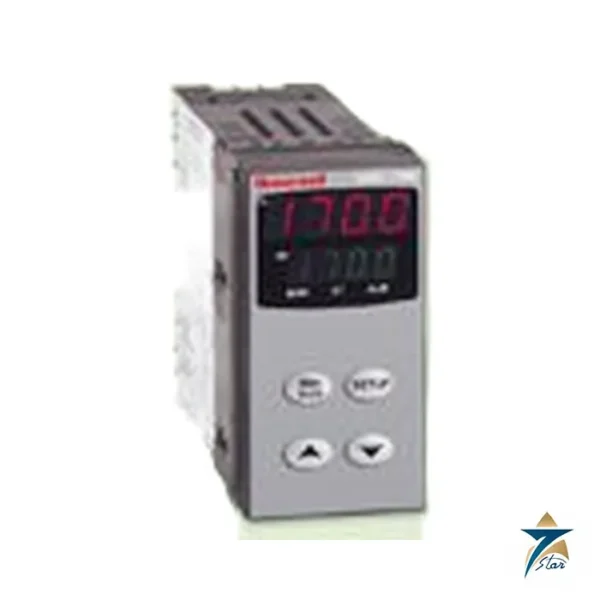
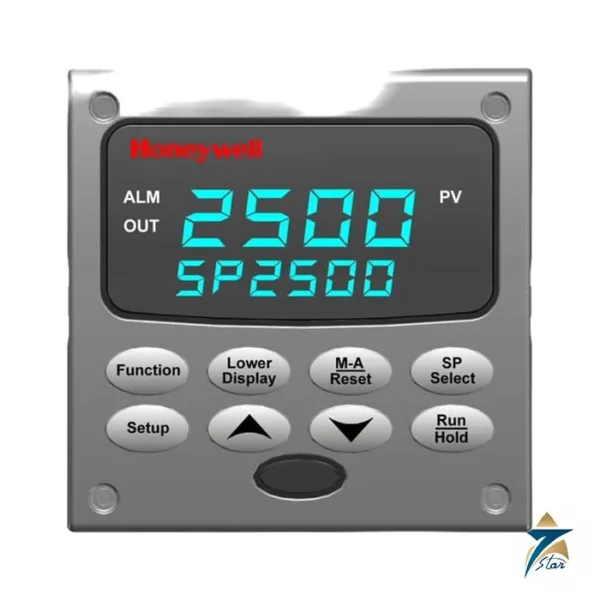
Related Honeywell controllers available on request include the UDC1200, DCP250 and the UDC2500 for loops that need a timer or ramp and soak option. Send the full model code so Seven Star LLC can quote the correct configuration.
DCP50 questions in brief
Buyers ask about profile capacity and communication. The DCP50 stores four profiles of sixteen segments, has a universal input and offers optional RS485 Modbus. The answers below summarise the main points.
Documents and quotation
The manufacturer datasheet for the DCP50 is available from Seven Star LLC with this listing when it is attached, and it should be read together with the installation manual before any engineering decision. To request a quotation, send an RFQ that states the part number DCP50, the quantity, the delivery location and, where relevant, the options you need. Seven Star LLC replies with availability and lead time; no price is published on this page.
























Reviews
There are no reviews yet.