Endress+Hauser t-mass A 150 thermal mass flowmeter for utility gases
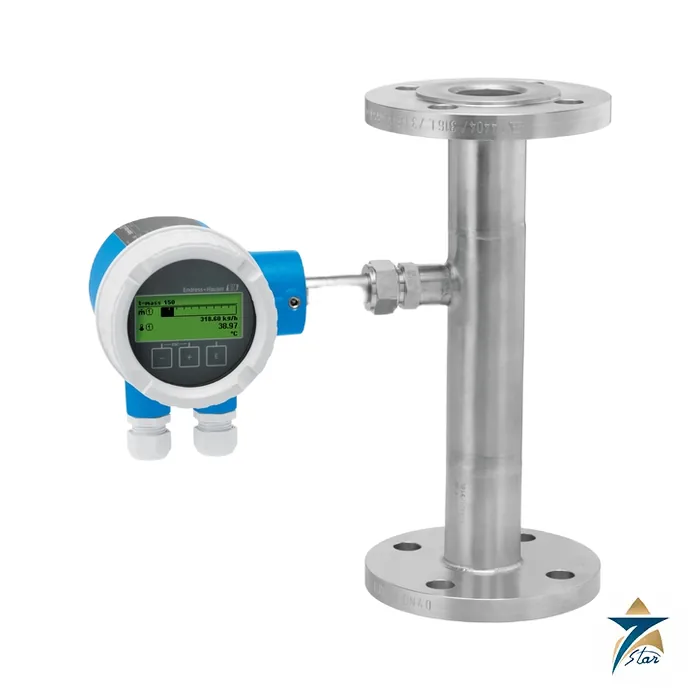
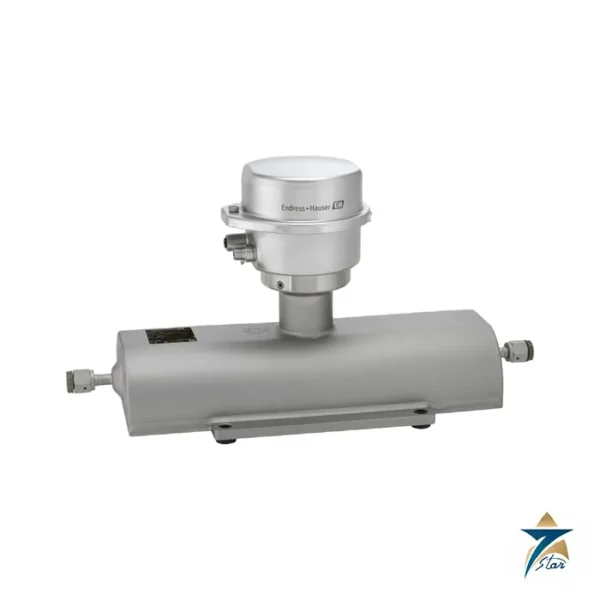
The Endress+Hauser t-mass A 150 (product root 6AAB) is an inline thermal mass flowmeter built for cost-effective measurement of utility gases, with compressed air as the main target. It is positioned by the manufacturer for sub-metering, where many branch lines have to be monitored and the budget per measuring point is limited. It covers nominal diameters DN 15 to 50 (½ to 2″) and sits at the simple end of the Endress+Hauser thermal range. Seven Star LLC supplies Endress+Hauser instruments in Oman and the GCC as an independent supplier in Muscat, and this page collects the verified data for specifiers and buyers.
The device is suitable for air, nitrogen, carbon dioxide and argon. It reports mass flow directly, so the reading is not affected by changes of line pressure and temperature the way a volumetric meter is, and it also provides temperature, corrected volume flow and free air delivery (FAD) volume flow.
t-mass A 150 technical specifications
| Parameter |
Specification |
| Manufacturer / part number |
Endress+Hauser / t-mass A 150 (6AAB) |
| Measuring principle |
Thermal mass flow |
| Nominal diameter |
DN 15 to 50 (½ to 2″), inline version |
| Measured variables |
Mass flow, temperature, corrected volume flow, FAD volume flow |
| Measuring range (air) |
0.5 to 910 kg/h (1.1 to 2002 lb/h) or 0.5 to 1365 kg/h (1.1 to 3003 lb/h), depending on the “Calibration flow” ordering option |
| Max. measurement error |
3 % o.r., 4 % o.r. or 5 % o.f.s., depending on the “Calibration flow” option |
| Medium temperature |
–40 to +100 °C (–40 to +212 °F) |
| Ambient temperature |
–40 to +60 °C (–40 to +140 °F) |
| Max. process pressure |
PN 40, Class 300 |
| Wetted materials |
Transducer and insertion tube 1.4404 (316L); measuring tube 1.4404 or 1.4435 (316L); connection 1.4404 (F316/F316L), 1.4404 (316L) or 1.4435 (316L) |
| Transmitter housing |
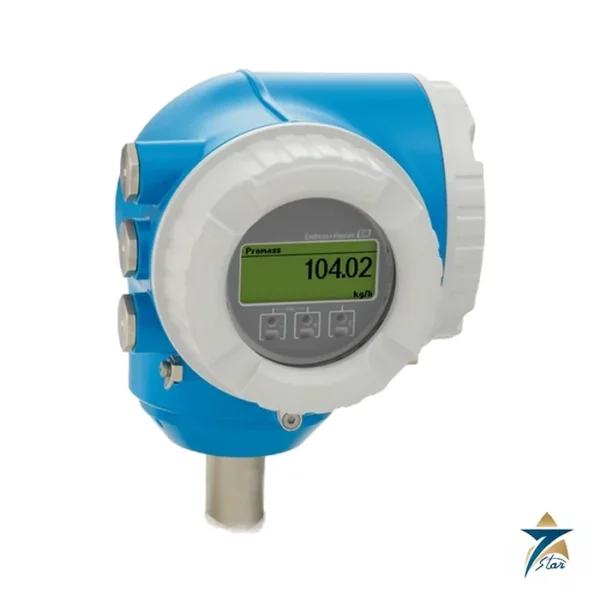
AlSi10Mg, coated; compact, with 4-line display or blind version |
| Degree of protection |
IP66/67, Type 4X enclosure |
| Power supply |
DC 18 to 30 V (compact version with DC 24 V supply) |
| Outputs |
4–20 mA HART (active), pulse/frequency/switch output (passive), status input; HART communication |
| Hazardous area approvals |
ATEX, IECEx, cCSAus |
| Pressure and metrology |
PED, CRN; calibration on accredited facilities per ISO/IEC 17025; NAMUR |
How the t-mass A 150 measures mass flow
Thermal mass flowmeters use the fact that a gas stream carries heat away from a heated element in proportion to how many gas molecules pass it, not merely how fast they travel. Electronics keep the heated sensing element at a controlled difference from the gas temperature, and the power needed to hold that difference is converted into mass flow. There is no moving part, no orifice and no need for separate pressure and temperature transmitters to compensate the reading. This is why the technique is widely used on compressed air, where pressure varies with compressor loading and demand.
Endress+Hauser describes the measuring principle as having a high operable flow range and direct mass flow measurement, with easy measurement even at low pressures and low flow velocities and negligible pressure loss. The datasheet-level accuracy figure depends on the calibration flow chosen at ordering, so the range you pick also decides the error class.
Where the t-mass A 150 fits in the t-mass family
The t-mass family is split by duty. The A 150 is the compact, utility-grade inline meter for small lines. Larger or more demanding duty moves up to the Proline-generation meters: the t-mass F 300 and F 500 are inline meters for DN 15 to 100 with gas-mixture programming, bidirectional measurement and a wider medium temperature range up to +180 °C, and the t-mass I 300 and I 500 are insertion meters for DN 80 to 1500. If your compressed air line is above 2″ or the gas is something other than the four gases above, one of those models is the correct step. The manufacturer lists the earlier Air Flow Trend Meter as the predecessor of the t-mass A 150.
Typical system partners are a PLC, an energy-monitoring system or a remote I/O station that reads the 4–20 mA signal or the pulse output for totalising, with HART used for configuration and diagnostics.
Selection checklist
- Gas: the A 150 is intended for air, nitrogen, carbon dioxide or argon. State the gas clearly in the enquiry.
- Line size from DN 15 to 50 and the required process connection type and pressure rating, up to PN 40 or Class 300.
- Minimum and maximum flow in kg/h, or in normal cubic metres if you work in volumetric units, so that the correct “Calibration flow” option can be matched to the range.
- Accuracy class: 3 %, 4 % of reading or 5 % of full scale, which depends on that calibration option.
- Gas temperature inside –40 to +100 °C and ambient inside –40 to +60 °C.
- Display or blind version; the display can store settings and copy them from one device to another.
- Hazardous-area approval (ATEX, IECEx or cCSAus) where the meter will be near classified areas.
- Output wiring: 24 V DC supply, active 4–20 mA, pulse/frequency/switch.
Installation, commissioning and maintenance
As with every thermal meter, the sensing element needs a developed, stable flow profile. Keep the meter away from valves, elbows, regulators and reducers as far as the line layout allows, and follow the inlet and outlet runs given in the Endress+Hauser documentation for the specific order code. Install the meter in the flow direction marked on the body and make sure the gas is dry enough that liquid water does not film the sensor, since condensate on a heated element distorts the reading. For wet compressed air, mount downstream of the dryer rather than directly after the compressor.
Commissioning is guided by operating menus and can be done from the local display or from a HART handheld or software. The manufacturer lists self-diagnostics, error monitoring and automatic recovery of data for servicing as benefits, and installation is described as maintenance-free in normal operation. Practical upkeep consists of checking the loop signal against a plant reference, looking for oil or dirt on the sensor if compressor oil carry-over is suspected, and keeping the order code and serial number on file so that a replacement or a recalibration can be specified accurately.
Typical applications in Oman and the GCC
Compressed air is the largest hidden energy cost in many Gulf plants, and leaks are common in hot, dusty yards where pipework is exposed. Branch metering with an inexpensive thermal meter such as the t-mass A 150 lets a maintenance team compare consumption by area and detect night-time flow that indicates leakage. Nitrogen blanketing and purge lines at oil and gas facilities, carbon dioxide dosing at water treatment and desalination sites, and argon supply to fabrication and welding bays are other realistic uses of the same product. Outdoor installations should consider sun load on the coated aluminium housing and keep the ambient limit of +60 °C in mind, using shading where the unit would otherwise heat above it.
Choosing between the A 150 and other t-mass meters
| Model |
Version |
Size range |
Medium temperature |
| t-mass A 150 |
Inline, compact, utility gases |
DN 15 to 50 |
–40 to +100 °C |
| t-mass F 300 / F 500 |
Inline, Proline, compact or remote |
DN 15 to 100 |
–40 to +180 °C |
| t-mass I 300 / I 500 |
Insertion, Proline |
DN 80 to 1500 |
–40 to +180 °C |
Information to send with an RFQ
Please send the gas type, line size, flange or thread standard, minimum and maximum flow, operating pressure and temperature, required accuracy class, display preference and any hazardous-area or documentation requirements. If you already have a nameplate or an order code from an installed meter, include a photo so the replacement can be matched exactly.
Documents and quotation
Please send the part number and the options you need, and we will confirm available documents such as the Endress+Hauser technical information and operating instructions.
Seven Star LLC prepares quotations for delivery to Oman and the GCC, with lead time confirmed on request.



















Reviews
There are no reviews yet.