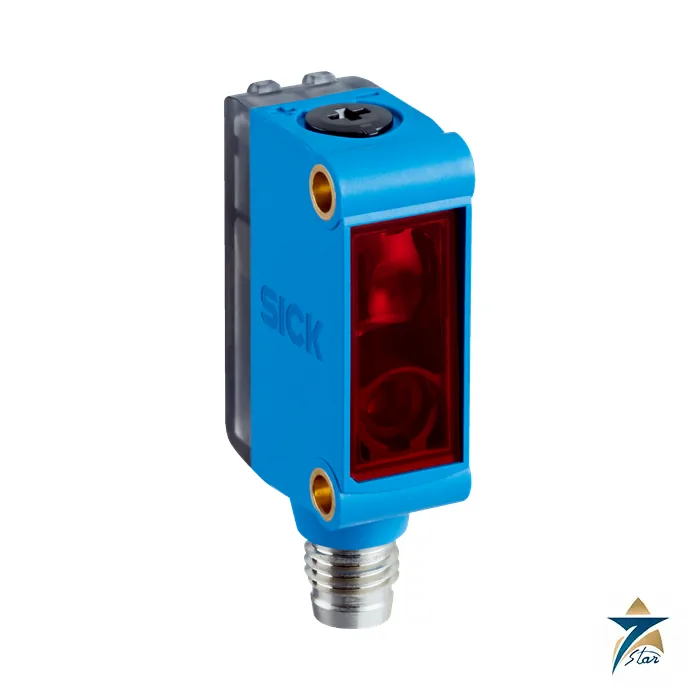
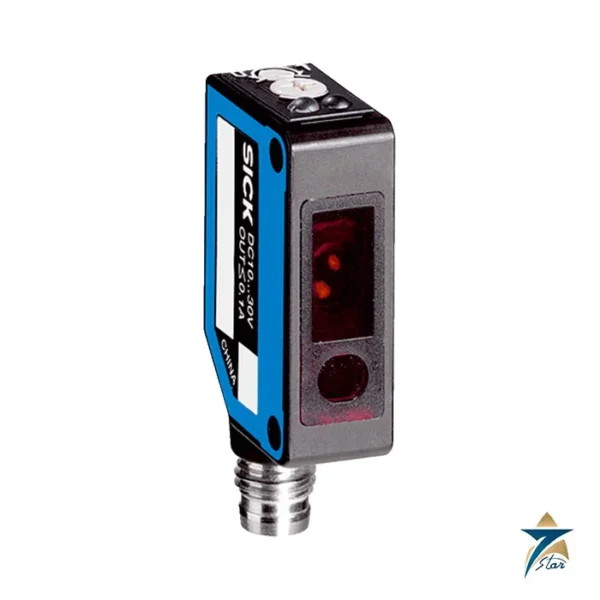
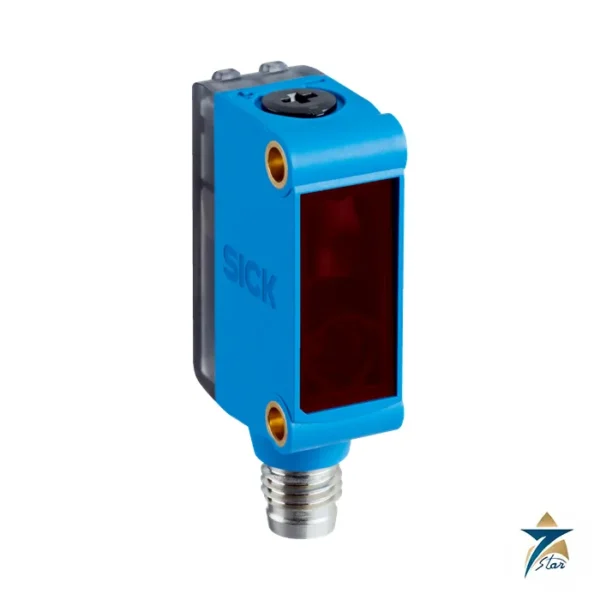
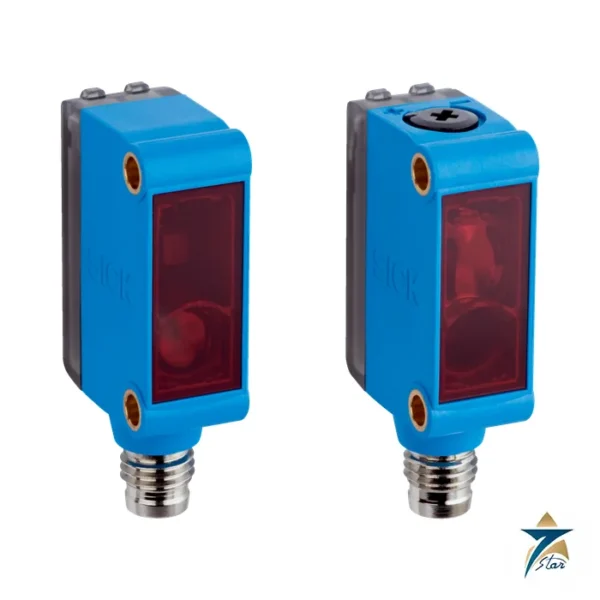
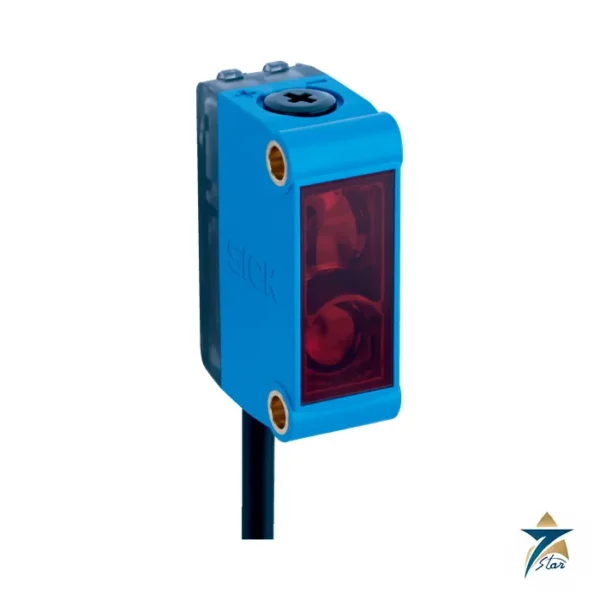
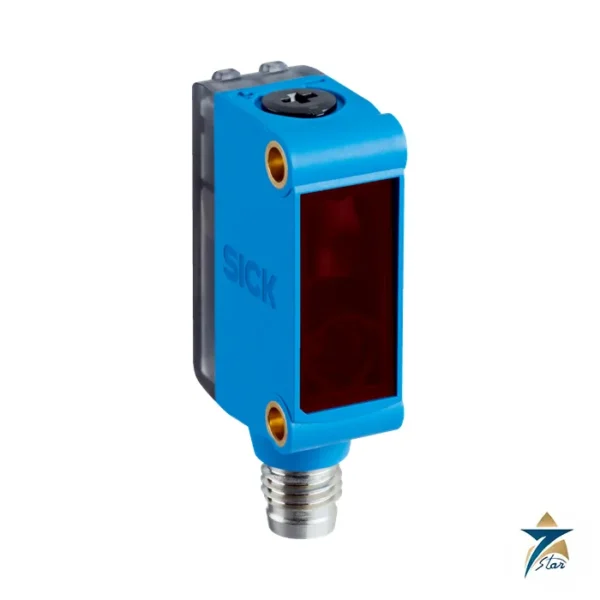
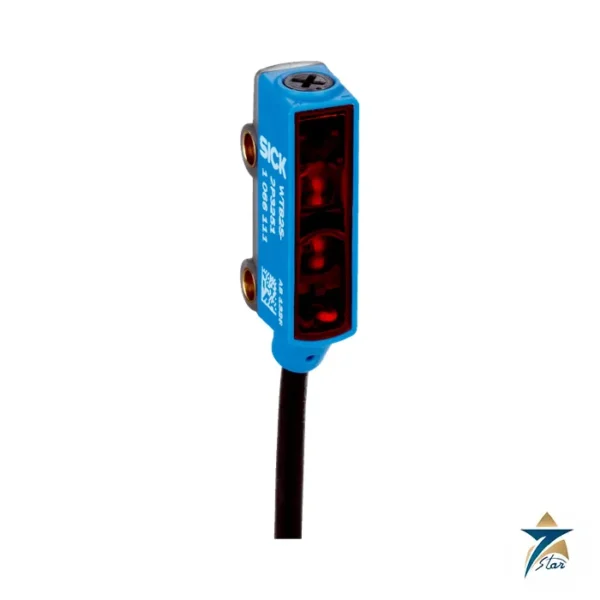
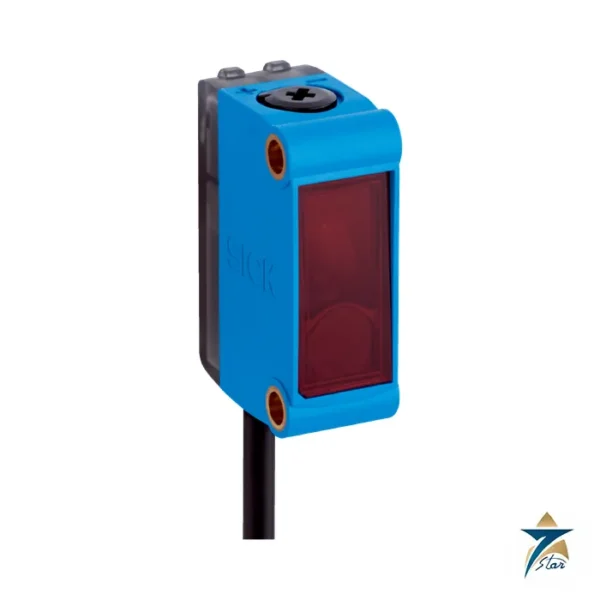
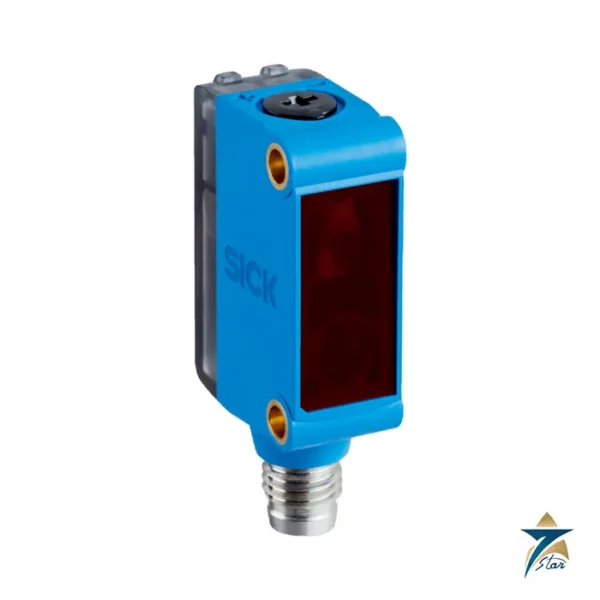
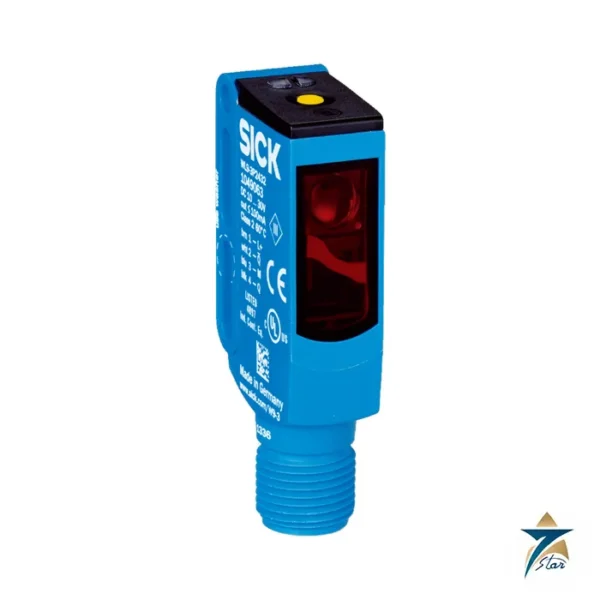
GL6L-P3211 is a SICK G6 retro-reflective photoelectric sensor (part no. 1117677) that sends a light beam to a reflector and switches when an object interrupts it. The catalogue summary lists: sensing range min. / max.: 0.08 m / 12 m; functional principle: Photoelectric retro-reflective sensor; switching output: PNP; switching mode: Light/dark switching; connection type: Connector M8, 3-pin.
GL6L-P3211: function, principle and typical use
A triple reflector returns the light to the sensor even when it is not perfectly aligned, and the sensing range in the table depends on the reflector type used for the measurement, so a smaller reflector or a dirty one shortens the usable range. Polarisation filters in the sensor allow shiny objects to be detected: a mirror-like surface reflects light without rotating its polarisation, so it is not mistaken for the reflector.
Sensors without a polarising filter can be fooled by glossy packaging, so check the light type and the principle listed for this type. Alignment is straightforward: the visible spot should hit the reflector in its centre, and the signal indicator LED shows whether enough light returns.
Technical specifications
| Parameter |
Specification |
| Type code |
GL6L-P3211 |
| Part number |
1117677 |
| Product family |
G6 |
| Functional principle |
Photoelectric retro-reflective sensor |
| Sensing range: Sensing range min. |
0.08 m |
| Sensing range: Sensing range max. |
12 m |
| Sensing range: Maximum distance range from reflector to sensor (operating reserve 1) |
0.08 m … 12 m |
| Sensing range: Recommended distance range from reflector to sensor (operating reserve 2) |
0.08 m … 10 m |
| Sensing range: Reference reflector |
Reflector P250F |
| Sensing range: Recommended sensing range for the best performance |
0.08 m … 4.2 m |
| Polarisation filter |
Yes |
| Emitted beam: Light source |
Laser |
| Emitted beam: Type of light |
Visible red light |
| Emitted beam: Shape of light spot |
Point-shaped |
| Emitted beam: Light spot size (distance) |
Ø 3.5 mm (1,000 mm) |
| Emitted beam: Maximum dispersion of the emitted beam around the standardized transmission axis (squint angle) |
< +/- 1.5° (at TU = +23 °C) |
| Key laser figures: Normative reference |
IEC 60825-1 / CDRH 21 CFR 1040.10 & 1040.11 |
| Key laser figures: Laser class |
1 |
| Key laser figures: Wave length |
680 nm |
| Key laser figures: Pulse duration |
2 µs |
| Key laser figures: Maximum pulse power |
≤ 11.9 mW |
| Key laser figures: Average service life |
100,000 h at Ta = +25 °C |
| Adjustment: Potentiometer |
For setting the sensing range |
| Adjustment: Operating mode switch |
For inverting the switching function (light/dark switching) |
| MTTFD |
1,005 years |
| DCavg |
0 % |
| Supply voltage UB |
10 V DC … 30 V DC |
| Usage category |
DC-13 (According to EN 60947-5-2) |
| Current consumption |
≤ 20 mA, without load. At UB = 24 V |
| Digital output: Number |
1 |
| Declarations and certificates in the data sheet |
EU declaration of conformity; UK declaration of conformity; ACMA declaration of conformity; Moroccan declaration of conformity; China RoHS; China Compulsory Product Certification (CCC) exempt; cULus certificate; Laser safety (IEC 60825-1) declaration of manufacturer |
Type code GL6L-P3211 and what to check before ordering
For the control cabinet and the cable run, the relevant figures are range of 0.08 m; supply of 10 V DC … 30 V DC; frequency of 1,000 Hz; current of ≤ 20 mA, without load. At UB = 24 V; response time of ≤ 625 µs.
For the mounting location, note dimensions is 12 mm x 31.5 mm x 21 mm; light source is Laser; wavelength is 680 nm; enclosure rating is IP67 (EN 60529); weight is approx. 60 g; vibration is 10 Hz … 55 Hz (Amplitude 0.5 mm, 3 x 30 min (EN60068-2-6)); operating temperature is –20 °C … +50 °C.
Compare the complete type code with the unit being replaced.
Typical uses are detection of boxes and containers on conveyors, door and gate monitoring, pallet and vehicle presence, and counting in packaging machines.
Related SICK products: SICK GL6G-P4211 Retro-Reflective Sensor, SICK WL4SL-3P2232 W4 Retro-Reflective Sensor, SICK GL6-P1212 G6 Retro-Reflective Sensor Set, 2 m Cable, SICK WL12G-3V2572 Retro-Reflective Sensor, SICK GL6-P4211 G6 Retro-Reflective Photoelectric Sensor, M8 and SICK WL4SLG-3P5254H W4 Retro-Reflective Sensor.
Setting up the GL6L-P3211 on site
The GL6L-P3211 is a retro-reflective sensor, so the emitter and receiver are in one housing and the light beam returns from a reflector mounted opposite. SICK specifies the reflector P250F as the reference reflector. The maximum distance from reflector to sensor is 0.08 m to 12 m (operating reserve 1) and the recommended range is 0.08 m to 10 m (operating reserve 2). For the best performance SICK recommends 0.08 m to 4.2 m, so a short, well-aligned beam gives the most margin against dust and misalignment.
Commissioning uses three simple elements described in the data sheet:
- Potentiometer for setting the sensing range.
- Operating mode switch for inverting the switching function between light switching and dark switching.
- Two LEDs: green is static on when power is on; yellow shows the status of the received light beam (static on when no object is present, static off when an object is present).
The polarisation filter helps the sensor ignore reflections from shiny objects passing through the beam, which is useful on conveyors carrying metal cans or film-wrapped packs.
Why the laser light source matters
The visible red laser (680 nm, laser class 1) produces a point-shaped light spot of about Ø 3.5 mm at 1,000 mm. SICK states the smallest detectable object as typically 3.5 mm at 1 m distance. This makes the sensor suitable for detecting small parts, edges and narrow gaps where a standard LED sensor would have a much wider spot. The visible beam also makes alignment easy. SICK’s data sheet warns not to look into the laser beam intentionally or point it at people’s eyes. The electrical side is simple: 10 to 30 V DC supply, one PNP output rated up to 100 mA, response time up to 625 µs and a switching frequency of 1,000 Hz.
Documents and quotation
The official SICK data sheet for GL6L-P3211 (part no. 1117677) is attached as a PDF. Send the type code, quantity and delivery location through the RFQ form and Seven Star LLC, an independent supplier in Muscat, will respond with a quotation. Similar products sit under Sensors & Transmitters. Confirm the full code against the device it replaces; if this page and the data sheet ever disagree, follow the data sheet.



















Reviews
There are no reviews yet.