Short GR18 reflex sensor with fixed sensitivity and dark switching
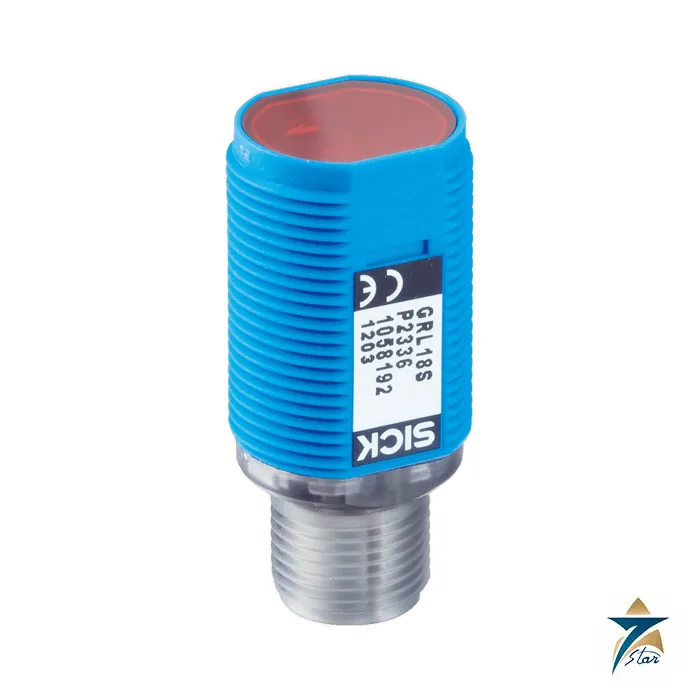
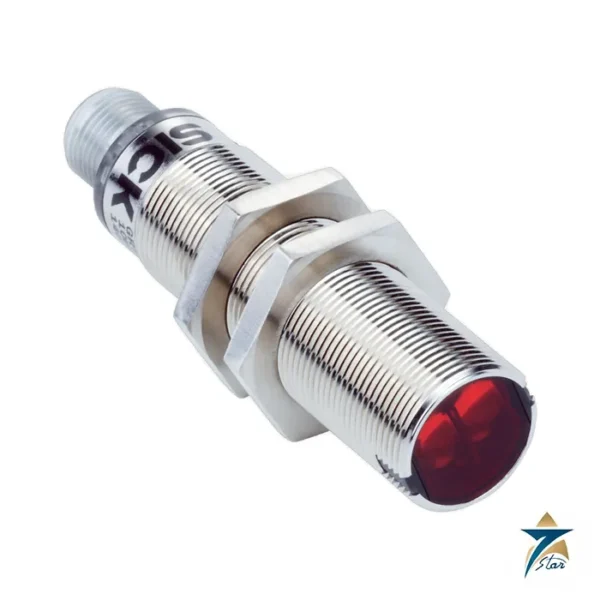
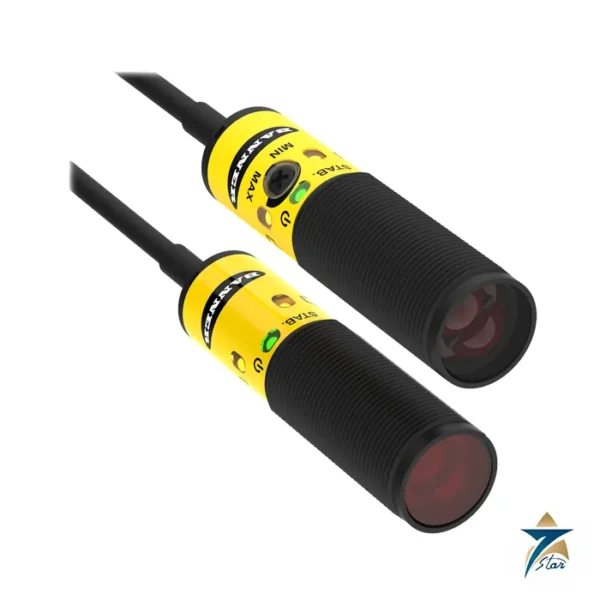
The SICK GRL18S-F2336 (part no. 1059533) is a short-bodied GR18 retro-reflective sensor, only 38.1 mm long in an M18 x 1 plastic ABS housing. It reads a PL80A reflector from 0.06 m to 6 m (maximum 0.03 m to 7.2 m) with a PinPoint LED and polarisation filter, switches in dark mode (output active when the beam is blocked) and offers no adjustment, which reduces set-up to alignment only.
An M12 3-pin connector and two status LEDs complete the package.
Technical specifications
| Parameter |
Specification |
| Manufacturer |
SICK |
| Type / family |
GRL18S-F2336 / GR18 |
| Part no. |
1059533 |
| Functional principle |
Photoelectric retro-reflective sensor, dual-lens system |
| Sensing range max. / typical |
0.03 m … 7.2 m / 0.06 m … 6 m (reflector PL80A) |
| Polarisation filter |
Yes |
| Light source / type |
PinPoint LED, visible red light, 650 nm |
| Light spot size |
175 mm diameter at 7 m |
| Adjustment |
None |
| Indicators |
Green LED: power on; yellow LED: beam status (on = object not present) |
| Items supplied |
2 x fastening nuts |
| Supply voltage UB |
10 V DC … 30 V DC |
| Ripple |
below 5 Vpp |
| Current consumption |
30 mA |
| Output |
PNP, dark switching |
| Output current Imax. |
100 mA |
| Response time / switching frequency |
below 500 microseconds / 1,000 Hz |
| Protection class |
III |
| Dimensions |
M18 x 1 thread; 18 mm x 18 mm x 38.1 mm |
| Housing / optics |
Plastic ABS / plastic PMMA |
| Connection |
Connector M12, 3-pin |
| Enclosure rating |
IP67 |
| EMC |
EN 60947-5-2 |
| Ambient temperature |
-25 °C … +55 °C operation; -40 °C … +70 °C storage |
| MTTFD |
2,712 years (DCavg 0 %, TM 20 years) |
| UL file no. |
NRKH.E348498 and NRKH7.E348498 |
When a 38 mm sensor is the answer
A housing length of 38.1 mm lets the sensor fit behind a thin panel, inside a chute wall or on a short machine bracket where a 74 mm M18 barrel would stick out. With no potentiometer to be turned by accident, the sensor suits OEM equipment that must be tamper-resistant.
Dark switching means the output is active when the beam is interrupted, the usual choice for object detection with a normally-open input on the controller. Check the PLC logic if you replace a light-switching sensor with this one. A 3-pin M12 connector is used, so existing 4-pin cordsets may need adapting.
Ordering information
Order GRL18S-F2336 with part number 1059533. The longer GRL18-P2432 (1066557) offers a potentiometer and complementary outputs; do not interchange them without checking the connector pinout and switching logic. A reflector is not in the delivery.
Key features of the GRL18S-F2336
- Retro-reflective operation with a polarisation filter, so the sensor responds to light returned by a corner-cube reflector and ignores most direct reflections from shiny objects.
- PinPoint LED with visible red light at 650 nm, which makes alignment to the reflector easy by eye.
- Fast response below 500 µs and a switching frequency of 1 000 Hz, enough for counting products on a moving conveyor.
- IP67 housing rated for washdown and dusty areas.
- Low current draw of 30 mA on a 10 to 30 V DC supply.
Alignment and installation
Mount the reflector square to the beam at the far side of the detection zone, then point the sensor at it until the yellow LED indicates that the beam is received. Because the light spot is large, 175 mm across at 7 m, small mounting errors are tolerated, but keep the working distance well inside the typical range of 6 m to leave margin for dust on the optics. Use both nuts supplied to lock the M18 thread firmly; on vibrating frames a sensor that drifts slowly off the reflector is a frequent cause of intermittent faults. Route the cable away from motor and drive cables, and give it a drip loop when mounting outdoors.
Detecting transparent or shiny objects
A polarised retro-reflective sensor rejects the mirror-like reflections that would otherwise make a glossy carton look like the reflector. It is not intended for clear bottles or films, which may let enough light through to hold the output in the “beam present” state; for those, a sensor designed for transparent objects is the right choice.
Maintenance
Because there is no sensitivity adjustment, maintenance is limited to keeping the front lens and the reflector clean and checking alignment. Wipe the optics with a soft cloth and a mild cleaner; solvents can attack the PMMA lens. Replace reflectors that are scratched or faded, since reduced reflectivity shortens the effective range.
Operation in Oman and GCC environments
The operating range of −25 to +55 °C covers indoor plants, but sensors on outdoor conveyors or loading bays can exceed 55 °C in direct summer sun; a shade hood or relocation is advisable there. Airborne dust settles on both the lens and the reflector, so include them in the routine cleaning round, especially in cement, mining and food-processing sites. Strong low-angle sunlight shining directly into the receiver can also disturb any optical sensor, so orient it away from open doors where possible.
What to include in your RFQ
- Type GRL18S-F2336 and part number 1059533.
- Quantity and delivery location.
- Reflector type and number, such as PL80A.
- M12 3-pin cordset length and whether straight or angled connectors are needed.
- Mounting brackets, if the existing ones are not reused.
Wiring the PNP output
Connect brown to the positive supply, blue to 0 V and black to the PLC input. With a PNP output the sensor sources current to the input, which matches the common sinking input cards used in European-style control panels. If the controller uses sourcing inputs, an NPN version or an interface relay is required instead, so check the input card before installation.
Documents and quotation
The official SICK data sheet for GRL18S-F2336 (part no. 1059533) is attached to this page, and the figures in the table above are taken from it. Seven Star LLC is an independent supplier in Muscat and quotes SICK items against a written request. In your enquiry, give the exact type code, part number, quantity and delivery location, and say whether you need accessories such as a reflector, cordset or protective hood. Data sheets carry a note that content is subject to change without notice, so confirm current details before ordering. More items are listed under sensors and transmitters, and you may also look at the SICK WTB4-3 miniature photoelectric sensor.







Reviews
There are no reviews yet.