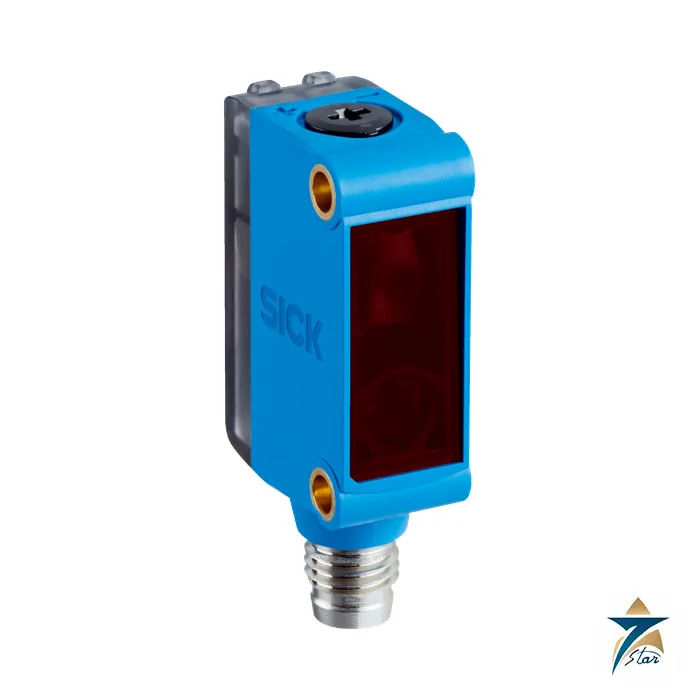
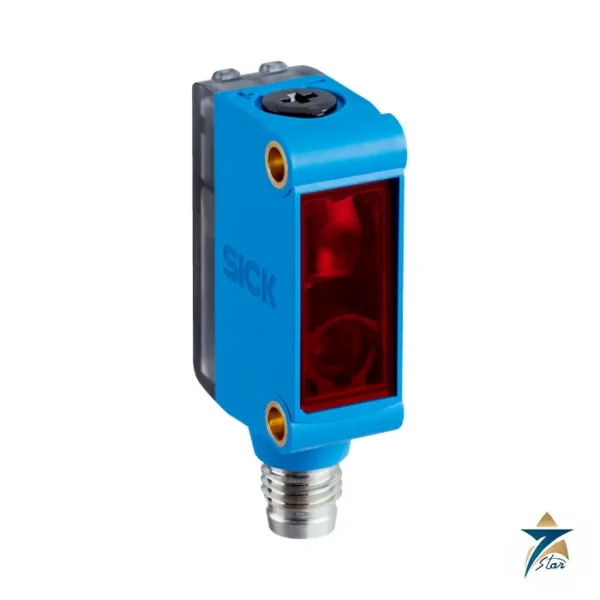
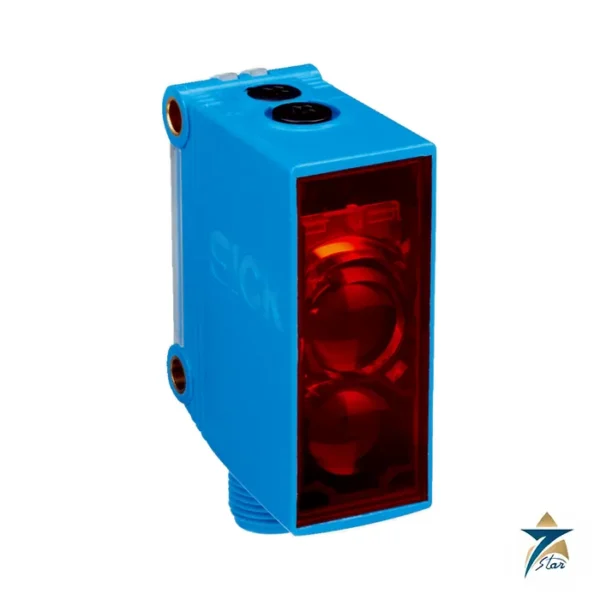
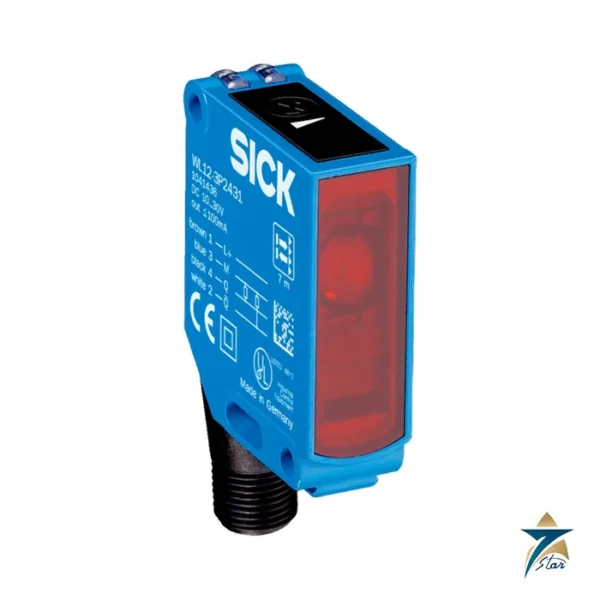
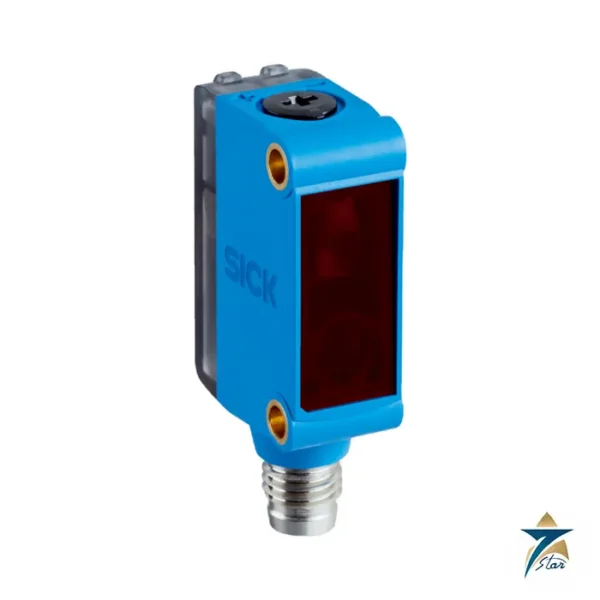
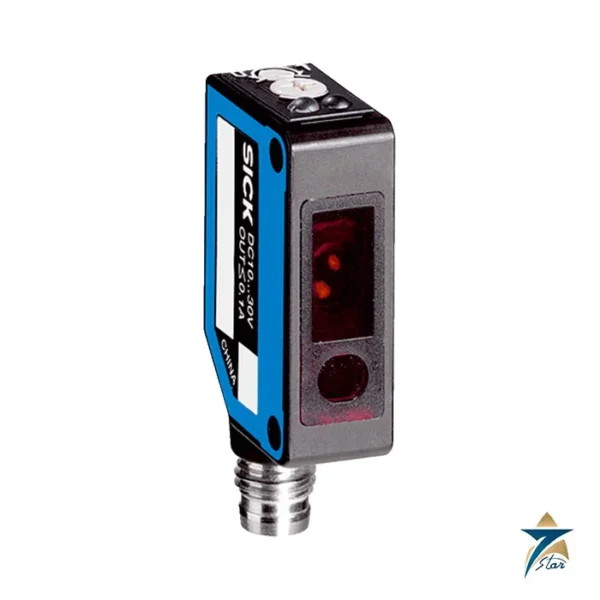
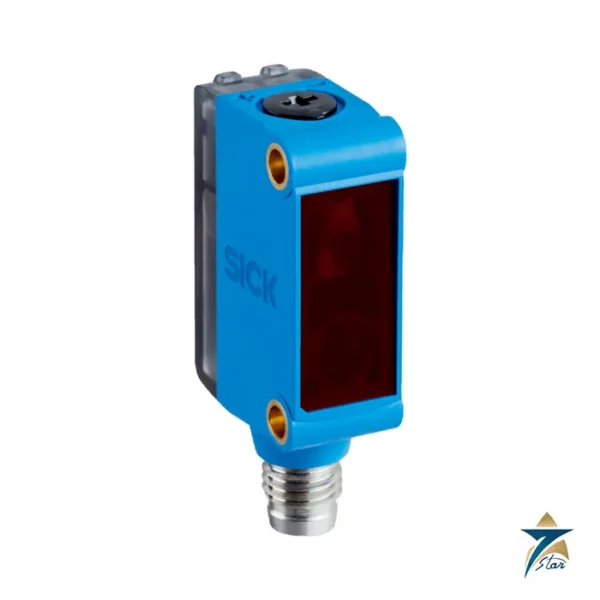
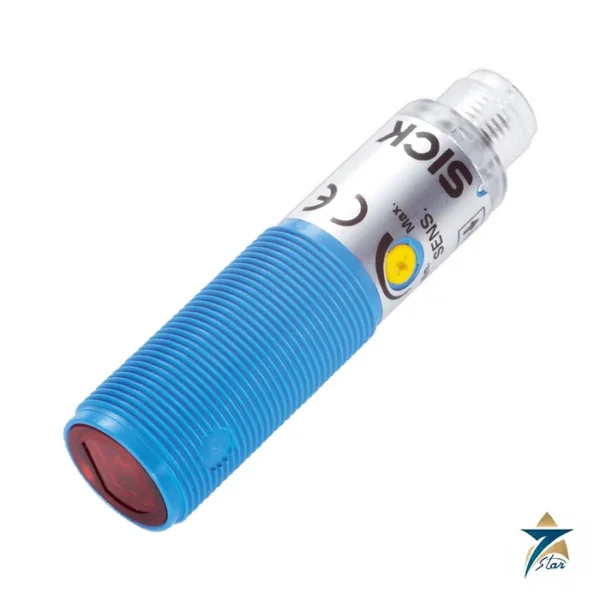
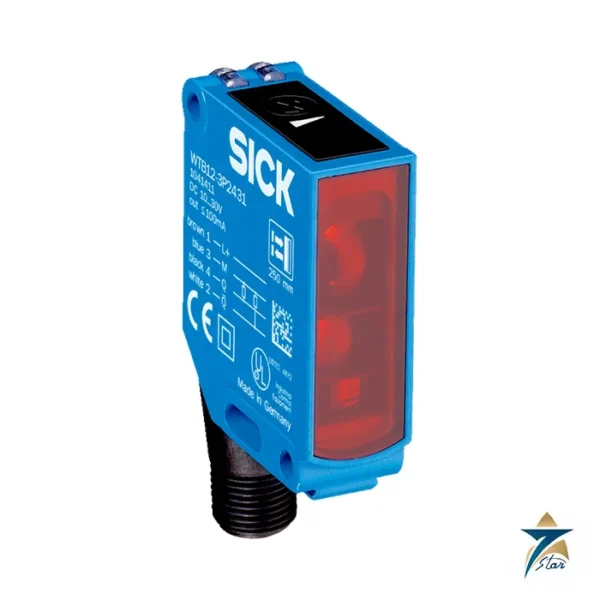
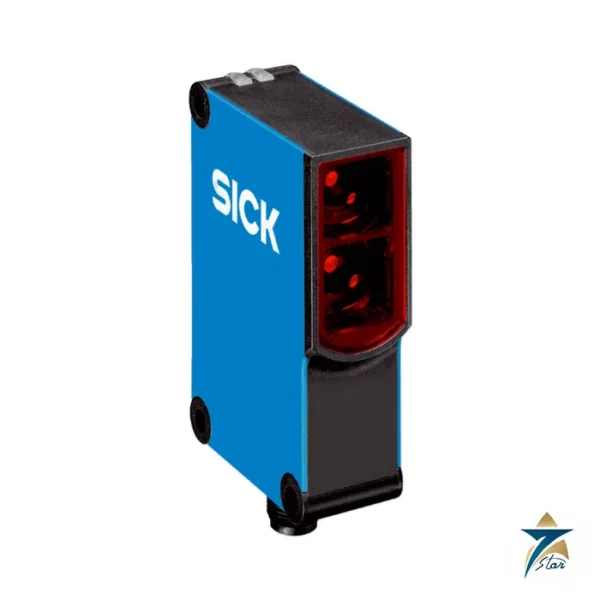
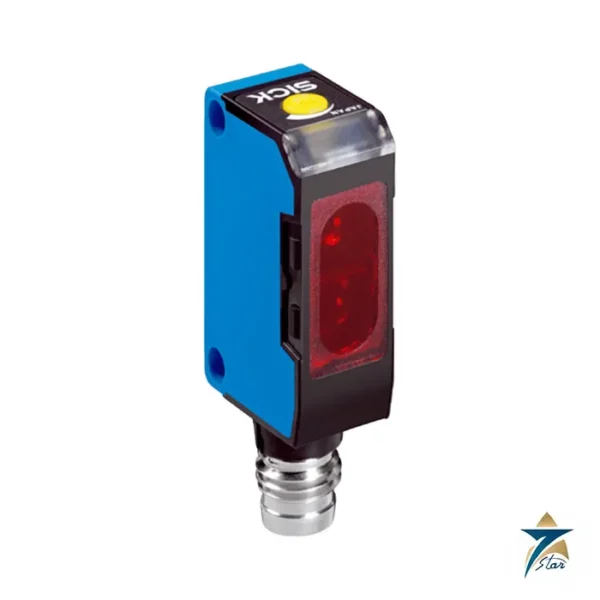
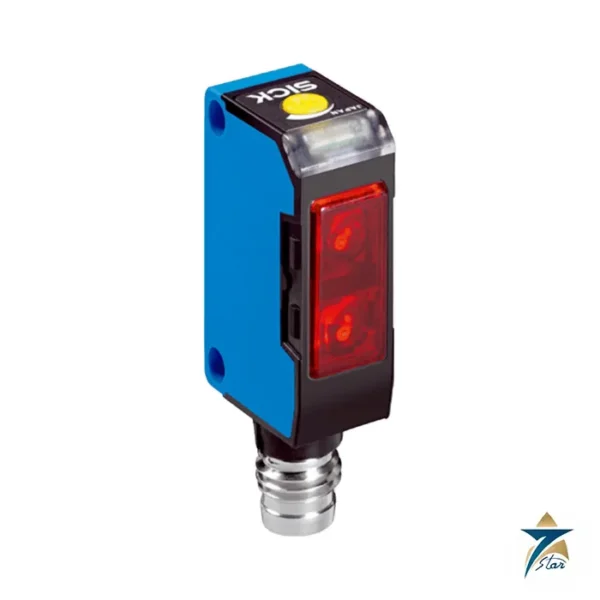
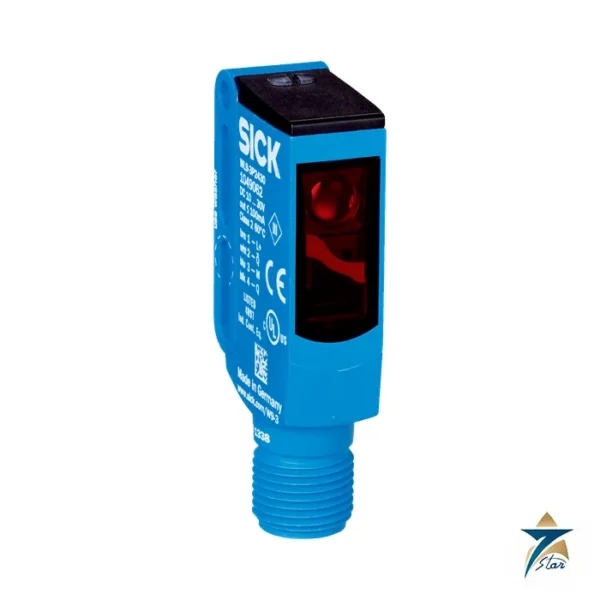
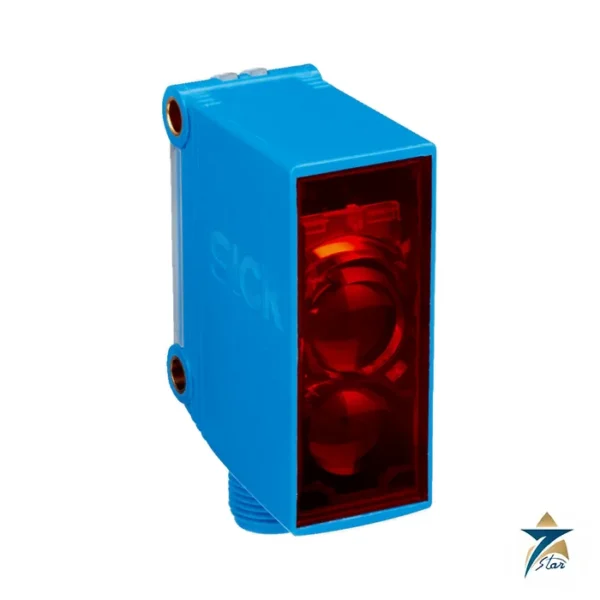
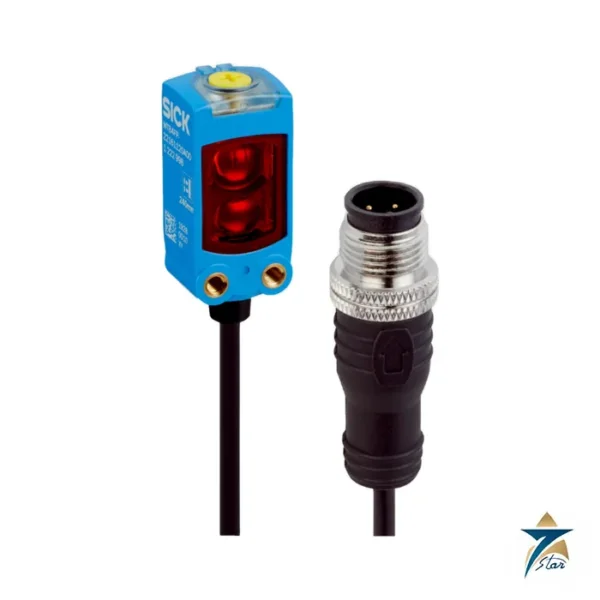
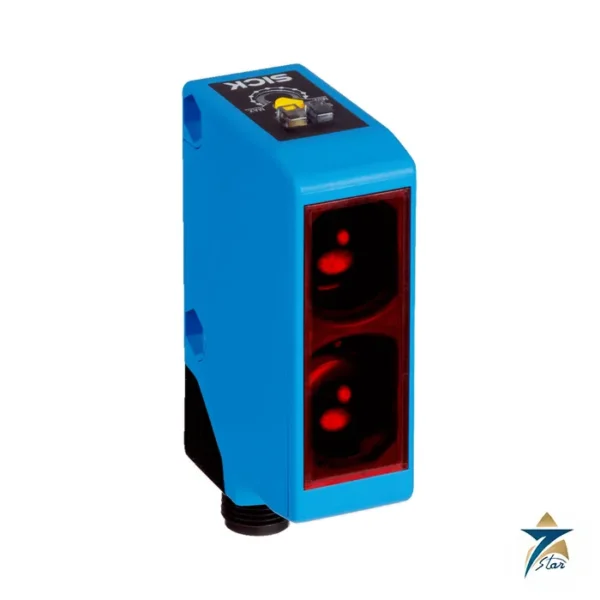
Part number 1052442 is the GTB6-P4212, a background-suppression proximity sensor from SICK’s G6 range. Objects inside the set range switch the output, while whatever lies beyond it (a guard, a belt frame, a wall) is ignored. The data sheet gives a maximum sensing range of 5 mm … 250 mm (sensing range value printed as 35 mm … 140 mm). The switching output is PNP with light/dark switching, the supply is 10 V DC … 30 V DC and the connection is Male connector M8, 4-pin.
Where the GTB6-P4212 fits: detecting objects against a busy background
Background suppression is a triangulation method: the receiver sees the returning light spot at a position that depends on object distance, and only spots inside the cut-off set at the adjuster switch the output. Keep the front screen clean: a film of dust or oil lowers the received light and shifts the effective switching point over time.
On the GTB6-P4212 the light source is PinPoint LED emitting visible red light with a spot of Ø 6 mm (100 mm). Adjustment method: mechanical spindle, 5 turns. Typical response: < 625 µs.
Technical specifications
| Parameter |
Specification |
| Type code |
GTB6-P4212 |
| Part number |
1052442 |
| EAN |
4047084257797 |
| Product family |
G6 |
| Functional principle |
Photoelectric proximity sensor |
| Functional principle detail |
Background suppression |
| Sensing range max. |
5 mm … 250 mm |
| Sensing range |
35 mm … 140 mm |
| Emitted beam: Light source |
PinPoint LED |
| Emitted beam: Type of light |
Visible red light |
| Emitted beam: Light spot size (distance) |
Ø 6 mm (100 mm) |
| Key LED figures: Wave length |
650 nm |
| Adjustment |
Mechanical spindle, 5 turns |
| Items supplied |
Stainless steel mounting bracket (1.4301/304) BEF-W100-A |
| MTTFD |
1,886 years |
| DCavg |
0 % |
| Supply voltage UB |
10 V DC … 30 V DC |
| Ripple |
± 10 % |
| Current consumption |
30 mA |
| Protection class |
III |
| Digital output: Type |
PNP |
| Digital output: Switching mode |
Light/dark switching |
| Digital output: Switching mode selector |
Selectable via light/dark selector |
| Digital output: Signal voltage PNP HIGH/LOW |
VS – (≤ 3 V) / approx. 0 V |
| Digital output: Output current Imax. |
≤ 100 mA |
| Digital output: Response time |
< 625 µs |
| Digital output: Switching frequency |
1,000 Hz |
| Circuit protection |
A ; B ; D |
| Housing |
Rectangular |
| Dimensions (W x H x D) |
12 mm x 31.5 mm x 21 mm |
| Connection |
Male connector M8, 4-pin |
| Material: Housing |
Plastic, ABS/PC |
| Material: Front screen |
Plastic, PMMA |
| Weight |
20 g |
| Enclosure rating |
IP67 |
| Ambient operating temperature |
–25 °C … +55 °C |
| Ambient temperature, storage |
–40 °C … +70 °C |
| Declarations and certificates in the data sheet |
EU declaration of conformity; UK declaration of conformity; ACMA declaration of conformity; Moroccan declaration of conformity; China RoHS; China Compulsory Product Certification (CCC) exempt; cULus certificate; Photobiological safety (DIN EN 62471) certificate |
Type code GTB6-P4212 and part number 1052442
The code GTB6-P4212 is a description, not a guarantee of interchangeability. Two sensors with the same prefix can differ in cable or plug, in PNP or NPN output and in sensing range, and SICK gives each its own seven-digit number. For a replacement, match part number 1052442, or send us the label photo and we will check the neighbouring variants against it.
Neighbouring versions of this family that SICK lists as active, with their part numbers:
- GTB6-P4211 (part no. 1052438)
- GTB6-P4211S66 (part no. 1086856)
- GTB6-P4211S83 (part no. 1096868)
- GTE6-P4211 (part no. 1050710) – Functional principle detail: Energetic
- GTE6-P4212 (part no. 1051781) – Functional principle detail: Energetic
Mounting, wiring and set-up notes for GTB6-P4212
The unit runs from 10 V DC … 30 V DC and carries IP67 protection; ambient temperature in operation is –25 °C … +55 °C. Current draw is 30 mA. The body measures 12 mm x 31.5 mm x 21 mm and weighs 20 g. Supplied with it: Stainless steel mounting bracket (1.4301/304) BEF-W100-A. Check light/dark switching against the logic of the PLC before commissioning, so that a wire break or a dead sensor is handled the way the machine expects.
Application checks before selecting the GTB6-P4212
Background suppression works best when there is a clear distance between the object to be detected and the background that must be ignored. Measure the nearest and farthest positions of the object on the machine, then the distance to the conveyor frame, wall or guard behind it, and confirm that a switching point can be set comfortably between the two within the 35 mm to 140 mm sensing range. If the object and the background sit very close together, or the object is highly reflective, glossy or very dark, run a practical test on site before committing the design.
Check the electrical side as well: the PNP output must match the input card of the PLC or relay, the load must stay within the 100 mA output limit, and the M8 4-pin connector needs a matching cable at the right length for the cable route.
Mounting and alignment on the line
Fix the sensor with the supplied BEF-W100-A bracket on a rigid part of the machine, so that vibration does not move the beam during operation. Aim the red light spot at the area where the object passes, and tilt the sensor slightly if a shiny object or background reflects light straight back towards the receiver. Route the cable with a strain relief loop and keep it away from motor and drive cables.
Setting the switching point
With the target object in its normal position, turn the mechanical spindle until the output switches reliably, then remove the object and confirm that the background does not trigger it. Repeat the test with the darkest and the brightest objects that the machine will handle, and set the light/dark selector so that the output state matches the control logic. Record the final setting on the machine documentation so that a replacement can be adjusted the same way.
Use in hot, dusty and humid conditions in Oman
Packaging lines, bottling plants and material handling equipment in Oman often run in warm halls where airborne dust and humidity are high. Keep the ambient temperature at the sensor within the –25 °C to +55 °C operating range, which may require shielding it from direct sun or nearby hot surfaces. Even with IP67 protection, dust and condensation on the front screen reduce the received light, so include a quick wipe of the optics and a check of the switching point in routine inspection. After washdown or cleaning cycles, verify that the connector is fully seated and that the sensor is still aligned with the product path.
Documents and quotation
For GTB6-P4212 the manufacturer’s data sheet (part no. 1052442) is attached as a PDF copy; read it together with your control drawing before you commit to the order. A quotation needs only the part number, the quantity and the delivery destination; the RFQ form takes all three. Related items are listed under Sensors & Transmitters. We suggest a last check of the output type, plug and ratings against your site documents before the order is placed; the data sheet governs.


Reviews
There are no reviews yet.