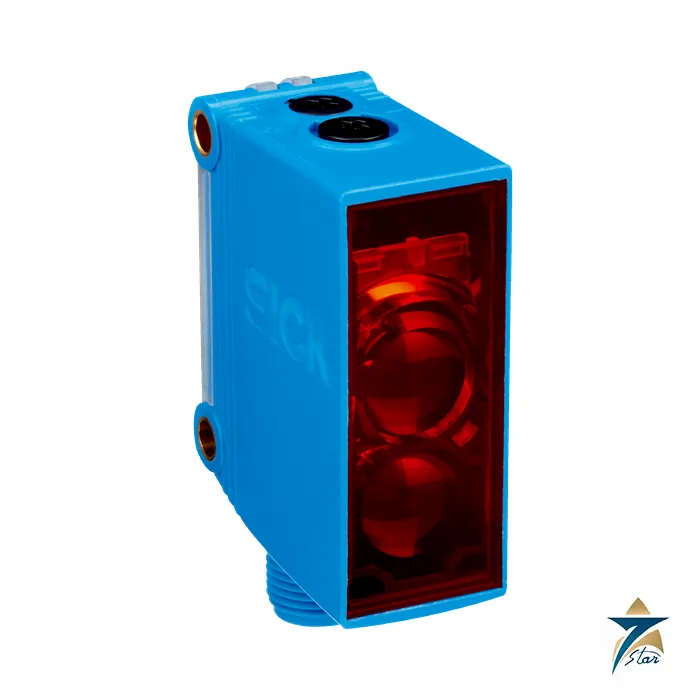
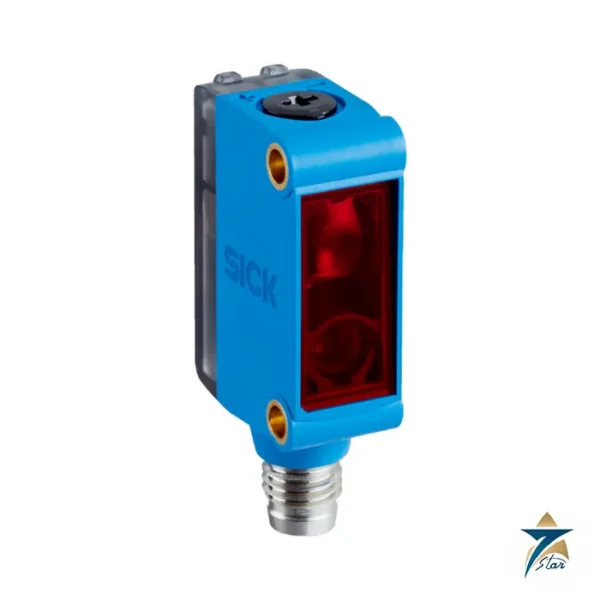
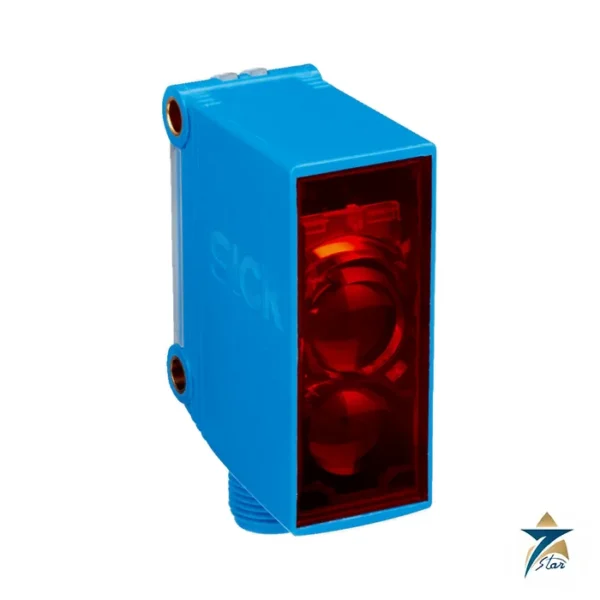
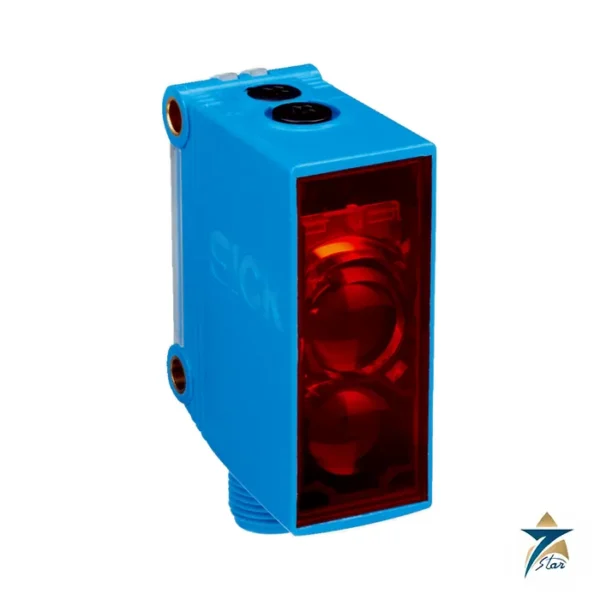
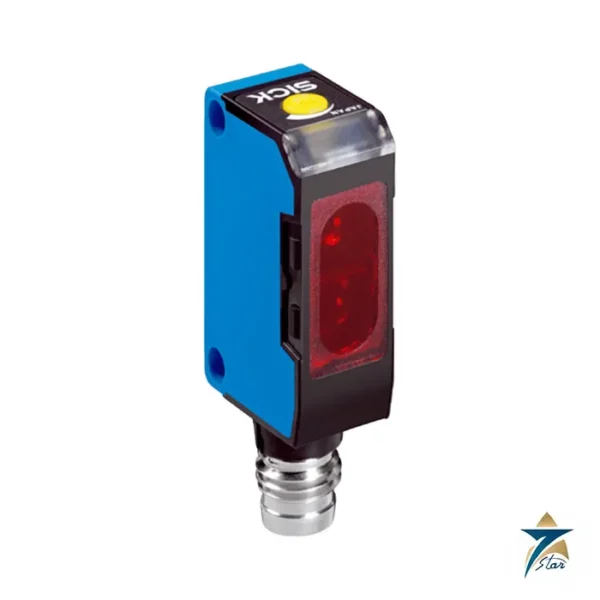
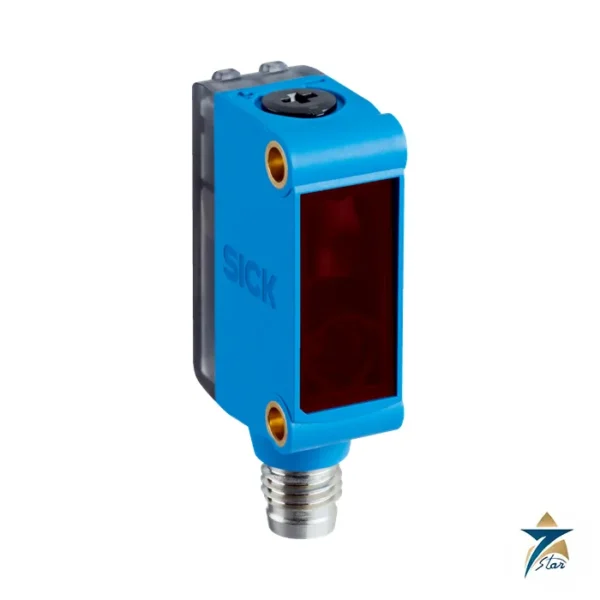
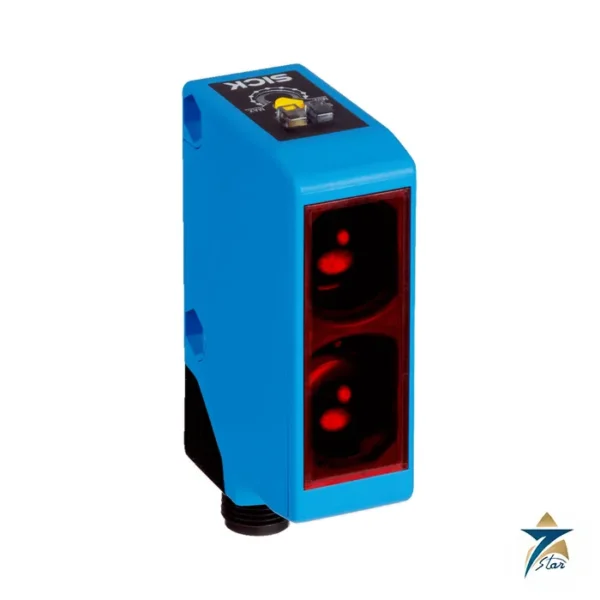
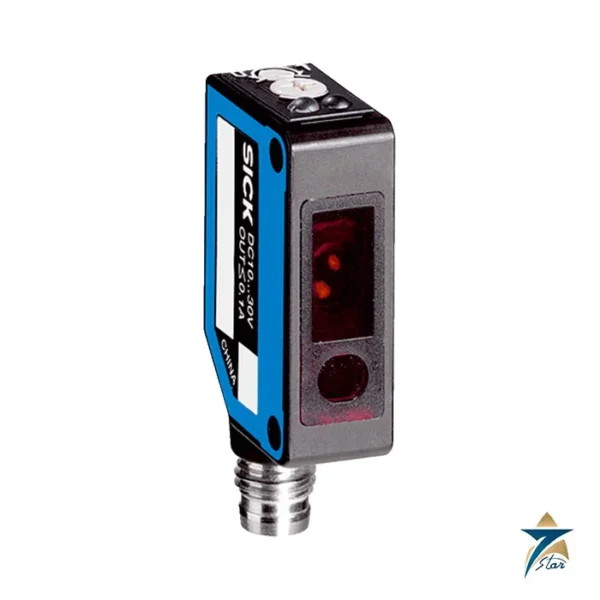
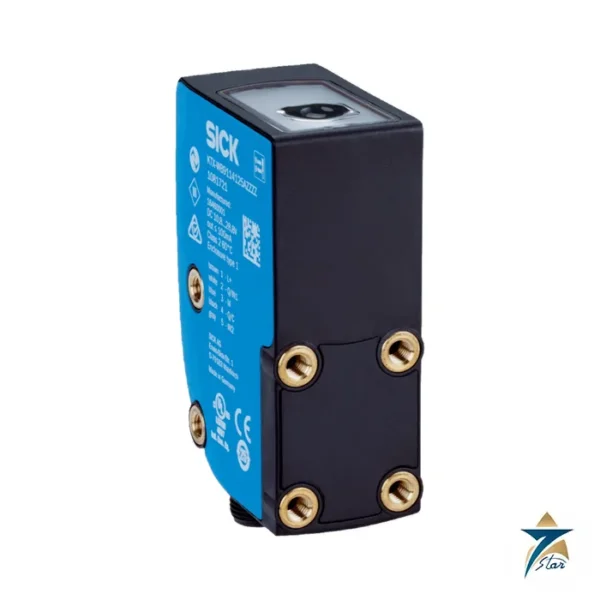
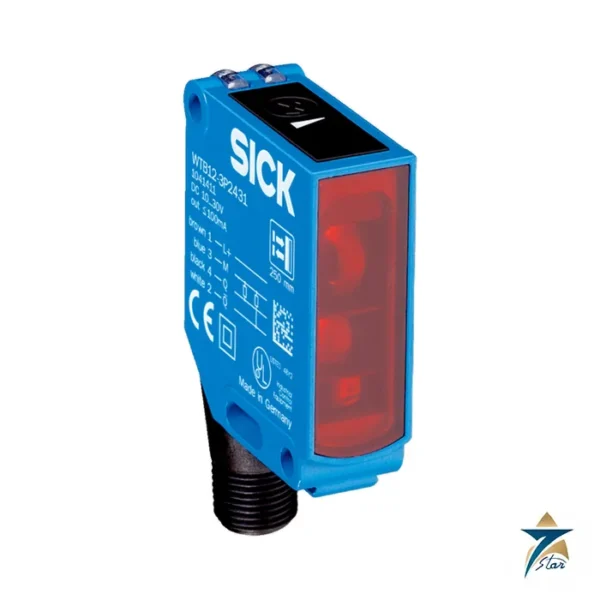
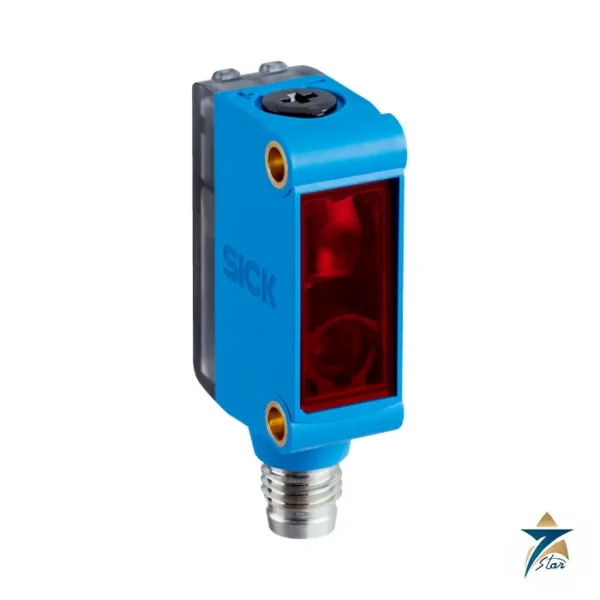
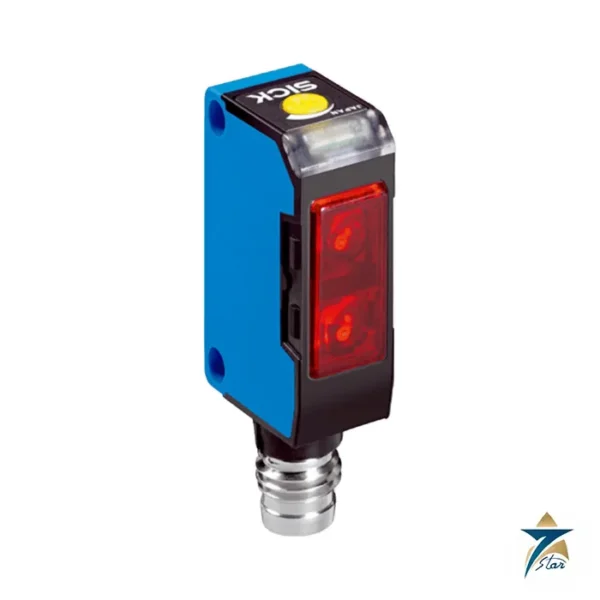
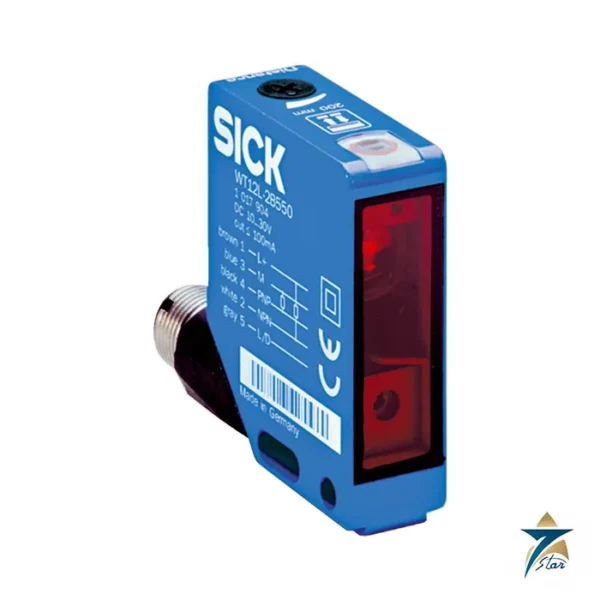
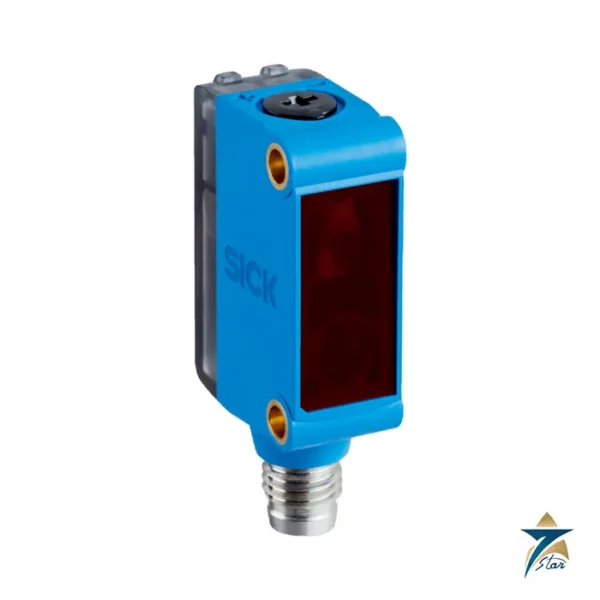
The GL10-P4211, SICK part no. 1065890, is a retro-reflective sensor from the G10 family: one housing holds emitter and receiver, a reflector returns the beam, and an object in the path switches the output. The sensing range maximum is 0.08 m … 15 m ; 0.08 m … 12 m (sensing range value 0.15 m … 12 m ; 0.15 m … 10 m). Output: PNP, light/dark switching; connection: Male connector M12, 4-pin.
Retro-reflective sensing with the GL10-P4211
The data sheet describes a dual-lens system with a minimum distance to the reflector. Place the reflector beyond that minimum distance; closer than that the beam geometry no longer works as intended, and the sensing range figures only apply from there outwards. A polarisation filter is fitted: it passes only light that the reflector has rotated, so shiny objects are less likely to be mistaken for the reflector. A light-switching output turns on while the beam reaches the receiver, a dark-switching output turns on when the beam is blocked. Choose according to how the controller treats a broken wire. Typical jobs are detecting boxes and pallets on conveyors, monitoring doors and gates and counting objects that pass a fixed aperture.
Light source: PinPoint LED, visible red light, light spot Ø 58 mm (5 m). Adjustment: potentiometer, 270°. Response time ≤ 500 µs, switching frequency 1,000 Hz.
Technical specifications
| Parameter |
Specification |
| Type code |
GL10-P4211 |
| Part number |
1065890 |
| EAN |
4047084298301 |
| Product family |
G10 |
| Functional principle |
Photoelectric retro-reflective sensor |
| Functional principle detail |
With minimum distance to reflector (dual lens system) |
| Dimensions (W x H x D) |
20 mm x 50 mm x 39 mm |
| Housing design (light emission) |
Rectangular |
| Sensing range max. |
0.08 m … 15 m ; 0.08 m … 12 m |
| Sensing range |
0.15 m … 12 m ; 0.15 m … 10 m |
| Type of light |
Visible red light |
| Light source |
PinPoint LED |
| Light spot size (distance) |
Ø 58 mm (5 m) |
| Wave length |
625 nm |
| Adjustment |
Potentiometer, 270° |
| Supply voltage UB |
10 V DC … 30 V DC |
| Ripple |
< 5 Vpp |
| Current consumption |
20 mA |
| Switching output |
PNP |
| Switching mode |
Light/dark switching |
| Switching mode selector |
Selectable via light/dark selector |
| Output current Imax. |
≤ 100 mA |
| Response time |
≤ 500 µs |
| Switching frequency |
1,000 Hz |
| Connection type |
Male connector M12, 4-pin |
| Circuit protection |
A ; B ; C ; D |
| Protection class |
III |
| Weight |
35 g |
| Polarizing filter |
Yes |
| Housing material |
Plastic, ABS/PMMA |
| Enclosure rating |
IP67 |
| Electromagnetic compatibility (EMC) |
EN 60947-5-2 |
| Ambient operating temperature |
–30 °C … +60 °C |
| Ambient temperature, storage |
–40 °C … +70 °C |
| More standards |
UL325 |
| MTTFD |
1,567 years |
| DCavg |
0 % |
| TM (mission time) |
20 years |
| Declarations and certificates in the data sheet |
EU declaration of conformity; UK declaration of conformity; ACMA declaration of conformity; Moroccan declaration of conformity; China RoHS; China Compulsory Product Certification (CCC) exempt; cULus certificate; Photobiological safety (DIN EN 62471) certificate |
Type code GL10-P4211 and part number 1065890
When a retro-reflective sensor is replaced, the part number 1065890 is the safest match for GL10-P4211. Variants of the GL10 family can differ in plug, output polarity and reach, and none of them includes a reflector unless the table says so.
Other active types in the same SICK family, each with its own part number:
- GL10-P4212 (part no. 1065887)
- GL10-N4212 (part no. 1065891) – Switching output: NPN
Mounting, wiring and alignment notes
Electrical supply: 10 V DC … 30 V DC. Environmental limits: IP67 and –30 °C … +60 °C ambient in operation. The body measures 20 mm x 50 mm x 39 mm and weighs 35 g. No reflector is listed as supplied, so add a suitable reflector to the order and check the operating reserve against the distance you need. Use a reflector sized for the distance and the dirt level; a larger one raises the operating reserve in dusty or wet areas.
Selection considerations for retro-reflective sensing
A retro-reflective sensor is the natural choice when only one side of a conveyor, doorway or gate can carry wiring, while the other side holds a passive reflector. Compared with a through-beam pair it needs one cable instead of two; compared with a diffuse sensor it is far less sensitive to the colour or surface of the object, because it detects the interruption of a beam rather than light scattered back from the target. The GL10-P4211 suits medium distances within the ranges stated above, and the polarising filter makes it a sensible option where shrink-wrapped pallets, metal cans or other glossy items pass through the beam. Transparent objects such as clear bottles or film are a different case and usually call for a sensor designed specifically for them, so check the object type before ordering.
Installation and alignment practice
Mount the sensor on a rigid support that will not shift with machine vibration or accidental knocks, and fix the reflector square to the beam at a distance beyond the minimum stated in the data sheet. Use the visible red spot to aim the beam onto the centre of the reflector, then fine-tune the potentiometer so the sensor switches reliably with the beam clear and with the smallest expected object in place. Choose light or dark switching with the selector to suit the control logic, and document the setting so a replacement sensor is configured the same way. Route the M12 cable away from motor leads and secure it with strain relief so the connector is not loaded.
Integration into conveyor and access systems
On conveyors the sensor typically feeds a PLC input for box presence, queue detection or counting; at doors and gates it provides a beam across the opening. The PNP output connects directly to sourcing-type PLC input cards, while the related NPN type in the family list suits sinking inputs. Think about failure behaviour as part of the design: with the right switching mode, a broken cable or lost supply can be made to look like a blocked beam, which the controller can treat as a fault rather than a clear path.
Dust, heat and sun in GCC plants
Warehouses, cement and food plants in Oman can have heavy airborne dust, and loading bays may see strong sunlight. Dust on the lens or reflector reduces the operating reserve gradually until the sensor starts to miss, so wipe both during routine cleaning and avoid mounting where the sensor looks into direct sun or strong reflections. Keep the installation within the stated operating temperature, shading sensors near roller doors or outdoor transfer points where needed.
What to include in an RFQ
State the type code and part number, the quantity, and whether a reflector should be quoted, together with the distance to be covered and the kind of objects to be detected. This lets the offer cover a complete, working sensing point.
Documents and quotation
We attach SICK’s own data sheet for part no. 1065890 (GL10-P4211) as an unaltered PDF; use it to compare dimensions, connections and ratings with the device on your machine. Send the type code and part number with quantity and delivery location through the RFQ form and we will quote. Related items are listed under Sensors & Transmitters. Please verify the variant against the nameplate of the device you are replacing, since similar types differ in small details. The data sheet is the authority.


Reviews
There are no reviews yet.