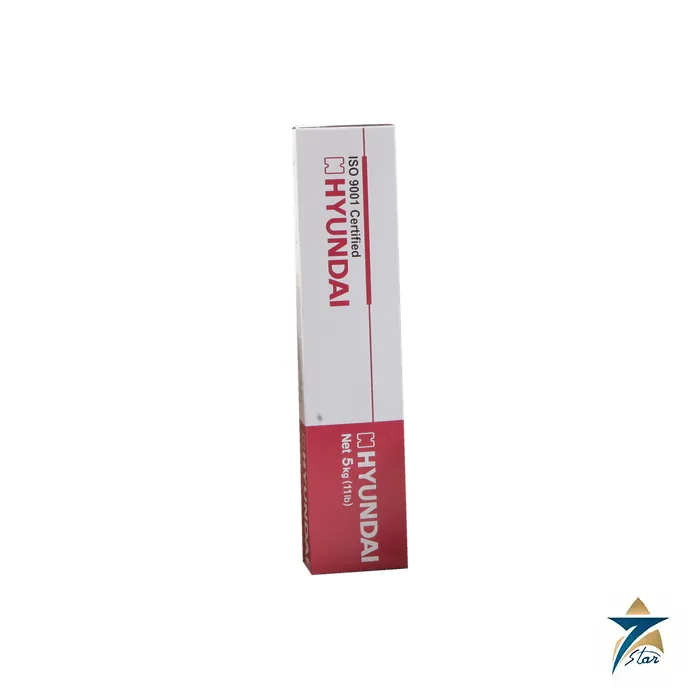
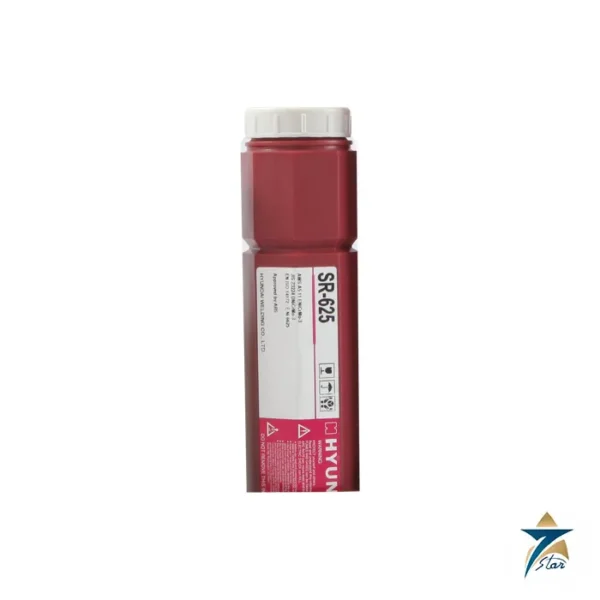
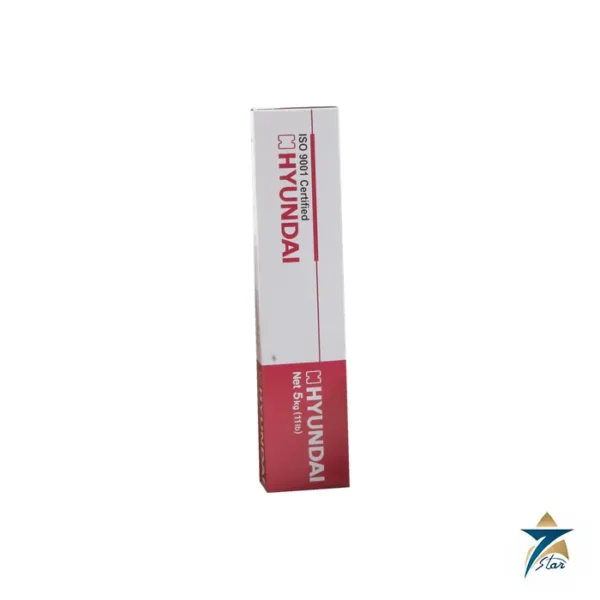
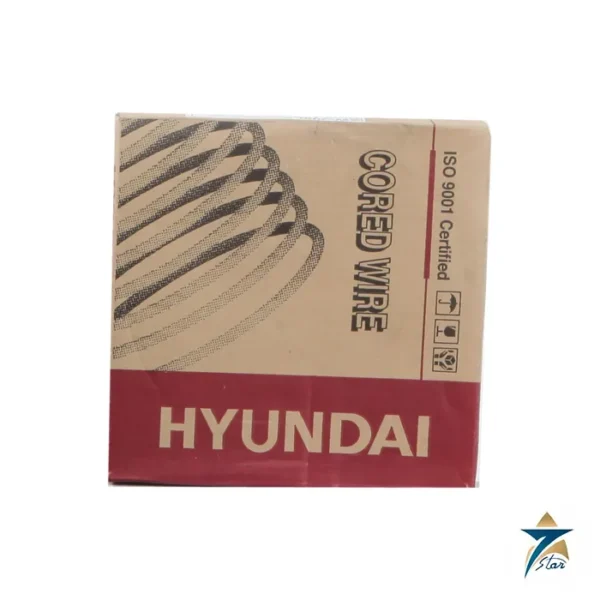
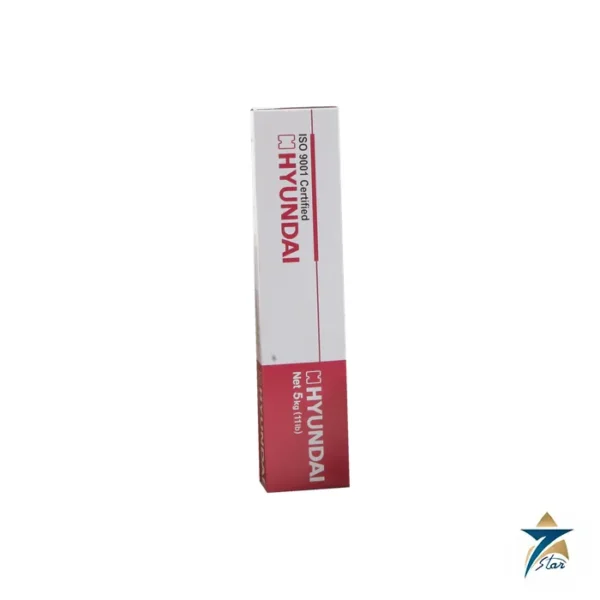
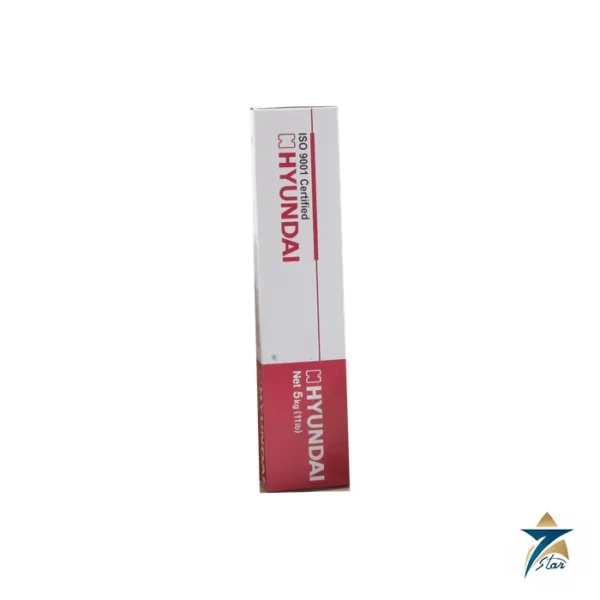
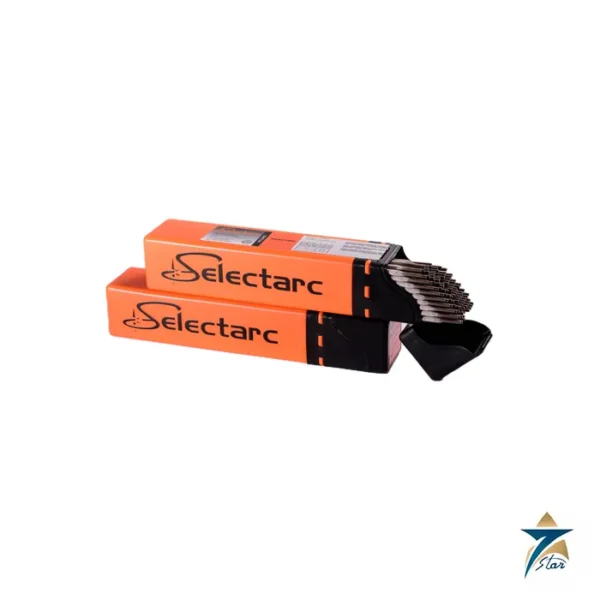
Hyundai Welding S-8010.P1 E8010-P1 Cellulosic Pipeline Electrode

Description

Overview

The Hyundai Welding S-8010.P1 is a high-cellulose electrode classified to AWS A5.5 / ASME SFA-5.5 E8010-P1 and EN ISO 2560-A E46 2 ZNi C 2 1. It belongs to the strongest group of Hyundai cellulosic pipe rods, giving an 80 ksi class deposit with a small nickel addition. Hyundai Welding highlights easy vertical-down welding, suitability for all-position pipe work, deep penetration and fast freezing.

Seven Star LLC supplies the Hyundai Welding S-8010.P1 to pipeline builders and piping fabricators across Oman and the GCC, backed by engineering support in Muscat. The data below follows the manufacturer datasheet; explanations of general welding practice are labelled as general.

Matching Weld Strength to Higher-Grade Line Pipe

As general practice, the strength of a pipeline weld should match or exceed the specified minimum strength of the pipe. As line pipe grades rise, E6010 and E7010 deposits may no longer provide enough overmatch for fill and cap passes, and an 80 ksi class cellulosic electrode becomes the natural choice for welders who want to keep the speed of vertical-down stick welding.

The Hyundai Welding S-8010.P1 provides that step up. Its typical chemistry includes 0.80 % Mn and 0.66 % Ni, which together lift strength while keeping toughness. Because it is still a cellulosic, hydrogen-rich process, it must be used with the preheat, interpass and pass-sequence controls set by the applicable pipeline code and your qualified welding procedure.

Datasheet Highlights of the Hyundai Welding S-8010.P1

Typical all-weld-metal composition is 0.17 % C, 0.25 % Si, 0.80 % Mn, 0.017 % P, 0.005 % S, 0.66 % Ni, 0.04 % Cr, 0.01 % Mo and 0.01 % V. Typical mechanical properties are 499 MPa (72 ksi) yield strength, 613 MPa (89 ksi) tensile strength and 26 % elongation, with 47 J (35 ft·lbs) impact toughness at -30 °C (-20 °F). Welding positions are 1G, 2F, 3G and 4G.

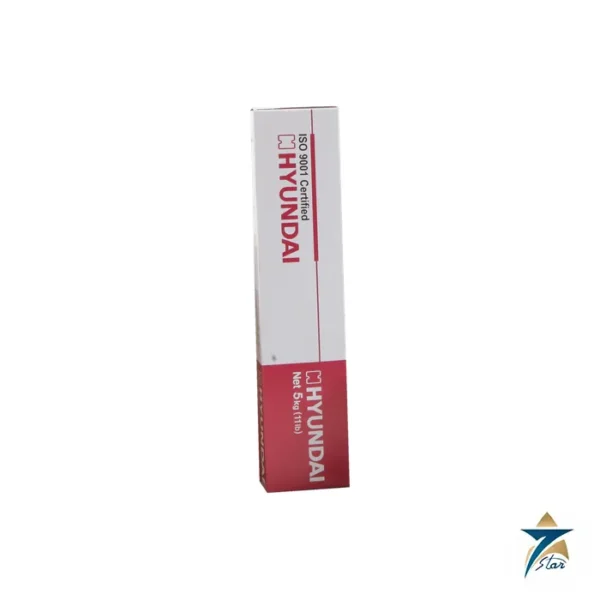
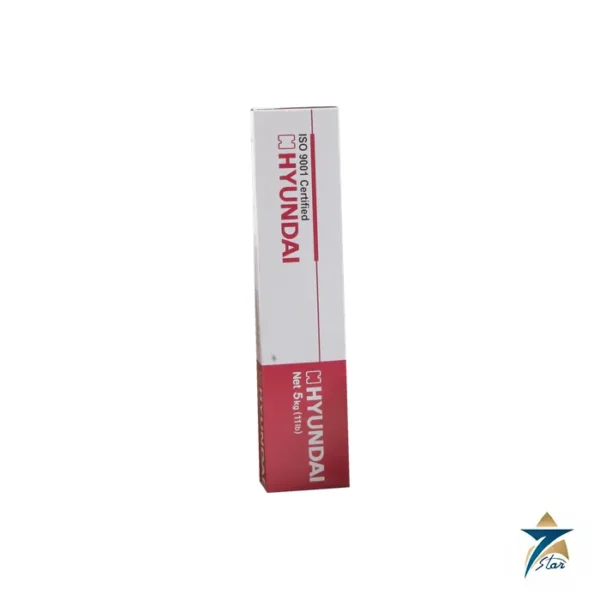
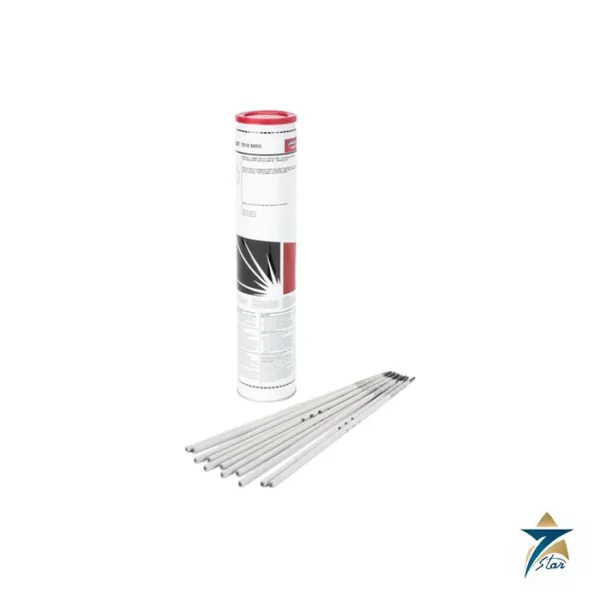
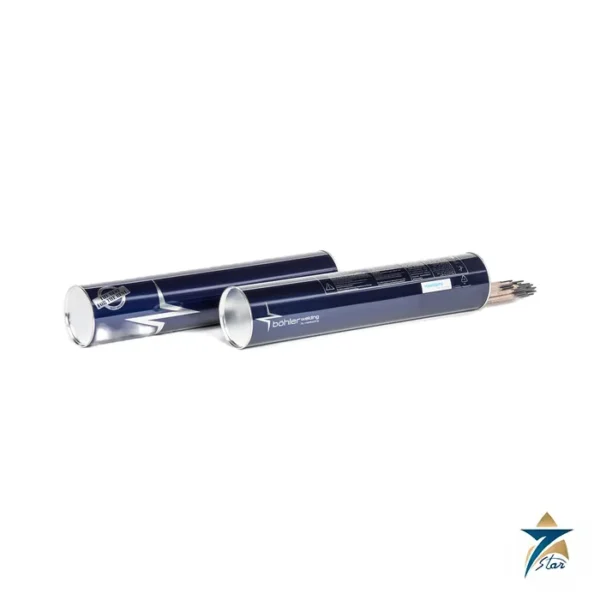
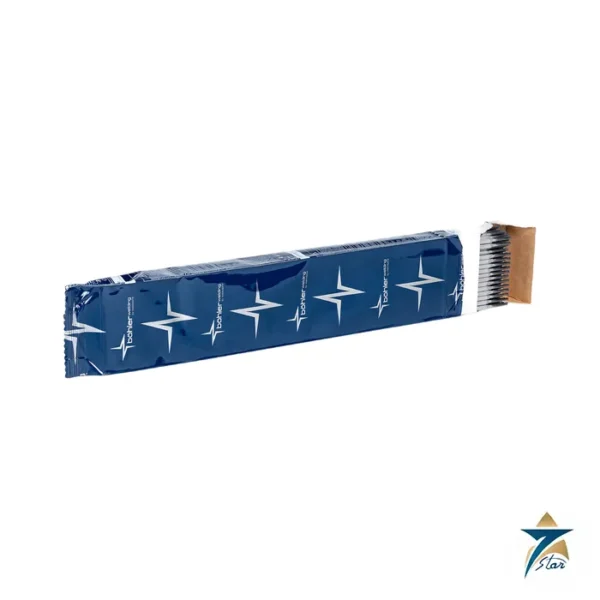
The Hyundai Welding S-8010.P1 is listed in three diameters, 3.2, 4.0 and 5.0 mm, each 350 mm long, so it is aimed at production passes rather than very thin root work. Packaging is a 5 kg packet in standard or vacuum form and a 20 kg carton, and the redrying condition is 70 to 100 °C for 0.5 to 1 hour. No approval marks are printed on this datasheet, so none are claimed here.

Key Features

The datasheet lists the following characteristics for the Hyundai Welding S-8010.P1:

  • High cellulose coating for a strong, penetrating arc.
  • Vertical downward welding can be carried out easily.
  • Suitable for all-position welding of pipes.
  • Fast freezing weld pool for good control out of position.
  • Typical tensile strength of 613 MPa (89 ksi), higher than the S-6010.D and S-7010.P1 cellulosic grades.
  • Nickel-bearing deposit, with 0.66 % Ni in the typical analysis.
  • Application areas given as root pass welding for pipeline and general fabrication.
  • Current window of 140 to 220 A on the 5.0 mm size in flat and horizontal-fillet positions.

Where It Is Used

The Hyundai Welding S-8010.P1 fits high-strength transmission pipelines, compressor and pumping station tie-ins, and fabrication of pipe spools where the material grade calls for an 80 ksi class weld. In Oman, typical users include contractors on gas transmission lines, oil export pipelines and large-diameter water conveyors linking desalination plants with inland reservoirs.

Seven Star LLC can combine the electrode with suitable power sources such as the ESAB Rebel EMP 285ic or the Lincoln Electric Power Wave S500 advanced process welder, and with shop consumables like the LongTeng EL8 submerged arc wire. See the welding electrodes category for other stick electrodes.

Procedure Considerations

General pipeline practice with an 80 ksi cellulosic electrode such as the Hyundai Welding S-8010.P1 starts with joint preparation. Bevel angle, root face and root gap must be consistent so that the forceful arc can produce an even internal bead without burn-through. Line-up clamps are normally kept in place until the specified portion of the root is complete, and the hot pass follows quickly to refine the root and reduce the risk of cracking.

Preheat is another key control. Higher-strength pipe and thicker walls generally need more preheat when a hydrogen-rich process is used, and the required temperature should be measured, not estimated. Interpass temperature, the maximum delay between passes and any requirement for slow cooling are all procedure variables. Seven Star LLC can supply the electrode and help you gather the manufacturer data your welding engineer needs, but the procedure itself must be qualified to the governing code.

Comparison With Other Hyundai Cellulosic Rods

Against the S-6010.D (typical 470 MPa yield, 590 MPa tensile) and the S-7010.P1 (typical 421 MPa yield, 523 MPa tensile), the Hyundai Welding S-8010.P1 offers the highest strength, with typical 499 MPa yield and 613 MPa tensile. All three show 47 J at -30 °C in their datasheets and share the same 70 to 100 °C redrying instruction. The S-8010.P1 is the only one of the three whose datasheet polarity field also lists AC.

Technical Specifications

Typical values from the Hyundai Welding S-8010.P1 datasheet are summarised below.

Parameter Specification
Model S-8010.P1
Electrode type High cellulose (SMAW)
AWS / ASME A5.5 / SFA-5.5 E8010-P1
EN ISO 2560-A E46 2 ZNi C 2 1
Polarity (datasheet) AC or DC+
Positions 1G, 2F, 3G, 4G
Application areas Root pass welding for pipeline, general fabrication
Redrying 70 to 100 °C (158 to 212 °F), 0.5 to 1 hour
Chemistry (wt %) C 0.17, Si 0.25, Mn 0.80, P 0.017, S 0.005, Ni 0.66, Cr 0.04, Mo 0.01, V 0.01
Yield strength 499 MPa (72 ksi)
Tensile strength 613 MPa (89 ksi)
Elongation 26 %
Impact 47 J (35 ft·lbs) at -30 °C (-20 °F)
Packaging 5 kg (11 lbs) packet, standard or vacuum; 20 kg (44 lbs) carton

Parameters

Diameter mm (in) Length mm (in) F and HF (A) V-up, OH (A)
3.2 (1/8) 350 (14) 75-120 65-115
4.0 (5/32) 350 (14) 90-165 90-145
5.0 (3/16) 350 (14) 140-220 125-185

Practical Notes

General welding knowledge for cellulosic grades applies: store packets sealed and dry, avoid high-temperature baking, and condition only at the low temperatures the manufacturer gives, which for the Hyundai Welding S-8010.P1 is 70 to 100 °C for up to an hour. Match the polarity, current range and travel technique to the qualified procedure for the pipe grade being welded.

Datasheet

The Hyundai Welding S-8010.P1 manufacturer datasheet is available for download on this page.

How to Order

For a quotation on the Hyundai Welding S-8010.P1, tell Seven Star LLC the diameters, quantities and inspection documents you need. We support pipeline, utility and fabrication customers in Oman and the GCC from Muscat with engineering guidance.

Datasheets & Documents
  • PDF Datasheet Hyundai Welding S-8010.P1 product datasheet Download
Reviews (0)

Reviews

There are no reviews yet.

How would you rate this product?

It takes about 10 seconds — just tap a star. Your email is never published.

About brand

Hyundai Welding is a South Korean manufacturer of welding consumables and welding equipment, incorporated on 3 September 1975 as Seohan Development Co., Ltd. It was set up to supply the Korean shipbuilding industry and now serves fabrication, offshore, power and petrochemical work. The company is headquartered in Seoul, describes itself as a privately owned family business, and works closely with other companies of the Hyundai business group.

Seven Star LLC lists Hyundai Welding electrodes and wires for carbon steel, chrome-moly, stainless, duplex and nickel alloy work and supplies them to fabricators and maintenance teams in Oman, matched to the classification written in the welding procedure.

Hyundai Welding company profile

Founded 3 September 1975, as Seohan Development Co., Ltd.
Headquarters Seoul, South Korea
Original market Welding consumables for Korean shipbuilding
Ownership Privately owned family business, linked to the Hyundai business group
Classification system Electrodes and wires sold under AWS classifications (for example E7024, E71T-1C, E2209-16, ENiCrMo-3)
Product families Carbon steel, low-hydrogen and cellulosic pipe electrodes, chrome-moly and stainless electrodes, duplex and super duplex electrodes, nickel alloy electrodes and MIG wires, flux-cored and solid wires, submerged arc wires and fluxes

Milestones

  • 1975: The company is incorporated as Seohan Development Co., Ltd.
  • 1970s: Its first market is welding consumables for Korean shipyards.

Hyundai Welding grades listed on this page

The product names follow a simple pattern: the letters show the consumable type and the number echoes the AWS class.

  • S- covered electrodes: S-7018.1 (E7018-1), S-7018.W for weathering steel, S-7010.P1 and S-8010.P1 cellulosic pipeline grades
  • Chrome-moly: S-8018.B2, S-9018.B3 and S-9015.B9 for P91, plus SC-91B3 flux-cored wire
  • Stainless and duplex: S-308L.17, S-309L.17, S-2209.16 and S-2594.16
  • Alloy 625: SR-625 electrode and SMT-625 MIG wire

Where these consumables are used

The mix above maps closely to process plant and pipeline work. Cellulosic E7010-P1 and E8010-P1 electrodes are for root and fill passes on line pipe. The B2, B3 and B91 grades serve steam piping, headers and heaters that run hot. E309L joins stainless to carbon steel, E2209 and E2594 cover duplex and super duplex piping, and the 625 fillers are used for overlay and for joining nickel alloys.

Hyundai Welding products we list

Family Examples
Welding Electrodes Hyundai S-2209.16 E2209-16 Duplex Stainl…, Hyundai S-2594.16 E2594-16 Super Duplex…, Hyundai S-308L.17 E308L-17 Stainless Ste…, Hyundai S-309L.17 E309L-17 Dissimilar St…, Hyundai SR-625 ENiCrMo-3 Nickel Alloy 62…, S-7018.1 E7018-1 Low Hydrogen Electrode, S-7018.W E7018-W1 Weathering Steel Elect…, S-7024.F E7024 High-Recovery Electrode and 3 more
Cellulosic Pipeline Electrodes S-6010.D E6010 Cellulosic Pipeline Elect…, S-7010.P1 E7010-P1 Cellulosic Pipe Elect…, S-8010.P1 E8010-P1 Cellulosic Pipeline E…
Flux-Cored Welding Wire Hyundai SC-91B3 E91T1-B3C Chrome-Moly Fl…, SF-71 E71T-1C Flux-Cored Wire
Solid Welding Wire Hyundai SMT-625 ERNiCrMo-3 Nickel Alloy…

Ordering Hyundai Welding consumables: what we need

State the Hyundai product name and the AWS classification together, since the procedure qualification record is written against the class. Add the diameter, the quantity in kilograms, the packing you prefer, and the shielding gas for wires. Tell us which test certificate your quality plan asks for, and note any impact temperature, hardness or post-weld heat treatment condition. GCC project specifications often add client approval lists, so mention those as well.

Facts checked against Hyundai Welding's company brochure and Korean company registry profiles, October 2026.

FAQ

Questions about the Hyundai Welding S-8010.P1 E8010-P1 Cellulosic

Answers from our engineering team on installation, compatibility and integration.

01What makes the Hyundai Welding S-8010.P1 different from E6010 and E7010 rods?
It is an 80 ksi class cellulosic electrode. The datasheet gives typical 499 MPa yield and 613 MPa tensile, with 0.66 % nickel in the weld metal, so it suits higher-strength pipe than the lower classes.
02Is the S-8010.P1 suitable for vertical-down welding?
Yes. Hyundai Welding states that vertical downward welding can be performed easily and that the electrode suits all-position welding of pipes, with deep penetration and fast freezing.
03Which diameters are available?
The datasheet lists 3.2 mm, 4.0 mm and 5.0 mm, all 350 mm long, packed in 5 kg packets and 20 kg cartons, standard or vacuum.
04What polarity does the S-8010.P1 use?
The datasheet polarity field reads AC or DC+, and the feature text describes it as a high cellulose type electrode for welding with direct current. Confirm the polarity in your qualified procedure.
05Can I buy the Hyundai Welding S-8010.P1 from Seven Star LLC in Oman?
Yes. Seven Star LLC supplies the Hyundai Welding S-8010.P1 to customers in Oman and the GCC from Muscat and includes the official datasheet with quotations.