Low-hydrogen E7018-1 electrode with CTOD and sour-gas credentials
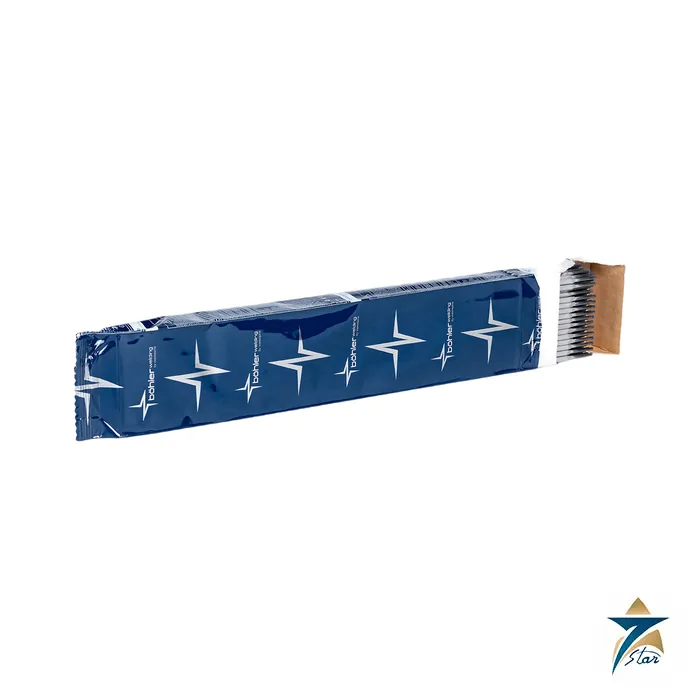
The Böhler FOX EV 50 is a basic-coated, very low hydrogen stick electrode classified AWS A5.1 E7018-1 H4R and EN ISO 2560-A E 42 5 B 4 2 H5. Böhler Welding describes it as an electrode for high-quality welds with excellent strength and toughness down to -60 °F, a metal recovery of about 110 % and good weldability in all positions except vertical-down. It is listed for steel construction, boiler and tank manufacture, vehicle construction, shipbuilding and machine construction, and for buffer layers on build-ups on high-carbon steels. The data sheet adds that it is especially suitable for offshore construction, with CTOD tests at -14 °F, and can be used in sour gas applications (HIC test to NACE TM-02-84), with SSC test values available on request.
Technical specifications
| Parameter |
Specification |
| AWS classification |
A5.1 / SFA-5.1 E7018-1 H4R |
| AWS A5.1M |
E4918-1 H4R |
| EN ISO classification |
2560-A E 42 5 B 4 2 H5; 2560-B E 4918-1 A U H5 |
| Typical all-weld metal analysis, wt % |
C 0.08; Si 0.4; Mn 1.2 |
| Hydrogen |
Very low; HD below 4 ml per 100 g weld metal (AWS condition) |
| Yield strength, as welded |
67 ksi typical (minimum 61) |
| Tensile strength, as welded |
81 ksi typical (minimum 73) |
| Elongation, as welded |
27 % typical (minimum 20) |
| Impact energy ISO-V, as welded |
140 ft-lbf at 68 °F; 118 at 0 °F; 52 at -60 °F (minimum 34) |
| Stress relieved 1110 °F / 2 h |
Yield 62 ksi; tensile 75 ksi; elongation 28 %; 148 ft-lbf at 68 °F; 66 at -60 °F |
| Polarity |
DC+ |
| Sizes and current |
5/64 in x 10 in: 50 to 70 A; 3/32 in x 14 in: 80 to 110 A; 1/8 in x 14 in: 100 to 140 A; 5/32 in x 14 in: 130 to 180 A; 3/16 in x 18 in: 180 to 230 A; about 1/4 in x 18 in: 240 to 290 A |
| Redrying, if necessary |
575 °F +/- 50 °F, minimum 2 h |
| Approvals |
ABS, TÜV (00426), DB (10.014.02), BV, DNV GL, LR, RMRS, RINA, CWB (1/8 in to 1/4 in), CE |
| Data sheet edition |
10/2020 |
Base materials and where it fits
Böhler lists steels up to 60 ksi yield strength, among them S235JR to S355J2, S275N to S420N, P235GH to P355GH, L245NB to L415NB, shipbuilding grades A to F 40, and ASTM A 106 Gr. A, B and C, A 516 Gr. 55 to 70, A 573, A 588 and API 5L Gr. B to X60. In practice this makes the FOX EV 50 the general-purpose low-hydrogen choice for structural steelwork, pressure vessels, storage tanks and offshore jackets where the specification asks for E7018-1 toughness rather than plain E7018. For pipe work where the root pass is made on DC-, see the ; for X70 and X80 line pipe fill and cap passes the vertical-down
FOX BVD 90.
is the higher-strength option.
| Related Böhler Welding electrode |
Classification (AWS A5.1 / A5.5 / A5.4) |
Typical use |
| FOX EV PIPE |
E7016-1 |
Pipe root passes (DC-) and fill and cap passes |
| FOX EV 70 |
E9018-G H4R |
High-strength fine-grained steel, 550 MPa class |
| FOX DCMS Kb |
E8018-B2 H4 |
1 % Cr, 0.5 % Mo boiler, plate and tube steel |
| FOX CM 2 Kb |
E9018-B3 H4R |
2.25 % Cr, 1 % Mo refinery and power-plant steel |
Handling and what to confirm
Low-hydrogen quality depends on dry storage. Keep unopened packs sealed, redry at the temperature and time on the data sheet only when moisture is suspected, and hold opened electrodes in a heated oven or quiver on site. Preheat and interpass temperatures come from the qualified procedure for the plate thickness and carbon equivalent, not from the electrode. State in the enquiry whether CTOD, sour-service SSC results or a particular certificate type is required, which diameter range is needed, and which pack type is preferred so the request can be checked against what Böhler can supply.
Documents and quotation
Attached: the manufacturer data sheet for FOX EV 50, which is the source of every figure on this page. More products of this kind are collected in welding electrodes. Send us the size, packaging, quantity, the steel you are welding and the certificate you expect, and we will prepare the offer.

Reviews
There are no reviews yet.