Yokogawa GX10 overview
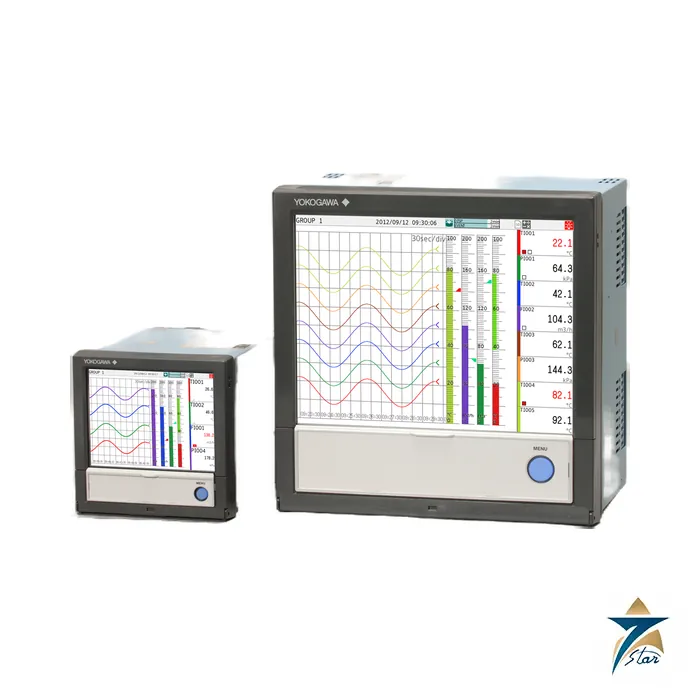
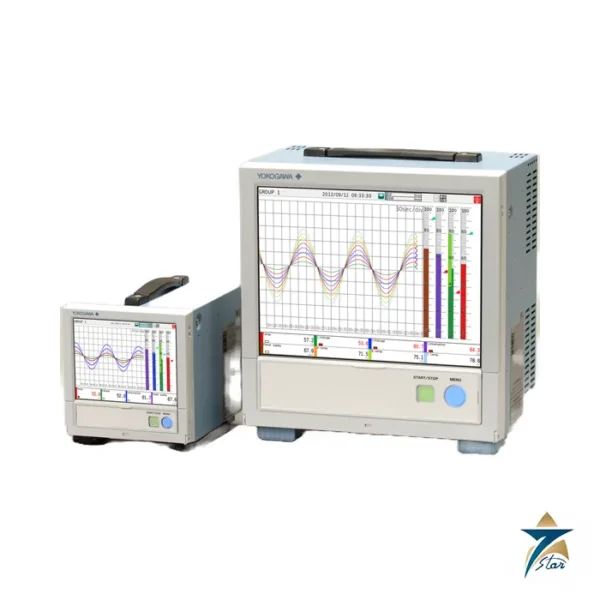
The Yokogawa GX10 is the small-display, 144 x 144 mm panel-mount paperless recorder of the Yokogawa GX series. It shows real-time measured data on a 5.7-inch touch screen and saves it to an SD card, replacing chart paper and pens with trend, bar-graph and digital displays, alarm summaries and report files.
The model name Yokogawa GX10 is the starting point of the order code. The main unit is then specified with a type code (-1 standard, up to 100 measurement channels), a display language code (E for English, degF and daylight-saving time), optional features such as /MT math, /PG program control or /P1 24 V DC/AC power, and, when wanted, a factory-fitted analog input module option such as /US10 or /UC10. Because so many choices sit behind the single name GX10, buyers searching for the exact model usually need a full string confirmed before purchase.
This page describes the GX10 as published in the manufacturer’s general specification GS 04L51B01, written in our own words for buyers who need to identify the exact part. Seven Star LLC is an independent supplier serving Oman and the GCC and is not affiliated with the manufacturer. We supply against the part number you provide and do not substitute without your written agreement.
Key features of the GX10
- Touch-screen operation with flick, pinch-in and pinch-out gestures, and a trend display that shows past data seamlessly while recording continues.
- Input and output are modular: seven module types cover analog input, analog output, digital input, digital output, digital input/output, pulse input and PID control.
- Input signals per channel can be set to DC voltage, thermocouple, resistance temperature detector, contact or DC voltage DI, DC current or pulse, depending on the installed module.
- Large internal memory with data saved to an SD card, plus Ethernet for FTP file transfer, e-mail notification, web monitoring, Modbus/RTU and Modbus/TCP.
- Health Monitor and Profile functions for predictive detection, and a Future Pen function that draws a predicted waveform for reference alongside real-time data.
- Optional math function with report generation (hourly, daily, monthly), program control with up to 99 patterns, and PID control on up to 20 loops with PID modules (6 loops on the standard-memory type).
- Scan intervals from 1 ms to 5 s depending on module and measurement mode, including high-speed and dual-interval modes.
- Up to 3 modules can be fitted to the GX10 (two expandable I/O or GM sub units can extend it), with a total of up to 100 analog input channels on the standard type.
GX10 technical specifications
| Item |
Specification |
| Model |
GX10, paperless recorder, panel mount type, small display |
| Type code |
-1 standard (max. 100 measurement channels); the large-memory type -2 is for the GX20 only |
| Display |
5.7-inch TFT color LCD, 640 x 480 dots, 4-wire resistive touch screen |
| Internal memory |
500 MB (standard type); external storage by SD card |
| Outside dimensions (modules fitted) |
144 x 144 x 255 mm (W x H x D from the panel mounting plane) |
| Outside dimensions (no modules) |
144 x 144 x 174 mm |
| Weight |
Approx. 2.1 kg, excluding modules |
| Module slots |
Up to 3 modules in the main unit (GX10) |
| Display groups |
30 groups, up to 10 channels each |
| Supply voltage |
100 to 240 V AC, 50/60 Hz (allowable 90 to 132 V and 180 to 264 V); 24 V DC/AC with option /P1 |
| Power consumption (100 V AC) |
16 VA backlight off, 20 VA normal operation, 48 VA maximum |
| Front panel protection |
IEC 529 IP65 and NEMA 250 Type 4 (except external icing test), except side-by-side mounting |
| Operating conditions |
Ambient 0 to 50 degC, humidity 20 to 80 percent RH, no condensation |
| Panel thickness |
2 to 26 mm |
| Scan interval |
1, 2, 5, 10, 20, 50, 100, 200, 500 ms, 1, 2 or 5 s depending on module and mode |
| Communication |
Ethernet (Modbus/TCP, FTP, e-mail, web); optional RS-232 (/C2) or RS-422/485 (/C3); optional USB host (/UH) |
The values above are taken from the manufacturer’s general specification for the GX10/GX20 paperless recorders. Treat the document as the controlling reference and confirm every figure against the latest revision before final design, because the manufacturer may change specifications without notice.
Typical applications in oil and gas, utilities, water and manufacturing
Paperless recorders suit temperature and process logging on heaters, boilers and furnaces, water and wastewater treatment plants, desalination units, power-station auxiliaries, pharmaceutical and food batch records, and test-bench or commissioning data capture in Oman and the GCC. They replace chart paper with SD card records that can be exported as files, which helps with audit trails and maintenance planning.
A buyer who already has the GX10 installed usually wants the same suffix code again, which keeps panel cutouts, terminal layouts, spare stocks and documentation unchanged. That is the main reason this exact part number is searched for rather than a generic description.
Selection and compatibility notes for the GX10
- Choose the GX10 when a 144 x 144 mm panel opening is available; the larger GX20 needs 288 x 288 mm.
- The number of channels depends on modules: universal analog input modules provide 10 channels each, and options /UC10 to /UC30 or /US10 to /US30 fit modules at the factory (higher counts are GX20 only).
- Add /MT when math, report or pulse integration is required, and /PG when program control is needed together with a PID control module.
- Modules can also be bought separately as GX90XA, GX90XD, GX90YD, GX90WD, GX90XP, GX90YA and GX90UT parts.
- Check cybersecurity and audit needs: option /AS provides the advanced security function (Part 11) listed in the general specification.
Shunt resistors for current inputs and other accessories are listed in the I/O module general specification.
Installation and commissioning
Flush-mount the unit in a vertical panel within the panel thickness range, inclined backward no more than 30 degrees from horizontal, leaving room behind the panel for the module depth and wiring. Ground the case with a low-resistance connection, wire each input module to its terminal block, set input type, range and scale for each channel, then configure recording intervals, alarms, groups and the Ethernet or serial settings. Insert an SD card, check the date, time and daylight-saving setting, and verify a few channels against a calibrator before handing over.
Before energising a GX10 in a hazardous or critical service, confirm that the selected variant, enclosure rating and any approvals you require are covered by the order string and by your site rules.
Maintenance and spare parts
Maintenance consists of cleaning the screen, checking the SD card and internal memory status, backing up the configuration, verifying channel accuracy against a calibrator, and keeping firmware and security settings under review. Keep a spare SD card and record the main unit and module order strings, because modules must be matched to the host generation and terminal style when replaced.
Related products and ordering notes
The GX10 belongs to the GX10/GX20 paperless recorders group. Related family members, modules, software and accessories are listed in the same general specification, and we can quote them together with the GX10 when you need a complete panel or loop. Because many Yokogawa instruments are specified by long suffix strings, always quote the complete order code, the option codes, the quantity and the destination. If your installed unit is an older revision, send a nameplate photograph or the exact code printed on it so that compatibility can be checked before any quotation is issued.
Frequently asked questions about the GX10
- What display does the GX10 have? The GX10 has a 5.7-inch TFT color LCD with 640 x 480 dots and a 4-wire resistive touch screen, according to the manufacturer’s general specification.
- How are measurement channels added to the GX10? Through plug-in input/output modules in the main unit (up to three) and through expandable I/O or GM sub units, within the channel limits in the general specification.
- Where is data stored? Data are held in internal flash memory (500 MB on the standard type) and saved to an SD card; Ethernet FTP transfer is also supported.
- Is the GX10 power supply selectable? The standard supply is 100 to 240 V AC. A 24 V DC/AC supply is obtained with option code /P1.
- What is needed for an RFQ on the GX10? Send the full order string with type code, language code and options, the quantity and the delivery point in Oman or the GCC with the GX10 RFQ.
Documents and quotation
The manufacturer’s datasheet for the GX10 is available on this page for download and lists the model and suffix codes, specifications and dimensions in full. To request a quotation, send the RFQ with the part number GX10, the quantity, any option codes and the delivery destination in Oman or the GCC. Our team will confirm availability, lead time and commercial terms for the GX10 by return.

 Automation & Control
 Electrical & Power
 Fittings & Valves
 Sensors & Transmitters
 Emergency Power
 Analyzer Systems
 Metering Systems
 Welding
 Fire & Gas Systems
 Motors, Pumps & Turbines
 Portable Test & Measurement
 Compressor & Cooling
 Bearings & Power Transmission
 Filtration
 Safety & PPE
 Material Handling & Lifting Equipment
 Non-Destructive Testing (NDT)









Reviews
There are no reviews yet.