A modular data acquisition system for large, distributed measurement points
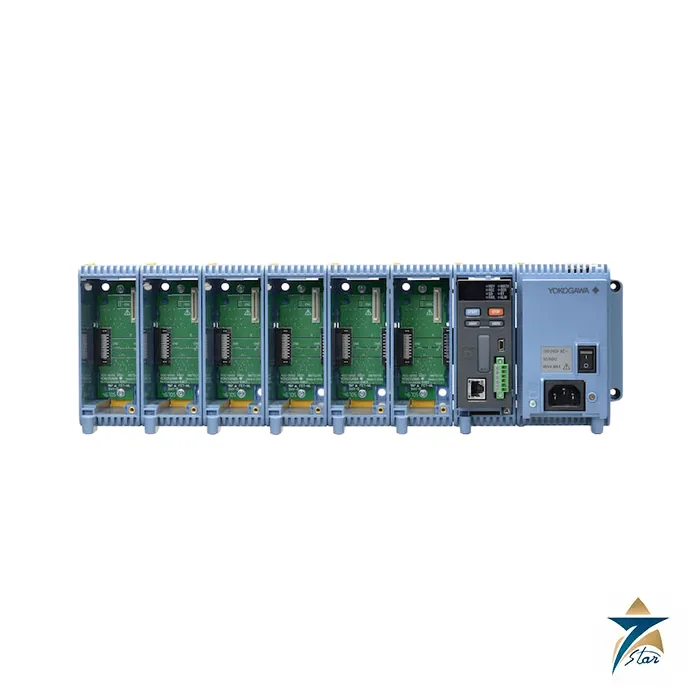
The Yokogawa GM10 is the data acquisition module of the SMARTDAC+ GM system. It has no display of its own: the unit is built from the GM10 module, a GM90PS power supply module and a GM90MB module base, with I/O modules plugged in alongside. It uses the same I/O modules as the GX and GP recorders, so thermocouple, RTD, DC voltage, current, digital input and output channels can be mixed to suit the plant. A single unit takes up to 10 analog input modules, and with expansion modules the GM10-2 reaches up to 420 analog channels (GM10-1: up to 100).
Because it is compact and guaranteed from -20 to 60 C, it suits panel interiors, skid enclosures, utility rooms and outdoor cabinets where a panel-mount recorder with a screen is not practical. Mounting is on a DIN rail, on a wall or on a desktop.
Technical specifications
| Parameter |
Specification |
| Models |
GM10-1, GM10-2 data acquisition module; GM90MB module base; GM90PS power supply module |
| Analog channels |
Up to 100 (GM10-1); up to 420 (GM10-2) |
| Input types |
DC voltage, thermocouple, RTD, DI, DC current (external shunt) |
| Internal memory |
500 MB (GM10-1); 1.2 GB (GM10-2); SD/SDHC card up to 32 GB |
| Fastest measurement |
1 ms with high-speed analog input module |
| Optional functions |
PID control (20 loops); program control 99 patterns (/PG); Part 11 security (/AS) |
| Communication |
Ethernet, USB, Modbus/TCP, FTP, web server; Modbus/RTU with /C3 |
| Supply |
100 to 240 V AC, 50/60 Hz, or 12 to 28 V DC |
| Ambient temperature |
-20 to 60 C (-20 to 50 C in some configurations) |
| Mounting |
DIN rail, wall or desktop |
Functions and connectivity
Internal memory is 500 MB on the GM10-1 and 1.2 GB on the GM10-2, with an SD or SDHC card slot (up to 32 GB, 1 GB card supplied). A high-speed analog module allows measurement as fast as 1 ms, and dual-interval recording lets fast event data and slow trend data be stored together. Optional functions include PID control on up to 20 loops, program control of up to 99 patterns (/PG) and Part 11 advanced security (/AS). Math and report functions, a built-in web server and alarm and e-mail notification are available.
The Ethernet port provides Modbus/TCP, FTP, web access and the GM server, and Modbus/RTU is available with the /C3 serial option. A USB port is provided for configuration. With the high-withstand-voltage analog input module the withstand voltage between input terminal and ground is 600 V.
Ordering and what to confirm
The model code defines the GM10 type (-1 or -2), the power supply type (AC 100 to 240 V or DC 12 to 28 V) and options, while the base, power module and each I/O module are ordered by their own codes. Confirm the number and type of input points, the scan interval, whether sub units over expansion modules are needed, the power supply and any network or Part 11 requirement. Supply voltage is 100 to 240 V AC or 12 to 28 V DC.
GM10-1 or GM10-2: which module to specify
| Point to compare |
GM10-1 |
GM10-2 |
| Maximum analog channels |
Up to 100 |
Up to 420 with expansion modules |
| Internal memory |
500 MB |
1.2 GB |
| Typical fit |
Single skid, machine or small test bench |
Large plants, multi-cabinet systems, long test campaigns |
If the channel count is likely to grow after commissioning, choosing the GM10-2 at the start avoids replacing the main module later. Both share the same I/O modules, so the input mix is defined separately from the module choice.
Building a GM system: the parts list
Because the GM10 is modular, a working system is assembled from several items rather than ordered as one part number. A typical configuration contains:
- The GM10 data acquisition module (GM10-1 or GM10-2) with the required option codes, such as /PG for program control, /AS for Part 11 security or /C3 for Modbus/RTU.
- A GM90PS power supply module, selected for AC or DC supply.
- A GM90MB module base to hold the modules together.
- I/O modules for each type of signal: universal analog input, high-speed analog input, digital input, digital output or combined modules.
- Expansion modules and sub-units where channels are located in other cabinets.
- An SD card for removable data storage, plus any configuration software or viewers needed by the engineering team.
Wiring and installation advice
- Group thermocouple and RTD wiring away from motor cables and drive outputs; low-level signals pick up noise easily.
- Use the correct extension or compensating cable for thermocouples, matching the thermocouple type, and keep cold-junction terminals out of direct airflow from cabinet fans.
- For 4–20 mA signals, the current input uses an external shunt resistor, so order the correct shunts with the I/O modules.
- Plan IP addresses, time synchronisation and FTP or web-server access with the site IT or OT team before installation.
- Confirm the ambient temperature limit for the exact configuration, as some combinations are guaranteed only to 50 °C.
Applications in Oman and the GCC
Distributed data acquisition fits many industrial and utility settings in the region. Oil and gas facilities use it for temperature profiles on heaters and process lines; power and desalination plants log turbine, boiler and membrane data; and test laboratories record temperature uniformity in ovens, cold rooms and climatic chambers. Because the GM10 has no screen, it can sit in a field cabinet close to sensors, shortening cable runs, while operators view live values on a PC through the web server or via the network.
In hot outdoor cabinets, internal temperature can rise well above ambient through solar gain. Sunshades, ventilation or cabinet cooling help keep the system within its rated temperature range and protect long-term measurement stability.
Details to include in an RFQ
- Total number of channels by signal type (thermocouple type, RTD, voltage, current, digital).
- Required scan interval and whether high-speed acquisition is needed.
- Supply voltage, mounting style (DIN rail, wall or desktop) and number of cabinets.
- Communication requirements, such as Modbus/TCP to a DCS or SCADA, Modbus/RTU or FTP transfer.
- Optional functions such as PID control, program control or Part 11 audit trail.
Documents and quotation
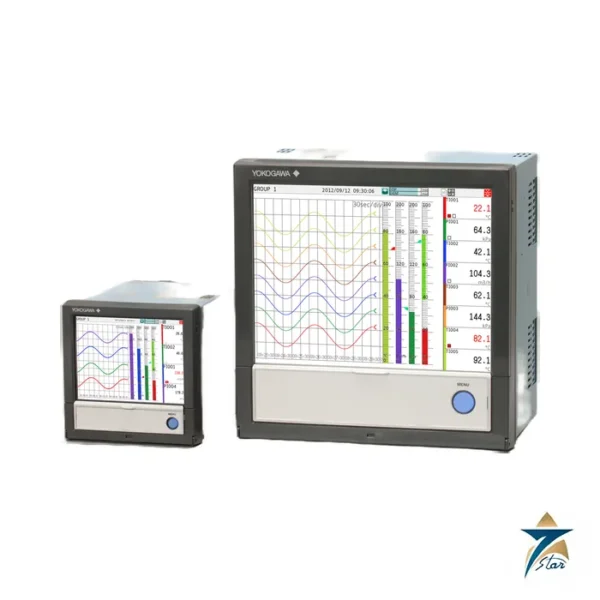
The attached file is the Yokogawa general specification GS 04L55B01-01EN covering the GM10, GM90MB and GM90PS modules. Panel-mount recorders from the same family are listed in controllers and data acquisition. Send the point list and the full model code and we will prepare a quotation.









Reviews
There are no reviews yet.