Brand:

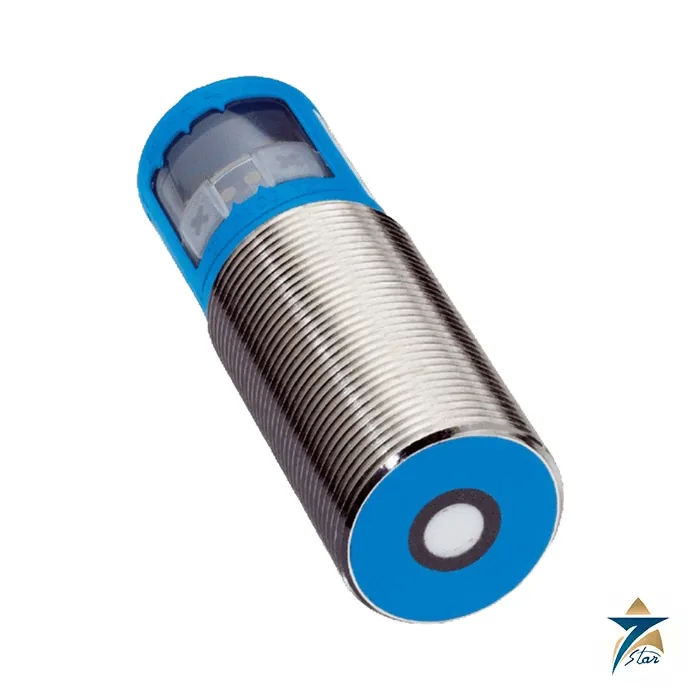
SICK UM30-211113 M30 Ultrasonic Distance Sensor, 30-250 mm Analog

Description

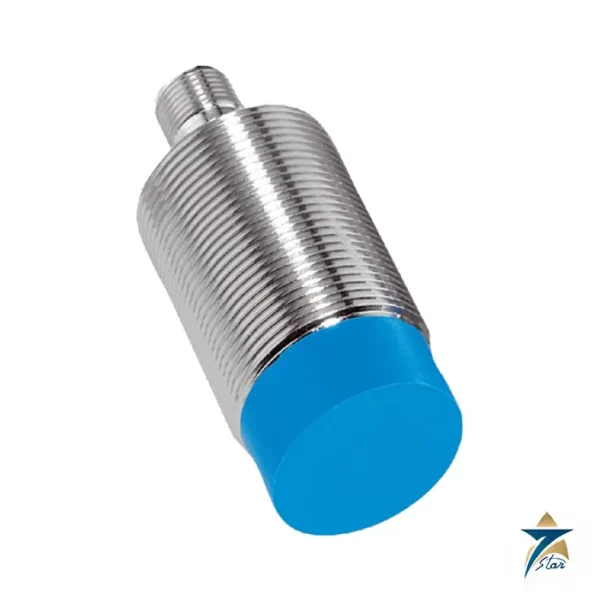
SICK UM30-211113: short-range ultrasonic measurement in an M30 barrel

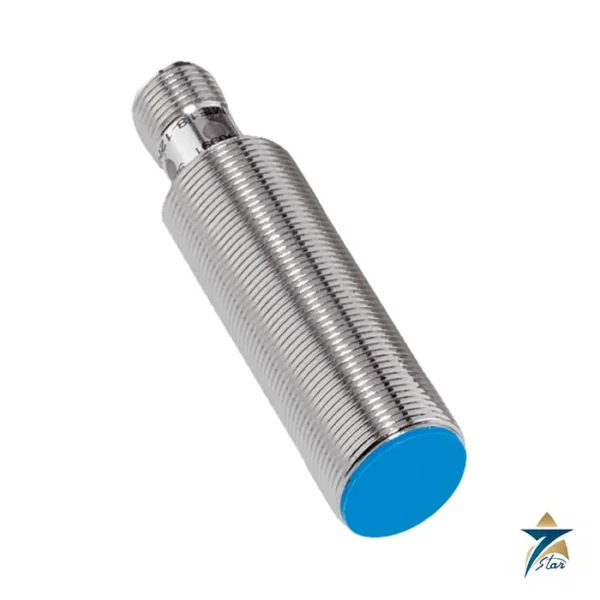
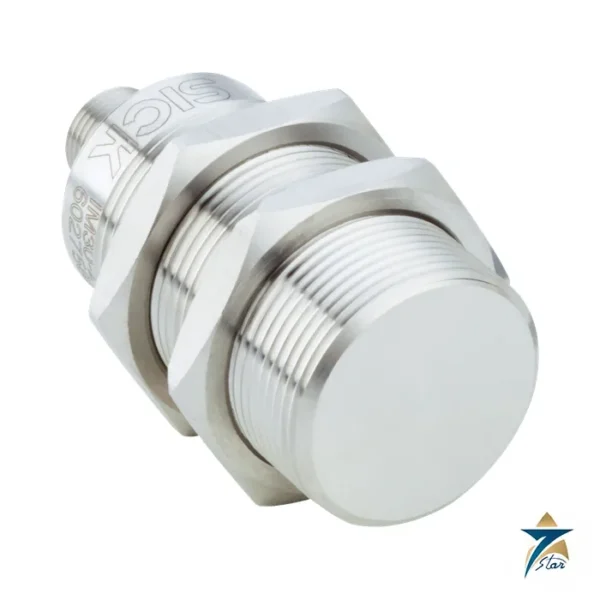
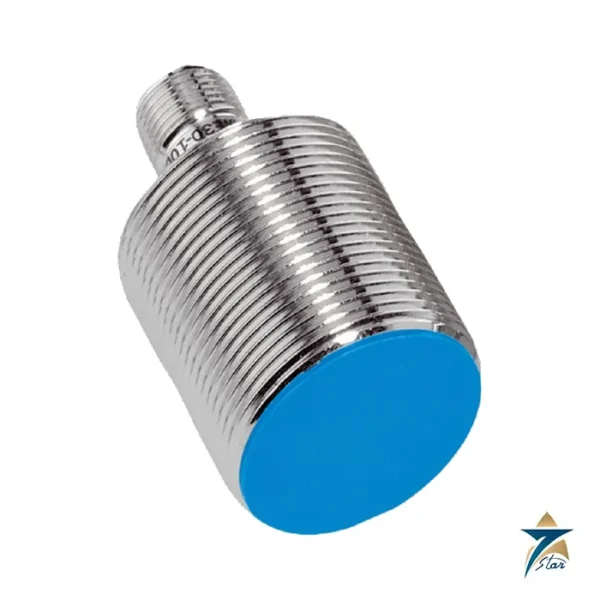
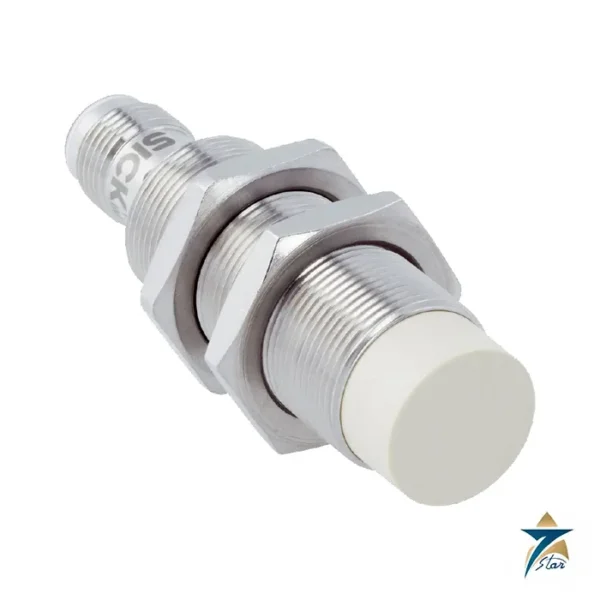
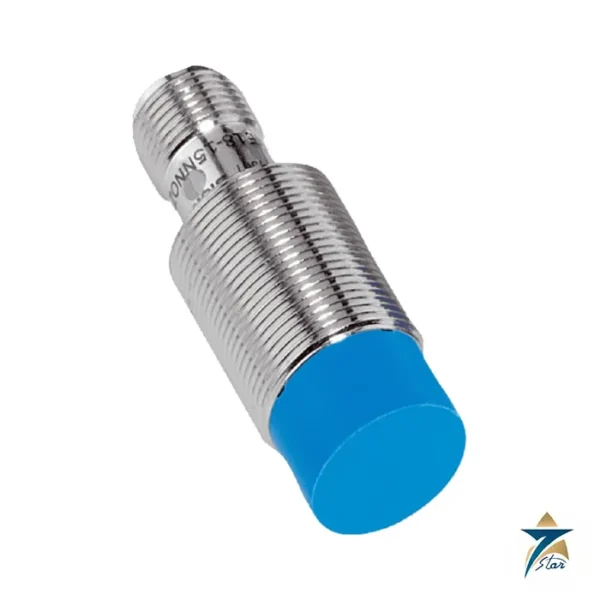
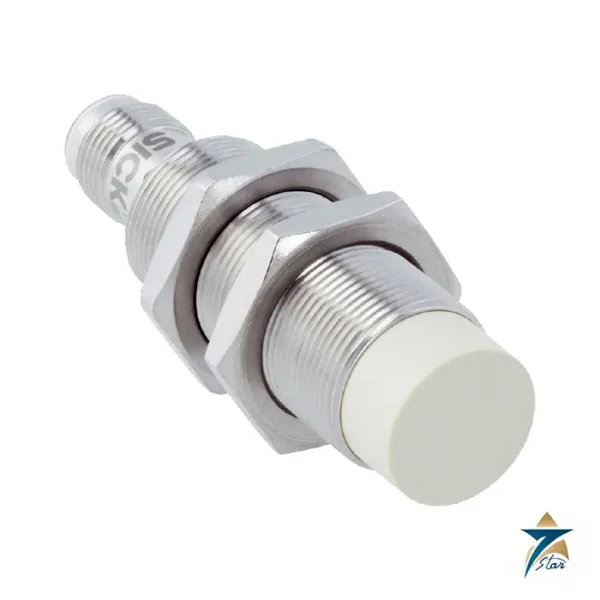
The SICK UM30-211113 (part no. 6036916) is an ultrasonic distance sensor in a cylindrical M30 x 1.5 metal housing. Its operating range is 30 mm to 250 mm, with a limiting range of 350 mm, and its single analog output automatically selects between 4 mA to 20 mA current and 0 V to 10 V voltage depending on the load connected.

Ultrasonic sensing is independent of colour, transparency and surface gloss. That makes the UM30-211113 a practical tool for measuring the level of clear liquids, the height of stacked sheets or the diameter of a roll, tasks where optical sensors can struggle.

The sensor emits a short burst of 320 kHz sound, waits for the echo, and converts the time of flight into distance. Because the speed of sound changes with air temperature, the UM30-211113 includes a temperature compensation that can be switched off; without compensation, the datasheet gives a drift of 0.17 percent per kelvin, a figure that helps you judge whether compensation is needed in a hot Gulf plant where the air can vary by 30 kelvin during a day.

UM30-211113 feature summary

  • Resolution of 0.18 mm or better, repeatability plus or minus 0.15 percent, measurement accuracy plus or minus 1 percent
  • Response time 32 ms, output time 8 ms, ultrasonic frequency typically 320 kHz
  • Temperature compensation (switchable), teach-in and scaling of the analog output, invertible output
  • Synchronisation or multiplexing of up to 50 sensors without cross talk
  • Adjustable measured-value filters, foreground suppression, detection area, sensitivity and sound beam
  • Display with two LEDs which can be deactivated, reset to factory default

UM30-211113 technical data

Parameter Value
Type part no. 6036916
Principle Ultrasonic distance sensor, cylindrical, straight sending axis
Operating / limiting range 30 mm to 250 mm / 350 mm
Resolution / repeatability 0.18 mm or better / plus or minus 0.15 percent
Accuracy Plus or minus 1 percent
Response / output time 32 ms / 8 ms
Ultrasonic frequency Typically 320 kHz
Analog output 4 mA to 20 mA (up to 500 ohm) or 0 V to 10 V (at least 100 kohm), 12 bit
Supply voltage 9 V DC to 30 V DC
Power consumption Up to 2.4 W
Enclosure rating IP65 / IP67
Dimensions M30 x 1.5, 30 x 30 x 84 mm
Weight 150 g
Connection Male connector M12, 5-pin
Operating temperature -25 to +70 degrees Celsius
Storage temperature -40 to +85 degrees Celsius
MTTFD 101 years

Reading the table, notice the pairing of range and resolution: with at least 0.18 mm of resolution over 250 mm, the analog output of 12 bit is not the limit, the acoustics are. The response time of 32 ms means the sensor is intended for process monitoring and level control, not for fast part counting. The housing is metal (nickel-plated brass, PBT) with a polyurethane-foam and glass-epoxy transducer, and the unit weighs 150 g.

UM30-211113 and the wider UM30 family

The dimensional drawing in the datasheet is shared by the UM30-211, UM30-212 and UM30-213 groups. The UM30-211113 covers the short 30 mm to 250 mm band, whereas longer-range types of the family reach farther but need more blind distance. If your application needs more than 350 mm of travel, do not stretch this model; choose a longer-range UM30 type instead.

Using UM30-211113 in Oman and the Gulf

Applications include fill level of small tanks and day bins, web and roll diameter monitoring in packaging and textile lines, loop control of sheets and foils, and detection of transparent bottles. Because the measurement ignores colour, it is also useful for reading the height of pallets of mixed products.

Where several sensors are mounted side by side, for example across the width of a web, the multiplexing and synchronisation functions avoid acoustic cross talk. Up to 50 sensors can be linked, which makes an array practical.

Selection and wiring of UM30-211113

Supply is 9 V to 30 V DC (15 V to 30 V when the analog voltage output is used), with power consumption up to 2.4 W. The current output must be loaded with 500 ohm or less, and the voltage output requires a load of at least 100 kohm. There is one multifunctional input (MF). Connection is an M12 five-pin male connector.

Check that the target is within the 30 mm blind zone limit at all times: below the lower operating range the sensor cannot give a valid reading, so mechanical stops should keep the product from approaching closer than 30 mm. Large flat targets perpendicular to the beam give the cleanest echo, while foam, felt or powder surfaces absorb sound and reduce the usable distance.

Mounting and set-up of UM30-211113

Screw the M30 x 1.5 body into a bracket, align the sensing face squarely to the target, teach near and far limits and enable temperature compensation as needed. Without compensation, the temperature drift is 0.17 percent per kelvin. Avoid soft, sound-absorbing targets at an extreme angle.

After mounting, set the near and far teach points using the target positions of the process, check the display and keep the factory-default reset in mind if a previous user changed filter settings. Verify the analog scaling against the PLC scaling in engineering units.

Maintenance of UM30-211113

Keep the transducer face clean from dust and condensation; build-up reduces the sensitivity. Housing temperature range is -25 to +70 degrees Celsius in operation. MTTFD is 101 years.

Supply of UM30-211113

Please quote UM30-211113 with part number 6036916. Seven Star LLC is an independent supplier serving Oman and the GCC and is not affiliated with the manufacturer.

Documents and quotation

The UM30-211113 datasheet is attached to this page. Send an RFQ stating UM30-211113, quantity and delivery location in Oman or the GCC.

Selection Notes for the SICK UM30-211113

When comparing the SICK UM30-211113 with alternatives, start from the duty it must perform: the measured or controlled variable, the range and accuracy you need, the environment at the mounting point and the interface to your control system. Check the electrical and mechanical connections against the installed equipment, and confirm any hazardous-area or ingress-protection requirements for the location. If any point is unclear, send a photo of the nameplate and a short description of the application, and we will compare it with the SICK inductive proximity sensors range and confirm the correct order code before you commit.

Datasheets & Documents
  • PDF Datasheet SICK UM30-211113 M30 Ultrasonic Distance Sensor, 30-250 mm Analog Datasheet Download
Reviews (0)

Reviews

There are no reviews yet.

How would you rate this product?

It takes about 10 seconds — just tap a star. Your email is never published.

About brand

SICK is the German maker of industrial sensors: photoelectric and proximity sensors, safety laser scanners and light curtains, encoders, distance sensors, code readers and gas analysers. Erwin Sick, an optics engineer, founded it in Munich in 1946, and in 1952 it introduced its first marketable accident-prevention light curtain, which protected press operators by stopping the machine when a hand broke the light beam. The company moved to Waldkirch in the Black Forest in 1956 and is still headquartered there. It is a privately held company, and has been an Aktiengesellschaft (AG) since 1996.

SICK company profile

Founded 1946, Munich, Germany, by Erwin Sick (1909–1988)
Headquarters Waldkirch, Baden-Württemberg, Germany (since 1956)
Ownership Privately held; after the founder's death in 1988 his widow Gisela Sick became the main shareholder. Legal form SICK AG since 1996
Size More than 12,000 employees and group revenue of about EUR 2.3 billion (company figures for 2023)
First breakthrough Accident-prevention light curtain for presses, shown in Hanover in 1952
International growth First foreign subsidiary in France in 1972, United States in 1976; today sales and service companies worldwide
Product families Photoelectric, inductive, capacitive, magnetic and ultrasonic sensors; safety laser scanners, light curtains, safety controllers and relays; encoders and motor feedback systems; distance sensors and LiDAR; barcode and 2D code readers and machine vision; gas analysers, dust and flow measurement for process and emissions monitoring

Milestones

  • 1946: Erwin Sick receives a licence to run his engineering firm in Munich.
  • 1952: The first marketable accident-prevention light curtain is presented in Hanover and goes into series production.
  • 1956: The company moves to Waldkirch with 25 employees.
  • 1972 and 1976: Subsidiaries are founded in France and the United States.
  • 1996: SICK becomes an Aktiengesellschaft.
  • Today: Sensors for factory and logistics automation, machine safety and process analysis, with a large share of revenue outside Germany.

Choosing a SICK sensor

For object detection, the sensing principle comes first. A retro-reflective sensor (WL series) sends light to a reflector and switches when an object breaks the beam; it is reliable over long distances and easy to align. A sensor with background suppression (WTB series) detects an object at a set distance and ignores what is behind it, which suits conveyors with shiny or dark backgrounds. A through-beam pair (WS/WE) gives the longest range and the highest reliability in dust. For transparent bottles and film, use a model built for transparent objects (for example WL12G-3B or WL150-P420). The digits in the code also matter: "P" usually means a PNP output and "N" NPN, and the last digits set the connector or cable. For machine guarding, a safety laser scanner such as nanoScan3 or microScan3 protects an area, while a safety controller such as Flexi Soft combines several safety devices.

Where SICK products are used

In Oman and the GCC, SICK sensors are used in packaging and bottling lines, food and beverage plants, logistics and airport baggage handling, cement and steel plants, ports and cranes, automated warehouses, and on machines built by European OEMs. SICK safety scanners guard robots and automated guided vehicles, and its encoders give position feedback on motors, hoists and conveyors.

SICK products we list

Family Examples
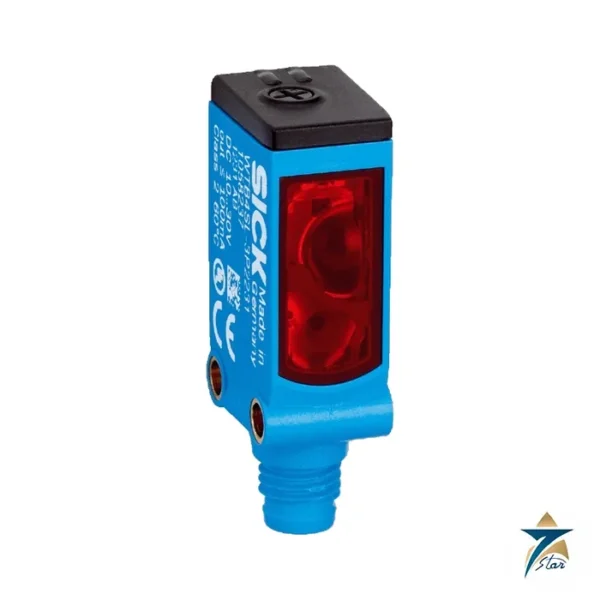
Photoelectric sensors WL12-3P2431, WTB12-3P2431, GTB6-P4211, VL18-4P3240, WL12G-3B2531, WS/WE100, KT5W contrast, W26 IO-Link
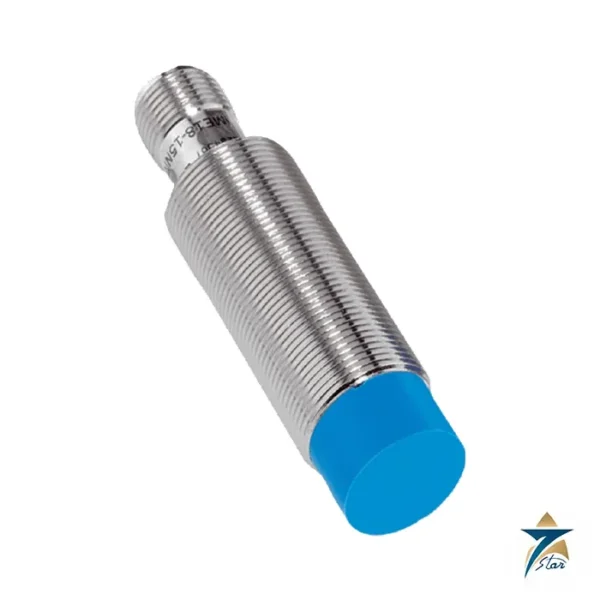
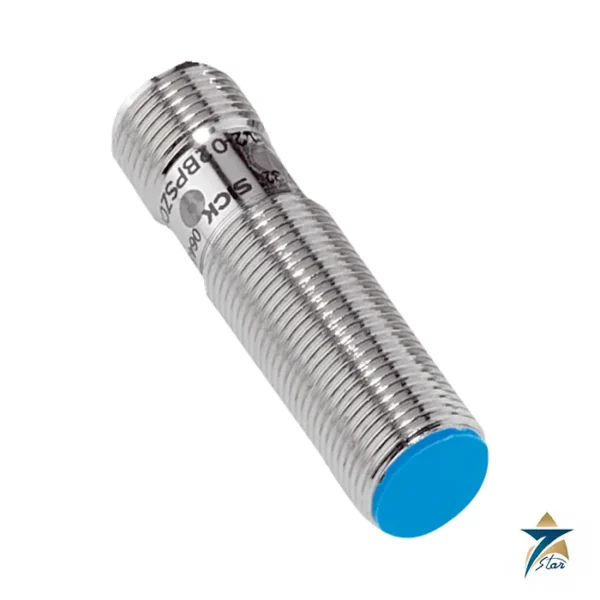
Proximity, cylinder and ultrasonic sensors IME12-08NPSZC0S, IME18-05BPSZC0S, MZT8, UM18 4-20 mA, UM30, UFN3 fork
Machine safety nanoScan3, microScan3, S300 Professional, Flexi Soft FX3-CPU1, FX3-XTIO, ReLy OSSD
Encoders and motor feedback DFS60B, AFM60 PROFINET, AFS60 SSI, ATM60 PROFIBUS, SRS50, EFS50
Distance sensors and code readers DT50, DL50, DT35, Lector632

Ordering SICK products: what we need

Send the type code and the 7-digit SICK part number from the label (for example WTB12-3P2431 together with its part number). For a replacement sensor, add the output (PNP or NPN), connection (M8, M12 or cable) and sensing distance. For encoders, add the interface (incremental, SSI, PROFIBUS, PROFINET), resolution and shaft type. For safety scanners, tell us the model and whether the existing configuration needs to be kept.

Frequently requested SICK models: SICK WTB4-3 Miniature Photoelectric Proximity Sensor, SICK IME18-08NPSZW2K Inductive Proximity Sensor, SICK DT35-B15251 Laser Distance Sensor, SICK microScan3 Safety Laser Scanner, SICK RZT7-03ZUS-KWB T-Slot Cylinder Sensor.

Facts checked against SICK's published company history and annual figures, October 2026.

FAQ

Questions about the SICK UM30-211113 M30 Ultrasonic Distance Sensor,

Answers from our engineering team on installation, compatibility and integration.

01What is the range of SICK UM30-211113?
Operating range 30 mm to 250 mm and limiting range 350 mm.
02What outputs does UM30-211113 provide?
One analog output that switches automatically between 4 mA to 20 mA and 0 V to 10 V based on load.
03How accurate is UM30-211113?
Accuracy is plus or minus 1 percent and repeatability plus or minus 0.15 percent.
04Can UM30-211113 be synchronised?
Yes, up to 50 sensors can be synchronised or multiplexed without cross talk.
05What connector does UM30-211113 use?
An M12 five-pin male connector, as stated in the manufacturer datasheet for UM30-211113.