- Automation & ControlView all 3,044 products
- Automation Accessories
- AC Drives
- PLC & I/O Cards
- Industrial Communications
- Vibration Monitoring
- Isolator & Barrier
- Controllers & Data Acquisition
- Safety Switches & Guard Locking
- Motor Soft Starters
- Encoders
- CCTV & Security
- Pneumatic Cylinders
- HMI Displays
- Servo Drives
- Industrial Computers
- Machine Vision
- Automation Software
- Robotics
Brand: SICK
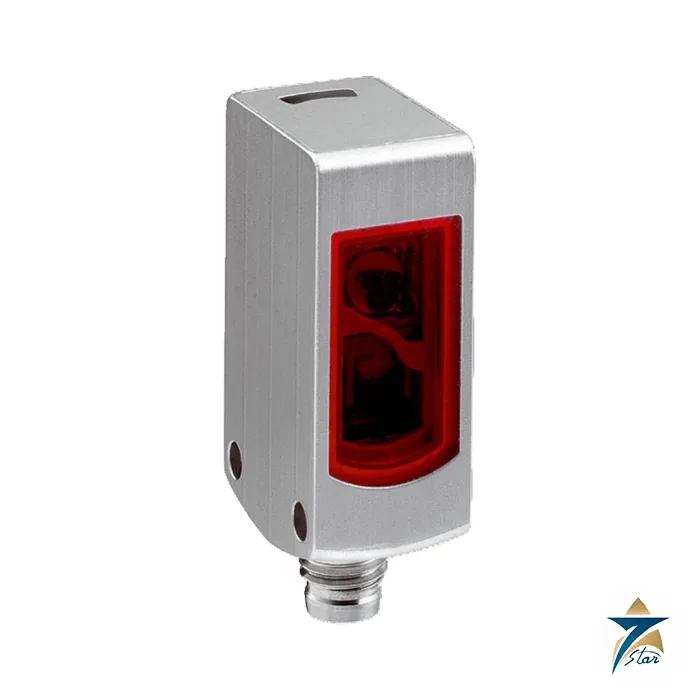
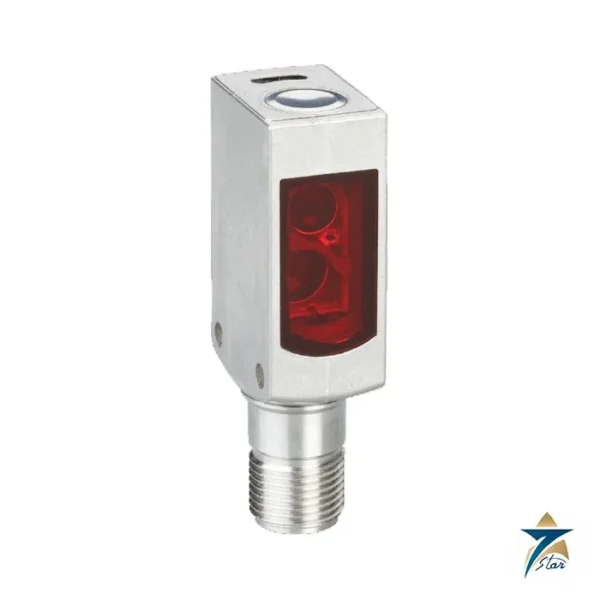
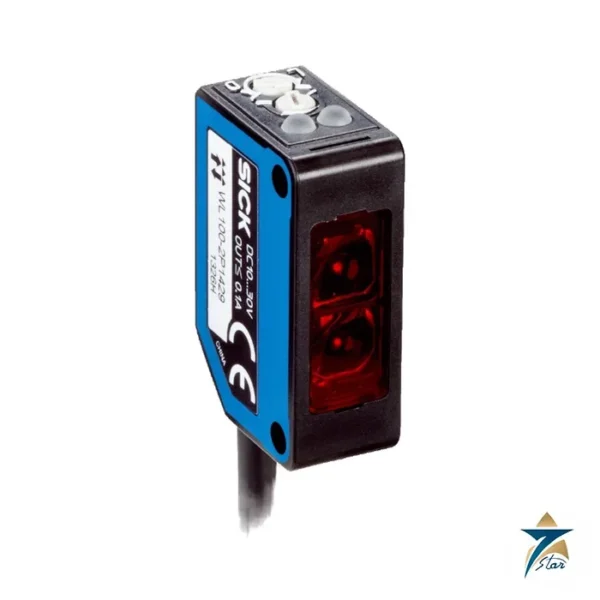
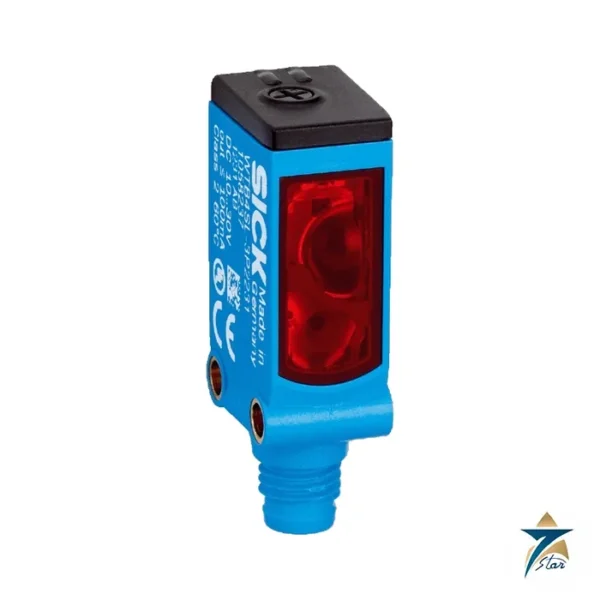
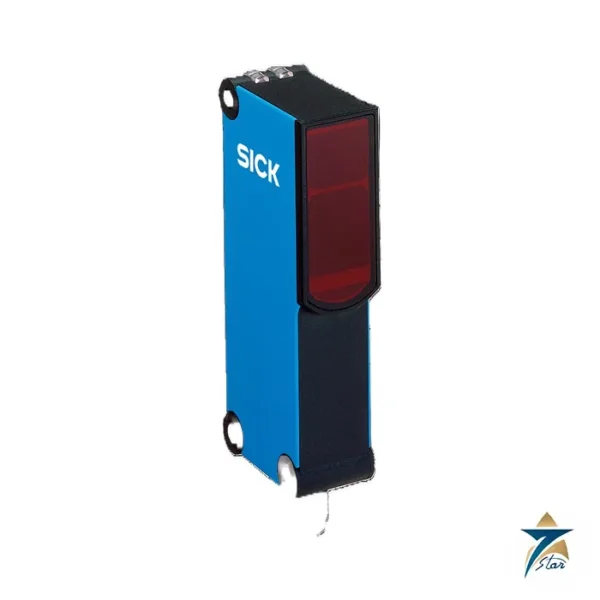
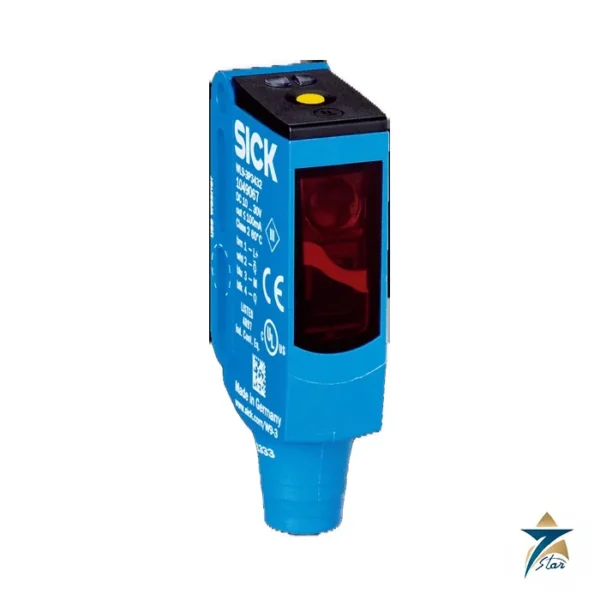
SICK WLG4S-3P3432V Stainless Steel Retro-Reflective Sensor, AutoAdapt
Description
SICK WLG4S-3P3432V: stainless washdown sensor with AutoAdapt
The SICK WLG4S-3P3432V (part no. 1046449) is a retro-reflective photoelectric sensor in a V4A stainless steel housing, designed for wet, hygienic zones. Its optics are coaxial, which means the emitter and receiver share the same axis and the sensor works down to zero distance from a reflector, covering 0 m to 3 m in normal use and up to 5 m maximum.
Compared with the plain WL4S-3P3432V, the WLG4S version adds the AutoAdapt feature and lists detecting transparent objects among its special applications. This makes it the preferred pick for clear PET bottles, glass jars, films and trays on filling lines.
Transparent-object detection is the harder task in photoelectrics. A clear bottle passes most of the red light, so the sensor has to notice a small drop in the returned signal rather than a full interruption. The polarisation filter in the WLG4S-3P3432V cancels glare from shiny wrap and wet glass, and the datasheet figure of more than 8 percent attenuation along the beam tells you how much signal loss an object must cause to be seen.
Features of the WLG4S-3P3432V
- Autocollimation optics with a polarisation filter, reflector type PL80A named in the datasheet
- PinPoint LED, red light at 650 nm, spot 45 mm at 1.5 m
- Single teach-in button for adjustment
- Housing: stainless steel V4A (1.4404, 316L), PMMA front screen, PVC cable with M12 four-pin plug, 150 mm
- Washdown housing design with ratings IP66, IP67, IP68 and IP69K
- Complementary PNP output with light and dark switching, 100 mA, response below 0.5 ms
WLG4S-3P3432V data table
| Parameter | Value |
|---|---|
| Type part no. | 1046449 |
| Principle | Retro-reflective, autocollimation, polarisation filter |
| Sensing range | 0 m to 3 m (max. 0 m to 5 m) |
| Light source | PinPoint LED, red, 650 nm, spot 45 mm at 1.5 m |
| Adjustment | Single teach-in button, AutoAdapt |
| Supply voltage | 10 V DC to 30 V DC, ripple below 5 Vpp |
| Current consumption | 30 mA |
| Output | PNP, light/dark, complementary, up to 100 mA |
| Response / frequency | Below 0.5 ms / 1,000 Hz |
| Connection | Cable with M12 plug, 4-pin, 150 mm |
| Dimensions (W x H x D) | 15.25 x 49.2 x 22.2 mm |
| Housing | Stainless steel V4A 1.4404 (316L), PMMA screen |
| Enclosure rating | IP66, IP67, IP68, IP69K |
| Operating temperature | -30 to +60 degrees Celsius |
| Storage temperature | -30 to +75 degrees Celsius |
| Maximum tightening torque | 0.7 Nm |
| MTTFD | 1,215 years |
The connection scheme is the usual M12 four-pin arrangement for four-wire DC sensors; on the 150 mm pigtail the plug is a standard A-coded type, so any matching M12 cordset can be used for the cable run to a junction box. The pigtail design also keeps the stainless body free of a threaded connector seat, which is one more crevice that does not need to be cleaned.
WLG4S-3P3432V versus WL4S-3P3432V
The two stainless W4 retro-reflective sensors share nearly every number: 0 m to 3 m range, 45 mm spot at 1.5 m, 30 mA current, 15.25 by 49.2 by 22.2 mm body and 60 g weight. The practical difference is the AutoAdapt capability and the transparent-object special application of the WLG4S-3P3432V, plus its operating temperature of -30 to +60 degrees Celsius against -30 to +70 degrees Celsius for the WL4S-3P3432V. Pick the WLG4S-3P3432V for clear targets, and the WL4S for opaque products at higher temperatures.
Applications of WLG4S-3P3432V in Oman and GCC food and beverage plants
Dairy and juice fillers, bottled-water lines, date-processing and packing halls and pharmaceutical vial lines all demand corrosion-proof sensors that survive hot-water sprays. In these plants, the WLG4S-3P3432V can detect a clear bottle against a reflector on the opposite guide rail, count transparent trays or confirm a film web is present. The IP69K rating means it can survive high-pressure, high-temperature cleaning.
In Muscat and Salalah bottling and dairy plants, line cleaning happens at least daily and often at the end of every shift. A device that is not rated for sustained spray will fail early, and false alarms from fogged lenses are among the commonest causes of line stops. Selecting a stainless unit with the highest ingress rating in its class reduces that risk, and the small 15.25 mm width fits in standard guide-rail slots.
Selection guide for WLG4S-3P3432V
The attenuation along the light beam is above 8 percent, which is the minimum signal loss that a transparent object must create for reliable detection. Very thin clear films may need testing. Use the PL80A reflector, and keep the reflector clean and dry; a droplet-covered reflector may give false states.
Mount the reflector on a rigid arm, not on a flexible guard; a reflector that moves by a few millimetres in the steam can make the sensor drift between teach states. After a washdown cycle, check the output condition with the beam clear and again with a sample bottle in position.
Installation of WLG4S-3P3432V
The maximum tightening torque is 0.7 Nm, so do not over-torque the fixing screws on the stainless body. Connect the pig-tail M12 plug to a four-pin extension cable, mount opposite the reflector, press the teach-in button with the reflector in place, and verify that a transparent sample interrupts the beam as expected.
Commissioning is a short routine of mount, plug, align, teach and test. The teach-in procedure is run with the reflector in place and no product in the beam. If the PLC logs excessive output toggling after a week, check for water drops on the reflector.
Care of the WLG4S-3P3432V
Rinse and wipe the screen after cleaning chemicals. Check the pigtail cable for scuffs. The MTTFD is 1,215 years with a 20-year mission time.
Supply notes for WLG4S-3P3432V
Order by full type code WLG4S-3P3432V (1046449). Seven Star LLC is an independent supplier serving Oman and the GCC and is not affiliated with the manufacturer.
Documents and quotation
A datasheet for the WLG4S-3P3432V is attached. Send your RFQ with part number WLG4S-3P3432V and quantity and we will respond with lead time.
Other Models in the Sick W4 Stainless Range
Seven Star LLC supplies models from the Sick W4 Stainless range in Oman and the GCC. Compare the related models below and request a quote for the one that matches your application.
| Model | Category | |
|---|---|---|
| SICK WL4S-3P3432V Stainless Retro-Reflective Photoelectric Sensor | Inductive Proximity Sensors | View details |
| SICK WLG4S-3P3432V Stainless Steel Retro-Reflective Sensor, AutoAdapt | Inductive Proximity Sensors | You are viewing this model |
Datasheets & Documents
- Datasheet SICK WLG4S-3P3432V Stainless Steel Retro-Reflective Sensor, AutoAdapt Datasheet Download
Reviews (0)
How would you rate this product? Cancel reply
About brand
SICK is the German maker of industrial sensors: photoelectric and proximity sensors, safety laser scanners and light curtains, encoders, distance sensors, code readers and gas analysers. Erwin Sick, an optics engineer, founded it in Munich in 1946, and in 1952 it introduced its first marketable accident-prevention light curtain, which protected press operators by stopping the machine when a hand broke the light beam. The company moved to Waldkirch in the Black Forest in 1956 and is still headquartered there. It is a privately held company, and has been an Aktiengesellschaft (AG) since 1996.
SICK company profile
| Founded | 1946, Munich, Germany, by Erwin Sick (1909–1988) |
|---|---|
| Headquarters | Waldkirch, Baden-Württemberg, Germany (since 1956) |
| Ownership | Privately held; after the founder's death in 1988 his widow Gisela Sick became the main shareholder. Legal form SICK AG since 1996 |
| Size | More than 12,000 employees and group revenue of about EUR 2.3 billion (company figures for 2023) |
| First breakthrough | Accident-prevention light curtain for presses, shown in Hanover in 1952 |
| International growth | First foreign subsidiary in France in 1972, United States in 1976; today sales and service companies worldwide |
| Product families | Photoelectric, inductive, capacitive, magnetic and ultrasonic sensors; safety laser scanners, light curtains, safety controllers and relays; encoders and motor feedback systems; distance sensors and LiDAR; barcode and 2D code readers and machine vision; gas analysers, dust and flow measurement for process and emissions monitoring |
Milestones
- 1946: Erwin Sick receives a licence to run his engineering firm in Munich.
- 1952: The first marketable accident-prevention light curtain is presented in Hanover and goes into series production.
- 1956: The company moves to Waldkirch with 25 employees.
- 1972 and 1976: Subsidiaries are founded in France and the United States.
- 1996: SICK becomes an Aktiengesellschaft.
- Today: Sensors for factory and logistics automation, machine safety and process analysis, with a large share of revenue outside Germany.
Choosing a SICK sensor
For object detection, the sensing principle comes first. A retro-reflective sensor (WL series) sends light to a reflector and switches when an object breaks the beam; it is reliable over long distances and easy to align. A sensor with background suppression (WTB series) detects an object at a set distance and ignores what is behind it, which suits conveyors with shiny or dark backgrounds. A through-beam pair (WS/WE) gives the longest range and the highest reliability in dust. For transparent bottles and film, use a model built for transparent objects (for example WL12G-3B or WL150-P420). The digits in the code also matter: "P" usually means a PNP output and "N" NPN, and the last digits set the connector or cable. For machine guarding, a safety laser scanner such as nanoScan3 or microScan3 protects an area, while a safety controller such as Flexi Soft combines several safety devices.
Where SICK products are used
In Oman and the GCC, SICK sensors are used in packaging and bottling lines, food and beverage plants, logistics and airport baggage handling, cement and steel plants, ports and cranes, automated warehouses, and on machines built by European OEMs. SICK safety scanners guard robots and automated guided vehicles, and its encoders give position feedback on motors, hoists and conveyors.
SICK products we list
| Family | Examples |
|---|---|
| Photoelectric sensors | WL12-3P2431, WTB12-3P2431, GTB6-P4211, VL18-4P3240, WL12G-3B2531, WS/WE100, KT5W contrast, W26 IO-Link |
| Proximity, cylinder and ultrasonic sensors | IME12-08NPSZC0S, IME18-05BPSZC0S, MZT8, UM18 4-20 mA, UM30, UFN3 fork |
| Machine safety | nanoScan3, microScan3, S300 Professional, Flexi Soft FX3-CPU1, FX3-XTIO, ReLy OSSD |
| Encoders and motor feedback | DFS60B, AFM60 PROFINET, AFS60 SSI, ATM60 PROFIBUS, SRS50, EFS50 |
| Distance sensors and code readers | DT50, DL50, DT35, Lector632 |
Ordering SICK products: what we need
Send the type code and the 7-digit SICK part number from the label (for example WTB12-3P2431 together with its part number). For a replacement sensor, add the output (PNP or NPN), connection (M8, M12 or cable) and sensing distance. For encoders, add the interface (incremental, SSI, PROFIBUS, PROFINET), resolution and shaft type. For safety scanners, tell us the model and whether the existing configuration needs to be kept.
Frequently requested SICK models: SICK WTB4-3 Miniature Photoelectric Proximity Sensor, SICK IME18-08NPSZW2K Inductive Proximity Sensor, SICK DT35-B15251 Laser Distance Sensor, SICK microScan3 Safety Laser Scanner, SICK RZT7-03ZUS-KWB T-Slot Cylinder Sensor.
Facts checked against SICK's published company history and annual figures, October 2026.
Browse SICK products by category: Sensors & Transmitters.
FAQ
Questions about the SICK WLG4S-3P3432V Stainless Steel Retro-Reflective
Answers from our engineering team on installation, compatibility and integration.
01What is the range of SICK WLG4S-3P3432V?
0 m to 3 m as the standard range and 0 m to 5 m maximum, with a PL80A reflector.
02Can WLG4S-3P3432V detect transparent objects?
Yes, the datasheet lists detecting transparent objects and hygienic washdown zones as special applications.
03What housing material does WLG4S-3P3432V use?
Stainless steel V4A (1.4404, 316L) with a PMMA front screen.
04Which IP ratings are stated for WLG4S-3P3432V?
IP66, IP67, IP68 and IP69K, as stated in the manufacturer datasheet for WLG4S-3P3432V.
05What is the tightening torque of WLG4S-3P3432V?
Maximum 0.7 Nm, as stated in the manufacturer datasheet for WLG4S-3P3432V.


Reviews
There are no reviews yet.