- Automation & ControlView all 3,105 products
- Automation Accessories
- AC Drives
- PLC & I/O Cards
- Industrial Communications
- Vibration Monitoring
- Isolator & Barrier
- Controllers & Data Acquisition
- Safety Switches & Guard Locking
- Encoders
- Motor Soft Starters
- CCTV & Security
- Pneumatic Cylinders
- HMI Displays
- Servo Drives
- Industrial Computers
- Machine Vision
- Automation Software
- Robotics
Brand: SICK
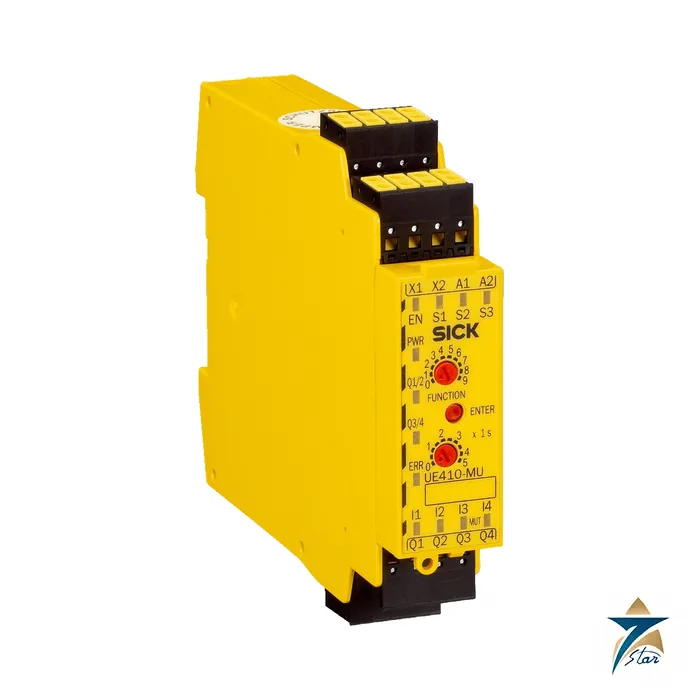
SICK UE410-MU3T5 Flexi Classic Safety Controller Main Module
Description
Overview
The SICK UE410-MU3T5 is a Flexi Classic main module: a small safety controller that evaluates safety inputs, applies a selected logic function and drives safety outputs, without any programming software. Its logic is chosen with a rotary switch on the front of the housing, which is why it is popular as a quick-to-commission alternative to a full programmable safety controller. The module is rated SIL 3 under IEC 61508, Category 4 and Performance Level e under EN ISO 13849, with a PFHD of 2.5 x 10 to the minus 9 per hour and a mission time of 20 years.
The code ending MU3T5 identifies the muting variant. The data sheet lists a function for differentiation between man and material, meaning the controller can bridge a light curtain temporarily when a pallet passes, using 0 or 2 muting sensors, and it also offers AND operation, OR operation, bypass, restart interlock and external device monitoring. Outputs Q3 and Q4 can be delayed by 0 to 5 seconds, which is the T5 part of the code.
Seven Star LLC is an independent supplier serving Oman and the GCC. The page is based on the manufacturer data of part number 6026136.
Inputs, outputs and logic functions of the SICK UE410-MU3T5
The module provides 4 safety inputs, 4 switching inputs, 4 safety outputs and 2 test outputs. Safety inputs connect emergency stop buttons, light curtains, safety mats and door switches, the test outputs allow cross-fault detection on two-channel devices, and the switching inputs carry signals such as reset or muting sensor information. The restart interlock can be set manually or automatically, and external device monitoring checks that downstream contactors have really dropped before the outputs can be enabled again.
Configuration happens through the rotary switch, with no PC link. This keeps documentation simple: the position of the switch defines the function, and an engineer can verify it at a glance during an audit. The terminals are plug-in screw type, so the wiring stays in the cabinet when a module is exchanged.
Technical specifications of the UE410-MU3T5
| Parameter | Value |
|---|---|
| Type / part number | UE410-MU3T5 / 6026136 |
| Module | Main module, Flexi Classic |
| Configuration | Via rotary switch |
| Safety integrity level | SIL 3 (IEC 61508) |
| Category / Performance level | Category 4 / PL e (EN ISO 13849) |
| PFHD | 2.5 x 10 to the minus 9 per hour |
| Mission time | 20 years |
| Safety inputs | 4 |
| Switching inputs | 4 |
| Muting sensors | 0 or 2 |
| Safety outputs | 4 |
| Test outputs | 2 |
| Output delay Q3 / Q4 | 0 s to 5 s |
| Restart interlock | Manual or automatic, configurable |
| Supply voltage | 24 V DC (19.2 V to 30 V), PELV or SELV |
| Residual ripple | 10 percent or less |
| Power consumption | 3 W or less |
| Switch-on time | 60 s or less |
| Connection | Plug-in screw-type terminals |
| Dimensions (W x H x D) | 22.5 mm x 96.5 mm x 120.8 mm |
| Weight | about 180 g |
| Enclosure rating | Housing IP40, terminals IP20 |
| Operating temperature | minus 25 to plus 55 degrees Celsius |
| Storage temperature | minus 25 to plus 70 degrees Celsius |
| Air humidity | 95 percent or less, non-condensing |
| Vibration resistance | 5 g RMS, 5 Hz to 500 Hz |
The data sheet notes that the power supply feeding the main module must be limited to a maximum of 4 A, either by the supply itself or by a fuse.
How UE410-MU3T5 differs from other UE410 modules
The UE410 family has several main modules with different functions. The SICK UE410-MU3T5 adds the muting function and the delayed outputs. A main module without muting leaves out the muting sensor inputs, while a version with a different delay range changes the permitted time setting for outputs Q3 and Q4. These modules look alike and share the 22.5 mm housing, so rely on the full code and the part number 6026136 when ordering a replacement.
Expansion modules in the same range add more inputs or outputs but cannot work alone; the main module is the unit that holds the logic and carries the safety rating of the function.
When comparing alternatives, also consider how much future change you expect. A rotary-switch controller is ideal for a fixed safety concept that will not be edited often, such as a single guarded cell with a handful of devices. If the machine will later receive additional zones, networked diagnostics or complex sequences, a programmable safety controller from the same maker may fit better, and that decision is easier to make before the first panel is built than after.
Typical applications in Oman and the GCC
The controller suits conveyor entry and exit points where material passes a light curtain but people must be stopped, as in packaging, bottling, palletising and warehouse automation. In heavy industry it is often chosen for emergency stop chains on workshops, machining cells and test benches that need more than one safe output and a delay for orderly run-down.
The operating range of minus 25 to plus 55 degrees Celsius and the climate class of EN 61131-2 make it suitable for air-conditioned control rooms and enclosed panels in the Gulf; use cabinet cooling where panels run hot.
Installation, commissioning and maintenance of SICK UE410-MU3T5
Snap the module on a DIN rail inside a cabinet with an enclosure rating suitable for the site, because the housing itself is rated IP40 and the terminals IP20. Provide a clean 24 V DC supply with the 4 A limit, wire the safety devices to the safety inputs, set the rotary switch to the intended function and connect each output to the actuator through its own contactor with the feedback loop closed.
After wiring, validate each safety function by actuating every device and checking the outputs. Record the rotary switch positions. Because the switch-on time can reach 60 seconds, plan for that delay in the start-up sequence. Repeat the function test at planned intervals and replace the module after the 20 year mission time.
Related items you may also need: SICK SRS50-HFV0-K22 Motor Feedback | SICK VL12-2P430 V12 Retro-Reflective Photoelectric Sensor | SICK Lector632 V2D632R-MWMFB4 Image-Based Code Reader | All SICK products.
Documents and quotation
The manufacturer data sheet for the SICK UE410-MU3T5 is attached and contains the connection diagram, the dimensional drawing and the full electrical data.
Please send your RFQ with the part number UE410-MU3T5, the quantity and the delivery location in Oman or the GCC. Seven Star LLC will check availability of the SICK UE410-MU3T5; expansion modules and accessories can be quoted in the same request.
Datasheets & Documents
- Datasheet SICK UE410-MU3T5 Flexi Classic Safety Controller Main Module Datasheet Download
Reviews (0)
How would you rate this product? Cancel reply
About brand
SICK is the German maker of industrial sensors: photoelectric and proximity sensors, safety laser scanners and light curtains, encoders, distance sensors, code readers and gas analysers. Erwin Sick, an optics engineer, founded it in Munich in 1946, and in 1952 it introduced its first marketable accident-prevention light curtain, which protected press operators by stopping the machine when a hand broke the light beam. The company moved to Waldkirch in the Black Forest in 1956 and is still headquartered there. It is a privately held company, and has been an Aktiengesellschaft (AG) since 1996.
SICK company profile
| Founded | 1946, Munich, Germany, by Erwin Sick (1909–1988) |
|---|---|
| Headquarters | Waldkirch, Baden-Württemberg, Germany (since 1956) |
| Ownership | Privately held; after the founder's death in 1988 his widow Gisela Sick became the main shareholder. Legal form SICK AG since 1996 |
| Size | More than 12,000 employees and group revenue of about EUR 2.3 billion (company figures for 2023) |
| First breakthrough | Accident-prevention light curtain for presses, shown in Hanover in 1952 |
| International growth | First foreign subsidiary in France in 1972, United States in 1976; today sales and service companies worldwide |
| Product families | Photoelectric, inductive, capacitive, magnetic and ultrasonic sensors; safety laser scanners, light curtains, safety controllers and relays; encoders and motor feedback systems; distance sensors and LiDAR; barcode and 2D code readers and machine vision; gas analysers, dust and flow measurement for process and emissions monitoring |
Milestones
- 1946: Erwin Sick receives a licence to run his engineering firm in Munich.
- 1952: The first marketable accident-prevention light curtain is presented in Hanover and goes into series production.
- 1956: The company moves to Waldkirch with 25 employees.
- 1972 and 1976: Subsidiaries are founded in France and the United States.
- 1996: SICK becomes an Aktiengesellschaft.
- Today: Sensors for factory and logistics automation, machine safety and process analysis, with a large share of revenue outside Germany.
Choosing a SICK sensor
For object detection, the sensing principle comes first. A retro-reflective sensor (WL series) sends light to a reflector and switches when an object breaks the beam; it is reliable over long distances and easy to align. A sensor with background suppression (WTB series) detects an object at a set distance and ignores what is behind it, which suits conveyors with shiny or dark backgrounds. A through-beam pair (WS/WE) gives the longest range and the highest reliability in dust. For transparent bottles and film, use a model built for transparent objects (for example WL12G-3B or WL150-P420). The digits in the code also matter: "P" usually means a PNP output and "N" NPN, and the last digits set the connector or cable. For machine guarding, a safety laser scanner such as nanoScan3 or microScan3 protects an area, while a safety controller such as Flexi Soft combines several safety devices.
Where SICK products are used
In Oman and the GCC, SICK sensors are used in packaging and bottling lines, food and beverage plants, logistics and airport baggage handling, cement and steel plants, ports and cranes, automated warehouses, and on machines built by European OEMs. SICK safety scanners guard robots and automated guided vehicles, and its encoders give position feedback on motors, hoists and conveyors.
SICK products we list
| Family | Examples |
|---|---|
| Photoelectric sensors | WL12-3P2431, WTB12-3P2431, GTB6-P4211, VL18-4P3240, WL12G-3B2531, WS/WE100, KT5W contrast, W26 IO-Link |
| Proximity, cylinder and ultrasonic sensors | IME12-08NPSZC0S, IME18-05BPSZC0S, MZT8, UM18 4-20 mA, UM30, UFN3 fork |
| Machine safety | nanoScan3, microScan3, S300 Professional, Flexi Soft FX3-CPU1, FX3-XTIO, ReLy OSSD |
| Encoders and motor feedback | DFS60B, AFM60 PROFINET, AFS60 SSI, ATM60 PROFIBUS, SRS50, EFS50 |
| Distance sensors and code readers | DT50, DL50, DT35, Lector632 |
Ordering SICK products: what we need
Send the type code and the 7-digit SICK part number from the label (for example WTB12-3P2431 together with its part number). For a replacement sensor, add the output (PNP or NPN), connection (M8, M12 or cable) and sensing distance. For encoders, add the interface (incremental, SSI, PROFIBUS, PROFINET), resolution and shaft type. For safety scanners, tell us the model and whether the existing configuration needs to be kept.
Frequently requested SICK models: SICK WTB4-3 Miniature Photoelectric Proximity Sensor, SICK IME18-08NPSZW2K Inductive Proximity Sensor, SICK DT35-B15251 Laser Distance Sensor, SICK microScan3 Safety Laser Scanner, SICK RZT7-03ZUS-KWB T-Slot Cylinder Sensor.
Facts checked against SICK's published company history and annual figures, October 2026.
Browse SICK products by category: Sensors & Transmitters.
FAQ
Questions about the SICK UE410-MU3T5 Flexi Classic Safety Controller
Answers from our engineering team on installation, compatibility and integration.
01What does the UE410-MU3T5 do?
It is a Flexi Classic main safety controller module with 4 safety inputs, 4 safety outputs, muting functions and logic selected by a rotary switch.
02What safety rating does the UE410-MU3T5 have?
The data sheet lists SIL 3, Category 4 and Performance Level e with PFHD of 2.5 x 10 to the minus 9 per hour and a mission time of 20 years.
03Does the UE410-MU3T5 need programming software?
No. The configuration method is a rotary switch, so the logic function is set on the module itself without a PC.
04What is the delay on the UE410-MU3T5 outputs?
Outputs Q3 and Q4 can be delayed from 0 s to 5 s, as part of the T5 variant of the code.
05What supply does the UE410-MU3T5 require?
It needs 24 V DC within 19.2 V to 30 V, PELV or SELV, with power consumption of 3 W or less and a supply limited to a maximum of 4 A.


Reviews
There are no reviews yet.