Overview
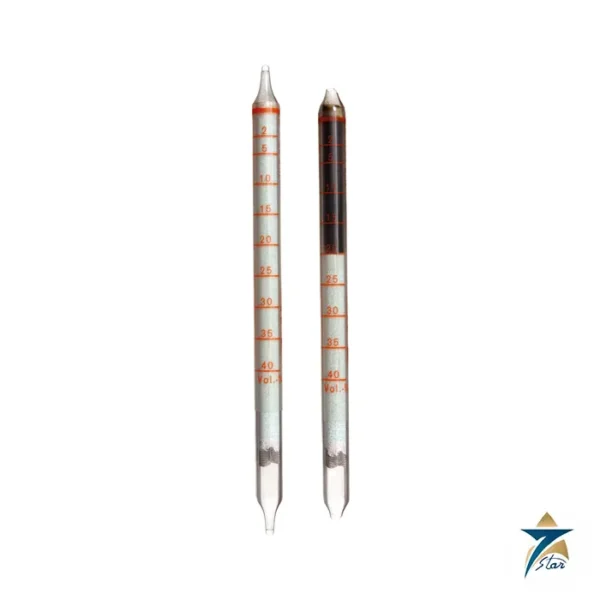
The Gastec No.4HH hydrogen sulphide detector tube measures H2S in the range 0.1 to 2.0% by volume with one pump stroke of 100 mL, and 2.0 to 4.0% with a half pump stroke of 50 mL. It is the standard Gastec short-term detector tube for H2S in higher concentrations, used with the Gastec piston pump for spot measurements in industrial atmospheres.
Hydrogen sulphide is a toxic and corrosive gas produced in oil and gas processing, sewage treatment and many chemical processes. The Gastec No.4HH H2S tube gives a fast, direct reading of H2S concentration without electronic calibration, making it a dependable tool for surveys, leak checks and verification of fixed detectors.
Engineering & Design
The Gastec No.4HH H2S tube contains a reagent layer that reacts with hydrogen sulphide: H2S + CuSO4 forms CuS + H2SO4, changing the colour from pale blue to blackish brown. The length of the stain is proportional to the H2S concentration and is read directly against the printed scale on the tube.
For a measurement, the sealed ends of the tube are broken off, the tube is inserted into the Gastec pump with the arrow pointing toward the pump, and the handle is pulled for the required number of strokes. The stain length is read directly against the printed scale and the concentration is recorded; for readings taken in hot or humid conditions the specified operating range of 0-40 °C and 0-90 % RH requires no correction factor. After use the tube is a hazardous waste item and should be disposed of according to site procedure.
Calibration gas for the tube is generated by the high pressure gas cylinder method at 0.01% per pump stroke. The tube has a detection limit of 0.01%, a relative standard deviation of 10% (for 0.1-0.6%) and 5% (for 0.6-2%), and operates without correction over 0-40 °C and 0-90% relative humidity. Each box contains 10 tubes for 10 tests with a shelf life of 36 months.
Key Features
- Gastec No.4HH H2S tube for hydrogen sulphide detection
- Measuring range 0.1-2.0% (1 stroke, 100 mL); 2.0-4.0% (1/2 stroke, 50 mL)
- Reaction: H2S + CuSO4, colour change pale blue to blackish brown
- Detection limit 0.01%; no temperature or humidity correction needed
- 10 tubes per box, 36 months shelf life
- Used with the standard Gastec piston pump
Applications
- H2S spot measurement in oil and gas facilities
- Verification of fixed H2S gas detectors
- Confined space entry surveys
- Leak detection in process plants and pipelines
Specifications
| Manufacturer |
Gastec Corporation |
| Tube number |
No.4HH |
| Gas |
Hydrogen sulphide (H2S) |
| Measuring range |
0.1-2.0% (1 stroke / 100 mL); 2.0-4.0% (1/2 stroke / 50 mL) |
| Detection limit |
0.01% (1 pump stroke) |
| Reaction |
H2S + CuSO4 to CuS + H2SO4 |
| Colour change |
Pale blue to blackish brown |
| Operating conditions |
0-40 °C, 0-90% RH, no correction |
| Relative standard deviation |
10% (0.1-0.6%); 5% (0.6-2%) |
| Quantity / shelf life |
10 tubes per box / 36 months |
Compatibility
The Gastec No.4HH H2S tube is used with the Gastec GV-100/GV-100S piston pump and the newer Gastec pump models with the same connection standard. It can be combined with other Gastec tubes for multi-gas survey kits.
Choosing the Right Tube
Gastec makes several H2S tubes, each covering a different concentration band. The No.4HH is intended for percent-level concentrations, so it suits sour gas streams, process vents and gas samples rather than personal exposure checks at ppm levels, where a lower-range tube is the right choice. If the expected concentration is unknown, start with a wider-range tube and then confirm with the tube whose range places the reading in the middle of the scale. Before a survey, check:
- The expected H2S level and whether it falls within 0.1–4.0%
- Other gases in the sample that may interfere; consult the instruction sheet in the box
- Sample temperature and humidity against the 0–40 °C and 0–90% RH conditions
- The expiry date on each box
Good Sampling Practice
- Leak-test the pump before use by inserting an unopened tube and pulling the handle; it should not return freely.
- Break both tube tips with the tip breaker on the pump, never by hand.
- Count strokes carefully; the half-stroke reading for 2.0–4.0% uses a different scale interpretation from the full stroke.
- Wait for the full sampling time indicated on the instruction sheet before removing the tube.
- Read the stain end in good light, at the point where the colour change is clearly visible.
When sampling from a pressurised line, use a sample bag or a proper sampling point so the tube only sees gas at atmospheric pressure. Personnel should wear the respiratory protection required by the site H2S procedure.
Troubleshooting Readings
An uneven or smeared stain front usually means the pump was pulled too quickly or the tube was held at an angle in a moist sample. Readings that are consistently low can come from a leaking pump seal or an expired tube. Store boxes in a cool place; in Gulf field conditions, keeping tubes in vehicle cabins shortens their useful life.
Applications in Oman and the GCC
Percent-level H2S is found in sour gas processing, sulphur recovery units and acid gas lines in Oman’s oil and gas fields. The Gastec No.4HH hydrogen sulphide detector tube gives operators a quick independent check of these streams and of fixed detector alarms.
Sourcing from Seven Star LLC
Ordering Information
Order the Gastec No.4HH H2S tube by tube number and gas: H2S 0.1-4.0%. Each box contains 10 tubes; order multiple boxes for survey campaigns. Check the expiry date printed on each box.
The Gastec No.4HH hydrogen sulphide detector tube is the direct reading detector tube of the Gastec system, and the Gastec No.4HH hydrogen sulphide detector tube covers the H2S range for the spot check measurement.
Maintenance teams order the Gastec No.4HH hydrogen sulphide detector tube and the pump for the pipeline spot checks.
Why Seven Star LLC
Seven Star LLC supplies gas detection consumables to plants across Oman and the GCC. Gastec tubes are supplied in sealed original boxes with valid shelf life, ready for immediate use with your Gastec pump.
Our engineers help you verify the exact model and revision before ordering, avoiding mismatches.
Request a Quote for Gastec No.4HH Hydrogen Sulphide H2S Detector Tube
For the Gastec No.4HH H2S tube or any related control and instrumentation requirement, contact the Seven Star LLC team. Submit a formal inquiry through our RFQ page with your required quantity and specification, and our specialists will respond with a detailed commercial proposal and the official Gastec documentation.
Related Products




















Reviews
There are no reviews yet.