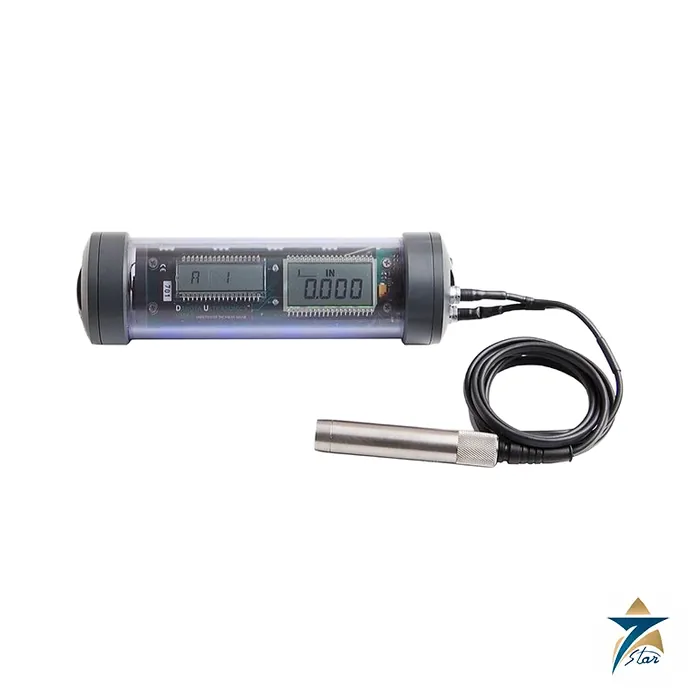
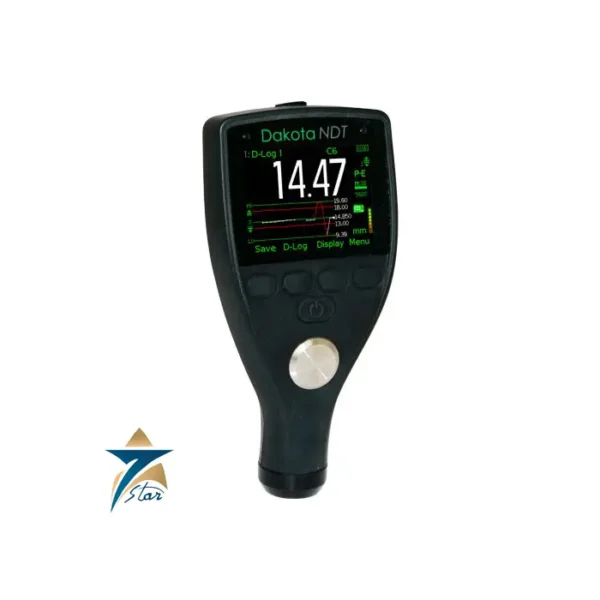
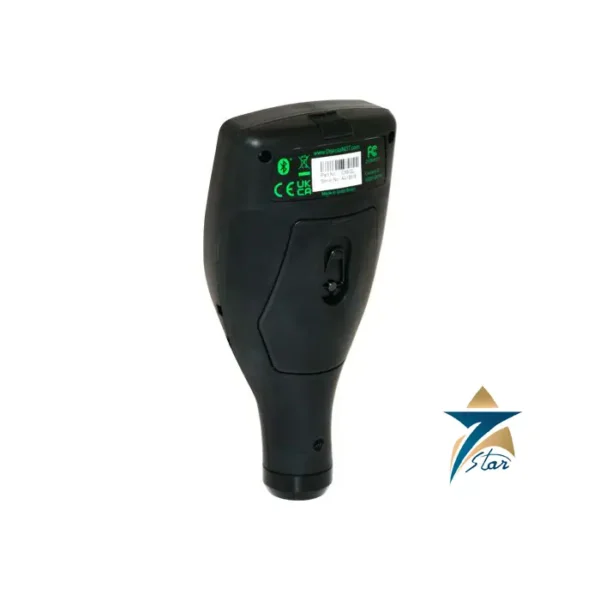
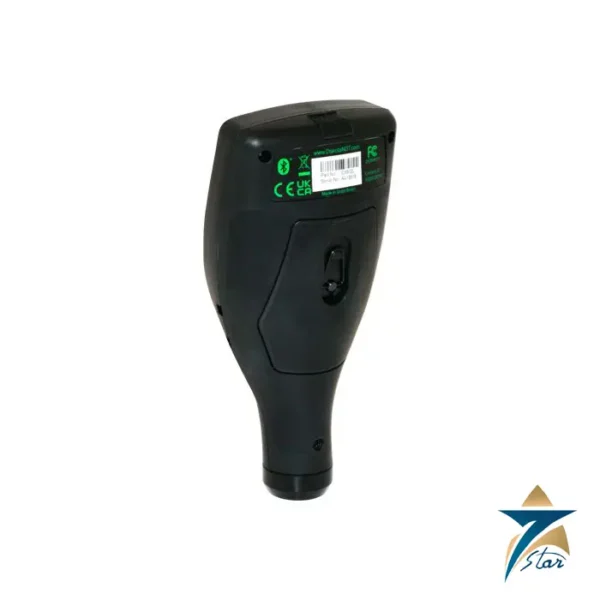
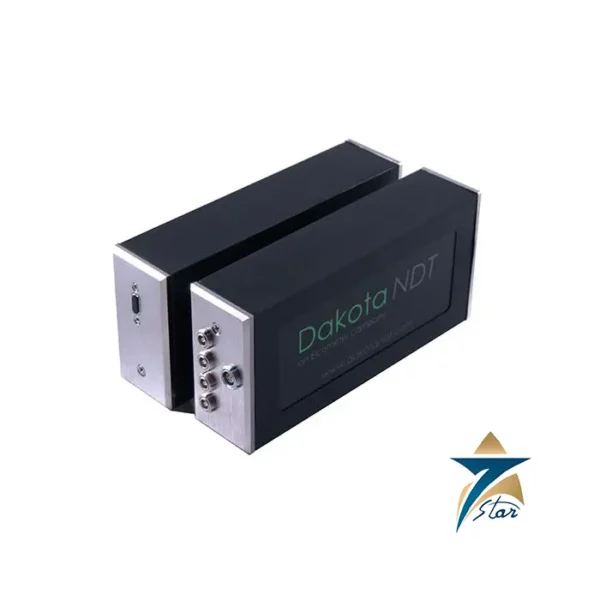
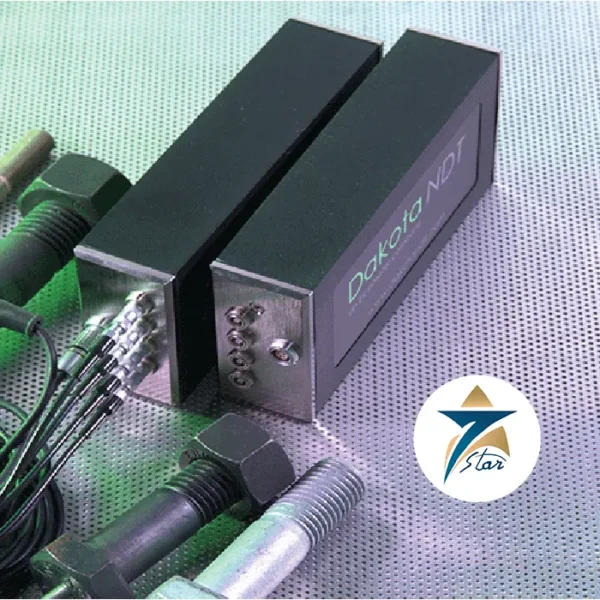
The Dakota NDT UX-2 is a diver-deployable ultrasonic thickness gauge built for work below the waterline. Seven Star LLC is the authorized representative of Dakota NDT in Oman and serves customers across the GCC; the notes below are written from the maker’s UX-2 datasheet so that integrity engineers and inspection contractors can judge fit before sending an enquiry. The Dakota NDT UX-2 sits in a clear, high strength plastic housing rated to 1000 ft (300 m), and it measures both base material and coating without anything having to leave the water.
Dakota NDT UX-2 overview
Offshore jackets, mooring chains, pipeline risers, sheet piling at ports and the hulls of workboats all lose wall to corrosion where nobody can easily reach them dry. The UX-2 puts the electronics, two backlit displays and the batteries into one watertight tube, so the inspector carries a single instrument and a cable to the probe. Per the datasheet it replaces the earlier UMX-2 and UG20DL models, and it is made in the USA. Case dimensions are 9.0 in (229 mm) long by 2.375 in (60.33 mm) in diameter, and with three AA cells it weighs 1.5 lb (0.680 kg), which keeps it manageable on a wrist lanyard or a tool bag.
Key features of the UX-2 gauge
- Depth rating of 1000 ft (300 m) with an IP68 rating and a transparent housing so both displays can be read through the wall.
- Two probe families: single membrane transducers and dual element transducers, with automatic probe recognition and, for dual element probes, automatic zero.
- Four measurement modes: Pulse-Echo, Pulse-Echo with Coating, Echo-Echo and Triple-Echo (TCG).
- A single magnetically coupled button, so no keys or openings can leak or snag on gloves.
- An A-scan waveform snapshot is captured with every stored reading and can be viewed with the Windows PC software that comes with the gauge.
- Eight blue LEDs and backlit displays that can be set on, off or automatic for murky water.
Dakota NDT UX-2 technical specifications
| Model |
UX-2 underwater thickness gauge |
| Depth rating |
1000 ft (300 m); IP68 |
| Housing |
High strength transparent plastic case |
| Length / diameter |
9.0 in (229 mm) / 2.375 in (60.33 mm) |
| Weight |
1.5 lb (0.680 kg) with 3 AA batteries |
| Keyboard |
Single button, magnetically coupled switch |
| Operating temperature |
-20 to 140 F (-29 to 60 C) |
| Probe types |
Single membrane and dual element, LEMO underwater connectors, 4 ft standard cable |
| Transducer frequency |
1 to 10 MHz (dual element and single element) |
| Pulse-Echo (P-E) |
0.025 to 19.999 in (0.63 to 508 mm) |
| Pulse-Echo Coating (PECT) |
Material 0.025 to 19.999 in (0.63 to 508 mm); coating 0.001 to 0.100 in (0.01 to 2.54 mm) |
| Echo-Echo (E-E) |
0.100 to 4.0 in (2.54 to 102 mm), varies with coating |
| Triple-Echo (TCG) |
0.040 to 6.00 in (1 to 152 mm) in steel |
| Resolution |
+/- 0.001 in (0.01 mm); English and metric units |
| Velocity range |
0.0492 to 0.5510 in/us (1250 to 13995 m/s) |
| Material velocities |
8 fixed and 1 programmable |
| Receiver / gain |
Dual receivers; manual or AGC gain with 100 dB range; 5 manual settings (42 to 50 dB) |
| Timing |
25 MHz TCXO, single shot 100 MHz 8 bit digitizer |
| Display |
1/2 in 4.5 digit LCD, 3/8 in 6 character LCD, both backlit; 8 blue LEDs |
| Data storage |
5,000 readings, settings and waveform graphics; grid and sequential formats; 32 megabit non-volatile RAM |
| Data output |
Bi-directional RS232 with USB converter; Windows PC software included |
| Power |
3 AA alkaline (1.5 V) or NiCad (1.2 V) cells; auto power off after 5 min idle |
| Battery life |
About 50 h alkaline, 20 h NiCad (backlight off); 15 h and 8 h with backlight on |
| Calibration and warranty |
Factory calibration traceable to NIST and MIL-STD-45662A; 3 year limited warranty |
How the four UX-2 measurement modes are used
Pulse-Echo reads bare material from 0.025 to 19.999 in (0.63 to 508 mm) and is meant for pit and flaw detection on clean steel. Pulse-Echo Coating reports material over the same span and, in addition, coating from 0.001 to 0.100 in (0.01 to 2.54 mm), so a painted or wrapped member can be assessed for both layers in one pass. Echo-Echo measures through paint and coatings from 0.100 to 4.0 in (2.54 to 102 mm), a window that shifts with the coating. Triple-Echo uses the single membrane probe and covers 0.040 to 6.00 in (1 to 152 mm) in steel, again varying with coating, material and probe. Resolution is plus or minus 0.001 in (0.01 mm) in either English or metric units.
Where the UX-2 is applied in Oman and GCC marine and offshore work
Gulf and Arabian Sea operators run fixed platforms, subsea pipelines, jetties and floating storage units that all need periodic wall thickness surveys. Typical UX-2 tasks include checking riser and splash-zone members during dive campaigns, verifying remaining thickness of ballast and storage tanks from the outside, surveying quay walls and sheet piles at ports such as those along the Omani coast, and documenting hull plate loss on tugs and supply vessels. Because the gauge stores 5,000 readings together with settings and waveform graphics, a diver can log a whole grid of points on one dive and the data engineer can review the waveforms topside.
How UX-2 handles velocity, gain and timing
Sound velocity can be set anywhere from 0.0492 to 0.5510 in/us (1250 to 13995 m/s). Eight velocities are fixed in the gauge: aluminum 2024 at 0.251, steel 4340 at 0.233, stainless steel 302 at 0.223, iron at 0.232, cast iron at 0.180, PVC at 0.094, polystyrene at 0.092 and polyurethane at 0.070 in/us, and one further value is user programmable. The pulser is a dual square wave design, the receiver is dual with manual or AGC gain over a 100 dB range, and manual gain offers five settings from 42 to 50 dB. Timing comes from a 25 MHz TCXO with a single shot 100 MHz, 8 bit digitizer, which is what gives the 0.001 in resolution.
Selecting transducers and compatibility for UX-2
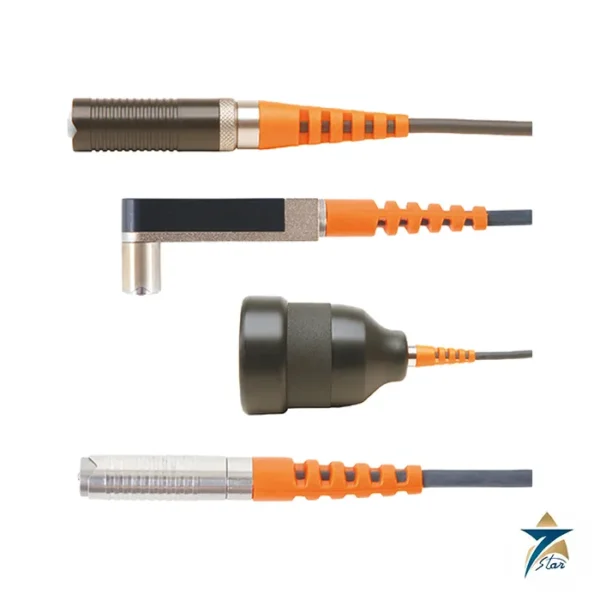
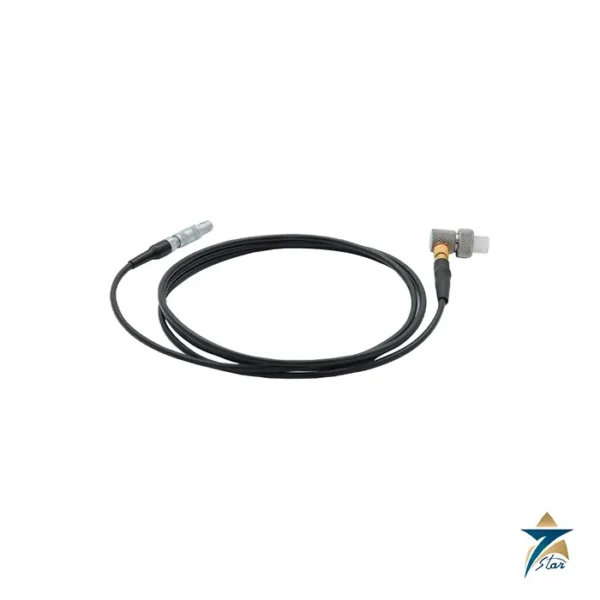
The datasheet lists dual element probes from 1 to 10 MHz, including custom auto recognition probes for flaw and pit detection, and single element probes from 1 to 10 MHz for general purpose use. Probes connect through LEMO underwater connectors and the standard cable is 4 ft long; custom transducers and cable lengths can be arranged for special jobs. When you send an enquiry for the UX-2, state which probe style you intend to use, because dual element and single membrane probes enable different modes, and mention whether a spare probe or longer cable is wanted.
UX-2 data storage and software
Data can be stored in a grid with alphanumeric locations or in a sequential file with an automatic identifier. One file template is held in the gauge, sized to the user’s dimensions, and capacity is 5,000 readings plus settings and waveform graphics in 32 megabit non-volatile memory. Output is a bi-directional RS232 port with a USB converter, and Windows PC interface software is included.
Power, operating limits and care of the UX-2
Three AA alkaline cells (1.5 V) or NiCad cells (1.2 V) power the gauge, for about 50 hours on alkaline and 20 hours on NiCad with the backlight off, and about 15 and 8 hours with it on. It switches itself off after 5 minutes idle and shows battery status at power up. Operating temperature runs from -20 to 140 F (-29 to 60 C). Keep the instrument within its stated depth and temperature limits, rinse it after immersion, and follow the maker’s instruction manual for the housing seals. Factory calibration is traceable to NIST and MIL-STD-45662A, and the warranty is three years limited.
UX-2 compared with other Dakota NDT thickness gauges
Dakota NDT handheld gauges such as the CX and ZX ranges are made for dry surfaces; the UX-2 is the family member built for immersion, with its 1000 ft depth rating, magnetic single button and transparent case. Its measuring ceiling of 19.999 in (508 mm) in Pulse-Echo, its coating window up to 0.100 in (2.54 mm) and its A-scan snapshot per reading are the figures to compare when deciding between a topside gauge on a dive cable and an in-water instrument.
UX-2 ordering notes
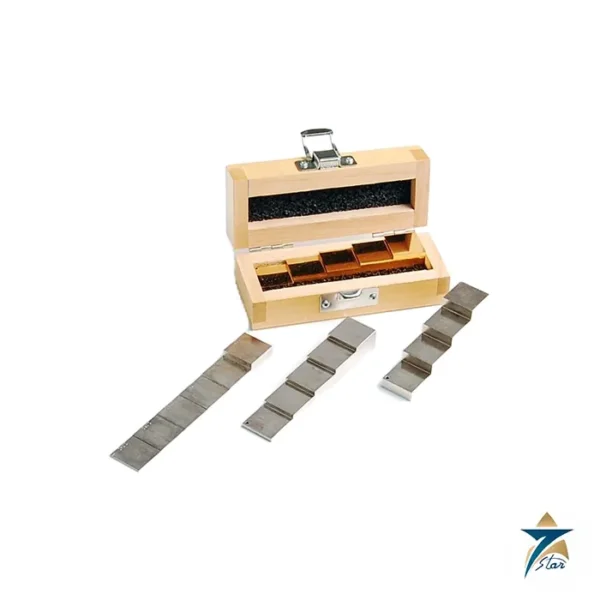
State the model UX-2, the probe type and frequency you need, any cable length beyond 4 ft, and the quantity. Couplant and calibration blocks for reference checks are separate items and can be quoted together with the gauge.
Documents and quotation
The UX-2 datasheet is attached to this page for download. To receive a quotation, send an RFQ with the part number UX-2, the probe configuration and the required quantity, and our team will reply with availability and lead time for delivery to Oman and the GCC.
Availability note: in the manufacturer’s current range the Dakota NDT UX-2 has been followed by the UX3-DL underwater gauge. Please confirm availability with us when you enquire; if the UX-2 is no longer supplied, we can quote the current underwater model with equivalent depth rating and documentation.

 Automation & Control
 Electrical & Power
 Fittings & Valves
 Sensors & Transmitters
 Emergency Power
 Analyzer Systems
 Metering Systems
 Fire & Gas Systems
 Welding
 Motors, Pumps & Turbines
 Portable Test & Measurement
 Compressor & Cooling
 Bearings & Power Transmission
 Filtration
 Safety & PPE
 Material Handling & Lifting Equipment
 Non-Destructive Testing (NDT)



Reviews
There are no reviews yet.