- Automation & ControlView all 3,008 products
- Automation Accessories
- AC Drives
- PLC & I/O Cards
- Industrial Communications
- Vibration Monitoring
- Isolator & Barrier
- Controllers & Data Acquisition
- Safety Switches & Guard Locking
- Motor Soft Starters
- CCTV & Security
- Encoders
- Pneumatic Cylinders
- HMI Displays
- Servo Drives
- Industrial Computers
- Machine Vision
- Automation Software
- Robotics
Brand: ION Science
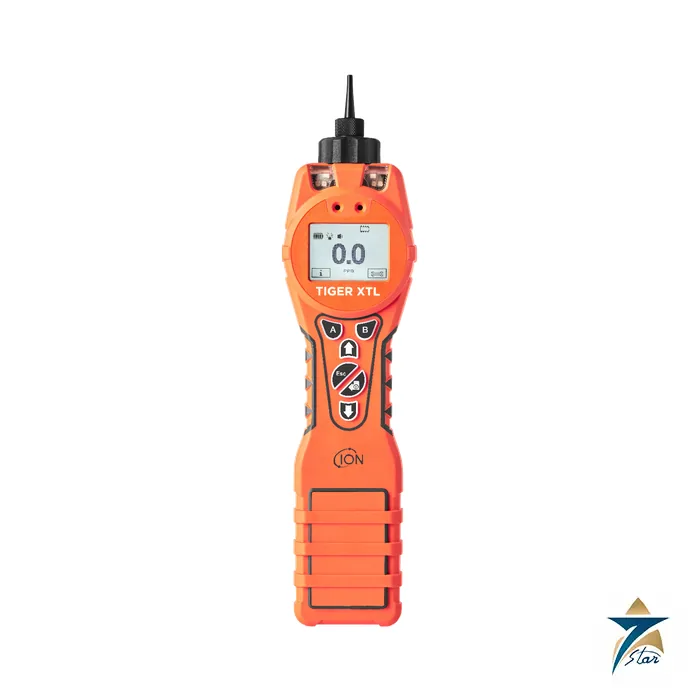
ION Science Tiger XTL Handheld VOC Gas Detector
Description
Overview
The ION Science Tiger XTL is a handheld photoionisation detector for volatile organic compounds, sold as the low-cost entry model of the Tiger XT line. It keeps the patented sensing technology of the better-known Tiger XT but trims the feature set so that crews who only need dependable VOC readings can buy a simpler instrument. Seven Star LLC is an independent supplier serving Oman and the GCC. The information below is drawn from the manufacturer’s brochure for the Tiger XTL, version 1.1, and is restated in our own words for buyers comparing portable gas detectors.
In practice the ION Science Tiger XTL is a pistol-grip style probe detector that you carry through a plant, along a trench or into a vessel entry check. A small pump draws sample air across the sensor, the display shows the reading in parts per million, and the unit flashes and sounds when a preset limit is exceeded. Because the sensor is a photoionisation cell, it responds to a very wide range of organic vapours and some inorganic gases, which is why one handheld unit can serve many different checks on a single site.
Headline performance of the ION Science Tiger XTL
The brochure describes the instrument as combining market-leading accuracy with the lowest running cost in its class, because lamps and filters are inexpensive disposable parts. The patented fence electrode design is said to resist humidity and contamination, which extends run time between cleans and limits false readings in damp air. The T90 response time is below 2 seconds, so the reading follows a change in concentration almost immediately, and a full charge of the lithium-ion pack lasts up to 24 hours of operation.
Alarm output is deliberately hard to miss. Amber and red LEDs flash for the low and high alarm, a sounder produces 95 dBA at 300 mm, and the alarm can also be set to vibrate in the hand. An integrated torch lights dim work areas such as tank bottoms, pits and under-deck spaces, and the large backlit display and keypad are designed for one-handed use, which matters when the other hand is holding a ladder or a sampling hose.
Technical data table for ION Science Tiger XTL
| Parameter | Published value |
|---|---|
| Minimum resolution | 0.1 ppm |
| Maximum reading | 5,000 ppm |
| Response time | T90 under 2 seconds |
| Accuracy | Plus or minus 5 percent of display reading or plus or minus one digit |
| Linearity | 5 percent of display reading or plus or minus one digit |
| Lamp | 10.6 eV krypton PID lamp (standard) |
| Battery | Lithium-ion up to 24 hours, charge time about 8 hours; alkaline option 3 x AA, about 8.5 hours |
| Operating temperature | -20 to 60 degrees C |
| Humidity | 0 to 99 percent RH, non-condensing |
| Protection | Designed to IP65 |
| Data logging | Push-to-log, 128 zones, 80,000 data points |
| Calibration | Standard calibration with 100 ppm isobutylene; custom calibration capability |
| Flow rate | At least 220 ml/min with blocked-flow alarm |
| Alarm | Flashing LEDs, 95 dBA sounder at 300 mm, selectable vibration |
| Dimensions and weight | 370 mm high x 91 mm wide x 60 mm deep, 870 g |
| Intrinsic safety | II 1G Ex ia IIC T4 Ga; Class 1 Division 1 Groups A, B, C and D, T4 |
How Tiger XTL differs from other Tiger XT variants
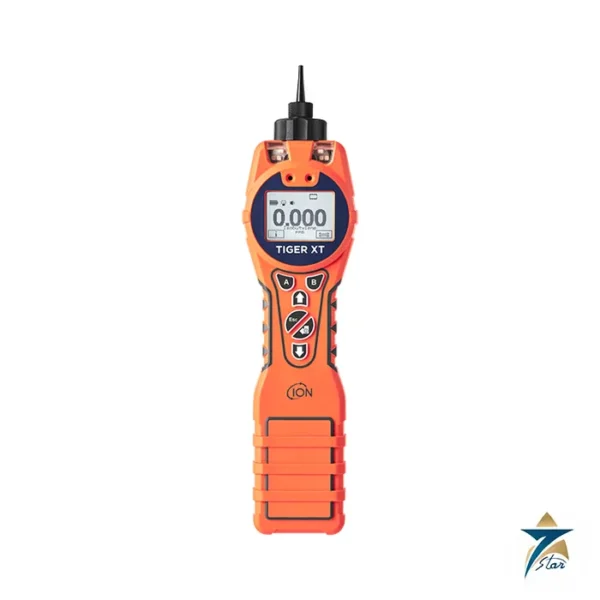
The Tiger family shares one body and one pump design, so the differences are in the sensing hardware and the logging. The ION Science Tiger XTL is the economy variant: a 10.6 eV lamp, a maximum reading of 5,000 ppm, a minimum resolution of 0.1 ppm and 80,000 logged points in 128 zones. The Tiger XT Select, by contrast, uses a 10.0 eV lamp, reads up to 20,000 ppm in standard mode, offers benzene tube mode and total aromatic compound mode, and logs 120,000 points. The Tiger XTL warranty extension on online registration reaches 2 years, whereas the Select model is quoted at 5 years. If you do not need selective benzene work or the widest range, the XTL is the lighter-weight purchase decision.
Where the Tiger XTL is used in Oman and the GCC
The brochure lists environmental monitoring, soil contamination detection, VOCs in landfill, confined space entry, emergency response, wing tank entry, fumigation gases and medical gases. In Oman those duties show up as site investigation at fuel terminals and refineries, headspace checks before tank entry at Sohar and Duqm, screening of excavated soil at construction sites, and fumigant clearance checks in storage and port facilities. Safety officers also use handheld PIDs for leak surveys around pumps, flanges and loading arms, where a quick ppm reading tells the team whether a closer look with a fixed detector is needed.
Intrinsic safety and approvals
The Tiger XTL is certified intrinsically safe to II 1G Ex ia IIC T4 Ga, with an ambient range of -25 to +45 degrees C when fitted with the lithium-ion pack and -25 to +40 degrees C with alkaline cells. The brochure also lists ETL, KGS and IECEx certification and cites the ATEX, IECEx and UKEX certificate numbers, and North American Class 1 Division 1 approval. Batteries can be exchanged in a potentially explosive atmosphere because of the intrinsically safe design, which saves a walk back to a safe area during a long job.
Using and servicing the ION Science Tiger XTL
Switch on, allow the sensor to stabilise, and zero in clean air. Calibrate with isobutylene at 100 ppm according to the manual, and apply a gas-specific correction if you are measuring a vapour other than isobutylene. Keep the inlet filter clean and replace it when the flow alarm shows restriction. Lamps and filters can be changed in minutes without special tools, so downtime is short.
Typical care routines include wiping the case after use in dusty or wet conditions, charging for the full eight hours before a long shift, checking the sounder and LEDs at the start of the day with a bump test, and logging results with the push-to-log function so that readings can be reviewed after the survey. Remember that a PID reports a total response to all ionisable vapours in the sample, so it is a screening instrument rather than a compound-specific analyser.
Selection notes before you order Tiger XTL
Ask first which compounds you expect. Most solvents, fuels and many fumigants ionise under a 10.6 eV lamp, whereas some small molecules such as methane do not. Decide whether a 5,000 ppm ceiling is enough for your leak surveys, whether you need the longer warranty or benzene-specific features of the Select, and whether you will use rechargeable lithium-ion or alkaline cells. Confirm the exact ordering code and any accessory kit with the supplier before purchasing, because the sensor and the accessories are ordered separately from the base instrument.
Related items you may also need: ION Science Tiger XT Handheld VOC Detector | ION Science Titan 2 Fixed Benzene Monitor | Crowcon Fgard IR3 Multi-Spectrum IR Flame Detector | All ION Science products.
Choosing the right ION Science Tiger XTL kit
The ION Science Tiger XTL is offered as a model with several kit and accessory options, so the exact supply is defined by the points below rather than by the model name alone.
- Target gas or gases and the measuring range needed for the ION Science Tiger XTL application.
- Lamp or sensor option where the instrument offers more than one, for example the standard VOC lamp or a selective configuration.
- Hazardous area approval required for the site, such as ATEX or IECEx zone rating.
- Accessories needed with the unit, such as charger, calibration adaptor, sampling probe, carry case or docking station.
- Any data logging, software or calibration certificate requirement for your records.
Share these points, or the part number printed on an existing unit or previous order, and the quotation will list the confirmed kit contents.
Documents and quotation
The manufacturer’s brochure for the ION Science Tiger XTL is attached to this page as a datasheet. To request a quotation, send your RFQ with the part number Tiger XTL, the quantity, the delivery location in Oman or the GCC and any accessories such as calibration kits, spare filters or lamps, and we will reply with availability and lead time.
Datasheets & Documents
- Datasheet ION Science Tiger XTL Handheld VOC Gas Detector Datasheet Download
Reviews (0)
How would you rate this product? Cancel reply
About brand
ION Science is a British maker of gas detection instruments, based in Fowlmere, Cambridgeshire. It has been active since 1989 and is best known for photoionisation detectors (PIDs) that measure volatile organic compounds at low concentrations. Its portable and fixed instruments are used for worker exposure monitoring, leak detection and environmental surveys.
Seven Star LLC is an independent supplier in Muscat. We list ION Science detectors for oil and gas, petrochemical and environmental users in Oman and the GCC.
ION Science company profile
| Active since | 1989, United Kingdom |
|---|---|
| Head office | Fowlmere, Cambridgeshire |
| Core technology | Photoionisation detection (PID) with patented Fence Electrode design |
| Product families | Tiger XT and Cub portable PIDs, Titan benzene monitor, Falco fixed detectors |
Milestones
- 1989: ION Science begins operating.
- 1998: Patents its PID sensor.
- 2002: Patents the Fence Electrode for humidity-resistant PIDs.
- 2017: Opens its head office in Fowlmere.
ION Science product series
The Tiger XT is a handheld VOC detector for hazardous areas, and the Titan 2 is a fixed benzene monitor.
A PID uses ultraviolet light to ionise volatile organic compounds and measures the resulting current, which allows detection down to ppb levels. Response factors convert the reading for each specific compound. General VOC detectors measure the total, while benzene-specific monitors separate benzene from other hydrocarbons, which matters because benzene has very low exposure limits.
Where ION Science detectors are used
Leak detection, confined space entry checks, worker exposure monitoring, refinery and terminal benzene monitoring, and environmental and soil surveys.
Ordering ION Science detectors: what we need
Send the model, the compounds and ranges, lamp type, hazardous-area requirement and accessories such as probes, filters and calibration kits.
Facts checked against ION Science's published company history, October 2026.
Browse ION Science products by category: Gas Analyzer Systems, Fire & Gas Detectors.
FAQ
Questions about the ION Science Tiger XTL Handheld VOC Gas Detector
Answers from our engineering team on installation, compatibility and integration.
01What lamp does the ION Science Tiger XTL use?
The brochure gives a 10.6 eV krypton PID lamp as standard, with disposable lamps and filters keeping running costs low.
02What is the maximum reading of the Tiger XTL?
The published maximum reading is 5,000 ppm with a minimum resolution of 0.1 ppm, and a T90 response time below 2 seconds.
03Is the Tiger XTL intrinsically safe?
Yes. It is marked II 1G Ex ia IIC T4 Ga and carries Class 1 Division 1 Groups A to D T4 approval, with batteries changeable in hazardous areas.
04How long does the Tiger XTL battery last?
The lithium-ion pack runs up to 24 hours on a charge taking about 8 hours, and an alkaline pack of 3 AA cells gives about 8.5 hours.
05How does the Tiger XTL differ from the Tiger XT Select?
The XTL has a 10.6 eV lamp, a 5,000 ppm maximum and 2-year warranty extension; the Select has a 10.0 eV lamp, 20,000 ppm, benzene tube mode and 5 years.


Reviews
There are no reviews yet.