Endress+Hauser TMT86 iTEMP PROFINET APL Transmitter

Description

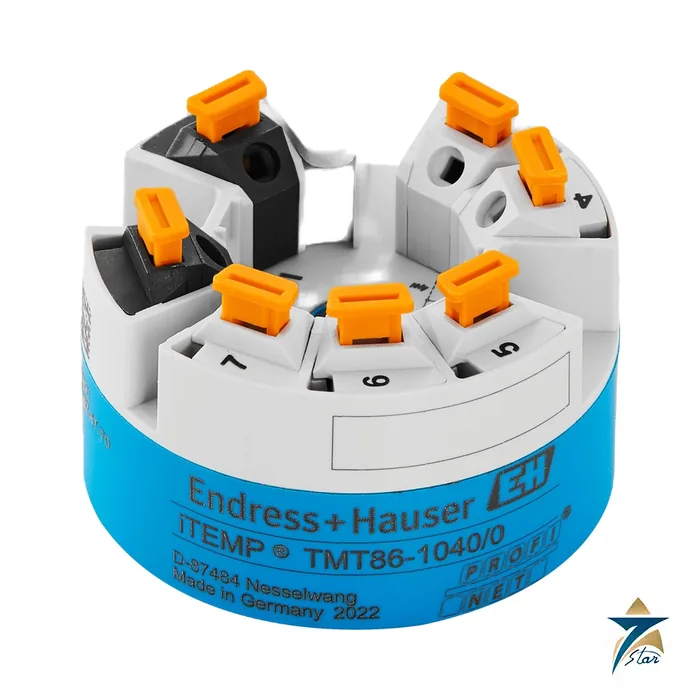
Endress+Hauser TMT86: a PROFINET Ethernet-APL head transmitter

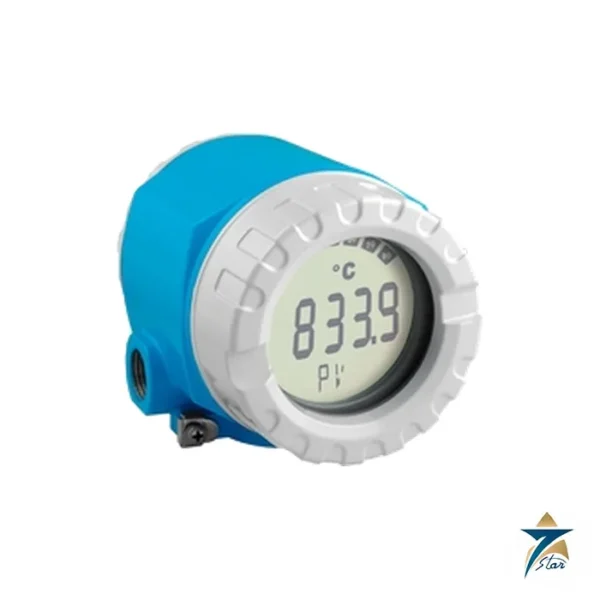
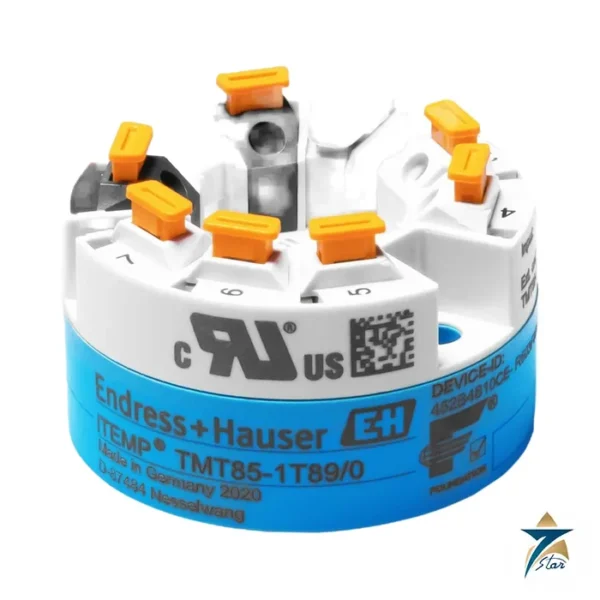
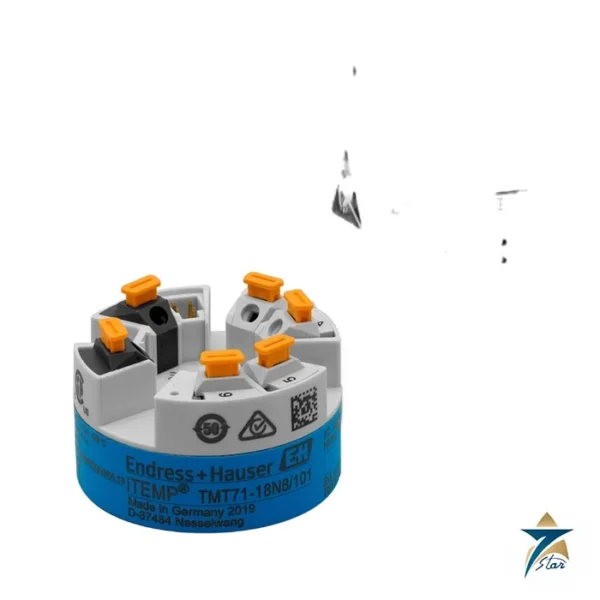
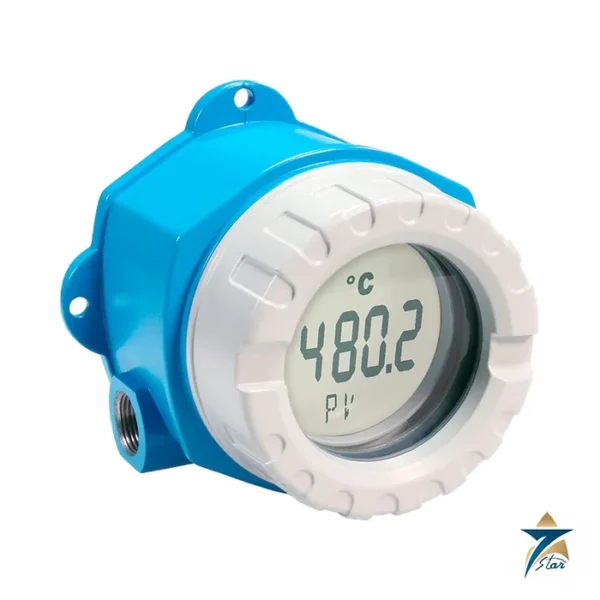
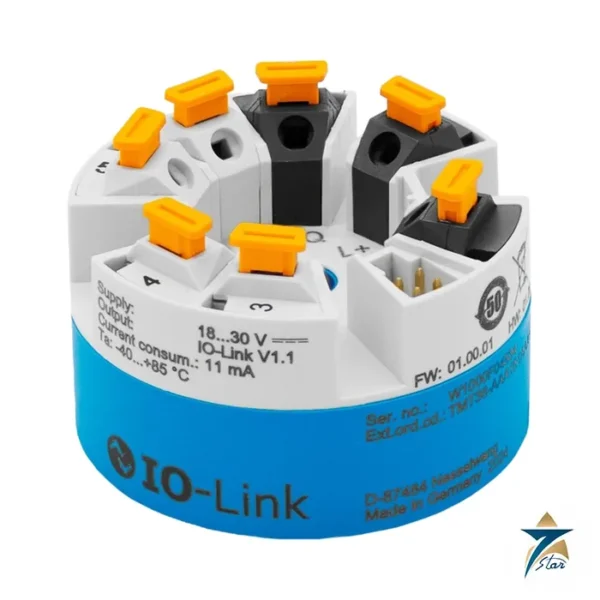
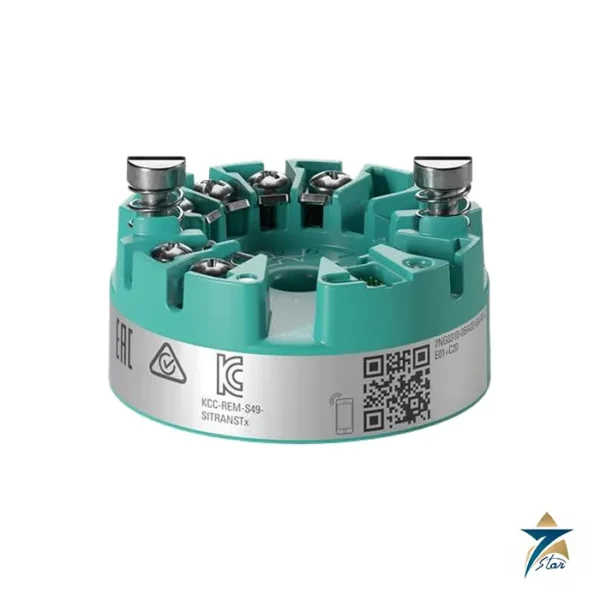
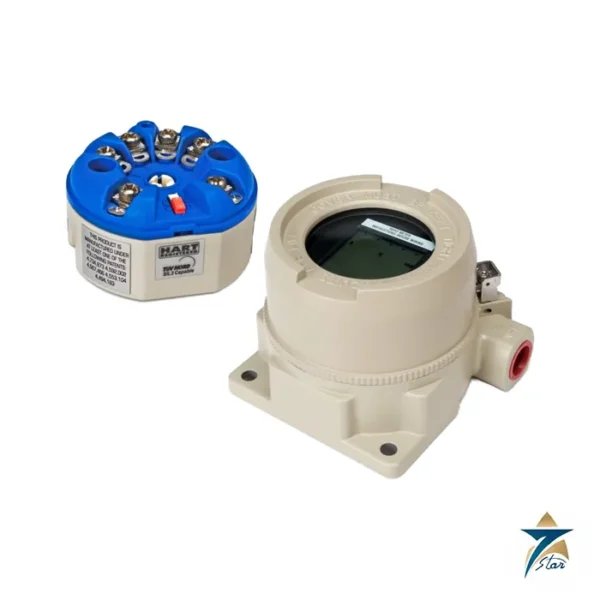
Endress+Hauser TMT86 is a dual-input iTEMP temperature transmitter that talks PROFINET over Ethernet-APL (IEEE 802.3cg, 10BASE-T1L) on a single two-wire cable, so a measuring point can reach the controller as a digital value at 10 Mbps without a gateway. Technical Information TI01605T presents it for installation in a terminal head form B (flat face) to DIN EN 50446, with an optional field housing for Ex d applications, push-in terminals and a display that can be attached. Because the cable carries both power and data, the same pair feeds the device. Seven Star LLC is an independent supplier serving Oman and the GCC and is not affiliated with the manufacturer.

Inputs of TMT86: two universal channels

The two inputs are independent but not galvanically isolated from each other, and each accepts an RTD, resistance, thermocouple or millivolt signal. The RTD list covers Pt100 and Pt200 from -200 to +850 degrees C, Pt500 and Pt1000 from -200 to +500 degrees C, JIS Pt100 to +510 degrees C, GOST Pt50 and Pt100, Cu50 and Cu100 from -180 to +200 degrees C, plus Callendar-Van Dusen and polynomial curves. Thermocouples include types A, B, E, J, K and N: type K reaches -270 to +1 372 degrees C and type B 0 to +1 820 degrees C. Resistance spans are 10 to 400 ohm and 10 to 2 850 ohm. Sensor current is at most 0.3 mA, two-wire lead compensation covers 0 to 30 ohm, and three- or four-wire sensors may have up to 50 ohm per wire.

Device iTEMP head transmitter, 2 universal inputs
Output PROFINET over Ethernet-APL, IEEE 802.3cg 10BASE-T1L, 2-wire, 10 Mbps
Profile PROFINET Profile 4, Conformance Class B, Real Time Class 1
Cycle time 128 ms
Galvanic isolation 2 kV AC for 1 minute, input to output
Response time At most 0.5 s per RTD or TC channel; cold junction 1.6 s; doubled in two-channel mode
Accuracy Pt100 0.06 degrees C + 0.006 percent of (MV – LRV)
Accuracy Pt1000 0.03 degrees C + 0.013 percent of (MV – LRV)
Typical Pt100, 0 to 200 degrees C 0.08 degrees C
Typical type K 0.36 degrees C
APL port classes SLAA or SLAC in hazardous areas; SLAX in safe areas
SPE switch supply Up to 30 VDC; at least 1.85 W; PoDL class 10, 11 or 12
Ambient -40 to +85 degrees C; -50 or -52 degrees C with order options JM or JN
Protection IP 20 bare; IP 66/67 in TA30A, TA30D or TA30H housing
Vibration 2 to 100 Hz at 4 g
Weight About 40 to 50 g
Housing Polycarbonate, UL94 HB, RoHS

How TMT86 differs from the 4-20 mA and HART head transmitters

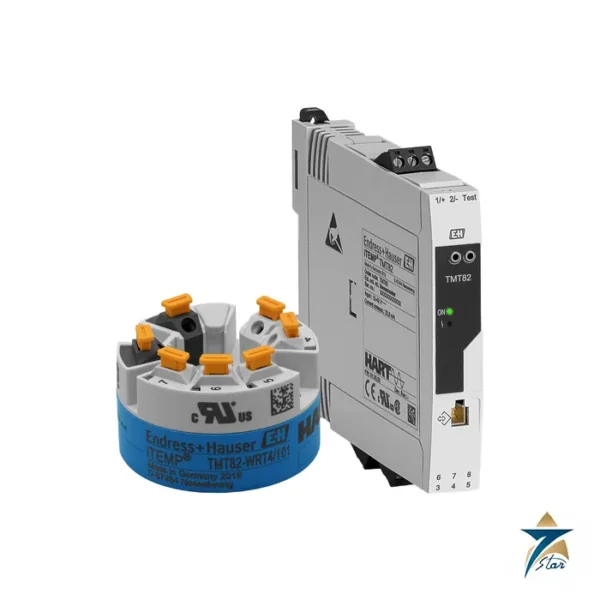
The HART head transmitters such as the TMT82 convey the temperature as a 4 to 20 mA current with a digital overlay. The TMT86 replaces that with a pure digital Ethernet-APL link, adds a built-in web server for engineering and diagnostics, and supports PROFINET system redundancy S2 with four application relations on one network access point. It does not support the Media Redundancy Protocol. It supports LLDP neighbourhood detection, and auto-polarity corrects a crossed TxD and RxD pair. The quoted accuracy comprises a fixed part plus a percentage of the span between the measured value and the lower range value, so narrow ranges help: a Pt100 measured from 0 to 200 degrees C has a typical error of 0.08 degrees C, while a type K thermocouple has 0.36 degrees C, and a type S over 0 to 800 degrees C shows 1.01 degrees C. Select the sensor type with those figures in mind, because a platinum element plus the TMT86 is one of the most accurate combinations offered.

Sensor matching and diagnostics

With Callendar-Van Dusen coefficients A, B and C entered for a calibrated Pt100, the TMT86 can be matched to its sensor, which improves accuracy compared with the general curve. It also monitors the sensor, flags hardware faults and signals alarms as defined in the PROFINET application layer protocol version 2.4. FieldCare and DeviceCare are the manufacturer tools named for configuration, and GSD, FDI and EDD description files are published on the manufacturer’s product page.

Where TMT86 is used in the GCC

An Ethernet-APL transmitter is aimed at new process plants and brownfield upgrades with APL field switches: chemical, oil and gas, and water facilities where Ex ia segments must carry digital data to the field. In Oman, plans for modular skids and package units often specify PROFINET, which makes the TMT86 a logical choice for reactor, heat-exchanger and furnace temperature points where dual sensors give redundancy.

Wiring and power for TMT86

An APL field switch should provide at most 15 VDC and at least 0.54 W. In non-hazardous areas the transmitter can also be connected to a suitable SPE switch with standard 10BASE-T1L, PoDL power classes 10 to 12, detection of devices without PoDL and polarity independence. Use push-in terminals only with ferrules on thin flexible wires, close the head tightly and observe the Ex documentation for hazardous installations. Operating altitude up to 4 000 m is stated.

Maintenance

Keep the firmware and description files aligned with the controller project, read diagnostics from the web server, and verify the sensor with a dry-block once a year. When replacing a unit, copy the sensor coefficients and range settings. Below -40 degrees C, the datasheet warns of increased failure rates.

Documents and quotation

The TI01605T datasheet is attached to the TMT86 page. For a quote, send an RFQ to Seven Star LLC with the part number TMT86, the full order code, quantity and delivery destination.

Installation and Commissioning Planning

Planning ahead shortens downtime when a Endress+Hauser TMT86 goes into service. Confirm the available mounting space, cable entry or process connection, and the tools and spare seals needed on the day. Keep the existing configuration or calibration data so the new unit can be set up to match, and check that loop drawings and the asset register are updated after the swap. If the installation has to fit a short shutdown window, tell us the date when you request a quotation so that delivery of the Endress+Hauser (E & H) equipment can be planned around it.

Datasheets & Documents
  • PDF Datasheet Endress+Hauser TMT86 iTEMP PROFINET APL Transmitter Datasheet Download
Reviews (0)

Reviews

There are no reviews yet.

How would you rate this product?

It takes about 10 seconds — just tap a star. Your email is never published.

About brand

Endress+Hauser makes process measurement instruments for flow, level, pressure, temperature and liquid analysis. Georg H. Endress and Ludwig Hauser started the business in Lörrach, Germany, on 1 February 1953, first selling level meters, and the Endress+Hauser name has been used since 1957. The group is headquartered in Reinach, Switzerland, and has been wholly owned by the Endress family since 1975.

Seven Star LLC is an independent supplier listing Endress+Hauser flowmeters, level and pressure transmitters, temperature assemblies and liquid analysis products for buyers in Oman and the GCC. Instruments are matched from the full order code on the nameplate.

Endress+Hauser company profile

Origin Founded in Lörrach, Germany, on 1 February 1953 by the Swiss engineer Georg H. Endress and Ludwig Hauser
Headquarters Endress+Hauser AG, Reinach (Basel-Landschaft), Switzerland
Ownership Family owned; the Endress family has been the sole shareholder since 1975, and a family charter commits the company to stay family owned
Size About 16,500 employees and sales of about EUR 3.7 billion (2023, as reported by the company)
Product families Proline flowmeters, Micropilot and Levelflex radar, Liquiphant switches, Cerabar and Deltabar pressure, iTEMP and iTHERM temperature, Liquiline and Memosens liquid analysis

Milestones

  • 1953: Georg H. Endress and Ludwig Hauser start the business in Lörrach on 1 February, first selling level meters.
  • 1957: The Endress+Hauser name comes into use.
  • 1975: The Endress family becomes sole shareholder.
  • 2023: About 16,500 employees and sales of about EUR 3.7 billion, as reported by the company.

Endress+Hauser product lines

Line Measuring principle Typical use
Promass F 300, Promass 80F, 83F/84F Coriolis mass flow Direct mass flow and density of liquids and gases, hydrocarbon transfer and chemical dosing
Promag P 300, P 500, H 300, W 400, W 10, 50P Electromagnetic flow Water, wastewater, slurries and other conductive liquids
Prowirl F 200, 72F Vortex flow Steam, gas and low-viscosity liquids
Prosonic Flow 92F, t-mass 65F Ultrasonic and thermal mass flow Water lines; compressed air and industrial gases
Micropilot FMR62, FMR67, FMR60, FMR10B, FMR20, FMR50, FMR52 Free-space radar level, 80 GHz and 26 GHz Tanks, process vessels, silos and open water channels
Levelflex FMP51, FMP50, FMP54, FMP55 Guided wave radar level Level and interface in vessels, separators and bypass chambers
Liquiphant FTL51, Prosonic S FMU90 Vibronic point level; ultrasonic level High and low level alarms, pump protection, open channel flow
Cerabar PMC71B, PMP51B, PMP71, Deltabar PMD78B, PMD75 Pressure and differential pressure Process pressure, hydrostatic level and DP flow
iTEMP TMT82, TMT162, iTHERM TM101, TR66, TR10 Temperature transmitters and thermometers RTD and thermocouple points with thermowells
Liquiline CM444, CM442, Memosens CPS11E, Stamolys reagents Liquid analysis pH, ORP, conductivity, dissolved oxygen and nutrient analysis in water treatment and process

Where Endress+Hauser instruments are used

In Oman and the GCC, Endress+Hauser instruments are common in oil and gas production and processing, refineries and petrochemicals, desalination and water networks, wastewater treatment, power plants and food and beverage plants. Coriolis meters measure hydrocarbon and chemical flows, electromagnetic meters cover water and wastewater, radar transmitters handle tank and silo level, and Liquiline analysers monitor water quality. Proline 300 and 500 flowmeters include Heartbeat Technology for in-situ verification, which reduces the need to remove a meter for checks.

Ordering Endress+Hauser instruments: what we need

The order code on the nameplate (for example PMP71-1QA1S11RDADU) defines every option: measuring range, process connection, materials, output, approvals and display. Send it with the serial number; Endress+Hauser can retrieve the original configuration from the serial number. For a new instrument add the medium, operating and design pressure and temperature, range, line size or tank geometry, process connection, wetted materials, output or protocol (4-20 mA HART, PROFIBUS, FOUNDATION Fieldbus, Modbus) and the hazardous-area approval required. Older models such as Promass 80/83 or Micropilot M are replaced by current Proline or 80 GHz Micropilot devices.

Facts checked against Endress+Hauser company history and product information, October 2026.

FAQ

Questions about the Endress+Hauser TMT86 iTEMP PROFINET APL Transmitter

Answers from our engineering team on installation, compatibility and integration.

01What communication does the Endress+Hauser TMT86 use?
It uses PROFINET over Ethernet-APL according to IEEE 802.3cg 10BASE-T1L on a 2-wire cable at 10 Mbps, with Conformance Class B and Real Time Class 1.
02How many sensors can a TMT86 connect?
Two independent universal inputs for RTD, resistance, thermocouple or millivolt signals; they are not galvanically isolated from each other.
03How is the TMT86 powered?
From an APL field switch (maximum 15 VDC, minimum 0.54 W) or, in non-hazardous areas, from a 10BASE-T1L SPE switch with PoDL class 10, 11 or 12.
04What response time does the TMT86 have?
At most 0.5 s per RTD or thermocouple channel and 1.6 s per cold junction channel, and the response time doubles in two-channel mode.
05Which housing does the TMT86 need outdoors?
The bare transmitter is IP 20, so it must be installed in a terminal head or field housing such as TA30A, TA30D or TA30H, which give IP 66/67.