Brand:

SICK MPS-G50CFH15D31DZZ MPS-G Position Sensor, C-Slot, IO-Link

Description

SICK MPS-G50CFH15D31DZZ: a 25 mm sensor that follows the gripper stroke

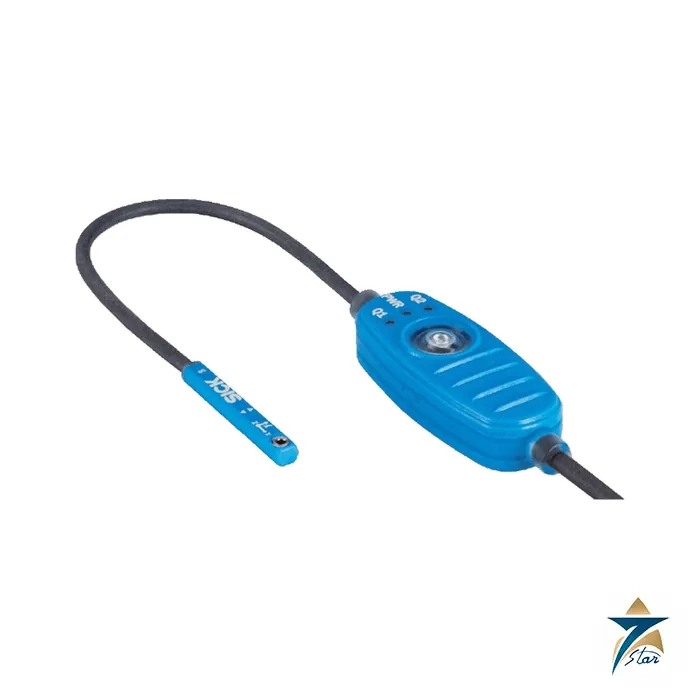
The SICK MPS-G50CFH15D31DZZ (part no. 1108681) is a magnetic position sensor of the MPS-G type, built for the C-slot of pneumatic grippers. It measures the stroke of a magnet in the piston over a 50 mm range, rather than just signalling end positions, and it is only 25 mm long, so it sits completely embedded in the slot.

The MPS-G50CFH15D31DZZ offers two push-pull digital outputs (PNP or NPN compatible) and IO-Link communication. Preferred slot manufacturers named in the datasheet are Festo, Zimmer and Gimatic.

Many grippers only report end positions: open or closed. A continuous reading changes what the controller can do. With the MPS-G50CFH15D31DZZ it can tell that a jaw has stopped at an intermediate position, which means a part of a certain size is held, or that the jaws have closed fully, which means the part is missing. A single sensor therefore replaces two or three discrete switches and improves quality checks.

The housing length of 25 mm and the complete embedding in the slot protect the sensor from impact, and the cable leaves axially.

MPS-G50CFH15D31DZZ feature list

  • Detection zone 0 mm to 50 mm, measuring range 50 mm, resolution typically 0.01 mm
  • Linearity error typically 0.3 mm, repeat accuracy typically 0.05 mm, sampling rate typically 1 ms
  • Teach-in button for 1 to 3 switching points, or up to 16 switching points via IO-Link
  • Overrun distance and hysteresis configurable, status LED
  • Diagnostics: vibration, orientation, temperature, maximum acceleration and actuator diagnosis
  • Adapters available for T-slot, round-body, profile and tie-rod cylinders

MPS-G50CFH15D31DZZ technical data

Parameter Value
Type part no. 1108681
Cylinder type C-slot (preferred: Festo, Zimmer, Gimatic)
Detection zone / measuring range 0 mm to 50 mm / 50 mm
Housing length 25 mm
Switching output 2 x push-pull PNP/NPN
Communication IO-Link
Switching points 1 to 3 by teach-in, up to 16 via IO-Link
Supply voltage 10 V DC to 30 V DC
Power consumption Up to 550 mW
Continuous current Up to 200 mA
Magnetic field required 2 mT to 20 mT
Resolution / linearity / repeatability 0.01 mm / 0.3 mm / 0.05 mm (typical)
Sampling rate 1 ms (typical)
Connection Cable with M8 4-pin plug, knurled screws, 0.5 m
Enclosure rating IP67
Operating temperature -20 to +70 degrees Celsius

Typical values show the quality of the measurement: 0.01 mm resolution, 0.05 mm repeat accuracy and a sampling rate of 1 ms. Remember that the linearity error of 0.3 mm limits absolute accuracy, while repeat accuracy limits positioning consistency; for part-size checks, repeatability matters most. The sensor is rated for shock and vibration of 30 g for 11 ms, and 10 to 55 Hz at 1 mm amplitude, and conforms to EN 60947-5-2 for EMC.

MPS-G50CFH15D31DZZ compared with other MPS-G types

The MPS-G family contains several types: for example the MPS-G50CSH15D43ZZZ, MPS-G50CSH53E31DZZ and MPS-G50CSH55D31DZZ share the same outline and measuring range of 50 mm but differ in slot type, output configuration and connection. The MPS-G50CFH15D31DZZ is the C-slot variant with a 0.5 m cable and a knurled-screw M8 four-pin plug, plus a 0.1 m control-element cable. Check the slot style of the gripper before selecting a type, because the sensor cannot be adapted to a different slot profile without an adapter.

Uses of MPS-G50CFH15D31DZZ in Oman and GCC automation

Gripper position monitoring on pick-and-place stations, part-size verification (the position of the jaws reveals whether a part is present and of what size), process monitoring on assembly lines for electronics and medical devices, and condition monitoring through the diagnostic data over IO-Link are typical uses. For tool changers and robot cells it gives the controller continuous information instead of two binary points.

For a plant in Muscat or Jubail commissioning a new robot cell, the IO-Link link allows the sensor to be configured from the PLC engineering tool, with parameter backup when a unit is replaced. The diagnostic channel reports vibration, orientation, temperature and maximum acceleration, which can warn of a loose gripper, a worn guide or overheating before the process fails.

Selection notes for MPS-G50CFH15D31DZZ

Make sure the gripper has a magnetic piston with a field of 2 mT to 20 mT at the sensor, which the datasheet states as the required magnetic field sensitivity. Power the sensor from 10 V to 30 V DC with up to 550 mW consumption and keep the continuous output current below 200 mA per output.

Order the correct slot type, because an incompatible slot profile will not seat the sensor.

Mounting and teaching MPS-G50CFH15D31DZZ

Push the sensor into the C-slot, connect the M8 plug, and use the teach-in button to set one to three switching points while the gripper is positioned. Alternatively, configure up to 16 points through IO-Link. The datasheet notes deviations depending on the drive.

The cable specification gives a conductor cross section of 0.08 mm square and a cable diameter of 2.6 mm, with a control-element cable of 0.09 mm square and 2.2 mm diameter; use cable guides that respect the stated bending radii.

Maintenance of MPS-G50CFH15D31DZZ

The sensor is sealed to IP67 and has no moving parts. Check that the cable bending radius is more than 10 times the cable diameter for flexible use, and more than 5 times for fixed installation. The operating temperature is -20 to +70 degrees Celsius.

Supply of MPS-G50CFH15D31DZZ

Order MPS-G50CFH15D31DZZ with the seven-digit part number 1108681. Seven Star LLC is an independent supplier serving Oman and the GCC and is not affiliated with the manufacturer.

Documents and quotation

The datasheet for the MPS-G50CFH15D31DZZ is on this page. Send your RFQ with MPS-G50CFH15D31DZZ, quantity and delivery location in Oman or the GCC.

Datasheets & Documents
  • PDF Datasheet SICK MPS-G50CFH15D31DZZ MPS-G Position Sensor, C-Slot, IO-Link Datasheet Download
Reviews (0)

Reviews

There are no reviews yet.

How would you rate this product?

It takes about 10 seconds — just tap a star. Your email is never published.

About brand

SICK is the German maker of industrial sensors: photoelectric and proximity sensors, safety laser scanners and light curtains, encoders, distance sensors, code readers and gas analysers. Erwin Sick, an optics engineer, founded it in Munich in 1946, and in 1952 it introduced its first marketable accident-prevention light curtain, which protected press operators by stopping the machine when a hand broke the light beam. The company moved to Waldkirch in the Black Forest in 1956 and is still headquartered there. It is a privately held company, and has been an Aktiengesellschaft (AG) since 1996.

SICK company profile

Founded 1946, Munich, Germany, by Erwin Sick (1909–1988)
Headquarters Waldkirch, Baden-Württemberg, Germany (since 1956)
Ownership Privately held; after the founder's death in 1988 his widow Gisela Sick became the main shareholder. Legal form SICK AG since 1996
Size More than 12,000 employees and group revenue of about EUR 2.3 billion (company figures for 2023)
First breakthrough Accident-prevention light curtain for presses, shown in Hanover in 1952
International growth First foreign subsidiary in France in 1972, United States in 1976; today sales and service companies worldwide
Product families Photoelectric, inductive, capacitive, magnetic and ultrasonic sensors; safety laser scanners, light curtains, safety controllers and relays; encoders and motor feedback systems; distance sensors and LiDAR; barcode and 2D code readers and machine vision; gas analysers, dust and flow measurement for process and emissions monitoring

Milestones

  • 1946: Erwin Sick receives a licence to run his engineering firm in Munich.
  • 1952: The first marketable accident-prevention light curtain is presented in Hanover and goes into series production.
  • 1956: The company moves to Waldkirch with 25 employees.
  • 1972 and 1976: Subsidiaries are founded in France and the United States.
  • 1996: SICK becomes an Aktiengesellschaft.
  • Today: Sensors for factory and logistics automation, machine safety and process analysis, with a large share of revenue outside Germany.

Choosing a SICK sensor

For object detection, the sensing principle comes first. A retro-reflective sensor (WL series) sends light to a reflector and switches when an object breaks the beam; it is reliable over long distances and easy to align. A sensor with background suppression (WTB series) detects an object at a set distance and ignores what is behind it, which suits conveyors with shiny or dark backgrounds. A through-beam pair (WS/WE) gives the longest range and the highest reliability in dust. For transparent bottles and film, use a model built for transparent objects (for example WL12G-3B or WL150-P420). The digits in the code also matter: "P" usually means a PNP output and "N" NPN, and the last digits set the connector or cable. For machine guarding, a safety laser scanner such as nanoScan3 or microScan3 protects an area, while a safety controller such as Flexi Soft combines several safety devices.

Where SICK products are used

In Oman and the GCC, SICK sensors are used in packaging and bottling lines, food and beverage plants, logistics and airport baggage handling, cement and steel plants, ports and cranes, automated warehouses, and on machines built by European OEMs. SICK safety scanners guard robots and automated guided vehicles, and its encoders give position feedback on motors, hoists and conveyors.

SICK products we list

Family Examples
Photoelectric sensors WL12-3P2431, WTB12-3P2431, GTB6-P4211, VL18-4P3240, WL12G-3B2531, WS/WE100, KT5W contrast, W26 IO-Link
Proximity, cylinder and ultrasonic sensors IME12-08NPSZC0S, IME18-05BPSZC0S, MZT8, UM18 4-20 mA, UM30, UFN3 fork
Machine safety nanoScan3, microScan3, S300 Professional, Flexi Soft FX3-CPU1, FX3-XTIO, ReLy OSSD
Encoders and motor feedback DFS60B, AFM60 PROFINET, AFS60 SSI, ATM60 PROFIBUS, SRS50, EFS50
Distance sensors and code readers DT50, DL50, DT35, Lector632

Ordering SICK products: what we need

Send the type code and the 7-digit SICK part number from the label (for example WTB12-3P2431 together with its part number). For a replacement sensor, add the output (PNP or NPN), connection (M8, M12 or cable) and sensing distance. For encoders, add the interface (incremental, SSI, PROFIBUS, PROFINET), resolution and shaft type. For safety scanners, tell us the model and whether the existing configuration needs to be kept.

Frequently requested SICK models: SICK WTB4-3 Miniature Photoelectric Proximity Sensor, SICK IME18-08NPSZW2K Inductive Proximity Sensor, SICK DT35-B15251 Laser Distance Sensor, SICK microScan3 Safety Laser Scanner, SICK RZT7-03ZUS-KWB T-Slot Cylinder Sensor.

Facts checked against SICK's published company history and annual figures, October 2026.

FAQ

Questions about the SICK MPS-G50CFH15D31DZZ MPS-G Position Sensor,

Answers from our engineering team on installation, compatibility and integration.

01What does SICK MPS-G50CFH15D31DZZ measure?
The position of a gripper piston magnet over a 50 mm range, in a C-slot, with typical resolution 0.01 mm.
02Does MPS-G50CFH15D31DZZ support IO-Link?
Yes, IO-Link allows up to 16 switching points and access to diagnostic data.
03How many switching points can be taught on MPS-G50CFH15D31DZZ?
One to three with the teach-in button, as stated in the manufacturer datasheet for MPS-G50CFH15D31DZZ.
04How long is the connection cable of MPS-G50CFH15D31DZZ?
A 0.5 m cable with a four-pin M8 plug with knurled screws.
05What diagnostics does MPS-G50CFH15D31DZZ offer?
Vibration, orientation, temperature, maximum acceleration and actuator diagnosis.