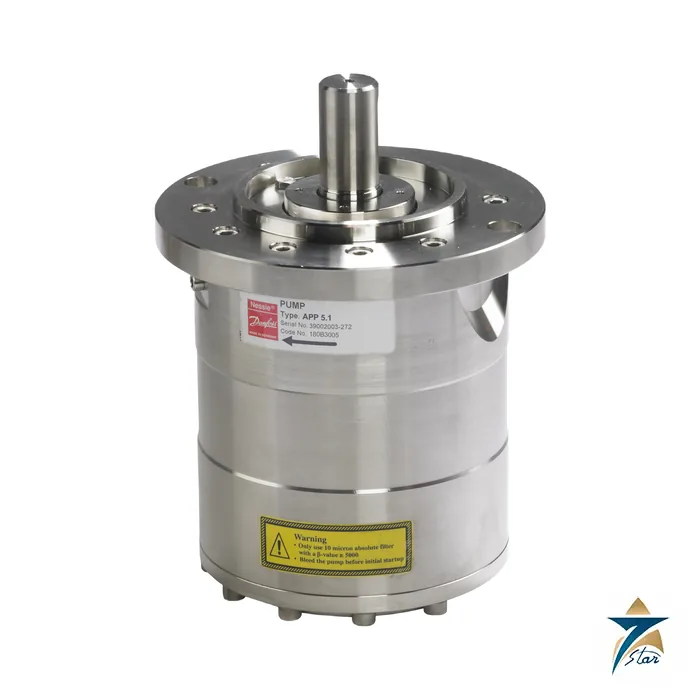
Danfoss 180B3005 APP 5.1 seawater high-pressure pump
The Danfoss 180B3005 is the APP 5.1, the smallest of the five frame sizes in the APP (W) 5.1–10.2 group of axial piston water pumps. It is a positive-displacement pump built for reverse-osmosis feed duty on seawater and brackish water: 50.2 cm³ per revolution, up to 83 bar continuous outlet pressure, duplex stainless steel housing, NBR seals and water as the only lubricant. Because the output follows shaft speed rather than discharge pressure, an APP 5.1 is a predictable building block for small and medium desalination skids. Seven Star LLC supplies this pump in Oman and the GCC as an independent supplier in Muscat.
In practice the 180B3005 is chosen when a skid needs roughly 2.8 to 4.2 m³/h of feed flow at 1000 to 1500 rpm and the designer wants a pump that fits a standard IEC motor with a bell housing. It does not carry an integrated flushing valve, which is a specific feature of this 5.1–10.2 group, so the system design must provide its own fill and flush path.
Reading the 180B3005 identification
| Element |
Meaning |
| APP |
Danfoss axial piston pump range for seawater, brackish water and, in the W version, waste water |
| 5.1 |
Size designation: 50.2 cm³/rev geometric displacement (3.06 in³/rev) |
| 180B3005 |
Danfoss code number for the standard APP 5.1 (duplex housing, NBR seals) |
| 180B3105 |
Code number of the ATEX version of the same size (Category 2 Zone 1 or Category 3 Zone 2) |
| 180B3075 |
Code number of the APP W version of the same size for waste-water duty |
When enquiring, always quote the code number and say whether you need the standard, ATEX or W version, because the three differ in certification and material arrangement even though the displacement is identical.
180B3005 technical specifications
| Parameter |
Specification |
| Manufacturer / part number |
Danfoss 180B3005 (APP 5.1) |
| Pump type |
Axial piston, positive displacement, water lubricated |
| Geometric displacement |
50.2 cm³/rev (3.06 in³/rev) |
| Maximum continuous outlet pressure |
83 bar g (1200 psig) |
| Minimum outlet pressure |
20 bar g (290 psig) |
| Inlet pressure, continuous |
0.5 to 5 bar g (7.3 to 72.5 psig) |
| Speed range |
700 to 1800 rpm continuous; above 1500 rpm the pump must be boosted at 2 to 5 bar g |
| Typical flow at maximum pressure |
2.79 m³/h at 1000 rpm; 4.19 m³/h at 1500 rpm; 14.75 gpm at 1200 rpm; 22.13 gpm at 1800 rpm |
| Media temperature |
2 to 50 °C (dependent on NaCl concentration) |
| Ambient temperature |
0 to 50 °C |
| Housing material |
Duplex stainless steel; seal material NBR |
| Connections |
Inlet and outlet M42 thread; drain M6 |
| Weight (dry) |
30 kg |
| Sound pressure level |
78 dB(A) at 1 m, motor-pump unit at maximum pressure and speed |
| Typical motor |
15 kW at 1200 rpm and maximum pressure (20 HP); torque 70 Nm |
| Approval |
CE; serviceable pump; made in Denmark |
How the APP 5.1 produces flow
Pistons arranged around a rotating cylinder barrel slide against a fixed swash plate. As the barrel turns, each piston is pushed in and drawn out once per revolution, and a valve plate connects it to the inlet during the suction stroke and to the outlet during the pressure stroke. The pumped seawater itself lubricates the sliding parts, which is why the pump contains no oil circuit that could contaminate the permeate and why the materials are chosen for corrosion resistance rather than for oil-film compatibility.
The theoretical flow is displacement multiplied by speed. For the APP 5.1 that is 50.2 cm³ × 1500 rpm, about 75 l/min or 4.5 m³/h. The datasheet value at maximum pressure is 4.19 m³/h at 1500 rpm, so internal leakage at 83 bar is roughly 7 percent. That slip is the reason RO designers size the pump from the data-sheet flow at the operating pressure rather than from displacement alone, and why a drop in delivered flow at constant speed is a reliable indicator of internal wear.
Torque scales with pressure. At 83 bar the APP 5.1 needs 70 Nm, so the motor must be checked for torque as well as for power, particularly if a variable frequency drive is used to trim flow at low speed.
Where the 180B3005 fits in the APP range
The APP 5.1–10.2 group has five sizes. The 180B3005 is the smallest at 50.2 cm³; the 180B3006 (APP 6.5, 63.3 cm³), 180B3007 (APP 7.2, 70.3 cm³), 180B3008 (APP 8.2, 80.4 cm³) and 180B3010 (APP 10.2, 100.5 cm³) share the same 83 bar rating, 0.5 to 5 bar inlet window and 700 to 1800 rpm speed range. All five use the same 2 to 50 °C media window, so upgrading to a larger size later is a question of flow and motor rather than of pressure class. Smaller APP 0.6 to 3.5 pumps and the larger APP 11 to 46 sizes are covered by the same datasheet but have different connections and motor sizes.
The 180B3005 is typically coupled to a 4-pole motor through a bell housing and flexible coupling, and it is commonly paired with an energy recovery device downstream of the membranes on larger plants. Pressure switches, a low-pressure relief valve and a precision depth filter complete the inlet side.
Selection and ordering checklist for APP 5.1
- Required permeate flow and recovery ratio, converted to feed flow at the plant design temperature, so that the 1000 to 1500 rpm flow figures can be matched.
- Maximum membrane pressure at end of membrane life and at the coldest water temperature, which must stay below 83 bar g.
- Inlet pressure available from the booster pump or supply line: at least 0.5 bar g, and 2 to 5 bar g if the speed will exceed 1500 rpm.
- Standard, ATEX (180B3105) or W (180B3075) version, and the zone classification if the pump is in a hazardous area.
- Motor frame and speed (50 Hz or 60 Hz, fixed or variable frequency) and the bell housing and coupling needed for the pump flange.
- Inlet filtration rated 10 µm absolute with a beta ratio of at least 5000, because the pump runs with very small clearances.
Installation, commissioning and maintenance
Mount the pump on a frame with anti-vibration dampers, couple it through a flexible coupling and bell housing, and keep axial and radial loads off the shaft. Use flexible hoses on inlet and outlet to reduce structure-borne noise. Install a low-pressure relief valve, a monitoring pressure switch between the filter and the pump inlet to prevent starting at low inlet pressure, and a non-return valve in the outlet so that stored membrane pressure cannot spin the pump backwards.
Because the 5.1 has no integrated flushing valve, fill and flush the line through the external piping before first start, and bleed through the plug on the housing. Under the manufacturer conditions the pump is expected to run 8000 hours between services, with an annual inspection recommended and a purpose-designed tool kit available. When the plant stops for more than a day, rotate the pump for about 10 seconds on permeate to rinse the inside; flushing through a valve without rotation does not clean the internals.
Typical applications of the 180B3005 in Oman and the GCC
Seawater reverse-osmosis units on the Gulf of Oman and Arabian Sea coast, containerised desalination for remote camps and hotels, offshore platform water makers and marine watermakers are the natural homes of a pump this size. Brackish-water RO on inland wells in the Interior and in Dhofar is equally suitable. High seawater temperature in summer lowers viscosity and raises salt passage, so designers usually check the pump flow at the warm-water design point; dust and humidity on the coast make a clean, closed enclosure and a rinse routine more important than any special pump option.
APP 5.1 to 10.2 family comparison
| Size |
Code |
Displacement cm³/rev |
Flow m³/h at 1000 / 1500 rpm |
Dry weight kg |
Typical motor kW |
Torque Nm |
| APP 5.1 |
180B3005 |
50.2 |
2.79 / 4.19 |
30 |
15 |
70 |
| APP 6.5 |
180B3006 |
63.3 |
3.57 / 5.36 |
30 |
18.5 |
81 |
| APP 7.2 |
180B3007 |
70.3 |
4.01 / 6.01 |
30 |
22 |
98 |
| APP 8.2 |
180B3008 |
80.4 |
4.62 / 6.93 |
30 |
22 |
112 |
| APP 10.2 |
180B3010 |
100.5 |
5.83 / 8.75 |
30 |
30 |
141 |
Information to send with an RFQ for 180B3005
- Code number 180B3005 and the quantity, with a note if ATEX or W versions are also wanted.
- Feed water type, salinity, temperature range and design recovery.
- Required flow, operating pressure and the motor speed or drive arrangement.
- Existing motor, bell housing and coupling data if the pump replaces another unit.
- Spare parts or service kit requirements, and the project delivery location.
Documents and quotation
The Danfoss APP data sheet covering this pump is attached on this page. It contains the technical tables, flow curves, accessory information and installation guidance referred to above.
Send the code number 180B3005 and your plant data and we will confirm availability, lead time and a quotation for Oman and the GCC.























Reviews
There are no reviews yet.