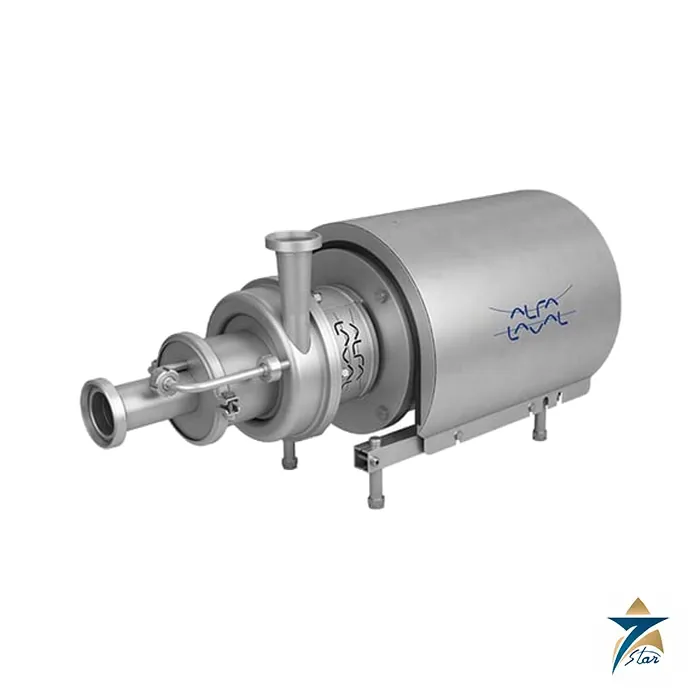
Alfa Laval LKH Prime self-priming hygienic pump: what it is
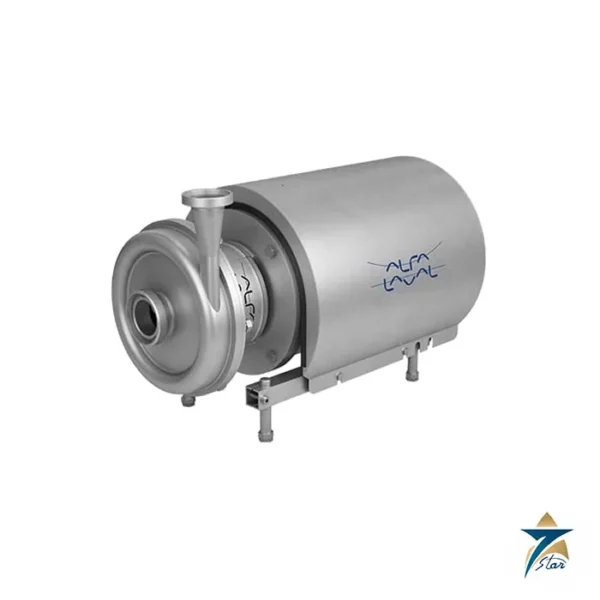
The Alfa Laval LKH Prime is a hygienic centrifugal pump that adds an air-screw stage in front of the impeller, so it can evacuate air from its own suction line and still behave like a normal centrifugal pump when the line is full. It belongs to the wider LKH hygienic pump platform, and it is aimed at duties where a plain centrifugal pump would lose prime: tank emptying and, above all, cleaning-in-place (CIP) return lines that carry a mix of liquid and air. Seven Star LLC supplies the LKH Prime in Oman and the GCC as an independent supplier based in Muscat.
In practice the name tells you two things. “LKH” is the family of premium hygienic centrifugal pumps, and “Prime” marks the self-priming air-screw version of it. The pump is not a separate machine design from the LKH range: it reuses the impeller, the front-loading shaft seal concept and much of the wet-end hardware, and swaps in dedicated parts where the air handling happens.
LKH Prime technical specifications
| Parameter |
Specification |
| Manufacturer / part number |
Alfa Laval / LKH Prime |
| Pump type |
Self-priming hygienic centrifugal pump, air-screw technology |
| Capacity |
Up to 110 m³/h |
| Head |
Up to 115 m |
| Brochure sizes shown |
LKH Prime 10, 20 and 40 on the performance chart |
| Dedicated components |
Air-screw, casing, re-circulation pipe and cover |
| Shared with LKH range |
Impeller (can be trimmed to the duty), front-loading shaft seal concept |
| Product-wetted surface finish |
Ra ≤ 0.8 µm |
| Elastomer options |
EPDM, nitrile (NBR) or fluorinated rubber (FPM) |
| Other options |
Reduced-diameter impeller, increased-safety / flameproof motor, double mechanical shaft seal, silicon carbide rotating seal ring, two ½″ tri-clamp drain connections |
| Hygiene credentials |
Designed, tested and approved by EHEDG and according to the 3-A standard (brochure); FDA-conforming materials and USP Class VI elastomers (product page) |
Figures are the manufacturer’s range limits. The usable duty of a given pump depends on size, impeller diameter, speed and frequency, so a duty point must always be checked against the curve for the exact configuration.
How the LKH Prime works
When the suction line carries a mixture of air and liquid, the rotating air-screw forms a continuous liquid ring inside the canister. Because the canister sits eccentrically to the air-screw, an air chamber opens up between the ring and the screw and splits into pockets between the screw vanes. As the screw turns, those pockets are pushed through the canister into the suction stage of the impeller and leave through the discharge.
Liquid from the discharge is fed back to the canister through the re-circulation pipe, which keeps the liquid ring intact at all times. Once no air is present, the canister and the recirculation loop do no further work: they simply fill with liquid, the product passes through to the impeller, and the unit runs as an ordinary centrifugal pump. This is why one machine can cover both a gassy CIP return and normal product transfer.
The manufacturer’s brochure compares the pump with conventional liquid ring designs and quotes up to 60% better efficiency, up to 25% better than other air-screw pumps, and a typical sound pressure level of 74 dBA against 81 dBA for a typical liquid ring pump. Treat these as manufacturer comparisons made under its own test conditions.
Where the LKH Prime fits in the LKH range
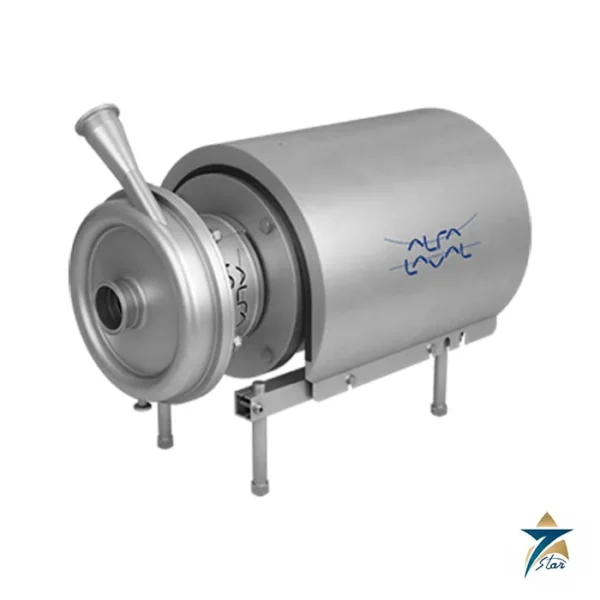
Within the family, the LKH Prime is the standard self-priming member. Three siblings change its character: the LKH Prime UltraPure adds pharmaceutical-grade finishes, a pharma seal and the Q-doc documentation package; the LKH UltraPure is the non-priming high-purity pump; and the LKH Evap, LKHPF and LKHex are specialised conventional LKH pumps for evaporation, high inlet pressure and ATEX areas. If your only requirement is air handling on a food, dairy, beverage or personal-care line, the LKH Prime is the part to look at first.
Because it shares the impeller and seal concept with the LKH range, a plant that already stocks LKH wear parts can often reduce the extra spares needed. Confirm the exact spare part list against the serial number of the pump before ordering.
Selecting and ordering the LKH Prime
- Duty point: required flow in m³/h and differential head in metres, with the mains frequency (50 Hz or 60 Hz) stated.
- Air content: how much entrained air or gas the suction line sees, and whether it is continuous or only during CIP return.
- Fluid: product or CIP fluid, viscosity, temperature, and any suspended solids.
- Shaft seal: single or double mechanical shaft seal, and silicon carbide rotating ring if required.
- Elastomers: EPDM, NBR or FPM, chosen against product and cleaning chemicals.
- Surface finish: Ra ≤ 0.8 µm on wetted parts as the standard figure.
- Motor: standard, or increased-safety / flameproof if the area is classified.
- Connections: process connection type and size, and whether the two ½″ tri-clamp drain connections are needed.
Installation, commissioning and maintenance of the LKH Prime
Install the pump with the suction line as short and as free of loops as possible, and avoid dead legs that trap product. Fill the pump according to the manual before the first start so the liquid ring forms immediately; running dry damages the shaft seal. Check rotation direction before coupling any final piping.
The shaft seal is front-loading, with the spring and washers on the atmospheric side, which keeps replacement quick. The product page also shows service videos for changing a single shaft seal and for the double mechanical seal on LKH Prime pumps. Keep a set of the seal kit, O-rings and the elastomer grade matching your product on the shelf, and record the serial number so the correct parts list can be identified.
During operation watch for changes in noise, seal leakage and flow. A pump that begins to struggle to clear air may point to a suction-side air leak, a worn seal or an impeller that is trimmed too small for the duty.
Typical applications in Oman and the GCC
The pump is intended for food, dairy, beverage, pharma, home and personal care duties. In Oman and the GCC that translates into dairies and juice plants, bottling and beverage lines, and personal-care or detergent manufacturing, where tank emptying and CIP return are daily tasks. High ambient temperature and dust in the Gulf make motor and enclosure selection worth discussing at enquiry stage, as does the chemical programme used for CIP. For areas that require explosion protection, specify an appropriately certified motor option at the outset.
LKH Prime options at a glance
| Option |
Choices listed |
Why it matters |
| Impeller |
Standard or reduced diameter |
Matches power and pressure to the exact duty |
| Shaft seal |
Single or double mechanical; SiC rotating ring |
Seal life and barrier fluid arrangements |
| Elastomers |
EPDM, NBR, FPM |
Compatibility with product and CIP chemistry |
| Motor |
Standard or increased-safety / flameproof |
Area classification |
| Drains |
Two ½″ tri-clamp |
Complete draining after cleaning |
Information to send with an RFQ for the LKH Prime
- Part name exactly as “LKH Prime” and the pump size if known (for example 10, 20 or 40).
- Flow, head, frequency and fluid data, including temperature and viscosity.
- Air or gas content on the suction line.
- Seal, elastomer and motor options required.
- Nameplate details if you are replacing an installed unit.
- Delivery location in Oman or the GCC and required date.
Documents and quotation
A manufacturer brochure for the LKH Prime is attached on this page, and it includes the performance chart and efficiency comparison discussed above. Detailed drawings and parts lists depend on the size and configuration.
Send us your duty data and the part name, and Seven Star LLC will prepare a quotation for delivery in Oman and the GCC.
Other Models in the Al Centrifugal Lkh Range
Seven Star LLC supplies models from the Al Centrifugal Lkh range in Oman and the GCC. Compare the related models below and request a quote for the one that matches your application.




























Reviews
There are no reviews yet.