WIKA TG53 process bimetal thermometer per ASME B40.200
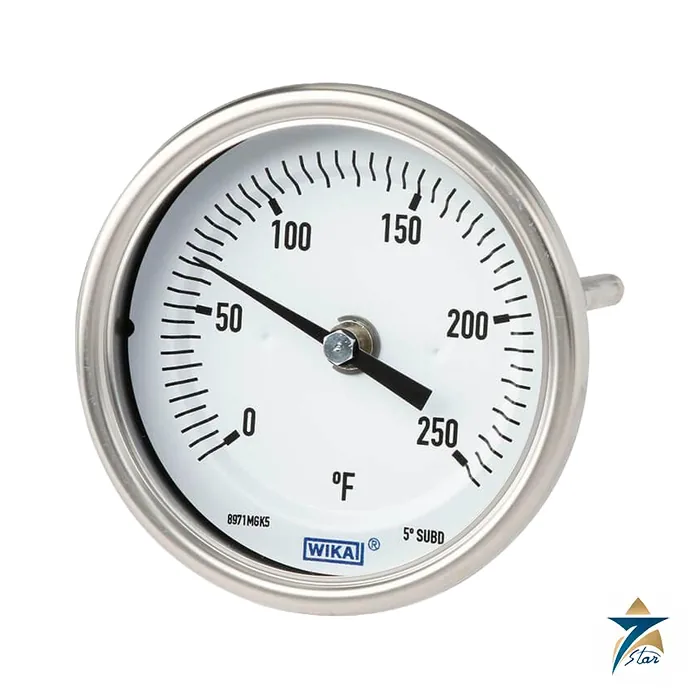
The WIKA TG53 is a 3 inch (80 mm) bimetal dial thermometer made to the ASME B40.200 standard for process plants. It has a hermetically sealed stainless steel case with IP66 (NEMA 4X) protection, a dished anti-parallax dial and an accuracy of ±1 % of full scale (grade A per ASME B40.200). It is intended for the chemical and petrochemical, oil and gas, power generation and water and wastewater industries, and it is offered with filling and damping options for vibrating service. Seven Star LLC supplies the TG53 in Oman and the GCC as an independent supplier in Muscat; this page lays out the connection, scale and stem choices so that an RFQ can be built from it.
Case styles and connection locations
| Connection location |
Description |
Use |
| Back mount (axial) |
Stem leaves the back of the case in line with the dial axis |
Panels and vessels where the dial faces the operator head-on |
| Lower mount (radial) |
Stem leaves the bottom of the case through an elbow |
Pipes viewed from the side |
| Back mount, adjustable stem and dial |
Articulated joint swivelling 90 degrees and rotating 360 degrees |
Awkward positions where the dial must be turned to the viewer after installation |
WIKA lists the adjustable-stem version as enabling optimal process fit: because the dial can be tilted and rotated after the stem is installed, it avoids the problem of a rigid thermometer ending up facing the wrong way. The elbow behind the case on lower mount versions and the articulated joint are in stainless steel 304.
TG53 technical specifications
| Parameter |
Specification |
| Manufacturer / part number |
WIKA / TG53 (data sheet TM 53.02) |
| Type |
Bimetal thermometer, process version per ASME B40.200 |
| Nominal size |
3 in [80 mm] |
| Measuring element |
Bimetal coil |
| Accuracy |
±1 % of full scale, grade A per ASME B40.200 |
| Case and ring |
Stainless steel 304 or 316 (option) |
| Window |
Instrument glass, laminated safety glass or polycarbonate (shatterproof) |
| Ingress protection |
IP66 (NEMA 4X), hermetically sealed case |
| Stem and wetted parts |
Stainless steel 304; 316 option for stem and process connection |
| Stem diameter |
1/4 in [6.35 mm] for the standard line; other diameters in the stem table |
| Insertion length l1 |
Standard lengths include 2.5, 3, 4, 5, 6, 7, 9 and 10 in depending on mount; overall L = l1 + 40 mm |
| Process connections |
Standard male thread (G ½ B or ½ NPT shown), plain stem, sliding compression fitting, compression fitting with support tube |
| Case filling |
Without, or silicone oil up to 250 °C at the probe; damped bearing bushing with inert gel |
| Versions |
Standard, oil- and grease-free, or silicone-oil-less |
| Zero adjustment |
Screw on the rear of the case, with a screwdriver |
| Pointer |
Adjustable pointer version listed |
| Scale |
Single scale or dual scale in °C/°F or °F/°C |
Scale ranges
The datasheet lists many ranges. In Celsius, examples include -70 … +70, -50 … +50, -50 … +200, -50 … +300, -50 … +500, 0 … 120, 0 … 150, 0 … 200, 0 … 250, 0 … 300, 0 … 400, 0 … 500 and 0 … 600 °C, with scale spacing from 1 to 10 °C according to span. In Fahrenheit the offering includes -100 … +150, 0 … 250, 30 … 400, 100 … 800 and 200 … 1,000 °F. Choose a range so that the normal working temperature sits in the middle third of the dial, because accuracy is a percentage of full scale and the pointer is easiest to read there.
Overtemperature resistance
The thermometer tolerates excursions above the range end by a stated margin: for ranges with a top between 50 and 120 °C the end of scale plus 100 % overload safety, for ranges above 120 up to 280 °C plus 50 %, and for higher ranges the limits tighten until, in the 400 to 600 °C range, the full scale is the maximum. WIKA notes that the overtemperature resistance applies only in non-hazardous areas.
Damping for vibrating service
The datasheet says the TG53 offers the widest variety of damping options in the industry. A silicone-oil case filling cushions the pointer against vibration up to 250 °C at the probe, and a damped bearing bushing with inert gel dampens the movement without liquid. Choose a filled version for pumps, compressors and piping with strong pulsation, and a dry case with the damped bushing where oil is undesirable. Oil- and grease-free and silicone-oil-less versions exist for clean services.
Thermowell fit and installation
A bimetal thermometer should normally be installed in a thermowell when the process is pressurised, flowing or hazardous, so the thermometer can be removed without opening the system. The plain stem and compression fittings let you match the instrument to existing wells; a union-nut design (design 3) allows rotation of the case. Check that the immersion length is at least the minimum for a bimetal coil (the coil sits in the lower part of the stem) and follow the stem length chart for the correct l1. Do not dismantle the hermetic case; use the rear screw to trim the zero point.
Where the TG53 sits in WIKA’s bimetal range
Within the range, the TG54 is the process bimetal thermometer to EN 13190, which uses a different case and connection convention, while the TG53 follows the ASME B40.200 approach, so choose it when your specification is written to US-style standards, with NPT threads and inch lengths.
Applications in Oman and the GCC
WIKA lists the chemical and petrochemical industries, oil and gas, power generation and water and wastewater, in harsh and aggressive conditions and high vibration. In the Gulf this covers local indication of heat-exchanger and cooler temperatures, pump skids, steam and condensate lines, desalination plants, and offshore or coastal facilities where 316 stainless steel and a sealed case resist salt air and humidity. Sun-baked outdoor locations favour a laminated safety glass or polycarbonate window and a dual scale, if your operators are used to both units.
TG53 ordering checklist
- Connection location: back mount, lower mount or adjustable stem and dial
- Scale range and unit (single or dual)
- Stem diameter, insertion length l1 and wetted material (304 or 316)
- Process connection: thread size, plain stem or compression fitting
- Window material and case filling or damping
- Oil- and grease-free or silicone-oil-less version
- Thermowell dimensions if one is already installed
Information to send with an RFQ
Send the tag, range, stem length, connection standard, thermowell data, quantity and certificate needs, or send the data sheet reference of the thermometer being replaced.
Documents and quotation
The WIKA data sheet TM 53.02 for the TG53 is attached on this page. Send us the specification and quantity for a quotation from Muscat as an independent supplier.



















Reviews
There are no reviews yet.