FTL33 Liquiphant hygienic point level switch
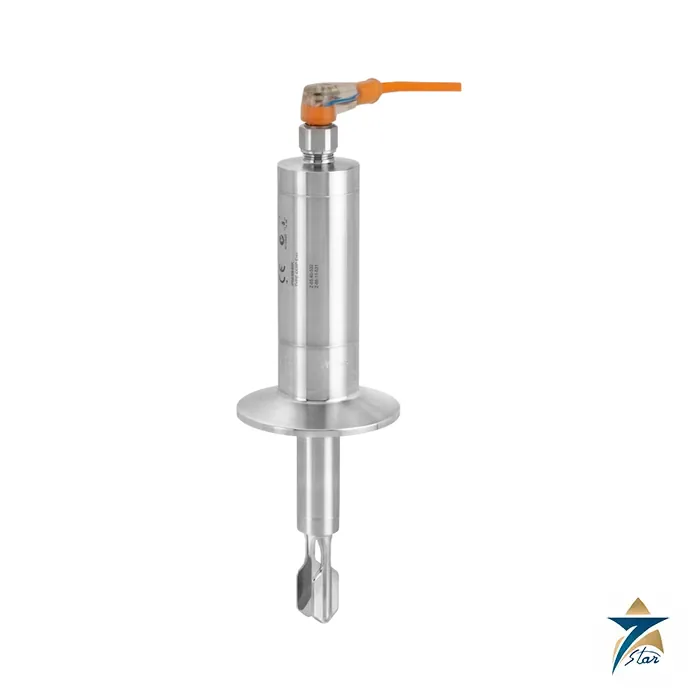
The Endress+Hauser FTL33 is the hygienic member of the compact Liquiphant family: a vibronic point level switch for all liquids in tanks, mixing vessels and pipes where internal and external cleanliness requirements are strict. A 316L tuning fork detects whether the liquid has reached the switching level; there are no moving parts, and no plastic in contact with the product. The FTL33 is intended for the food, beverage and dairy industries and similar clean processes.
Two process temperature ratings are offered: up to 100 °C for CIP-suitable sensors, and up to 150 °C for sensors suitable for CIP and SIP. The pressure limit is –1 to +40 bar, subject to the derating of the chosen connection and seal. Compared with the FTL31, which uses the same fork and electronics for general industrial duty, the FTL33 changes the process connections, surface finish and hygienic documentation.
FTL33 technical specifications
| Parameter |
Specification |
| Manufacturer / part number |
Endress+Hauser / FTL33 (Liquiphant, hygienic vibronic point level switch) |
| Measuring principle |
Vibronic tuning fork, 316L, all-metal process side |
| Process temperature |
–40 to +100 °C or –40 to +150 °C (CIP / SIP) |
| Process pressure |
–1 to +40 bar, with derating by connection |
| Density / viscosity |
Above 0.7 g/cm³ (above 0.5 g/cm³ optional); 1 to 10,000 mPa·s |
| Switch point |
Approx. 13 mm ± 1 mm (water, vertical from above); hysteresis up to 3 mm |
| Switching delay |
0.5 s covered, 1.0 s uncovered; 0.2, 1.5 or 5 s optional |
| Electronics |
3-wire DC-PNP 10 to 30 V DC; 2-wire AC/DC 20 to 253 V |
| Housing cover / plug |
316L with M12 plug (IP66/68/69), M12 plug IP65/67, valve plug IP65 (PPSU), or cable IP66/68 |
| Ambient temperature |
–40 to +70 °C, with derating at high process temperature |
| Surface finish |
Ra 1.5 µm (59 µin) or 0.76 µm (30 µin) per EHEDG and 3-A versions |
| Hygienic data |
FDA-compliant wetted materials; 3-A Sanitary Standard No. 74-06; EHEDG and 3-A certificate copies orderable |
| Other approvals |
CSA C/US general purpose; WHG overfill and leak detection; CRN |
FTL33 hygienic process connections
The process connection decides whether the FTL33 meets the hygienic design you need. The datasheet lists the following, with 3-A and EHEDG approval marked per connection.
| Connection |
Detail |
| Thread G 1/2, MNPT 1/2, 3/4 and 1 |
316L threaded; hygiene approval depends on the connection version |
| G 3/4 and G 1 flush |
Installation in a weld-in adapter accessory |
| M24 thread |
Process adapters for Varivent N, Varivent F, DIN 11851 DN50 and SMS 1-1/2 |
| DIN 11851 DN25, DN32, DN40 |
PN 40 milk pipe fittings, supplied without slotted nut |
| Tri-Clamp ISO 2852 |
DN25-38 (1 to 1-1/2 in) and DN40-51 (2 in), DIN 32676 compatible |
| Flush mount |
Installation in weld-in adapter RD52, 316L, without slotted nut |
If CIP is required, use the weld-in adapters offered for 3-A compliance. In horizontal installation the leakage hole must point down so a leak is detected quickly. The EHEDG design principles in Document 37 and Document 16 should be followed for sensor mounting and pipe couplings.
How the FTL33 works
A piezoelectric drive makes the fork oscillate at resonance. When liquid covers the fork, the resonance frequency falls in proportion to the density of the liquid, and the electronics switch the output. The measurement is not affected by conductivity, foam, flow, bubbles or build-up in the normal range, and the switch has MAX and MIN modes: MAX for overfill protection, MIN for dry-run protection of pumps or a low-level signal. The output opens on fault or power failure, so the safe state is the same as the alarm state.
On the housing, a green LED shows operation, a yellow LED shows the switching state and a red LED indicates warnings or a fault. A test magnet held against the housing mark for 2 seconds inverts the switch state for a functional test.
FTL33 selection and ordering checklist
- Hygienic standard needed: 3-A, EHEDG, FDA, GMP or food-contact declarations.
- Process connection: Tri-Clamp size, DIN 11851 size, Varivent or weld-in adapter flush mount.
- Surface roughness (Ra 1.5 or 0.76 µm) and whether a 3.1 certificate or roughness report is required.
- Process temperature (100 or 150 °C), cleaning cycle and pressure.
- Medium density and viscosity, and installation position of the fork.
- Electronics (PNP or AC/DC), connector type and housing cover material.
- Sealing material: silicone or EPDM seals comply with BfR recommendations.
FTL33 installation notes
Observe the switch point in your orientation, and keep at least 10 mm between the fork and the vessel wall. Use the hygienic weld-in adapter and seal matched to the connection, so the joint stays gap-free. The datasheet notes that the silicone seals supplied comply with BfR Recommendation XV and the EPDM seals with BfR Recommendation XXI. Also check that the cleaning temperature at the connection stays within the limits of both the sensor and the clamp or nut.
FTL33 applications in Oman and the GCC
In Oman and the GCC the FTL33 fits dairy, juice, water-bottling and beverage plants and food-processing utilities in industrial zones. It is also a candidate for potable-water and dosing tanks where an all-stainless, easily cleaned switch is preferred over a float. The ability to withstand CIP and SIP cycles is relevant in plants with frequent washdown. Seven Star LLC supplies Endress+Hauser instruments as an independent supplier in Muscat to food, beverage and utility customers in the region.
Information to send with an FTL33 RFQ
- Product handled, density, viscosity and temperature, including CIP and SIP conditions.
- Process connection size and standard, or the weld-in adapter already installed.
- Certificates required: 3-A, EHEDG, 3.1 inspection, surface roughness report, FDA or EC 1935/2004 declaration.
- Electronics, connector or cable, and function (MIN or MAX).
- Quantity and delivery schedule.
Documents and quotation
The Endress+Hauser Technical Information for the FTL33 is attached on this page as a datasheet, including the hygiene approval table and process adapter drawings.
Send the FTL33 order code or your hygiene requirements, and we will prepare a quotation for delivery in Oman and the GCC.
Other Models in the Eh Liquiphant Vibronic Range
Seven Star LLC supplies models from the Eh Liquiphant Vibronic range in Oman and the GCC. Compare the related models below and request a quote for the one that matches your application.























Reviews
There are no reviews yet.