Endress+Hauser t-mass F 300 inline thermal mass flowmeter with compact transmitter
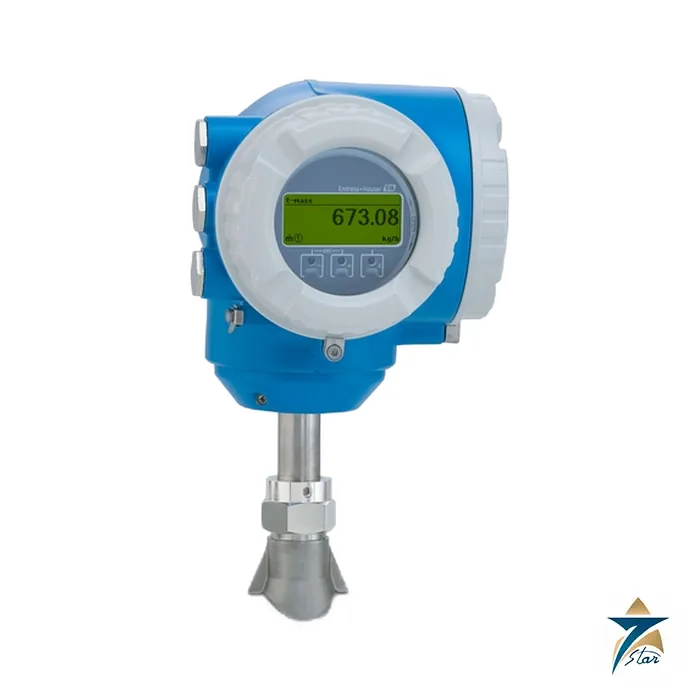
The Endress+Hauser t-mass F 300 (product root 6F3B) is an inline thermal mass flowmeter for utility and process gases in small line sizes, DN 15 to 100 (½ to 4″). The transmitter is mounted directly on the sensor as a single compact unit with a dual-compartment aluminium housing, a backlit display with touch control and WLAN access, and up to three configurable inputs and outputs. It measures mass flow directly and reads out in several other units derived from it. Seven Star LLC supplies Endress+Hauser instruments in Oman and the GCC as an independent supplier in Muscat, and this page explains how to specify the t-mass F 300 correctly.
Reading the t-mass F 300 name and order code
In the Proline naming scheme the letter F stands for the flanged inline sensor, the digit 3 stands for the compact Proline 300 transmitter, and the code 6F3B is the product root used in the documentation. The sibling t-mass F 500 uses the same sensor with a remote Proline 500 transmitter. Two ordering features change the behaviour of the sensor in a way that matters when you write the enquiry:
- Sensor version SB, bidirectional: measures and totalises flow in both directions, calibrated in both directions.
- Sensor version SC, reverse flow detection: measures forward flow only and flags reverse flow without totalising it.
- Sensor option CC, IP68 Type 6P customer-potted version for installations that may be flooded.
- Application package EV, second gas group: lets you store two gases or gas mixtures and switch between them by status input or bus command.
t-mass F 300 technical specifications
| Parameter |
Specification |
| Manufacturer / part number |
Endress+Hauser / t-mass F 300 (6F3B) |
| Measuring principle |
Thermal; heated PT100 resistance thermometer cooled by the gas, second PT100 records process temperature |
| Nominal diameter |
DN 15 to 100 (½ to 4″) |
| Measured variables |
Mass flow, temperature; calculated: corrected volume flow, volume flow, FAD volume flow, flow velocity, calorific value, heat and energy flow, density |
| Measuring range |
0.5 to 3750 kg/h (1.1 to 8250 lb/h), depending on gas, pipe size and flow conditioners |
| Operable flow range |
200:1 with factory calibration; up to 1000:1 with application-specific adjustment |
| Max. measurement error (gas) |
1.0 % of reading from 10 to 100 % of full scale; 0.1 % of full scale from 1 to 10 % |
| Repeatability |
±0.25 % of reading above 1.0 m/s |
| Response time |
Typically below 3 s for 63 % of a step change |
| Medium temperature |
–40 to +180 °C (–40 to +356 °F) |
| Medium pressure |
Minimum 0.5 bar absolute; maximum PN 40 / Class 300 / 20K |
| Wetted materials |
Measuring tube DN 15 to 50 stainless cast steel CF3M / 1.4408; DN 65 to 100 stainless steel 1.4404 (316/316L); flanges 1.4404 (F316/F316L) |
| Ambient temperature |
–40 to +60 °C (–50 °C with test option JP); display readable from –20 to +60 °C |
| Power supply |
DC 24 V ±20 % or AC 100 to 240 V (–15 / +10 %), 50/60 Hz; max. 10 W |
| Outputs / communication |
4–20 mA HART (active or passive), Modbus RS485, pulse/frequency/switch, relay, current input, status input |
| Degree of protection |
IP66/67, Type 4X enclosure; IP68 Type 6P optional |
| Functional safety |
Patented drift-free sensor with SIL 2 capability (application package) |
How the thermal principle and Gas Engine work
Two PT100 elements sit in the measuring section. One tracks the real gas temperature. The other is heated and held at a constant temperature difference above it. The more mass flows past, the more heat is carried away and the more electrical power is needed to hold the difference, so the heating power is a direct indicator of mass flow. No pressure or temperature compensation is needed for the mass reading itself.
The Gas Engine is a built-in database of gas properties. Each meter is calibrated with air under reference conditions, and the Gas Engine converts that calibration to the real gas, so you do not pay for calibration on each process gas. Twenty-one gases and water vapour can be selected, from ammonia, argon, butane, chlorine, carbon dioxide, helium, hydrogen, hydrogen sulfide, methane, nitrogen, oxygen and propane to xenon. Mixtures of up to eight components, such as natural gas, are programmed by percentage share, and dynamic correction of pressure and temperature changes is applied.
Where the meter fits and related t-mass models
The F 300 is the right choice when the transmitter can sit next to the pipe and the ambient conditions are reasonable. When the sensor is in a hot or vibrating spot, or when the display must be read at a safe distance, the t-mass F 500 separates the transmitter with a cable. For larger ducts and pipes from DN 80 to 1500 the insertion versions t-mass I 300 and I 500 take over, and the basic utility-gas meter in the family is the t-mass A 150. A remote display is also available for the F 300 itself. On the control side, the F 300 talks to a PLC through HART, Modbus RS485 or the pulse output, and the relay and status input can handle simple alarms and gas-group switching locally.
Selection checklist for t-mass F 300
- Gas or gas mixture with percentage composition, or confirm it is among the 21 selectable gases.
- Line size DN 15 to 100, flange standard and pressure rating up to PN 40 or Class 300.
- Minimum, normal and maximum mass flow and operating pressure; ask whether flow conditioners are needed for a short inlet run.
- Unidirectional, bidirectional (SB) or reverse flow detection (SC).
- Power supply: 24 V DC or 100 to 240 V AC, and the output mix required.
- Hazardous-area approval, SIL needs, Heartbeat verification and IP68 option.
- Ambient extremes at site; transmitter neck must not exceed 80 °C at its lower end, so allow convection.
Installation, commissioning and maintenance of the t-mass F 300
A fully developed flow profile gives the best result. The datasheet recommends 50 × DN of inlet after control valves, a doubled inlet run for very light gases such as helium or hydrogen, and flow conditioners where straight pipe is not available. For bidirectional sensors the recommended run applies in both directions. Keep the gas free of liquid droplets, because wetting changes the heat transfer, and avoid mounting directly downstream of regulators.
Commissioning uses the Make-it-run wizards on the touch display or the WLAN interface. Heartbeat Technology provides built-in verification and a downloadable verification report. The sensor is removable, which allows service without cutting pipe in many cases, and the accuracy statement relies on factory calibration rather than periodic adjustment, so keep the serial number for future recalibration or verification requests.
Typical applications in Oman and the GCC
Fuel gas and flare gas branches, nitrogen and instrument air headers, biogas and landfill gas, hydrogen and CO2 utility lines, and process air to burners and aeration blowers are all typical for a thermal mass meter. In oil and gas and petrochemical sites the direct mass reading is helpful for combustion control and custody-style allocation of utility gases. Desalination and power plants use it for nitrogen blanketing and gas injection. In the Gulf climate attention goes to the +60 °C ambient limit of the compact housing, sun shading and the dusty air that coats display windows.
Compact F 300 versus remote F 500
| Feature |
t-mass F 300 |
t-mass F 500 |
| Transmitter |
Proline 300, compact on sensor |
Proline 500 digital, remote |
| I/O channels |
Up to 3 |
Up to 4 |
| Sensor to transmitter |
Direct |
Cable, up to 300 m (Zone 2 / Div 2) or 150 m (Zone 1 / Div 1) |
| Best use |
Easy access, mild ambient |
Hot, hard-to-reach or vibrating positions |
Information to send with an RFQ for t-mass F 300
Send the gas and composition, line size and flange rating, flow range, operating pressure and temperature, required I/O, power supply, bidirectional or reverse-flow need, hazardous area classification and any documentation requirements. A nameplate photo or order code helps for replacements.
Documents and quotation
The Endress+Hauser technical information for the t-mass F 300 is attached on this page as a datasheet, with dimensions, I/O wiring, approvals and ordering features. Please confirm the final order code against it.
Send the order code or your gas duty and Seven Star LLC will prepare a quotation for Oman and the GCC.
Other Models in the Eh Tmass Thermal Range
Seven Star LLC supplies models from the Eh Tmass Thermal range in Oman and the GCC. Compare the related models below and request a quote for the one that matches your application.




















Reviews
There are no reviews yet.