Overview
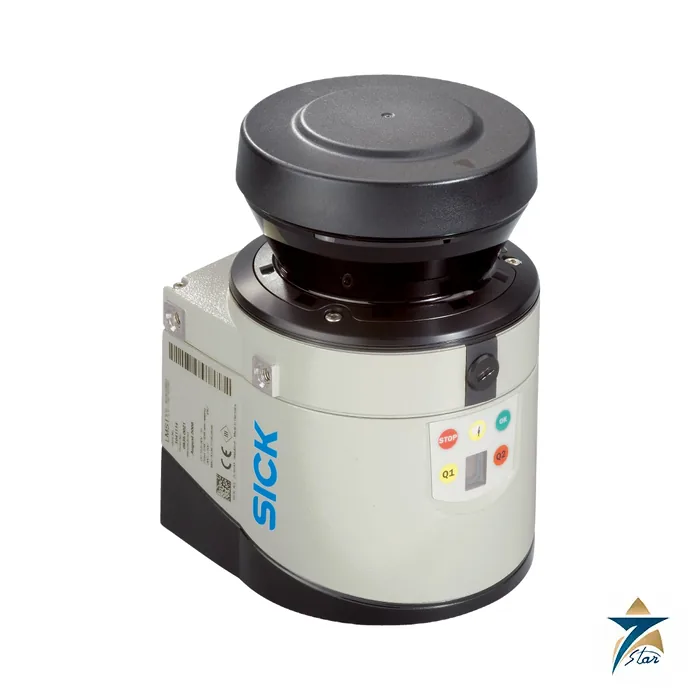
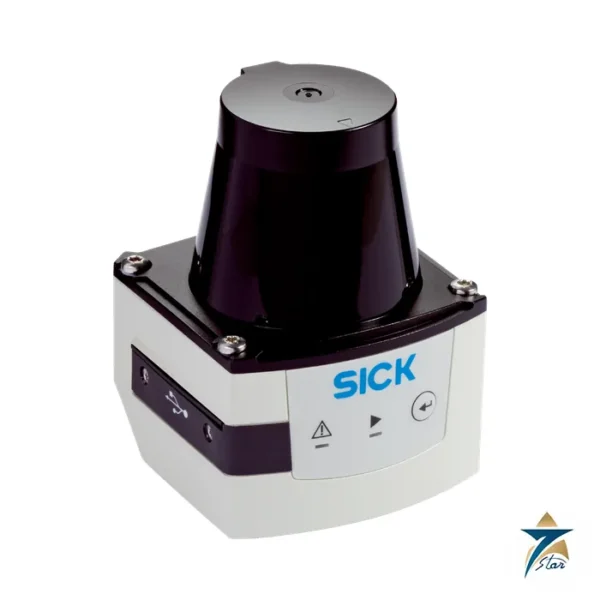
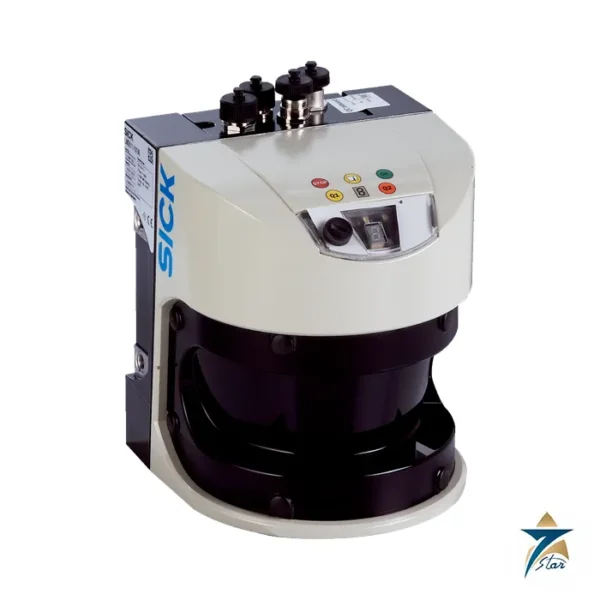
The SICK LMS111-10100 is the outdoor-rated member of the LMS1xx family of two-dimensional LiDAR sensors from SICK. It sweeps an infrared laser beam across a 270 degree sector and returns distance values for every angular step, so a controller sees a complete contour of whatever stands in front of it instead of a single switching point. What sets this type apart from its indoor siblings is the heated, IP67 housing: the device is specified from minus 30 up to plus 50 degrees Celsius and carries a built-in heater, which is why it is the usual choice for gates, yards, quay edges and vehicle approaches that are exposed to dust, rain and wide temperature swings.
Part number 1041114 is the factory ordering code behind the type name. The sensor measures with a 905 nm infrared source in laser class 1, so it is eye safe and needs no special signage. Its working range runs from 0.5 m to 20 m, and it evaluates two echoes per measurement, which helps when the beam passes through rain, dust or a light fog and a weaker first echo would otherwise hide the real target.
Seven Star LLC is an independent supplier serving Oman and the GCC. This page collects the facts a buyer needs before sending a request for quotation for this exact code: what the sensor measures, how it connects, how it is built and what to check on site before it goes into service.
Key features of the SICK LMS111-10100
- 270 degree aperture angle with selectable angular resolution of 0.25 or 0.5 degrees and scanning frequency of 25 Hz or 50 Hz.
- Scanning range of 18 m on a target with 10 percent remission and 20 m on a target with 90 percent remission.
- Integrated heating and fog correction, so the unit keeps measuring in cold, damp or dusty air.
- Field evaluation application built in: up to 10 field sets and 10 simultaneous evaluation cases without an external PC.
- Ethernet TCP/IP data interface at 10/100 MBit/s plus an RS-232 serial port for service and data output.
- Two digital inputs, two encoder inputs and three outputs, with a CAN interface that can extend the outputs.
- A seven-segment display and five status LEDs show device state, contamination warning and the initial condition.
The two encoder inputs are worth a closer look. They allow the scanner to be tied to a conveyor or vehicle drive so the contour data can be stamped with travel distance, which is the basis for volume, length and profile measurement on moving goods.
Technical specifications of the SICK LMS111-10100
| Parameter |
Value |
| Type / part number |
SICK LMS111-10100 / 1041114 |
| Application |
Outdoor, indoor |
| Light source |
Infrared, 905 nm |
| Laser class |
1 (IEC 60825-1:2014) |
| Aperture angle |
270 degrees horizontal |
| Scanning frequency |
25 Hz or 50 Hz |
| Angular resolution |
0.25 degrees or 0.5 degrees |
| Working range |
0.5 m to 20 m |
| Scanning range at 10 percent remission |
18 m |
| Scanning range at 90 percent remission |
20 m |
| Evaluated echoes |
2 |
| Systematic error |
plus or minus 30 mm (typical) |
| Statistical error |
12 mm (typical) |
| Response time |
20 ms or more |
| Field sets / simultaneous cases |
10 / 10 |
| Supply voltage |
10.8 V DC to 30 V DC |
| Power consumption |
typically 8 W, heating typically 35 W |
| Connection |
1 x M12 round connector |
| Interfaces |
Ethernet TCP/IP, RS-232, CAN |
| Digital I/O |
2 inputs plus 2 encoder inputs, 3 outputs |
| Enclosure rating |
IP67 |
| Protection class |
III |
| Housing colour |
Gray, RAL 7032 |
| Dimensions (L x W x H) |
105 mm x 102 mm x 162 mm |
| Weight |
1.1 kg |
| Ambient operating temperature |
minus 30 to plus 50 degrees Celsius |
| Storage temperature |
minus 30 to plus 70 degrees Celsius |
| Ambient light immunity |
80,000 lx |
The ordering table above reflects the data sheet for this single type. Figures marked typical in the source depend on environmental conditions, so treat them as planning values rather than guarantees for a particular installation.
How LMS111-10100 differs from other LMS1xx variants
Within the LMS1xx range the SICK LMS111-10100 is the outdoor version with the heater and the IP67 housing. The LMS100-10000 is the indoor variant: its data sheet lists no heating, an enclosure rating of IP65 and an operating temperature of 0 to plus 50 degrees Celsius, whereas the code described here works from minus 30 degrees. The LMS151-10100 keeps the heater and the IP67 housing but stretches the working range to 50 m, with 50 m on a 90 percent remission target against 20 m for the SICK LMS111-10100, and it is a separate part number with a different performance envelope.
For a buyer this means the type code matters. Ordering by the physical look of the unit is risky because the indoor and outdoor housings are very similar in outline; confirm the code 1041114 on the nameplate or in the existing documentation, and quote that code when sending the request.
Typical applications in Oman and the GCC
Because of its heater and IP67 body the sensor suits open-air jobs that the Gulf climate makes demanding. On bulk-handling sites it can profile the load on a truck or a stockpile edge, and on port and logistics yards it detects vehicles and containers at crane and gate zones. Where workers and vehicles share a lane, the ten configurable fields allow a controller to raise a warning when something enters an area, although the data sheet states clearly that the sensor is not a safety component under machinery safety legislation and must not be used where a certified protective device is required.
In utilities and water plants the scanner is often mounted above a screening channel or a tank filling bay to monitor object presence. In manufacturing yards it measures the position of crane hooks, pallets and trailers. In every case the combination of fog correction, two evaluated echoes and an ambient light immunity of 80,000 lx is what keeps readings usable under bright sun and dusty haze.
Selection and compatibility notes for LMS111-10100
Check the supply first. The unit accepts 10.8 V DC to 30 V DC, and the heating adds a typical 35 W on top of the typical 8 W operating draw, so a supply and cable sized only for the logic power will sag in winter conditions. Plan the supply for the combined load and keep the cable run short enough to avoid voltage drop at the connector.
Next check the controller side. Measurement data leave the device over Ethernet TCP/IP, while the RS-232 port at 9.6 to 115.2 kBaud serves for service and configuration. The CAN interface extends the outputs rather than carrying scan data. If the application needs the encoder inputs, confirm that your drive provides a signal level compatible with the sensor inputs described in the data sheet before ordering cables.
Finally think about targets. The remission range runs from 3 percent up to above 1,000 percent for reflectors; very dark surfaces fall near the lower limit and shorten the usable range to roughly the 18 m figure or less, while retro-reflective tape can extend detection.
Installation and commissioning of the LMS111-10100
Mount the housing on a rigid surface using the M5 threaded holes, which are 7.5 mm deep, and keep the 270 degree field free of brackets, cables and rain shields that would cut into the scan. A slight downward tilt prevents standing water and dust from collecting on the optics cover in open installations.
Connect power and the Ethernet cable at the M12 connectors; the Ethernet port is a 4-pin D-coded M12 female. After the supply is applied, the display and LEDs show the initial condition. Configure the scan frequency, resolution and field sets through the service interface or the vendor configuration tool, then walk a test object through each field and watch the output states. Record the settings so a replacement unit can be configured identically.
Maintenance and service life of SICK LMS111-10100
The sensor has no moving parts exposed to wear in the way a mechanical switch does, and the data sheet gives an MTBF of more than 100 years. The practical maintenance item is the optics cover. The contamination warning on the status LEDs tells the operator when dust or film reduces the signal; clean the cover with a soft, lint-free cloth and a mild cleaner, never with abrasives that could scratch it.
Inspect the M12 connector and cable gland seals when the unit is serviced, since these are the first places where moisture can enter in outdoor service. Keep the housing label legible: the part number 1041114 and the type code are what you will need if a replacement is ever sourced.
Related products and ordering notes
Buyers who specify this scanner often also need mounting brackets, M12 connection cables and a matching power supply. These accessories are separate items with their own part numbers, so list them alongside the sensor in the same request.
Other LiDAR types, safety laser scanners and photoelectric sensors from the same maker can be quoted together when a project needs more than one detection technique. When you write to us, state the full type SICK LMS111-10100, the number of units, the intended site and any required delivery window.
Related items you may also need: SICK CM18-12NPP-EW1 CM Capacitive Proximity Sensor | SICK SRS50-HGA0-K22 Motor Feedback | SICK MZC1-4V3PS-KR0 MZC1 C-Slot Cylinder Sensor, PNP | All SICK products.
Before you order the SICK LMS111-10100
- To avoid a wrong delivery, compare the code on the nameplate of the installed unit with the SICK LMS111-10100 code on this page.
- The quotation for the SICK LMS111-10100 states the confirmed code, the condition of the unit and the lead time to site.
- The attached manufacturer datasheet covers the SICK LMS111-10100 ratings, dimensions and installation details.
- Delivery of the SICK LMS111-10100 is arranged to project sites in Oman and across the GCC, alongside the rest of our laser distance, lidar & radar sensors range.
- A spare SICK LMS111-10100 on the shelf is a simple way to protect critical service from long lead times.
Documents and quotation
The manufacturer data sheet for the SICK LMS111-10100 is attached to this page and lists the electrical, mechanical and performance data used above. Please read it together with the operating instructions for the LMS1xx family before commissioning.
To receive a quotation, send your RFQ with the part number SICK LMS111-10100, the quantity and the delivery location in Oman or the wider GCC. Seven Star LLC will confirm availability and lead time for the SICK LMS111-10100 and any accessories you list.

 Automation & Control
 Electrical & Power
 Fittings & Valves
 Sensors & Transmitters
 Emergency Power
 Analyzer Systems
 Metering Systems
 Fire & Gas Systems
 Motors, Pumps & Turbines
 Welding
 Portable Test & Measurement
 Compressor & Cooling
 Bearings & Power Transmission
 Filtration
 Safety & PPE
 Material Handling & Lifting Equipment
 Non-Destructive Testing (NDT)




Reviews
There are no reviews yet.