A 2 m laser distance sensor with display, TEACH modes and IO-Link
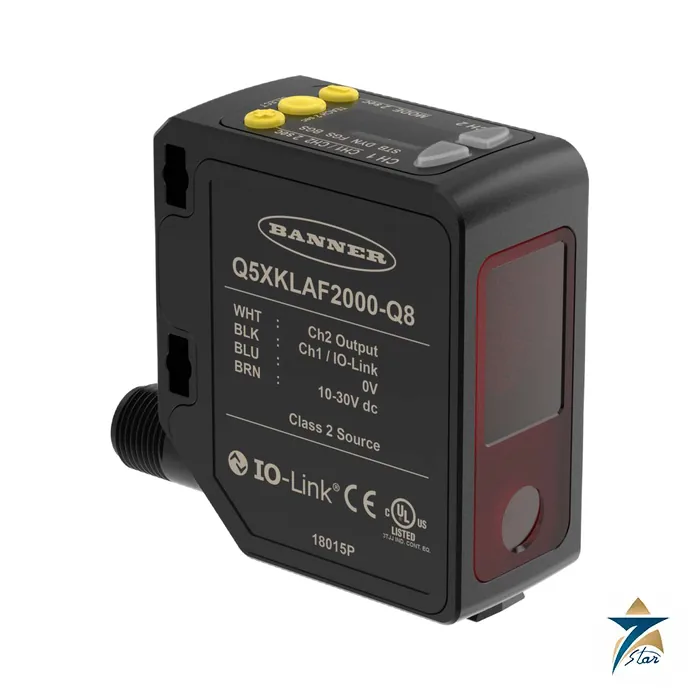
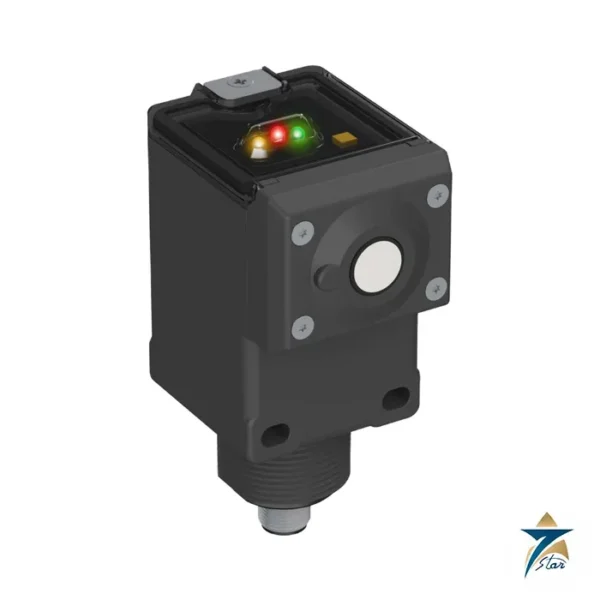
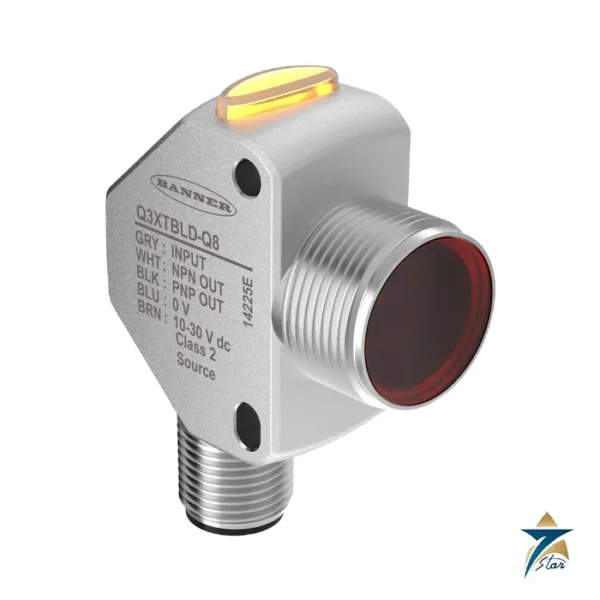
The Q5XKLAF2000-Q8 belongs to Banner Engineering’s Q5X laser triangulation family with dual discrete outputs and IO-Link. It measures from 95 mm to 2000 mm with a visible red Class 2 laser, and its four-digit, seven-segment display shows the live distance in centimetres while running, or the percentage match to the taught surface in Dual TEACH mode (a reading of 999P means the sensor has not been taught).
Three amber TEACH indicators and a green stability indicator sit beside the display. Together they show whether the sensor is in two-point, background suppression, foreground suppression, dynamic or dual TEACH mode, so a technician can see at a glance how the output is being decided.
Technical specifications
| Parameter |
Specification |
| Model |
Q5XKLAF2000-Q8; other models in the datasheet: Q5XKLAF3000-Q8, Q5XKLAF5000-Q8, Q5XKLAF10000-Q8 |
| Sensing range |
95 mm to 2000 mm (3.74 in to 78.74 in) |
| Sensing beam |
Visible red Class 2 laser |
| Supply voltage |
10 V DC to 30 V DC (Class 2 supply), 10 % maximum ripple; under 1 W for 2000 and 3000 mm models |
| Boresighting |
Plus or minus 43 mm at 2000 mm |
| Channel 1 / Channel 2 |
IO-Link push/pull, PNP or NPN selectable / multifunction PNP or NPN or pulse frequency modulated output |
| IO-Link interface |
Revision V1.1, Smart Sensor Profile, 38400 bps, minimum cycle time 3.6 ms |
| Response speed |
2000 mm model: user selectable 3, 5, 15, 25 or 50 ms |
| Display |
4-digit, 7-segment LED with STB, DYN, FGS and BGS indicators |
| Connection |
270 degree rotatable integral 4-pin M12 male quick-disconnect |
| Construction |
ABS housing, PMMA acrylic lens cover, polycarbonate lightpipe |
| Environmental rating |
IP67 per IEC 60529 |
| Operating / storage temperature |
-10 degrees C to +50 degrees C / -25 degrees C to +70 degrees C; 35 % to 95 % relative humidity |
| Delay at power-up |
Under 2.5 s |
| Maximum torque |
Side mounting 1 N-m (9 in-lbs) |
Reading the TEACH indicators
With DYN, FGS and BGS all off the sensor is in two-point TEACH, the default. DYN lit selects dynamic TEACH, FGS lit foreground suppression, BGS lit background suppression, and all three lit mean Dual TEACH. The STB stability indicator stays on when the signal is stable inside the specified range, flashes when excess gain is low or a multiple-peak condition exists, and is off when no target is found.
This quick start guide is intended for installers; the instruction manual p/n 208794 covers remote input and pulse frequency modulation in more detail.
Which range version to order
The same datasheet lists a 3000 mm model (95 mm to 3000 mm, boresight plus or minus 65 mm), a 5000 mm model (50 mm to 5000 mm, plus or minus 86 mm) and a 10000 mm model (50 mm to 10000 mm, plus or minus 172 mm). The 5 m and 10 m versions draw under 1.4 W and offer response speeds of 2, 5, 15, 50 or 250 ms. Choose the shortest range that covers the application, because boresight tolerance grows with range.
All versions share the rotatable M12 connector, so the mating cordset and mounting bracket decisions are common across the family. Confirm output polarity and IO-Link parameters before ordering.
Selection considerations for laser triangulation
Laser triangulation suits applications where a target must be detected or measured at a defined distance and where the background or foreground needs to be ignored. Typical tasks include presence detection of products on conveyors, height or level checks, detecting objects of varying colour, and confirming position on machines. Before choosing the 2000 mm version, measure the closest and farthest target positions in the application and make sure both fall inside the sensing range with some margin. Consider the target surface as well: very glossy, transparent or dark surfaces can behave differently from matte targets, so testing with real parts is good practice.
Decide early how the output will be used. If the sensor only needs to switch, the discrete outputs and a suitable TEACH mode are enough. If the control system needs the measured value, diagnostics or remote configuration, IO-Link on channel 1 allows the sensor to exchange data with an IO-Link master.
Installation and commissioning practice
Mount the sensor rigidly so that vibration does not move the beam, and respect the maximum side mounting torque. Align the beam with the target, keeping in mind the boresight tolerance at full range. Use the rotatable M12 connection to route the cable away from moving parts and avoid sharp bends. Supply the sensor from a Class 2 source within the stated voltage range.
At commissioning, select the TEACH mode that fits the task, teach the target and background conditions, and watch the STB indicator to confirm a stable signal. Choose a response speed that matches the machine cycle: faster settings react quickly, while slower settings give more filtering of the signal. Record the TEACH mode and settings so that a replacement sensor can be set up the same way.
Operation in GCC plant conditions
In Oman and the GCC, dust and heat are the main practical concerns for optical sensors. Keep the lens cover clean, because dust on the window affects the received light and can reduce signal stability. Check that the installation location stays within the operating temperature range, particularly near hot processes or in unshaded outdoor equipment. Although the housing is rated IP67, avoid locations where condensation forms on the lens, and clean the window only with methods that do not scratch the acrylic cover. Laser safety signage and practice for Class 2 lasers should be followed on site.
What to include in your RFQ
State the exact model code, the quantity, the required sensing range, the output configuration you intend to use, and whether the sensor will be connected to an IO-Link master. Mention the target material and distance if you would like the selection reviewed, and note whether the sensor replaces an existing unit on a running machine.
Documents and quotation
Open the attached Banner Q5X with Dual Discrete Outputs and IO-Link Quick Start Guide, p/n 208795 (manufacturer, unaltered) for the complete data and dimension drawings. Before you place an order, confirm the range version, output polarity and IO-Link settings with the system designer, then submit your request with the exact code; our team prepares the quotation. Related items are listed under Sensors & Transmitters.










Reviews
There are no reviews yet.